

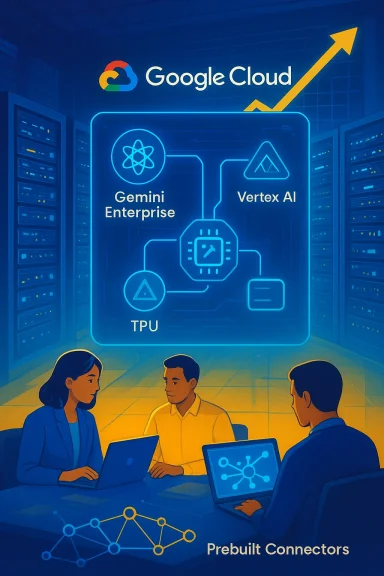
Google Cloud’s recent sprint has rewritten the short-term narrative in the hyperscaler race: the division’s AI-driven momentum is delivering outsized percentage growth and commanding a larger share of the fresh cloud wallet, even as AWS remains the leader in absolute dollars and Microsoft leverages deep enterprise ties. r moved from a long‑running turnaround story into a visible growth engine for Alphabet, powered by model-led products (the Gemini family), developer tooling (Vertex AI), and custom silicon (TPUs). Over recent quarters the company has recorded the fastest percentage increases among the three major hyperscalers, and analysts have repeatedly pointed to GenAI workloads as the dominant demand driver.
The competitive picture now has three disached scale and margin; the default choice for broad infrastructure needs.
Important caveat on customer counts: the specific claim that “over 120,000 businesses, including Airbus and Honeywell, now utilize Google Cloud’s Gemini platform” is not present in the documents available for this article. Company disclosures and independent reporting in the files cite large seat/subscriber counts and notable customers — but the exact phrase “120,000 businesses” and the Airbus/Honeywell examples could not be corroborated in the available set and should be treated as unverified until confirmed by Google’s own press materials or a named enterprise announcement. Procurement teams should ask for contract‑level confirmation (contracting entity, number of paid seats, start date, service scope) rather than relying on aggregated headline counts.
That said, the winning conditions are not guaranteed. The business is capital‑intensive, operationally complex, and full of governance landmines. Customersigh the upside of rapid AI‑driven adoption against the realities of capex, cost per query, governance, and potential lock‑in. Pragmatic procurement — pilot, measure, contract, govern — will decide whether Google Cloud’s headline growth translates into sustainable, profitable market share.
Final note on reported customerines circulating claim “over 120,000 businesses, including Airbus and Honeywell, use Gemini.” That specific formulation does not appear in the documents reviewed for this article; available reporting documents many enterprise adopters and large seat/subscriber counts but do not corroborate that exact 120,000 / Airbus / Honeywell phrasing. Treat such granular customer‑count claims as unverified until confirmed by Google or named customer press releases and contract disclosures.
Key reporting and analysis drawn from aggregated corporate and industry coverage in the files: Google Cloud revenue and growth trend reads; Gemini product and adoption reporting; TPU and Anthropic compute commitments; market context comparing AWS, Azure and Google Cloud.
Source: Analytics India Magazine Analytics India Magazine
The competitive picture now has three disached scale and margin; the default choice for broad infrastructure needs.
- Microsoft Azure — enterprise distribution and seat-based monetization (Microsoft 365/Copilot).
- Google Cloud — developer/data/ML-first platform with differentiated model and silicon integration.
 The Numbers: What the reporting actually says
- Recent reporting in the fild posting roughly $17.7 billion in revenue for the quarter referenced, a year‑over‑year increase near 48%*. That headline number is central to the story that Google Cloud is outpacing its larger rivals on growth rate*.
- Other quarter‑level reads from the same reporting window show Google Cloud earlier at around **$15.1–$15uarter ending September 30, 2025, indicating rapid sequential acceleration across the year. Those figures align with multiple corporate disclosures and independent coverage.
- By contrast, AWS continues to post the largest single‑vendor quarterly revenue (low‑to‑mid‑$30 billion range in recent quarters), and Microsoft Cloud / Azure reports cloud segment revenues in the tens of billions per quarter — both companies delivering meaningful absolute additions even where their percentage growth lags Google’s. The quarter‑to‑quarter incremental dollars illustrate how Google is capturing a disproportionate share of net‑new AI‑driven spending, despite its smaller base.
What’s powering the surge: Gemini, Vertex AI, TPUs and package deals
Gemini as the commercial engine
Google’s Gemini family — rebranded from Bard and expanded aggressively through late‑2025 releases — is the visible product pivot. The platform has been embedded across Search, Workspace, Chrome, Android and as a standalone app, driving both consumer and enterprise usage spikes (vendor figures and industry reporting put app MAUs in the hundreds of millions and enterprise seat/subscriber metrics in the millions). Gemini’s enterprise packaging (Gemini Enterprise, Agent Studio, prebuilt agents and connectors) reduces the friction for procurement and accelerates bookings into Google Cloud’s revenue funnel.- Vendor/market reporting cited in the dataset mentions consumer‑scale MAUs for the Gemini app and Gemini Enterprise seat/subscriber metrics (millions of seats), as well as dramatic API call growth (tens of billions to many more). Those usage and seat numbers are a material commercial signal — they help explain why Google’s cloud growth has accelerated.
Vertex AI, Workbench and the agent play
Vertex AI and the associated Workbench/Agent tooling position Google as an integrated stack for model training, deployment, and agent orchestration. Enterprises adopting agentic automation (connectors, workflows, prebuilt agents for CX and marketing) are increasingly willing to buy packaged subscriptions tied to Google’s model family and connectors into Workspace/BigQuery. That productization translates to faster pilot‑to‑scale conversions.TPU / Ironwood: the silicon and economics story
Google’s TPU roadmap (Ironwood / TPU v7 family) and multi‑year commitments to custom silicon and datacenter capacity are a second, less visible pillar of the execution story. Custom accelerators can shift the price/performance curve for training and inference and give Google procurement leverage with major model builders. Industry reporting in the files shows large model builders arranging long‑term TPU allocations (Anthropic’s announcements being a notable example), which supports Google’s case that vertical integration (models + chips + cloud) can produce a competitive economic advantage.Who’s using Gemini / Google Cloud AI — and what the files verify
Vendor materials and press coverage aggregated in the files list many enterprise adopters and vertical packages (retail CX packs, franchise retail names, major ISVs testing integrations). Retailers such as Kroger, Lowe’s and Woolworths appear in public PR materials tied to Gemini Enterprise packages, while other documented customers include a mix of retailers, financial services, industrials and public sector pilots. The vendor narrative also claims broad adoption across customers and increasing token volumes.Important caveat on customer counts: the specific claim that “over 120,000 businesses, including Airbus and Honeywell, now utilize Google Cloud’s Gemini platform” is not present in the documents available for this article. Company disclosures and independent reporting in the files cite large seat/subscriber counts and notable customers — but the exact phrase “120,000 businesses” and the Airbus/Honeywell examples could not be corroborated in the available set and should be treated as unverified until confirmed by Google’s own press materials or a named enterprise announcement. Procurement teams should ask for contract‑level confirmation (contracting entity, number of paid seats, start date, service scope) rather than relying on aggregated headline counts.
Critical analysis — strengths, limitations and near‑term risks
Strengths (what Google Cloud is doing well)
- Product‑led distribution: embedding Gemini across Search, Workspace and Android creates habitual, low‑friction adoption that converts consumer familiarity into enterprise interest. That distribution effect drives adoption faster than standalone API plays.
- Model + silicon integration: owning TPUs and verticalized model tooling (Vertex AI + Gemini) lets Google optimize cost/perf for specific enterprise workloads and creates a plausible margin edge at scale if utilization stays high. The Anthropic TPU allocation and other large deals are concrete examples of that strategy in action.
- Developer & data tooling: BigQuery + Vertex AI remains a strong combo for data‑centloper mindshare translates into enterprise pilots that can scale into paid seats.
Limitations & operational risks
- Capital intensity and capacity constraints: AI workloads are capex hungry. Google’s own guidance and industry reads point to massive capex commitments to secure GPU/TPU supply and datacenter power, with multiple files highlighting multi‑year, multi‑billion investments and higher capex guidance for 2026. If utilization growth slows, capex could pressure margins and free‑cash flow.
- Margin and cost of serving AI: serving long, multi is expensive. The files include examples and analyst notes emphasizing that per‑query costs scale rapidly at high volumes and that vendor claims about cost improvements should be treated with caution until independently audited. Enterprises must model cost per token and per seat carefully.
- Governance and security for agentic automation: agentic agents that can act on behalf of users increase attack surfaces (prompt injection, unintended actions, credential exposure). Files stress the need for granular governance, logging, approval gates and least‑privilege connectors when deploying Gemini Enterprise agents in production. These are operational controls customers must plan for before broad rollout.
- Vendor concentration and lock‑in risks: heavy platform embedding (Workspace connectors, Search Overviews, device ties) accelerates adoption but increases switching costs. Procurement should insist on exit runbooks, encryption controls (BYOK/HSM), and validated migration tests to avoid entrapment. Several files discuss sovereignty and portability trade‑offs that are relevant for regulated buyers.
Market & competitive dynamics
- AWS: still the largest revenue engine and profit center; its modular, componentized approach and broad service catalog remain compelling — particularly for customers who prioritize feature breadth, global regions and mature enterprise ecosystems.
- Microsoft: converts seat economics into sticky revenue via Microsoft 365 Copilot, Azure integrations and large enterprise contracts. Microsoft’s hybrid and sovereign options continue to win regulated customers who prize contractual hygiene and integration with existing Windows ecosystems.
- Google: is winning a disproportionate share of the incremental AI wallet by offering tightly integrated ML tooling, prebuilt agents, and silicon-backed hosting. The test ahead is converting percentage growth into long‑duration commercial relationships across regulated industries and global geographies while preserving unit economicsadvice for IT leaders and procurement teams
- Start with a narrow, high‑value pilot that has measurable ROI: e.g., CX triage, contract summarization, or time‑savings for rcrete KPIs (time saved, accuracy, cost per transaction).
- Model the total cost of ownership: include per‑token costs, inference tiers, cached contexts, seat fees, data egress, and expected growth. Test representative workloads under realistic volumes.
- Require governance by design: audit trails, approval gates for agent actions, least‑privilege connectors, and explicit test plans for prompt injection and exfiltration scenarios. Agentic automation requires the same lifecycle controls as other software.
- Negotiate commercial protections: portability clauses, migration runbooks, audit rights, and BYOK/HSM key controls for sensitive data. Ask for detailed service level descriptions for model updates, data handling, and potential model retraining/prividate sovereign/region options if you operate in regulated industries — don’t assume headline product claims equal legal insulation; require contract language and technical attestations.
Homonths: what will determine if this momentum sticks
- Convertibility of backlog into recurring revenue: large multi‑year deals (bookings / RPO) are the forward indicator that matters more than a single quarter’s growth. Watch how well Google turns enterprinized revenue and healthy margins.
- Capex discipline vs. utilization: Google’s willingness to invest heavily in 2026 (files cite very large capex ranges) is a double‑edged sword — necessary for capacity but risky if demand moderation occurs. Track utilization, prgin trajectory.
- Third‑party audits and reproducible benchmarks: vendor benchmark claims (model supremacy on various tasks) should be verified with independent, reproducible tests that mirrmpts and domain. Benchmarks are useful signals but not procurement substitutes.
- Regulatory and geopolitical friction: sovereign cloud demands, procurement rules in regulated sectors, and cross‑border data controls will affect where and how customers deploy Gemini Enterprise and TPU-backed hosting. Public sector and regulated industries may de‑operated sovereign options.
Conclusion
Google Cloud’s recent growth leap is a genuine, productized phenomenon driven by Gemini’s distribution, Vertex AI’s tooling, and Google’s silicon investments. The net effect is a clear acceleration: Google is capturingf new AI spend and converting developer interest into enterprise bookings at a pace that dwarfs its historical growth rates.That said, the winning conditions are not guaranteed. The business is capital‑intensive, operationally complex, and full of governance landmines. Customersigh the upside of rapid AI‑driven adoption against the realities of capex, cost per query, governance, and potential lock‑in. Pragmatic procurement — pilot, measure, contract, govern — will decide whether Google Cloud’s headline growth translates into sustainable, profitable market share.
Final note on reported customerines circulating claim “over 120,000 businesses, including Airbus and Honeywell, use Gemini.” That specific formulation does not appear in the documents reviewed for this article; available reporting documents many enterprise adopters and large seat/subscriber counts but do not corroborate that exact 120,000 / Airbus / Honeywell phrasing. Treat such granular customer‑count claims as unverified until confirmed by Google or named customer press releases and contract disclosures.
Key reporting and analysis drawn from aggregated corporate and industry coverage in the files: Google Cloud revenue and growth trend reads; Gemini product and adoption reporting; TPU and Anthropic compute commitments; market context comparing AWS, Azure and Google Cloud.
Source: Analytics India Magazine Analytics India Magazine
