

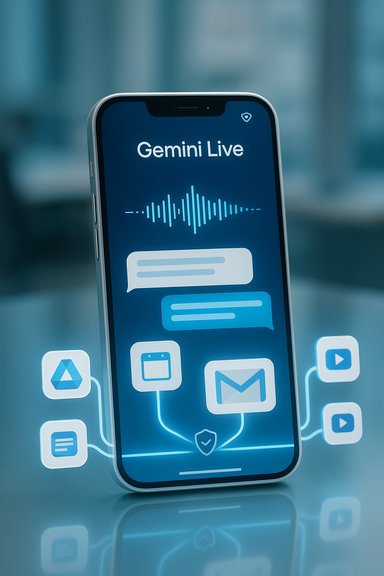
Google has pushed Gemini onto the iPhone, delivering the company’s most ambitious mobile AI toolkit — voice-first conversations with Gemini Live, premium image and video generation, and a new Extensions/Workspace integration that folds Gmail, YouTube, Drive and other Google services into single, conversational workflows.
Gemini began life as Google’s answer to the rapid rise of large language models and conversational agents, evolving from earlier efforts such as Bard and the company’s Google Assistant work. Over the past 18 months Google consolidated its model development under the Gemini brand, rolled out progressively larger and more capable models (branded as Gemini 1.5 Pro, Gemini 2.0 variants and so on), and turned model access into a multi-tier product strategy that mixes free capabilities with paid “Gemini Advanced” features bundled into Google One AI/One Premium subscriptions.
The iPhone launch is the clearest signal yet that Google intends Gemini to be a cross-platform, first‑class mobile AI presence and not merely an Android advantage. The standalone iOS app (released to App Store users in mid-November) brings parity to several mobile-first features that were previously Android-only, and introduces new conveniences tailored for iPhone users — for example, Dynamic Island and Lock Screen Live Activity behavior that keeps Gemini Live conversations accessible while multitasking.
For everyday users it promises faster, more creative and more productive interactions; for businesses it offers a potential productivity multiplier that’s mindful of enterprise privacy when used with Workspace controls. For the industry, it tightens the three‑way competition among Google, Microsoft and Apple and forces each vendor to think beyond mere model capability and into product ergonomics, privacy controls and ecosystem plays.
Yet the launch also highlights ongoing and unresolved tensions. Privacy tradeoffs remain complex for consumer data, regulatory scrutiny is increasing, subscription economics may frustrate some users, and iOS platform limitations mean Gemini can’t (yet) become a full replacement for every assistant role users expect. Organizations and consumers should approach the new Gemini iPhone app with strategic caution: test it, pilot it where appropriate, but set guardrails and governance before relying on it for sensitive or mission‑critical workflows.
In short, Gemini’s arrival on iPhone is a watershed for mobile AI — robust, forward‑looking, and useful — but not risk‑free. The next year will determine whether Gemini becomes an indispensable personal AI on every phone or another powerful tool that must be carefully managed to avoid privacy, security and expectation pitfalls.
Source: PYMNTS.com Google Rolls Out Gemini AI Offerings for the iPhone | PYMNTS.com
 Background
Gemini began life as Google’s answer to the rapid rise of large language models and conversational agents, evolving from earlier efforts such as Bard and the company’s Google Assistant work. Over the past 18 months Google consolidated its model development under the Gemini brand, rolled out progressively larger and more capable models (branded as Gemini 1.5 Pro, Gemini 2.0 variants and so on), and turned model access into a multi-tier product strategy that mixes free capabilities with paid “Gemini Advanced” features bundled into Google One AI/One Premium subscriptions.The iPhone launch is the clearest signal yet that Google intends Gemini to be a cross-platform, first‑class mobile AI presence and not merely an Android advantage. The standalone iOS app (released to App Store users in mid-November) brings parity to several mobile-first features that were previously Android-only, and introduces new conveniences tailored for iPhone users — for example, Dynamic Island and Lock Screen Live Activity behavior that keeps Gemini Live conversations accessible while multitasking.
What the iPhone release actually includes
Gemini Live: conversational voice on iOS
- Real‑time, interruptible voice conversations: Gemini Live lets you speak naturally, interrupt the assistant, and resume the conversation — behavior that aims to mimic human turn-taking rather than the push-to-talk pattern of traditional voice assistants.
- Multiple selectable voices: Users can choose from a palette of voices to personalize tone and style.
- Background presence: On supported iPhones, Gemini Live can stay active via Live Activities or similar system affordances so the conversation can continue while the user moves between apps.
Image and video generation
- High‑quality image generation: The mobile app exposes Google’s image models (Imagen 3 or later versions at the time of the launch) as an integrated image generator, so prompts typed or spoken to Gemini can produce images within the app.
- Time‑limited promotions for video tools: Google has periodically made video generation tools available to Gemini users in promotional windows; these capabilities are likely to evolve into tiered access tied to subscription plans.
Extensions / Workspace apps
- One conversation, many services: The new Extensions (also presented as Workspace apps in enterprise contexts) enable Gemini to call into Gmail, Drive, Docs, Calendar, YouTube, Maps and others during a single chat session. That means you can ask Gemini to summarize an email thread, find a Drive doc and create a calendar event without switching apps.
- Admin and account controls: For paid Workspace customers, administrators control which Workspace apps Gemini can access. Google has stated that content pulled from Workspace apps for use in Gemini responses is not used to train foundation models, and admins retain policy control over access.
Account eligibility and limits
Google’s rollout is deliberate about account types. The Gemini app requires either a personal Google account you manage yourself or a Google Workspace account that is allowed to use Gemini Apps and Google Assistant. Several account classes are explicitly excluded: work accounts that are provisioned with certain enterprise-only tiers, some school/education accounts, accounts managed by Family Link, and Workspace Education accounts designated as under‑18. In short, organizations and parents retain strong gates on who can use which features.Why this matters: product strategy and platform reach
Google’s decision to ship a full Gemini client on iPhone reshapes the mobile AI landscape in three crucial ways.- User reach: iPhone users are a massive market segment. By offering the same flagship capabilities on iOS, Google removes a compelling reason for consumers to favor Pixel/Android purely for AI features.
- Feature parity pressure: With voice, multimodal media generation and Extensions on iOS, Google forces competitors to prioritize cross‑platform parity rather than Android-first rollouts.
- Ecosystem leverage: Extensions link Gemini to Google’s deep portfolio of products; that makes Gemini more than a chat surface — it becomes a potential productivity layer that can orchestrate email, documents, calendar events and media.
The competitive landscape: Copilot, Apple and the race for the mobile AI assistant
Google’s mobile push must be read alongside Microsoft and Apple efforts.- Microsoft Copilot: Microsoft has repositioned Copilot as an “AI companion,” emphasizing voice and vision features and deep integration with Microsoft 365. Microsoft’s messaging frames Copilot as a cross-device personal assistant that learns user preferences and can act on their behalf within Microsoft services. This makes Copilot a direct rival to Gemini in productivity scenarios.
- Apple: Apple has been developing its own on‑device and cloud-assisted AI features (branded as Apple Intelligence and related initiatives). Rumors and industry commentary have also suggested Apple has broader devices in mind — including a potential AI‑centric display or home hub — that could redirect purchases and platform lock-in back to Apple’s ecosystem.
Strengths: what Google did well
- Multimodal parity: Delivering voice, images and document integrations to iPhone users shows Google is serious about cross‑platform parity.
- Deep product integration: Gemini’s Extensions linking to Drive, Gmail, YouTube and Calendar give it practical, workflow‑oriented capabilities that go beyond standalone prompt-and-response chatbots.
- Privacy controls for Workspace: For business and education customers, Google has articulated explicit protections: content accessed via Workspace apps in Gemini isn’t used to train models and remains under admin control — a crucial enterprise requirement.
- Model improvements and scale: Google’s progression to larger context windows (hundreds of thousands to millions of tokens in newer model variants) and specialized models for image/video generation make Gemini technically competitive across many use cases.
- Voice UX innovation: Gemini Live’s interruptible, conversational voice is closer to natural human dialogue than most prior mainstream mobile assistants.
Risks and weaknesses
- Privacy ambiguity for consumer data: While Google has been explicit that Workspace content accessed via Extensions isn’t used to train models, the privacy posture for consumer interactions — especially for free-tier users — is more complex. Consumer prompts and feedback can be logged and used for product improvement unless users opt out; this nuance raises real privacy tradeoffs that must be surfaced clearly to users.
- Platform limitations on iOS: iOS imposes restrictions that limit background behaviors and deeper system integrations (e.g., controlling device settings, interacting with third‑party apps, or system-level shortcuts) compared with Android. Users who expect a full replacement for Siri or for Assistant-style device control will find gaps.
- Fragmentation of capabilities: Google’s tiered approach (free vs Gemini Advanced) means not all users will see the same features. That creates potential confusion: which features are free, which require a subscription, and which are limited by account type or region.
- Safety and hallucinations: Large language models still hallucinate or produce incorrect outputs. When Gemini pulls data from private email or documents to produce action items or summaries, errors can have outsized consequences.
- Regulatory and reputational exposure: Expanded capabilities in voice, vision and integrations open Gemini to regulatory scrutiny around data use, advertising personalization, and child safety — especially as governments move to legislate AI-specific controls.
- Monetization friction: Tying advanced model access and extended context windows to a $19-ish monthly plan risks slowing consumer adoption and encourages churn for heavy users. If Apple or Microsoft offer comparable features under different economics, Google may face resistance.
Practical implications for users and IT managers
For consumers
- Expect a richer conversational AI on iPhone without switching devices, but check account settings if privacy matters. Free users get many capabilities, but some higher-end features (extended context, the most powerful models and extra storage) sit behind Gemini Advanced or Google One AI subscriptions.
- Beware of assumptions about on‑device privacy: while some Apple systems prioritize on‑device processing, Gemini is cloud‑centric and its data handling depends on account type and settings.
For enterprise IT and admins
- Review and control access to Gemini and Workspace apps via admin settings.
- Define policy for what information employees can surface to Gemini and what must remain excluded.
- Train users on pitfalls: generative outputs should be vetted before being used in client communications or regulatory filings.
- Update DLP and context-aware access settings to govern how the assistant interacts with sensitive documents.
A recommended checklist for deployment
- Audit which Google Workspace apps your users need Gemini to access.
- Adjust admin toggles to enable only the necessary Extensions.
- Communicate to staff how Gemini handles Workspace data (not used to train models) and what user-level options exist.
- Provide a clear escalation path for incorrect or sensitive AI-generated outputs.
- Monitor usage to detect over-reliance on AI for critical decisions.
What remains uncertain and what to watch next
- Feature parity across platforms: Google has closed the gap, but some voice-actions and device controls are still better on Android due to OS-level hooks. Watch whether future iOS updates or Google workarounds narrow that gap further.
- Commercial terms and regions: Pricing, subscription bundling and availability have varied by country. Expect staged rollouts, in‑app pricing updates and promotional windows for media tools.
- Regulatory pressure: As more users route private documents and inboxes through conversational AI systems, regulators will press cloud providers for clearer data governance and transparency. Enterprise and consumer protections will be a battleground.
- Apple’s strategy: Reports about an Apple AI display and deeper Apple Intelligence rollout were speculative at the time of initial reports; their actual market timing and impact will materially affect how consumers choose between device ecosystems for AI. Treat those device‑level rumors as unconfirmed until a concrete Apple product announcement and shipping date appears.
Final assessment: pragmatic optimism with caveats
Google’s launch of Gemini on the iPhone is a substantial, well‑executed move that accelerates the shift from single‑device AI experiments to ubiquitous, cross‑platform mobile AI companions. The combination of Gemini Live voice, multimodal generation and Extensions that reach into Gmail, Drive and YouTube is a compelling product proposition that materially elevates what mobile assistants can do.For everyday users it promises faster, more creative and more productive interactions; for businesses it offers a potential productivity multiplier that’s mindful of enterprise privacy when used with Workspace controls. For the industry, it tightens the three‑way competition among Google, Microsoft and Apple and forces each vendor to think beyond mere model capability and into product ergonomics, privacy controls and ecosystem plays.
Yet the launch also highlights ongoing and unresolved tensions. Privacy tradeoffs remain complex for consumer data, regulatory scrutiny is increasing, subscription economics may frustrate some users, and iOS platform limitations mean Gemini can’t (yet) become a full replacement for every assistant role users expect. Organizations and consumers should approach the new Gemini iPhone app with strategic caution: test it, pilot it where appropriate, but set guardrails and governance before relying on it for sensitive or mission‑critical workflows.
In short, Gemini’s arrival on iPhone is a watershed for mobile AI — robust, forward‑looking, and useful — but not risk‑free. The next year will determine whether Gemini becomes an indispensable personal AI on every phone or another powerful tool that must be carefully managed to avoid privacy, security and expectation pitfalls.
Source: PYMNTS.com Google Rolls Out Gemini AI Offerings for the iPhone | PYMNTS.com
