

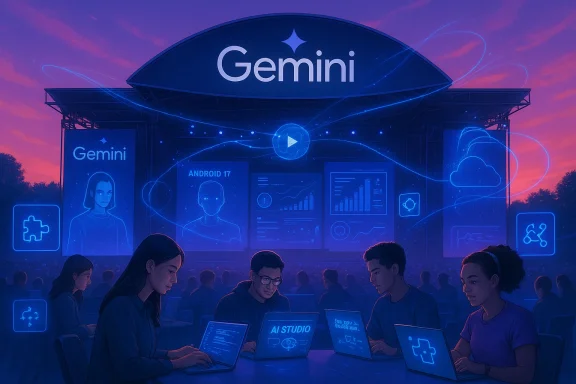
Google has confirmed that its flagship developer conference, Google I/O 2026, will take place on May 19–20, 2026 at the Shoreline Amphitheatre in Mountain View, California, with a full global livestream for developers who can't attend in person. This year's save‑the‑date messaging explicitly teases a heavy AI agenda — from Gemini to Android and across Google's product portfolio — signaling that I/O 2026 will be one of the company's most consequential events in the era of generative AI.
Google I/O has traditionally been the company's primary stage for developer tools, platform roadmaps, and flagship product updates. In 2026, the event is returning to the familiar Shoreline Amphitheatre venue and a hybrid live/online format, but the context around the conference has shifted: industry momentum and competitive pressure have pushed AI — and specifically the Gemini family of multimodal models — to the center of Google's public roadmap. The official announcement frames the conference around "the latest AI breakthroughs and updates in products across the company, from Gemini to Android and more," a deliberate pivot that aligns product messaging with Google's AI investments.
The dates were revealed via Google's official save‑the‑date experience, which this year included interactive puzzles and minigames powered by Gemini — an early showcase of the kinds of developer‑facing playgrounds Google expects to build around its AI tooling. That puzzle-driven reveal adds a layer of marketing theater while also previewing the interactive, generative demos likely to appear on stage.
For developers and IT leaders, I/O 2026 will be a critical signal — not only for what Google builds, but for how it plans to govern and commercialize AI across its platforms. The practical advice is straightforward: watch the keynote for the big APIs and timelines, join upcoming betas, and prepare governance controls before you adopt large-scale generative features.
Google has chosen a moment when the market is hungry for clarity about AI’s next phase. The Shoreline Amphitheatre keynote on May 19 will be the first full public readout of that clarity — or the first major test of Google's ability to translate AI research into responsible, deployable products.
—
Source: The Tech Buzz https://www.techbuzz.ai/articles/google-sets-i-o-2026-for-may-19-20-with-ai-focus/
 Background / Overview
Google I/O has traditionally been the company's primary stage for developer tools, platform roadmaps, and flagship product updates. In 2026, the event is returning to the familiar Shoreline Amphitheatre venue and a hybrid live/online format, but the context around the conference has shifted: industry momentum and competitive pressure have pushed AI — and specifically the Gemini family of multimodal models — to the center of Google's public roadmap. The official announcement frames the conference around "the latest AI breakthroughs and updates in products across the company, from Gemini to Android and more," a deliberate pivot that aligns product messaging with Google's AI investments.The dates were revealed via Google's official save‑the‑date experience, which this year included interactive puzzles and minigames powered by Gemini — an early showcase of the kinds of developer‑facing playgrounds Google expects to build around its AI tooling. That puzzle-driven reveal adds a layer of marketing theater while also previewing the interactive, generative demos likely to appear on stage.
Why the timing matters: strategy and context
Where I/O sits in the 2026 conference season
Scheduling I/O for mid‑May places Google strategically between Microsoft's Build (usually late May) and Apple's WWDC (usually early June). That calendar positioning is no accident: it gives Google a prime window to set the narrative around AI integrations in consumer and developer products before rival keynotes finalize competing messages. Industry observers widely note that this timing helps Google maintain developer mindshare during a tightly packed spring conference season.A tactical response to the AI arms race
Google's emphasis on Gemini at I/O is a tactical response to competition from Microsoft, OpenAI, Anthropic, and other large model vendors. Over the past two years Google has consolidated multiple AI initiatives under the Gemini brand and productized portions of that effort for enterprise customers; that positioning makes Gemini both a technical product and a strategic sales umbrella for cloud, Workspace, Android, and device integrations. Expect I/O to be used as a narrative moment: to show developers how Gemini will be the connective tissue across Google's platform stack.What to expect on stage: products, platforms, and engineering signals
Gemini: upgrades, integrations, and new developer surfaces
Gemini will be the focal point. Google has already been integrating Gemini across Chrome, Workspace, Android, and even Nest devices; the I/O save‑the‑date and early reporting both highlight Gemini as central to the company's messaging. On technical fronts to watch:- New Gemini model variants or incremental advances (improved reasoning, longer context windows, or specialized multimodal capabilities).
- Expanded developer tooling: improvements to AI Studio, Vertex AI integrations, or new SDKs that make embedding Gemini features easier on mobile and web platforms.
- On‑device and hybrid deployments — announcements that push Gemini features into Pixel phones, Chromebooks, or Android OEMs with more robust local inference or tighter NPU utilization.
Android: Android 17 and platform-level AI features
Multiple outlets and the official save‑the‑date point to Android as another core pillar for the event, with Android 17 the natural candidate for a major I/O reveal. Developers should expect:- Android 17 previews or beta timelines, including platform APIs that support AI‑driven features (privacy-preserving on‑device APIs, model runtime improvements, or tighter NPU schedulers).
- New system-level integrations that make it simpler for apps to call Gemini‑powered services or use on‑device model acceleration.
- Developer guidance and migration tooling for taking advantage of Android 17's AI capabilities while maintaining compatibility.
Chrome, Workspace, Cloud, and Agents
Beyond Gemini and Android, expect incremental but meaningful updates across Chrome, Workspace, and Cloud:- Chrome: deeper Gemini integration for tab‑level assistance, summarization, and agentic browsing features.
- Workspace: richer assistant experiences in Docs, Sheets, and Gmail, including automation for business workflows and governance hooks for admins.
- Cloud / Vertex AI: productized paths for enterprises to adopt Gemini models, including new pricing tiers or managed agent tooling for production use.
Developer impact: opportunities and practical takeaways
Why developers should pay attention
For developers, I/O 2026 will offer two immediate reasons to tune in:- New APIs and SDKs — These are the building blocks that will determine how quickly apps can embed advanced AI capabilities.
- Platform guarantees and best practices — Security, privacy, and governance are already table stakes for enterprise adoption; Google will use I/O to clarify where it stands on data residency, model explainability, and admin controls.
Tactical checklist for teams preparing for I/O
- Audit current app surface area for AI integration points: search bars, composition flows, document editors, camera and vision features.
- Evaluate current data governance: what telemetry, logs, or PII could be exposed to a cloud model? Prepare questions about retention and access controls.
- Line up test scenarios and datasets that will reveal how well Gemini variants perform in your domain — before you commit to integration.
- Plan for staged rollouts: can features be gated behind opt‑in flags or enterprise admin controls?
Business and enterprise implications
Gemini as a cloud and enterprise product
Google's push to productize Gemini for enterprise — bundling model access, prebuilt agents, and connectors into subscription offerings — changes the procurement and integration equation for businesses. Enterprises will be watching for clearer SLAs, governance tools, and pricing that makes large‑scale deployments predictable. The trend toward packaged enterprise AI was visible in Google's prior launches and analysis of the market, and I/O will likely be the venue where these options are clarified.Competing with Microsoft and OpenAI
Google's I/O lineup and timing suggest an explicit strategy to counter competing narratives from Microsoft, OpenAI, and others. Product integrations that position Gemini as the default assistant across search, productivity, and device surfaces would be a defensive move as much as an offensive one. Developers and enterprise architects should read announcements through that lens: features that appear to be consumer-friendly may also be footholds for broader enterprise adoption.Technical and ethical risks: what Google must address on stage
Model safety, hallucinations, and trust
Generative models are capable but imperfect. A major risk for any headline I/O demo is a high‑profile model hallucination or safety failure. Google will need to show not just new capabilities, but how it prevents, detects, and corrects erroneous or harmful outputs. Expect technical sessions that cover:- Guardrails, content filters, and moderation strategies.
- Fact‑checking pipelines and grounding mechanisms to reduce hallucinations.
- Developer controls for output verification and human‑in‑the‑loop workflows.
Privacy, data residency, and regulatory exposure
Adding AI into search, mail, documents, and devices raises immediate questions about data flows. Enterprises will demand clarity on:- What user data is sent to cloud models versus processed locally.
- How long prompts, files, and outputs are retained.
- Admin controls and auditing for model queries in Workspace and Cloud environments.
Developer lock‑in and platform dependency
Tooling that makes it trivial to call Gemini from Android or Workspace will accelerate development — but it also raises lock‑in concerns. If new APIs are proprietary and tightly coupled to Google cloud services, developers will need to weigh speed versus portability. Open standards, well-documented abstractions, and clear export paths for models and data will mitigate risk for customers who must keep vendor portability on their roadmap.Competitive analysis: where Google stands entering I/O 2026
Strengths
- Massive installed base across Android, Chrome, Workspace, and Cloud gives Google a unique cross‑product distribution advantage.
- Deep research and engineering bench in multimodal models and infrastructure.
- Existing product integrations that serve as a launchpad: Chrome AI mode, Workspace assistants, Gemini for Home on Nest devices, and enterprise packaging previously rolled out.
Weaknesses and exposures
- Public perception issues after past product stumbles or over‑promising demos could color expectations.
- Competing vendor ecosystems (Microsoft Copilot + Azure, OpenAI + plugins ecosystem) are mature in specific enterprise verticals and may offer tighter integrations for non‑Google clouds.
- Regulatory risk and privacy concerns remain a fundamental obstacle to broad, unregulated model deployment.
Wildcards to watch
- Any surprise collaborations (e.g., deeper OEM partnerships or cross‑company alliances) could reframe mobile or device strategies.
- Announcements that make advanced Gemini variants available more cheaply or with permissive hosting terms would shift economics for startups and enterprises.
Predictions: five announcements to watch for at I/O 2026
- A Gemini model update or variant with demonstrably larger context windows or improved reasoning capabilities, paired with sample benchmarks.
- A public beta for Android 17 developer previews, including AI‑forward platform APIs and an initial timeline for stable releases.
- New developer tooling in AI Studio or Vertex AI that simplifies building agentic workflows and connecting to third‑party systems.
- Expanded on‑device AI runtimes or SDKs to run Gemini‑level features locally on Pixel and partner hardware, including explicit NPU acceleration guidance.
- Enterprise governance and pricing announcements for Gemini Enterprise‑style offerings: admin controls, audit logs, data residency options, and per‑seat or consumption pricing.
How developers and IT leaders should prepare
For developers
- Sign up for the I/O livestream and early SDK betas immediately after the keynote.
- Set up sample projects to test new Gemini APIs — build quick proofs of concept to assess latency, quality, and cost.
- Harden testing and QA to include adversarial prompts, hallucination checks, and performance tests across target devices.
For IT and security leaders
- Prepare a data governance checklist: what user data flows to cloud models, where logs are stored, and how to manage consent.
- Inventory apps and endpoints that will most benefit from AI features, and evaluate the operational risk of adding model-driven automation.
- Engage procurement early: clarify pricing models and contractual protections for SLAs, data protection, and compliance.
Broader implications: the shape of AI in 2026 and beyond
I/O 2026 is not just another developer conference; it's a strategic moment for Google to define its role in a marketplace where AI is increasingly embedded into core user experiences and enterprise workflows. If Google successfully demonstrates an ecosystem where Gemini is both technically advanced and operationally safe, it could reframe the competitive battleground — not as a contest of raw model size, but as a contest of integrated experience, governance, and developer velocity. Conversely, failed demos or light governance signals would hand narrative advantages to rivals betting on reliability and enterprise trust. Early reporting and the official save‑the‑date both suggest Google plans to make Gemini central to that narrative, and the company’s prior productization steps indicate a coordinated push across consumer and enterprise surfaces.Final assessment: strengths, red flags, and the bottom line
Google arrives at I/O 2026 with real strengths: distribution on mobile and web, a multi‑product approach that can surface Gemini broadly, and an engineering depth few rivals can match. That combination sets the stage for ambitious announcements and meaningful developer tooling. However, the company faces two persistent challenges: convincing enterprise customers that generative AI can be both powerful and safe, and avoiding the PR damage from any public-facing demo failures.For developers and IT leaders, I/O 2026 will be a critical signal — not only for what Google builds, but for how it plans to govern and commercialize AI across its platforms. The practical advice is straightforward: watch the keynote for the big APIs and timelines, join upcoming betas, and prepare governance controls before you adopt large-scale generative features.
Google has chosen a moment when the market is hungry for clarity about AI’s next phase. The Shoreline Amphitheatre keynote on May 19 will be the first full public readout of that clarity — or the first major test of Google's ability to translate AI research into responsible, deployable products.
—
Source: The Tech Buzz https://www.techbuzz.ai/articles/google-sets-i-o-2026-for-may-19-20-with-ai-focus/
