

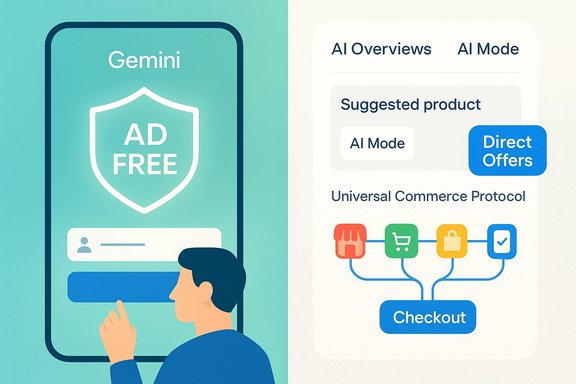
Google’s advertising leaders have quietly drawn a clear line: Gemini the assistant stays ad‑free for now, even as Google races to fold advertising into other AI experiences where commercial intent is clearer and measurement is less fraught. Dan Taylor, Google’s vice president of global ads, told reporters this week that “there are no plans for ads in the Gemini app,” framing the choice as deliberate rather than temporary and distinguishing the company’s monetization roadmap for AI search from its approach to conversational assistants. That public posture arrives at a volatile moment: Gemini has exploded in scale, Google has rolled generative AI into search via AI Overviews and AI Mode, and the company is actively piloting commerce‑oriented ad formats and an open standard for agentic shopping. The result is a split strategy — ads in some AI surfaces, restraint in others — designed to balance economics, user trust, and the messy realities of measuring advertising performance when answers are generated, not simply linked. This feature unpacks what Google is doing, why the company says Gemini will remain ad‑free, how advertisers are being invited into adjacent AI experiences, and what risks and tradeoffs now define the generative‑AI ad playbook.
Google’s AI product set has bifurcated into two distinct user experiences: search‑centric AI (AI Overviews and AI Mode inside Search) and the Gemini standalone assistant (the Gemini app and agentic features). The company is treating these surfaces differently for monetization. Search remains an ad first‑class citizen; Google has decades of commercial infrastructure and measurement tied to intent signals in search queries. Gemini, by contrast, is positioned as an assistant for creation, analysis and multi‑step workflows, where a premature introduction of advertising could undermine perceived neutrality and usefulness. Dan Taylor’s statement — that there are no plans for ads in the Gemini app — reiterates this product distinction. Two headline numbers that inform the calculus: the Gemini app reportedly reached roughly 650 million monthly active users by late 2025, while Google says AI Overviews (the generative summaries inside search results) now touch billions of users — Google’s own figures and industry coverage cite usage figures in the multi‑hundreds of millions to billions for these surfaces. Those large audiences explain why advertisers are keen to understand how to buy inventory in AI‑driven experiences. At the same time, Google is moving on commerce. In January 2026 the company unveiled the Universal Commerce Protocol (UCP) — an open standard engineered to let AI agents discover, compare and check out with retail partners — and introduced a pilot ad format called Direct Offers, which places personalized discounts into high‑intent buying moments inside AI Mode and other shopping surfaces. Retail partners such as Target and Walmart have been named as early integrators of UCP and checkout flows for the Gemini app and AI Mode. These product moves show Google’s dual strategy: hold off on advertising in the assistant experience while monetizing intent‑heavy AI search and commerce moments.
The Universal Commerce Protocol (UCP) reduces integration friction, but it also centralizes acquisition and checkout inside platform experiences — a consolidation that will attract regulatory interest around platform power and fairness. Enterprises and privacy advocates should watch the legal treatment of agentic transactions and the data flows behind Direct Offers carefully.
This approach has clear merits: it lets Google learn ad design, measurement and merchant integration in lower‑risk contexts and gives the company time to build consented, auditable mechanics for targeting and payment. But the risks are just as clear: publishers face traffic disruption, advertisers face measurement uncertainty, and regulatory attention will likely intensify as agentic commerce grows.
For now, the company’s messaging — that “there are no plans for ads in the Gemini app” — is a useful guardrail for user trust. The caveat in that phrasing is important: it is a current plan, not an immutable commitment. Businesses and IT teams should treat it as such: plan for multiple scenarios, insist on contractual protections, and run disciplined experiments rather than making large, irreversible ad‑buy decisions.
The next practical milestones to watch are concrete: formal documentation of Direct Offers measurement, merchant adoption breadth for UCP, updated product controls that demonstrate separation between consumer telemetry and ad targeting, and any investor or earnings commentary that quantifies how much revenue Google expects from these new surfaces. Those signals will determine whether Google’s guarded strategy is a durable path or a temporary pause before a broader monetization pivot.
Google’s choice — to monetize where intent and measurement are strongest while keeping the assistant ad‑free — is logical, defensible and technically sensible. It is also fragile: the moment any assistant experience feels like an ad vehicle, trust evaporates and the competitive field resets. Over the coming months, advertisers, publishers and regulators will test that boundary. The safest move for organizations that depend on search and AI is to plan for change: diversify monetization, demand auditable metrics, and protect enterprise data from being quietly repurposed into ad signals. Only by pairing product caution with rigorous commercial experiments can the industry find a sustainable balance between the economics of AI and the user trust that made the web valuable in the first place.
Source: PPC Land https://ppc.land/why-google-wont-put-ads-in-gemini-vp-explains-the-strategy-gap/]
 Background / Overview
Google’s AI product set has bifurcated into two distinct user experiences: search‑centric AI (AI Overviews and AI Mode inside Search) and the Gemini standalone assistant (the Gemini app and agentic features). The company is treating these surfaces differently for monetization. Search remains an ad first‑class citizen; Google has decades of commercial infrastructure and measurement tied to intent signals in search queries. Gemini, by contrast, is positioned as an assistant for creation, analysis and multi‑step workflows, where a premature introduction of advertising could undermine perceived neutrality and usefulness. Dan Taylor’s statement — that there are no plans for ads in the Gemini app — reiterates this product distinction. Two headline numbers that inform the calculus: the Gemini app reportedly reached roughly 650 million monthly active users by late 2025, while Google says AI Overviews (the generative summaries inside search results) now touch billions of users — Google’s own figures and industry coverage cite usage figures in the multi‑hundreds of millions to billions for these surfaces. Those large audiences explain why advertisers are keen to understand how to buy inventory in AI‑driven experiences. At the same time, Google is moving on commerce. In January 2026 the company unveiled the Universal Commerce Protocol (UCP) — an open standard engineered to let AI agents discover, compare and check out with retail partners — and introduced a pilot ad format called Direct Offers, which places personalized discounts into high‑intent buying moments inside AI Mode and other shopping surfaces. Retail partners such as Target and Walmart have been named as early integrators of UCP and checkout flows for the Gemini app and AI Mode. These product moves show Google’s dual strategy: hold off on advertising in the assistant experience while monetizing intent‑heavy AI search and commerce moments. Why Google draws the line: product distinctions and the “trust” calculus
Search versus assistant: two different user intents
Google’s internal framing — echoed by the VP of global ads — is simple: Search = discovery (including commercial intent); Gemini = assistant (help with tasks, creation and reasoning). That distinction matters for ad policy because discovery moments are where users expect product choices and sponsored suggestions; assistant moments are where users expect impartial help. Ads in search are a well‑understood interaction pattern; ads in a conversation can feel intrusive or misaligned if shown too early.- Search queries are often transactional or navigational (clear signals of intent).
- Conversations with an assistant can be exploratory, iterative, and context dependent.
- A misplaced ad in a conversational thread may damage credibility and reduce the assistant’s utility.
The first‑mover risk and competitive optics
Introducing ads into a popular assistant is a high‑stakes move. A poorly executed ad rollout can quickly push users toward competitors. Industry commentators have warned that the first vendor to monetize an assistant aggressively risks losing users if the experience feels compromised; Google’s resources allow it to wait and be deliberate. That defensive calculation — delay plus deployment in adjacent surfaces — explains the current strategy.Where Google is placing bets instead: AI Overviews, AI Mode, Direct Offers and UCP
AI Overviews and AI Mode: the low‑friction ad surface
Google has already experimented with ads in AI Overviews — the short, model‑generated summaries that sit at the top of search results — and in AI Mode, the conversational search tab. The company reports that AI Overviews have wide reach and that ad engagement there is roughly comparable to traditional search ads, though independent measurements suggest those placements are rare and still experimental. Google’s public statements and third‑party monitoring indicate ad frequency is low but that the company is actively testing placement mechanics and measurement.- AI Overviews integrate summarization with links and, in tests, small sponsored product suggestions.
- AI Mode supports longer dialogues and is more complicated for ad insertion because it can easily interrupt a user’s reasoning flow.
Direct Offers and the Universal Commerce Protocol (UCP)
Rather than put traditional impression‑based ads into Gemini, Google is piloting Direct Offers — contextually targeted discounts delivered at high‑intent moments — and shipping UCP, an open technical framework that allows AI agents to orchestrate product discovery and checkout across multiple retailers. UCP aims to reduce integration friction between AI agents and commerce platforms, enabling in‑app checkout using stored wallet and payment credentials. Early partners include several major retailers and payment providers, and Google has positioned UCP as an industry standard for agentic commerce. UCP is strategically clever: it preserves an ad and commerce revenue path while shifting the unit of monetization from “impression” to “transaction” — placing the ad or discount at a moment of conversion rather than in the middle of a diagnostic conversation. That reduces the risk of alienating users and also addresses measurement — conversions are easier to attribute than nominal engagement inside a long chat.Economic realities: cost of running models, ad revenue tradeoffs, and the “zero‑click” problem
AI infrastructure is expensive
Running large generative models at consumer scale is capital‑intensive. Google’s public numbers show Gemini and related APIs process billions of tokens per minute, while the company has increased capital expenditures to support compute and datacenter growth. Those economics motivate monetization experiments. But Google’s decades‑old ad engine also gives it flexibility: it can pilot formats inside search where measurement and billing are better established before risking the assistant’s trust with intrusive advertising.The zero‑click risk for the wider web
A structural concern for the industry is the “zero‑click” outcome: if assistants answer questions without sending users to original content, publishers lose referral traffic and ad inventory shrinks. That effect has been widely debated; Google counters that AI Overviews often increase the quality of clicks and that overall organic click volumes remain “relatively stable.” Independent studies, however, have documented substantial declines in CTRs and referral volumes for certain query types when generative features are present. The tension is real and unresolved.- Third‑party research has shown meaningful CTR declines for informational queries since AI features were introduced.
- Google’s public line is that traffic changes are nuanced and that AI surfaces can both decrease and increase clicks depending on query intent.
UX, trust and measurement: why ads in an assistant are uniquely hard
Timing, labeling and the “sponsored voice” problem
Putting an ad into a conversational answer requires multiple safeguards: the content must be clearly labeled as sponsored, it must match user intent, and it must respect the ongoing context of the dialogue. Otherwise sponsored content risks being interpreted as part of the assistant’s answer, eroding credibility. That’s the core of Google’s hesitation with Gemini. Design options include discrete “cards” or “carousel” units that are visually separated from the assistant’s narrative, but the UI choice alone does not eliminate deeper problems of personalization, privacy and attribution. The industry’s early design playbook suggests:- Always label sponsored content clearly and separately from the assistant’s narrative.
- Limit ad placements to moments where purchase intent is high.
- Provide easy opt‑outs and account‑level controls for personalization and ad targeting.
Measurement and attribution in conversational flows
Traditional ad metrics — impressions, CTR, view‑through conversions — are poorly suited to long, multi‑turn conversations. Determining whether a purchase resulted from an assistant suggestion requires new measurement frameworks and rigorous incrementality testing. Google’s early approach is to make AI search placements available through its existing auction and campaign systems only when the algorithm determines a user is in a purchase moment; advertisers cannot yet directly buy “AI Mode” placements separately. That limits advertiser control but reduces the risk of misuse while Google sorts out reliable measurement.Advertising industry reaction: opportunism, skepticism, and testing playbooks
Advertisers and agencies are reacting pragmatically. Many are eager to reach high‑intent AI searches and are testing Google’s new formats; others caution against wholesale budget shifts without controlled experiments.- Agencies report Google recommends moving spend into YouTube, Discovery and Demand Gen formats while AI monetization experiments mature.
- Analysts and performance shops advise running holdout groups and incrementality tests rather than making broad reallocations based purely on vendor metrics.
Publisher and enterprise implications
For publishers
Publishers face real risk if conversational answers reduce referral traffic. Practical steps for publisher resilience include:- Diversify revenue beyond referral ad dollars (subscriptions, licensing and e‑commerce).
- Engage platforms about revenue‑share or licensing for AI outputs that repurpose publisher content.
- Enhance content formats that encourage clicks — long‑form analysis, original reporting, multimedia and community features.
For enterprises and IT teams
Enterprise adoption of assistant tech demands explicit contractual protections:- Require attestations that internal data and employee interactions won’t be used for ad targeting without consent.
- Push for API and product distinctions (consumer app vs enterprise API) that guarantee an ad‑free experience for paid or managed deployments.
- Ask for audit rights and technical evidence of telemetry separation between consumer and enterprise products.
Regulatory and privacy angles
Advertising in assistants raises layered policy questions: consent for personalization, targeting minors, transparency of sponsored content, and anti‑competitive access to ad inventory. Regulators in the EU, UK and multiple U.S. states are already paying attention to how AI vendors collect and repurpose personal signals for monetization. Any ad rollout into assistants will likely trigger scrutiny and demand for explicit disclosures and user controls.The Universal Commerce Protocol (UCP) reduces integration friction, but it also centralizes acquisition and checkout inside platform experiences — a consolidation that will attract regulatory interest around platform power and fairness. Enterprises and privacy advocates should watch the legal treatment of agentic transactions and the data flows behind Direct Offers carefully.
Strengths and potential risks of Google’s approach
Notable strengths
- Pragmatic monetization sequencing: Monetize AI surfaces where intent and measurement are strongest (search, commerce) while keeping the assistant ad‑free to protect trust.
- Technical leverage: Google’s ad stack, merchant data and payment integrations make commerce inside AI experiences economically attractive without immediately polluting the assistant experience.
- Standards‑led commerce: UCP’s open‑standard approach lowers integration costs for merchants and could accelerate adoption while giving Google a central role in the agentic shopping stack.
Material risks
- Trust erosion over time: Even a future decision to insert ads into Gemini risks long‑term trust loss; once the assistant’s neutrality is questioned, recovery is difficult.
- Publisher backlash and political pressure: Reduced referral trarceived platform capture of commerce could provoke legislative and industry pushback.
- Measurement and attribution gaps: Without new, accepted measurement standards, advertisers risk misallocating budgets based on platform‑reported metrics that may not translate into real business outcomes.
Practical guidance: what advertisers, publishers and IT leaders should do now
- Advertisers: run controlled experiments (holdouts and incrementality tests) before shifting sizable budgets into AI placements; demand transparent measurement and independent audits where possible.
- Publishers: accelerate diversification strategies and consider licensing or partnership discussions with platforms that repurpose content for AI answers.
- IT and procurement: require contractual guarantees that enterprise deployments remain ad‑freereed, and insist on technical attestations for telemetry separation.
- Create a 90‑day pilot plan that tests AI Overview placements against control audiences.
- Require vendors to produce a measurement glossary that maps conversational events to standard attribution metrics.
- Negotiate contract clauses that prevent consumer‑grade telemetry from being repurposed for ad targeting in enterprise deployments.
- For publishers, pilot “answers licensing” to explore revenue share models for AI‑extracted content.
Final assessment — a cautious, credible middle path
Google’s current posture is a calculated compromise. By keeping Gemini ad‑free for now, the company minimizes a direct trust hit to the assistant while still experimenting with monetization in adjacent, intent‑rich experiences like AI Overviews, AI Mode and agentic commerce enabled by UCP and Direct Offers. The strategy reflects a tradeoff between short‑term revenue capture and long‑term product integrity.This approach has clear merits: it lets Google learn ad design, measurement and merchant integration in lower‑risk contexts and gives the company time to build consented, auditable mechanics for targeting and payment. But the risks are just as clear: publishers face traffic disruption, advertisers face measurement uncertainty, and regulatory attention will likely intensify as agentic commerce grows.
For now, the company’s messaging — that “there are no plans for ads in the Gemini app” — is a useful guardrail for user trust. The caveat in that phrasing is important: it is a current plan, not an immutable commitment. Businesses and IT teams should treat it as such: plan for multiple scenarios, insist on contractual protections, and run disciplined experiments rather than making large, irreversible ad‑buy decisions.
The next practical milestones to watch are concrete: formal documentation of Direct Offers measurement, merchant adoption breadth for UCP, updated product controls that demonstrate separation between consumer telemetry and ad targeting, and any investor or earnings commentary that quantifies how much revenue Google expects from these new surfaces. Those signals will determine whether Google’s guarded strategy is a durable path or a temporary pause before a broader monetization pivot.
Google’s choice — to monetize where intent and measurement are strongest while keeping the assistant ad‑free — is logical, defensible and technically sensible. It is also fragile: the moment any assistant experience feels like an ad vehicle, trust evaporates and the competitive field resets. Over the coming months, advertisers, publishers and regulators will test that boundary. The safest move for organizations that depend on search and AI is to plan for change: diversify monetization, demand auditable metrics, and protect enterprise data from being quietly repurposed into ad signals. Only by pairing product caution with rigorous commercial experiments can the industry find a sustainable balance between the economics of AI and the user trust that made the web valuable in the first place.
Source: PPC Land https://ppc.land/why-google-wont-put-ads-in-gemini-vp-explains-the-strategy-gap/]
