

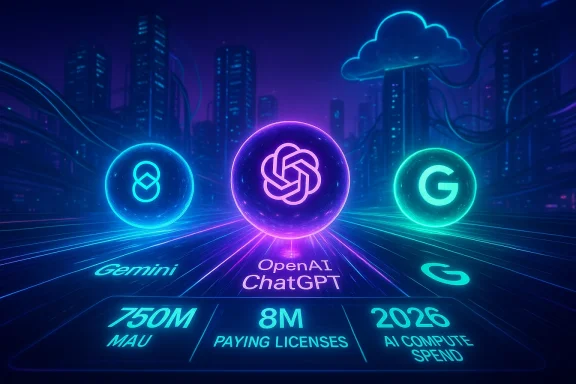
Google’s latest earnings snapshot has a simple, headline‑friendly takeaway: the AI race that began in earnest with ChatGPT’s breakout in early 2023 has become a three‑horse sprint, and Alphabet is no longer the trailing contender — it is visibly closing the gap with OpenAI. In Alphabet’s Q4 2025 results, CEO Sundar Pichai highlighted that the Gemini app surpassed 750 million monthly active users by the end of the December quarter, and that the company is seeing meaningfully higher engagement per user since the deployment of the Gemini 3 family of models. At the same time, OpenAI’s CEO Sam Altman has publicly described ChatGPT as serving around 800 million weekly active users earlier in 2025 — a metric that, when put next to Google’s MAU figure, shows the contest is not just about raw counts but about how each company measures and monetizes attention. This article unpacks those numbers, verifies the most important claims, and analyzes what they mean for the broader AI landscape: product design, enterprise adoption, monetization, technical infrastructure, competition, and regulatory risk.
Since ChatGPT’s rapid adoption in 2023, the generative‑AI market fragmented into multiple major players: OpenAI (ChatGPT), Google (Gemini), Anthropic (Claude), Meta (Meta AI), Microsoft’s Copilot integrations, and newer entrants like xAI’s Grok, Perplexity, and others. Google’s path to this point has been notable for a slow start, public missteps with early Bard prototypes, and an intense pivot: rebranding Bard into Gemini, launching a dedicated Gemini app and multi‑model ecosystem, and releasing Gemini 3 in November 2025 as a broad platform upgrade.
Key monetization signals from Alphabet’s disclosures and product moves:
What’s verifiable:
Why this matters:
Why enterprise seats matter:
Google’s advantages:
But the press shorthand “Google closing in on OpenAI” masks critical nuances. OpenAI’s 800‑million figure was expressed on a weekly basis, which is not directly comparable to Google’s monthly figure. Model performance claims still require independent verification; enterprise seat counts don’t automatically translate to market dominance; and enormous capital spending is both a necessity and a liability.
For users and CIOs, the takeaway is practical: choose AI vendors on measurable business outcomes, not by single headline metrics. For investors and technologists, the story is a long game: the winner will be the organization that combines model quality, cost efficiency, safe and auditable behavior, and deep product integration — and that can navigate supply chains, regulation, and enterprise risk in the years ahead.
One thing is clear: the AI race has matured from a launch‑day arms race into industrial competition. The next phase won’t be decided by a single model release or a single quarter’s user number, but by durable adoption, real value creation for customers, and an ability to make trillion‑token models useful, affordable, and safe at planetary scale.
Source: ummid.com Google closing in on OpenAI in AI race
 Background and context
Since ChatGPT’s rapid adoption in 2023, the generative‑AI market fragmented into multiple major players: OpenAI (ChatGPT), Google (Gemini), Anthropic (Claude), Meta (Meta AI), Microsoft’s Copilot integrations, and newer entrants like xAI’s Grok, Perplexity, and others. Google’s path to this point has been notable for a slow start, public missteps with early Bard prototypes, and an intense pivot: rebranding Bard into Gemini, launching a dedicated Gemini app and multi‑model ecosystem, and releasing Gemini 3 in November 2025 as a broad platform upgrade.- Bard was rebranded to Gemini and Google first rolled the Gemini app and capabilities out through 2024 and 2025, with localized launches such as the India release that included regional languages.
- Gemini 3, publicly rolled out in November 2025, marked a major model refresh with multiple variants (e.g., Pro, Flash, Deep Think) and a focus on large context windows and agentic features.
- Alphabet’s Q4 2025 earnings call framed AI as the engine powering growth across Search, Cloud, and consumer services — a public pivot from cosmetic AI features to product‑led revenue and large‑scale infrastructure spending.
The raw numbers — what’s verifiable, and what those numbers actually mean
A lot of headlines reduce this week’s results to “Google is catching OpenAI.” The truth is more nuanced. Let’s verify the load‑bearing claims.- Alphabet reported that the Gemini app exceeded 750 million monthly active users (MAUs) at the end of the December quarter, up from roughly 650 million the prior quarter. That figure was disclosed by Alphabet management during the company’s Q4 2025 earnings commentary. This is a company‑reported MAU metric tied to the Gemini app ecosystem. It is a clear uptick and a credible data point because it comes directly from Alphabet’s investor communications.
- OpenAI leadership, in public remarks at its Dev Day in October 2025, stated that ChatGPT reached ~800 million weekly active users (WAUs). That was a CEO‑level statement and not an independently audited number; it uses a different cadence (weekly instead of monthly). WAU and MAU are not directly comparable — WAU can be higher relative to MAU depending on how often users return — so apparent “leads” must be read carefully.
- Alphabet’s management also said that its enterprise Gemini offering reached 8 million paying licenses (seats); some public reporting expands that into paid seats across thousands of enterprises. Company transcripts mention “paid seats” or “paid licenses,” which is a standard enterprise metric but is not the same as “customers” or “companies.” A single company can buy many seats, so the macro impact must be understood in context.
Engagement and monetization: the real battleground
Alphabet stressed that engagement per user is increasing — and that matters far more than headline user counts. Higher engagement translates into better monetization opportunities (subscriptions, in‑app purchases, ad monetization via AI‑generated queries), more data for product improvement, and deeper enterprise stickiness when users connect Gemini with Google Workspace, Search, and Chrome.Key monetization signals from Alphabet’s disclosures and product moves:
- Subscriptions and paid tiers (Gemini Advanced, Google AI Pro/AI Plus options) are being used to convert heavy users. Google has been experimenting with multiple plan tiers and price points to capture consumers and prosumers.
- Enterprise seats (the “8 million paying licenses” figure) show traction in recurring revenue from businesses integrating Gemini into workflows and search‑adjacent automation. Paid seats create predictable cash flow and legitimise AI as a revenue generator beyond one‑time app installs.
- Integration into Search’s “AI Mode” — where Gemini‑powered overviews and conversational follow‑ups replace or augment traditional search snippets — begins to channel ad dollars back into AI‑driven queries. Google framed this as a way to monetize long, complex queries that were previously harder to sell ads against.
Gemini 3: technical step‑change or iterative advance?
Gemini 3 — launched publicly in November 2025 — is the centerpiece of Google’s recent momentum. Public technical claims around Gemini 3 include a very large context window (reported up to ~1,000,000 tokens for Pro variants), several model variants tuned for different latency‑cost tradeoffs (Flash for speed, Pro for capability, Deep Think for heavy reasoning), and enhancements in multimodal reasoning, coding, and agentic behavior.What’s verifiable:
- Google deployed Gemini 3 widely across the Gemini app, Search “AI Mode,” and enterprise offerings in late 2025. That rollout is confirmed by company statements and multiple independent news reports.
- Multiple technical write‑ups and developer previews have cited very large context windows (on the order of hundreds of thousands to around one million tokens) for the top‑tier Gemini 3 offerings. These specifications have also appeared in Vertex AI preview logs and product documentation leaks discussed by developer communities. Large context windows are consistent with Google’s positioning: solving long‑document, multi‑file, and multi‑media use cases without frequent retrieval calls.
- Google described speed and cost improvements in serving Gemini: management said they lowered serving unit costs materially in 2025 through optimizations. Those efficiency claims were repeated during the earnings commentary and are plausible given continuous systems work, but the exact percentage improvements and long‑term sustainability should be taken as company guidance rather than independently audited proof.
- Some benchmarking claims (outright statements that Gemini 3 “outperforms GPT‑5.1 on every major benchmark” or specific Elo scores presented in fringe outlets) are either vendor PR or third‑party benchmarking interpretations. Benchmarks vary widely by prompt, measurement method, and whether tool‑assisted chain‑of‑thought and tool execution are enabled. Independent, reproducible comparisons between frontier models are rare and typically require careful methodological controls. Treat benchmark claims that lack open, reproducible data with skepticism.
- Reports of 100% or near‑perfect scores on advanced, high‑stakes evaluations are unlikely and often result from selective testing. High performance on some benchmarks can co‑exist with glaring failure modes in others (e.g., up‑to‑date facts, safety‑sensitive outputs, or domain‑specific reasoning).
Infrastructure: money, chips, and the race for compute
One of Alphabet’s most consequential announcements in the quarter is not a user figure but a financial commitment: management guided to a $175–$185 billion range in capital expenditures for 2026 to support AI compute, data centers, and cloud expansion. That is an order‑of‑magnitude amount for a single year and signals a willingness to build hardware capacity at scale.Why this matters:
- Training and serving state‑of‑the‑art models requires enormous compute, power, and cooling. Whoever controls the supply chain for chips, datacentres, and energy wins advantages in throughput, latency, and cost per token. Google will be competing with Microsoft, OpenAI, Nvidia customers, and others for the same constrained resources.
- Alphabet owns one strategic lever: vertical integration. Google designs TPUs and builds data centers; it can optimize stacks end‑to‑end to drive down per‑token costs and iterate quickly. According to management commentary, improvements in serving efficiency materially reduced unit costs in 2025 — a crucial advantage as margins on AI services will depend on cost control.
- Capital intensity raises risk: such large capex ramps require time to bear fruit and are sensitive to supply bottlenecks (land, power, chips). Alphabet itself acknowledged “supply‑constrained” conditions, which could delay the full payoff from the 2026 investments.
Enterprise traction: seats, APIs, and a battle for business workflows
Alphabet announced substantial enterprise adoption: multiple millions of paid seats for Gemini in business environments. That’s a critical differentiator from the early ChatGPT era, when consumer MAUs dominated the narrative.Why enterprise seats matter:
- Enterprise contracts are sticky and higher ARPU (average revenue per user) than consumer subscriptions. They also serve as a vector for monetizing Google Cloud, Vertex AI, and professional services.
- Integration into productivity software (Google Workspace) and Search gives Google an advantage: it can create a closed loop where AI improves workplace productivity, which justifies further AI spend for companies. The more Gemini is embedded in email, documents, and search workflows, the harder it is for enterprises to switch.
- Competition is intense: Microsoft bundles Copilot into Microsoft 365 and has deep enterprise relationships; Anthropic and OpenAI are targeting enterprise customers with safety and fine‑tuning features; and cloud providers (AWS, Azure, Google Cloud) compete on price, model performance, and integration services. Winning enterprise requires not just model quality but security certifications, contractual guarantees, identity integration, and on‑prem or private‑cloud deployment options.
Competitive posture: is Google now “ahead” of OpenAI?
Short answer: not decisively. Long answer: Google is demonstrably stronger in several axes, but OpenAI remains a formidable competitor with unique strengths.Google’s advantages:
- Deep integration across Search, Chrome, Android, and Workspace — allowing ubiquity and seamless touchpoints for Gemini.
- Massive capital commitments and existing global datacenter footprint to scale compute.
- Proprietary TPUs and hardware/software optimization expertise that can lower inference costs over time.
- Rapid consumer adoption of the Gemini app and many product hooks that entrench usage.
- Developer ecosystem and API penetration — many apps and startups are built on OpenAI models.
- Brand recognition — ChatGPT remains synonymous with generative AI for many users.
- An expansive partner network (e.g., with Microsoft and others) and high WAU counts suggesting intense engagement among power users.
- Focused product iterations (agents, tools) and a large installed base of developers (millions of developers building with OpenAI’s API).
Risks, unknowns, and where to be cautious
- Measurement mismatch and headline confusion
- Weekly vs monthly active users: mixing WAU and MAU is misleading. Always compare like with like. Public statements from companies use the metrics that favor their narrative. Treat cross‑company comparisons cautiously.
- Benchmark reliability and “fog of claims”
- Some performance claims about Gemini 3 vs rival models appear in press write‑ups without reproducible datasets. Benchmarks vary; vendor‑published numbers should be validated by independent researchers for a true apples‑to‑apples comparison.
- Capital intensity and execution risk
- A $175–$185 billion capex plan is a bet on infrastructure returns. It assumes supply chain availability and that rate of return on AI services justifies the investment. Delays or cost overruns could pressure margins and raise investor concerns.
- Regulatory and legal pressure
- Increased market share raises antitrust attention. Integrating AI into search and ads invites regulatory scrutiny on fairness, disclosures, and whether AI monopolizes query monetization. Privacy and data residency rules will further complicate global deployments.
- Safety and hallucination risk
- Even advanced models make factual mistakes and can produce harmful outputs. Rapid enterprise adoption increases the stakes — a single high‑profile error could trigger legal liability concerns and slow enterprise procurement. Companies building on third‑party models will need robust guardrails and auditing mechanisms.
- Monetization and user retention tradeoffs
- Heavy reliance on subscription tiers and enterprise seats is sensible, but if core search monetization is disrupted by free AI tiers or if consumers find substitutes, growth could slow. Sustaining high engagement while converting to paid tiers will be a central test.
What this means for users, developers, and businesses
- Consumers: Expect richer assistant experiences baked into devices (Search, Chrome, Android) and new convenience features (image editing, multi‑step browsing agents). Subscription tiers will continue to segment capabilities by power users vs casual users.
- Developers: Model diversity and API competition mean more choice but also more fragmentation. Portability, cost optimization, and privacy considerations will be central. Expect increasing demand for integration tools that manage context windows, cost, and compliance.
- Enterprises: AI will be an operational multiplier; early adopters that standardize on robust, audited stacks and integrate AI into workflows will see productivity gains. However, procurement must demand contractual safety, data protections, and exit options to avoid vendor lock‑in risk.
Short checklist for executives evaluating AI vendors today
- Clarify metrics: ask vendors whether user counts are WAU or MAU, and request breakdowns by geographic region and product.
- Probe enterprise guarantees: uptime SLAs, data residency, model auditability, and indemnification clauses.
- Cost modeling: run sample inference budgets at expected scale to understand long‑term unit economics.
- Integration plan: test how the model hooks into identity, storage, and compliance tooling.
- Safety audit: require red‑teaming results, hallucination rates, and mitigation playbooks before deploying in high‑risk workflows.
Conclusion — a race defined by nuance, not a single headline
Alphabet’s Q4 2025 results and the Gemini 3 rollout mark a pivotal chapter in the generative‑AI sweepstakes. The company’s user numbers are unmistakably significant — 750 million MAUs for the Gemini app is a major footprint — and its enterprise traction and ambition for massive capex spending underline that Google intends to compete on every front: consumer, business, infrastructure, and developer ecosystems.But the press shorthand “Google closing in on OpenAI” masks critical nuances. OpenAI’s 800‑million figure was expressed on a weekly basis, which is not directly comparable to Google’s monthly figure. Model performance claims still require independent verification; enterprise seat counts don’t automatically translate to market dominance; and enormous capital spending is both a necessity and a liability.
For users and CIOs, the takeaway is practical: choose AI vendors on measurable business outcomes, not by single headline metrics. For investors and technologists, the story is a long game: the winner will be the organization that combines model quality, cost efficiency, safe and auditable behavior, and deep product integration — and that can navigate supply chains, regulation, and enterprise risk in the years ahead.
One thing is clear: the AI race has matured from a launch‑day arms race into industrial competition. The next phase won’t be decided by a single model release or a single quarter’s user number, but by durable adoption, real value creation for customers, and an ability to make trillion‑token models useful, affordable, and safe at planetary scale.
Source: ummid.com Google closing in on OpenAI in AI race
