

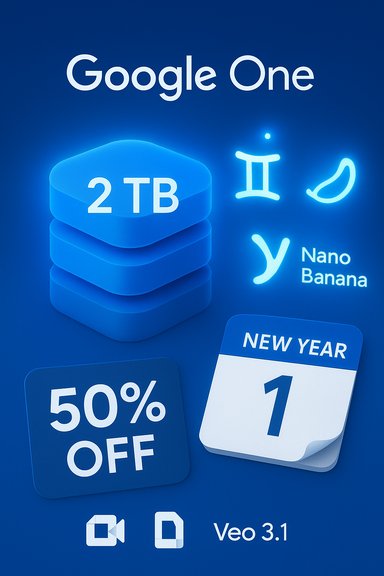
Google’s New Year promotion has cut the headline price of Google One’s premium tiers — including the company’s flagship AI-backed subscription — in half for new annual subscribers, a move that lowers the cost of the 2 TB AI Pro bundle and the standard 2 TB Premium plan for the first year and changes the economics of cloud storage and consumer AI access heading into 2026.
Background
Google has layered its consumer cloud product, Google One, with tiered AI capabilities over the past two years, culminating in distinct AI-focused plans such as Google AI Pro and Google AI Ultra that combine storage, premium Workspace integrations, and access to Google’s most capable Gemini models and creative engines. The company’s published plan pages show the standard retail pricing and feature set for each tier — for example, AI Pro has been offered as a 2 TB bundle historically priced at about $19.99/month (or $199.99/year when billed annually), while the plain 2 TB Premium storage tier sits at $9.99/month (or roughly $99.90/year billed annually). What changed at the end of December is a time-limited promotional discount framed as a “Capture every moment of the new year” offer: Google ran a 50% discount on annual plans for new subscribers, knocking the 2 TB Premium annual to about $49.99 for the first year and AI Pro to $99.99 for the first year. The entry-level 100 GB annual was also halved to roughly $9.99 for the year under the promotion. The offer was positioned for new sign-ups and labeled as limited-time, with many outlets reporting an expiration around New Year’s Eve.What exactly is on offer?
The headline numbers
- 100 GB Basic (annual) — advertised at roughly $9.99 for the first year during the promotion (normally ~$19.99/year).
- 2 TB Premium (annual) — promotional first-year price $49.99 (regularly ~$99.99/year). Benefits include the usual 2 TB of shared storage, family sharing, 10% back at the Google Store, and premium Workspace features like extended Google Meet call lengths.
- Google AI Pro (annual) — promotional first-year price $99.99 (regular price ~$199.99/year). This bundle combines 2 TB of storage with advanced Gemini-powered features and higher creative/compute limits inside Google’s Gemini app and associated tools (Flow, Whisk, NotebookLM).
The AI extras that matter
The promotional coverage emphasized the product features users gain in the AI Pro tier — specifically access to the higher-capability Gemini models and enhanced creative engines. Reported daily or monthly usage limits (which differ by product and can change with policy or system load) included:- Large context window support for the top-tier model — a 1,000,000-token context window (useful for processing very long documents, codebases, or multi-document research).
- Expanded image generation via Nano Banana / Nano Banana Pro image models (higher-resolution, studio-grade image editing), and reporting that higher plans can generate many more images per day versus free users.
- Updated video generation via Veo 3.1 (and a “Fast” variant), with the ability to produce videos from photos or prompts and improved audio, editing controls and realism.
- Increased daily limits for tools like Deep Research inside Gemini and priority access to new studio/creative capabilities across Google Photos, Flow, Whisk, and NotebookLM.
Cross-checking the claims — what’s verifiable and what’s provisional
Because the promotion bundles product pricing with complex AI features, it’s important to separate concrete, verifiable facts from claims that may vary by region, by timing, or by the state of Google’s deployments.- The 50% promotional pricing for annual plans (first year only) for new subscribers is reported consistently across multiple reputable outlets and corroborates with Google One’s pricing pages and the press reporting that tracked the limited-time landing page. This is a high-confidence claim.
- The existence and capability of Gemini 3 Pro (1M token context window) is confirmed by Google’s announcements and developer documentation. The 1,000,000-token input window and Gemini 3 family rollout were publicly documented as core technical upgrades late in 2025. This is verifiable on Google developer materials and coverage in technical press.
- The Veo 3.1 updates (improved audio and editing controls, availability in Flow and the Gemini API) are documented in Google’s developer blog and covered by major outlets describing how that model is integrated into consumer and developer tools. This is confirmed and verifiable.
- The Nano Banana family (Nano Banana / Nano Banana Pro) is officially referenced in Google’s Gemini API documentation and Google’s product recaps, confirming that Nano Banana is the name for Gemini’s native image generation capability and that higher tiers unlock more advanced variants. Daily image-generation numbers reported in some press pieces (for example, claims of 1,000 images per day for top tiers) are plausible given internal rate limits, but they can vary by region, by load and by plan — in other words, those per-day caps are operational parameters that Google can change and are therefore less stable than published list prices. Treat daily-generation caps as provisionally accurate and subject to confirmation inside the user account UI or Google’s official plan pages.
- Any reporting that lists granular daily quotas (images/day, videos/day, Deep Research reports/day) should be treated as indicative rather than definitive until you see those exact limits in your own account’s plan summary. Google documents model access and example quotas, but internal throttling, regional rollouts and load management mean those numbers can change quickly. When in doubt, consult your Google One account or the Gemini app’s usage & limits page for the definitive, current allocation.
Why Google is doing this: strategic logic
There are several business and product drivers behind a high-visibility “half-off the first year” promotion for AI-backed storage:- On-ramping users into the AI ecosystem. Once a user experiences Gemini’s convenience inside Gmail, Docs or Photos, the incremental friction to continue paying for AI-enabled features drops. Reduced first-year pricing accelerates adoption and lock-in.
- Competitive positioning. Microsoft and other competitors have built aggressive AI bundles tied to productivity suites. Bundling storage with AI features creates a broad consumer touchpoint that competes not just on compute but on convenience (Photos + Drive + Gmail integrations). Recent Microsoft moves to simplify Copilot offerings underscore why Google wants more consumers tied to its own paid stack.
- Upsell funnel optimization. Lowering the price to try AI Pro allows Google to convert storage-only customers into higher-margin AI users who may later upgrade to AI Ultra or consume paid API/enterprise services. The half-off promotion is textbook loss-leader economics for a platform business.
Practical guidance: how to evaluate whether to take the deal
- Check eligibility: the promotion has been reported as valid for new subscribers only. If you already have an AI Pro or 2 TB Premium plan, the promotional price might not apply to you. Confirm eligibility in the Google One app or the promotion landing page before buying.
- Compare first-year vs renewal pricing: promotional pricing typically reverts to the standard annual or monthly rate after the first year. Do the math on the second-year renewal cost and the value you expect to get from the AI features beyond year one.
- Verify regional availability and features: some AI features (model access in Search, Gemini in Gmail or advanced API features) are region- or language-limited. Confirm that the specific AI capabilities you want are available in your country and language.
- Check for trials and refunds: Google sometimes offers a free trial month for AI Pro; understand trial terms and the cancellation/refund policy to avoid unintended renewals. Read the subscription fine print in your Google One account.
- Inspect usage limits inside the Gemini app: if your work relies on image or video generation at scale, confirm daily quotas from the Gemini app’s “Usage & Limits” screen or the Google One plan summary rather than relying solely on press-reported numbers.
What this means for power users, creators and IT admins
For creators and designers
The availability of Nano Banana Pro (the Gemini 3 Pro image model) and Veo 3.1 for video generation in subscriber plans dramatically lowers the barrier to high-fidelity, AI-assisted creative production. Heavy creators should:- Audit the daily generation caps your workflow requires and test the models in a non-critical pilot before committing to an annual plan.
- Factor in API or enterprise pricing for production-scale pipelines — consumer tiers can be great for prototyping, but paid API usage for bulk renders often becomes necessary for sustained production.
For knowledge workers and researchers
The 1M-token context window in Gemini 3 Pro opens possibilities for multi-document summarization, long-range codebase analysis, and deep-research workflows that were previously painful for smaller-window models. Teams should:- Validate compatibility with internal security policies before uploading proprietary source code or sensitive legal documents, and review the enterprise product and retention/processing policies if using Google Cloud/Vertex AI versions.
For IT admins and privacy teams
A cheaper acquisition funnel for consumer AI means users may start relying on Google-hosted AI outputs more often. Security teams need to:- Re-assess data classification and acceptable-use policies for documents sent to consumer AI tools, and enforce data loss prevention (DLP) controls if corporate data is involved. Google’s product pages note that terms, data handling and availability vary by feature and region; organizations must confirm the contractual and technical protections for sensitive data.
Risks and caveats
- Auto-renew and sticker shock in year two. Promotional first-year pricing can mask the true recurring cost. Expect plans to auto-renew at full price unless you cancel; this is standard for subscription promotions. Confirm renewal terms before committing.
- Feature availability and limits may change. Reported daily quotas and model-capacity allocations (images/day, videos/day, Deep Research counts) are operational and subject to change with load, policy decisions, or regional rollout schedules. Treat per-day numbers in press coverage as provisional until seen inside your account.
- Data governance and compliance. Consumer cloud AI tools are powerful but can raise compliance questions for regulated data. For corporate or regulated workloads, enterprises should use Vertex AI / Gemini Enterprise offerings with contractual controls and enterprise-grade compliance assurances rather than consumer Google One plans.
- Deepfake and content-misuse risk. Easier access to high-quality image and video generation (Veo 3.1, Nano Banana) increases the potential for misuse, both malicious and inadvertent. Organizations and creators must implement ethical guardrails, watermarks, or verification steps if outputs are used in public or regulated contexts.
- Vendor lock-in and ecosystem gravity. The more integrated you become with Gemini inside Gmail, Docs, Photos and Drive, the more friction there is to move to alternative providers. If you value portability, maintain local copies and export workflows; don’t rely on a single vendor’s transient promotional pricing as a long-term procurement strategy.
Pricing context: how this compares to other consumer AI bundles
Google’s promotional first-year price for AI Pro makes a cost comparison with competitive consumer AI bundles instructive.- Microsoft has recently consolidated some of its consumer AI offerings into new bundles that position Copilot features inside Microsoft 365 premium products. Reported consumer Copilot bundles and premium Microsoft 365 tiers have varied in headline price, but the ongoing strategy is clear: major platform vendors are bundling AI features into productivity and storage subscriptions rather than selling AI entirely as a standalone product. That makes promotional moves by Google competitive posture rather than an isolated price cut.
- For users whose needs are purely storage-based, incumbent 2 TB plans ($9.99/mo) still represent the best pure-storage economy; the AI-enabled tiers justify higher price points primarily for users who will realize recurring value from model access, creative generation, and Workspace integration. The promotion is therefore most compelling for customers who expect to use the AI features regularly enough to justify a higher renewal price after year one.
Quick checklist before you click “subscribe”
- Confirm you are classified as a new subscriber for the promotion to ensure eligibility.
- Review the long-term renewal price and calendar the date to decide whether to keep or cancel at renewal.
- Verify the exact AI features and usage caps inside the Gemini app or Google One account UI for your country and language.
- For corporate use, confirm that data governance and compliance requirements are met — escalate to procurement or IT if you plan to process regulated data.
- Consider whether you need API-scale production access (Vertex AI / Gemini Enterprise) instead of a consumer Google One tier if your workflows are business-critical.
Bottom line
Google’s New Year promotion makes the AI-powered Google One plans materially cheaper for the first year and is an effective acquisition play to get more people using Gemini, Nano Banana image tools and Veo video generation inside Google’s ecosystem. For many consumers — particularly creators and heavy Google users who want integrated AI inside Gmail, Docs and Photos — the discount is an attractive, low-risk way to trial what the company now positions as the future of productivity and creativity.However, the promotion’s long-term value depends on whether the AI features prove essential enough to justify full-price renewal in subsequent years, and on careful verification of operational limits, regional availability and data governance considerations before entrusting sensitive or production-critical workloads to a consumer-tier AI subscription. Users and IT teams should treat this promotion as an opportunity to pilot Google’s most capable consumer AI tools — but plan the exit strategy, governance checks, and renewal calculus before the first-year discount expires.
Source: PhoneArena Cell Phone News
