

Google Play Store is rolling out an AI-powered review summary that condenses what users actually say about apps into a short paragraph and topic chips, making it far easier to judge an app at a glance without wading through dozens of individual reviews.
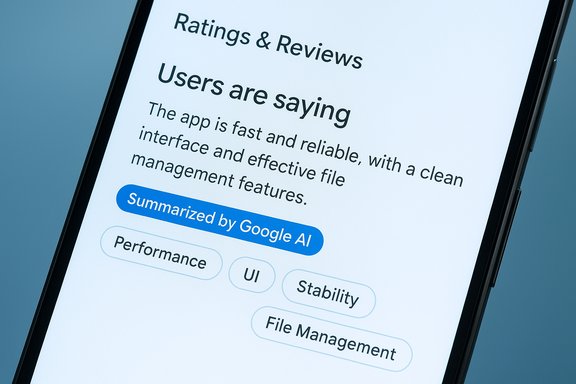
Google has quietly begun surfacing a new element on Play Store app pages called “Users are saying” (or similarly labeled), which sits in the Ratings & Reviews area and contains an AI-generated, three-to-four sentence summary of the most common praise and complaints for that app. The summary is labeled so users know it’s machine-generated, and beneath it are small tappable chips that filter reviews by topic — for example, Performance, User interface, or File management — letting users jump directly to reviews about a specific issue or feature. The rollout is gradual and appears to be server-side: multiple outlets have reported seeing the feature on devices running Play Store version 48.5.23-31, but many users with the same app version do not yet see the summaries, indicating a staged distribution by account, region, or server flag. Google has not published a formal global rollout timeline as of this writing. This addition follows an industry trend: Apple introduced App Store review summaries earlier in 2025 and Amazon has long used automated review synopses for product pages, so Play Store’s move is part of a broader shift toward AI-assisted review navigation across major platforms.
Source: Gizchina.com Google Play Store launches AI review summary feature
 Background / Overview
Google has quietly begun surfacing a new element on Play Store app pages called “Users are saying” (or similarly labeled), which sits in the Ratings & Reviews area and contains an AI-generated, three-to-four sentence summary of the most common praise and complaints for that app. The summary is labeled so users know it’s machine-generated, and beneath it are small tappable chips that filter reviews by topic — for example, Performance, User interface, or File management — letting users jump directly to reviews about a specific issue or feature. The rollout is gradual and appears to be server-side: multiple outlets have reported seeing the feature on devices running Play Store version 48.5.23-31, but many users with the same app version do not yet see the summaries, indicating a staged distribution by account, region, or server flag. Google has not published a formal global rollout timeline as of this writing. This addition follows an industry trend: Apple introduced App Store review summaries earlier in 2025 and Amazon has long used automated review synopses for product pages, so Play Store’s move is part of a broader shift toward AI-assisted review navigation across major platforms. How the Play Store summaries present information
What users will see on an app page
- A short paragraph under a heading such as “Users are saying” that captures the common positives and negatives distilled from that app’s reviews. The paragraph is deliberately concise and aims to surface the recurring themes rather than isolated complaints.
- A line or badge that clarifies the summary is “Summarized by Google AI” or a similar disclosure, making the automated nature of the text visible.
- Clickable chips (also called tags or filters) immediately under the summary that let people focus on specific topics (for example, Stability, File Management, UI, Crash Reports). Tapping a chip narrows the visible reviews to ones that mention that topic, enabling quick, targeted triage.
How Google likely generates summaries (and what’s still unclear)
Public reporting and early teardowns indicate Google is using its large language models and topic-extraction pipelines to cluster review text, identify recurring themes, and paraphrase them into a single readable paragraph. Some outlets have speculated the work is being powered by Google’s Gemini family of models, but there is no formal Google engineering note confirming the exact model or the full architecture publicly at the time of reporting. Treat claims about the specific backend model as probable but not fully verified until Google confirms. Key unknowns include:- The minimum number of reviews required for the feature to appear on a listing (Google has not disclosed a threshold).
- The precise privacy and retention policy for the review text used to generate summaries.
- Whether summaries are refreshed on a fixed cadence or updated in near-real time as new reviews arrive.
Why this matters: benefits for users and developers
Faster, clearer app discovery
For end users, the new Play Store feature addresses a real friction point: review overload. Instead of scrolling through many repetitive or unrepresentative reviews, users can:- See the prevailing sentiment in one paragraph.
- Jump to reviews about the precise topic they care about via chips.
- Make a download decision much quicker.
Better triage for troubleshooting and ASO
Developers and product teams can also benefit:- Summaries will amplify recurring issues that matter: if a majority of users complain about crashes or a broken sync feature, the summary will likely surface that, making it easier to prioritize fixes.
- App Store Optimization (ASO) teams can use the chips and summary to detect thematic trends faster and measure whether fixes alter public perception over time.
Risks, limitations, and possible harms
AI-generated summaries create convenience but introduce several design, accuracy, and governance risks that merit careful attention.1. Overgeneralization and loss of nuance
Automated summaries risk flattening nuanced feedback into blunt statements. A minority but important complaint (e.g., a security flaw, regulatory concern, or issue affecting a particular device or locale) might be lost if the model prioritizes volume over impact. Users and developers should treat the summary as a starting point, not a final judgment.2. Hallucinations and factual errors
Generative models sometimes produce confident-sounding but inaccurate statements — a phenomenon called a hallucination. If a summary asserts that an app never syncs when the majority of users actually report occasional sync delays, that mischaracterization can mislead downloaders. Early critics of similar features on other platforms urged caution and the ability to report or flag problematic summaries; Apple’s rollout included a reporting affordance for bad summaries, which is a model Play Store should consider if it hasn’t already.3. Bias amplification and sampling issues
If the pool of reviews that the model trains or aggregates from is skewed — for instance, if reviewers come predominantly from one region or platform — the summary could amplify that bias and make it appear universal. The chips mitigate this by letting users look at raw reviews by topic, but they don’t solve upstream sample bias.4. Developer impact and visibility mechanics
Summaries increase the stakes of recurring complaints: an app with a persistent but easily fixable issue could suffer disproportionately in installs because the summary leads with that problem. That makes responsiveness more important but also raises the cost of poor communication from developers. Google should ensure developers have a transparent path to contest or request re-evaluation of summary text when it’s wrong or misleading.5. Privacy and data handling questions
Play Store reviews are user-generated public content, but building summaries at scale could involve additional processing, caching, or dataset retention. Google’s broader AI policies around data use and model training are relevant here; however, specific Play Store handling (how long derived summaries are stored, how review text is tokenized or anonymized before summarization, whether summaries feed back into model training) is not yet documented in public release notes. Users and enterprise admins should expect a privacy FAQ or developer note to appear soon; absent that, caution is prudent.Verification of load-bearing claims
Several of the article’s most important claims can be independently confirmed by multiple outlets:- The Play Store is showing AI-generated review summaries under a “Users are saying” heading on some devices. Multiple outlets, including Android Police and Android Central, have published first-hand accounts of the UI and phrasing.
- The feature has been observed in Play Store version 48.5.23-31, but the rollout is server-side and limited, meaning not all users with the version will see it immediately. Multiple independent reports corroborate the version number and the server-side behaviour.
- Clickable chips or topic filters appear beneath the summary to let users filter reviews by theme. Android Central’s reporting and screenshots describe chips that filter reviews to relevant topics.
- Apple and Amazon introduced similar review-summarization features earlier (Apple’s was rolled into iOS 18.4 beta in early 2025 and Amazon has its own summary tools), establishing a broader industry pattern. Multiple reports and Apple developer notes confirm Apple’s feature.
- The claim that Gemini powers the summaries appears frequently in press coverage and in vendor-teardown speculation, but Google has not published an explicit, product-level confirmation attributing the Play Store summary to a named model family; treat that as plausible but not conclusively verified until Google issues technical notes.
Practical guidance for users, developers, and IT pros
For users
- Use the summary as a time-saver: read the one-paragraph overview, then tap chips for the aspects that matter to you.
- Verify any decisive claim by scanning a handful of the most recent and the most helpful reviews yourself before installing; don’t accept any single summary as the final word.
For developers
- Monitor review themes proactively: set up alerts for topic clusters that could appear in summaries.
- Prioritize root-cause fixes for recurring complaints — summaries amplify patterns, not one-off issues.
- Respond to reviews transparently and quickly; a corrective reply might reduce the prominence of a complaint in later summaries.
- Expect increased visibility of common bugs and prepare public-facing messaging (release notes, in-app banners) to address them promptly.
For enterprise administrators and app governance teams
- Recognize that summaries may affect app adoption decisions by employees or customers. If your organization relies on specific enterprise apps, validate app suitability with staged deployments rather than relying solely on summary text.
- If data sensitivity or compliance concerns exist around user reviews in your region, reach out to vendors and monitor Google’s privacy post for Play Store AI features; the company will likely release documentation as the rollout broadens.
Where Play Store AI could go next
Google is likely to expand and refine the system in several directions:- Multi-language support and regional tuning: summaries that accurately reflect region-specific concerns and languages beyond English.
- Developer tools: an appeals or feedback path for developers to flag inaccurate or harmful summaries, and possibly analytics to show how summary text changed after fixes.
- Searchable review text and deeper filters: current chips are topical; Google could add full-text review search or sentiment heatmaps to surface reviews mentioning precise phrases like “battery drain” or “offline mode.” Early reporting suggests Google is treating this as a foundation for more advanced review analysis.
- Cross-platform parity: similar summarization features could appear in Google Maps, Shopping, and other consumer-facing properties where user feedback guides decisions. The Play Store may be a proving ground for those broader deployments.
Editorial assessment: strengths and concerns
Strengths
- Practical UX improvement: Summaries plus chips materially reduce the time required to evaluate an app, which is a measurable win for discovery and conversion flows.
- Focus on themes, not noise: By surfacing patterns across reviews, the feature reduces the impact of outlier one-star or five-star posts that don’t reflect the majority experience.
- Competitive alignment: The Play Store is catching up with similar features on other major platforms, reducing product parity gaps for Google and improving the ecosystem for users.
Concerns and open questions
- Transparency and accuracy: Without published methodology and clear user-reporting channels, the risk of misleading summaries remains. Users should be given an easy way to flag incorrect summaries and developers an operational channel to respond.
- Model provenance and privacy: If summaries are derived from user reviews and then used to fine-tune models, Google needs to clarify how that data is handled; otherwise, organizations with compliance requirements will be understandably cautious.
- Potential for outsized impact: Summaries can disproportionately shape an app’s first impression; inaccuracies or biased sampling could cause avoidable harm to developers and users.
Final verdict: useful but not definitive
Google’s Play Store AI review summary is an upgrade that legitimately helps users and developers navigate the noise of app reviews. As an addition to the Ratings & Reviews section, the combination of a concise, labeled summary and topical chips is an elegant product move that prioritizes utility. Early reporting confirms the feature exists in limited rollouts (notably in Play Store version 48.5.23-31 for some users) and that chips and labeling are part of the UI. At the same time, the feature should be used with caution. It is a heuristic — a way to speed decisions — not a replacement for reading original reviews when an install decision carries real consequences (security, payment, or enterprise deployment). Google, like its peers, must provide clear transparency, robust error-reporting mechanisms, and developer recourse to avoid amplifying mistakes. The underlying model choice, training data policies, refresh cadence, and developer appeal process remain the most important unresolved details for trustworthy adoption; those deserve rapid clarification from Google as the rollout proceeds.What to watch next
- Official Google documentation or a Play Console update that describes how summaries are generated, refreshed, and governed.
- A developer-facing appeals or report mechanism that Google may add in response to early feedback.
- Broader rollout signals: when summaries appear for smaller apps, in more languages, and across more regions (that will show whether the feature is mature enough for global use).
Source: Gizchina.com Google Play Store launches AI review summary feature
