

Google Search is entering a new phase, and Sundar Pichai’s “agent manager” framing captures just how far that evolution could go. Rather than acting only as a system for retrieving answers, Search is being positioned as a coordination layer that can help users complete multi-step tasks over time, across sites, tools, and sessions. That is a much bigger shift than a smarter results page, because it changes Search from an endpoint into an orchestrator. Google is also making clear that this does not mean Gemini disappears; the company wants both products to coexist, each with a distinct role in the AI stack. Google’s own recent Search and retail announcements show that the company is already laying groundwork for more agentic experiences in shopping, commerce, and personalized assistance.
Google has spent the past two years steadily transforming Search from a static lookup tool into something closer to an intelligent workspace. At Google I/O 2025, the company said AI Overviews had scaled to more than 1.5 billion users and that AI Mode was a “total reimagining” of Search, aimed at longer, more complex queries and richer follow-up interactions. That framing matters because it shows Google was already moving away from the one-query, one-answer model long before this latest “agent manager” language appeared.
The next step has been to make Search less passive and more action-oriented. Google’s January 2026 retail remarks described a new Universal Commerce Protocol built for agentic commerce, with buy-button experiments and support for retailer workflows across discovery and purchase. The company presented that protocol as open and compatible with existing standards, signaling that Google sees commerce as a proving ground for broader agent behavior. In other words, shopping is not just a vertical test case; it is a preview of how Google thinks agentic systems should move through the web.
This is also happening at the same time Google is deepening Gemini’s role across its own ecosystem. Recent Google materials show Gemini expanding into Search, Chrome, and Workspace, while Personal Intelligence-style features use connected Google services to add context. That creates a layered strategy: Gemini becomes the reasoning engine, while Search becomes the interface through which many of those capabilities are discovered, initiated, and supervised. The reported “agent manager” concept fits naturally into that architecture.
The timing is important because the broader AI market has moved decisively toward agentic workflows. OpenAI has built Operator around browser-based task execution, while Microsoft has pushed Copilot deeper into task-oriented experiences across its productivity stack. Google’s response is not to retreat into classic search rankings, but to make Search itself the place where tasks begin and are coordinated. That is a strategic bet that the front door to the internet may become the front door to action, not just information.
In practice, an agent manager sounds more like a dispatcher than a doer. It would not necessarily execute every action itself; instead, it would help route tasks, preserve context, and keep related threads alive so the user can return to them later. That distinction matters because it keeps Search at the center of the experience even when the underlying work is distributed across other services and websites.
That framing also suggests a more persistent Search relationship. A user who asks about products today may continue that same thread tomorrow with price changes, inventory updates, or a follow-up question about warranties. If Google succeeds, Search becomes less of a query box and more of an ongoing project workspace. That is the real product leap, because persistence is what turns one-off assistance into daily utility.
That separation is strategically smart. Consumers do not want every AI interaction to feel like a generic chatbot, and enterprises certainly do not want every workflow to depend on one conversational surface. By keeping both brands alive, Google gives itself room to address different jobs-to-be-done without forcing everything into one interface.
It also helps Google manage trust. Search has decades of user familiarity behind it, while Gemini is still the newer, more flexible, more experimental layer. If Google can make Search the dependable place where agentic work is supervised and Gemini the broader reasoning system behind it, the company may avoid some of the confusion that comes from overloading a single assistant with every possible role. That split is not cosmetic; it is architectural.
That timeline also reflects the reality that agentic systems need more than model quality. They need protocols, retailer participation, browser compatibility, trust safeguards, and enough consumer behavior change to justify the workflow shift. Google’s 2026 UCP rollout is therefore important because it is not just a shopping feature; it is an ecosystem test for how well agents can coordinate across vendors and services.
A 2027 horizon also gives Google space to harden safety, privacy, and consent design. The more Search can do on behalf of a user, the more it must prove it knows when to stop, when to ask, and when to defer. That is the hidden challenge of agentic search: the technology may be capable before the market is emotionally ready to trust it.
The competition is no longer just about who has the best model. It is about who can own the interface where users express intent and approve action. Microsoft has an obvious advantage inside enterprise software, while OpenAI has a strong consumer AI brand and a fast-moving agent story. Google’s answer is to leverage Search’s unmatched scale and habit formation, turning its existing front door into the place where the next generation of tasks starts.
That is a serious advantage, but it is not automatic. Google’s challenge is that users may appreciate Search for information and Gemini for conversation, yet still hesitate when the system starts taking action on their behalf. Trust is the real battlefield. A company can own the most traffic on the web and still lose the agent layer if users feel more comfortable delegating to a rival.
Google’s retail announcements suggest the company understands this. The Universal Commerce Protocol is designed to keep the retailer relationship in view from discovery to purchase, which is exactly where advertising and commerce start to blend. If Search becomes a shopping concierge, then the ad unit is no longer just a link slot; it becomes part of a guided transaction path.
That has obvious upside for advertisers who want higher-intent traffic, but it also raises difficult questions. Will agentic Search reduce user choice by steering them into narrower funnels? Will the system surface fewer independent sites if it can complete the job inside Google’s own interfaces? And how will publishers be compensated if more of the journey becomes invisible or condensed? Those are not hypothetical concerns; they are the core business tensions of AI search.
For enterprises, though, the stakes are more complex. If Search starts coordinating tasks across work apps, it becomes a governance surface, not just a user surface. That means permissions, audit trails, identity boundaries, and policy enforcement all become part of the product story. Google’s broader AI push across Workspace and related services suggests it knows enterprise adoption will depend on that trust layer as much as on model capability.
There is also a difference in acceptable failure modes. Consumers may forgive the occasional wrong recommendation; enterprises generally will not forgive data leakage or unauthorized action. That asymmetry is why Google’s agentic Search story must balance ambition with restraint. The more useful Search becomes, the more dangerous a mistake becomes.
The opportunity is not just to make Search smarter. It is to make Search the operating layer that helps users move from intent to completion with less friction and less tool-hopping. If Google can do that while preserving trust, it could extend Search relevance well into the next decade.
There is also a business risk. If agentic Search reduces page views or reshapes referral traffic too aggressively, Google could create friction with publishers and retailers even as it improves user convenience. That tension has haunted search changes for years, and AI orchestration could make it sharper by keeping more of the user journey inside Google’s own surfaces.
Privacy and safety are equally important. The more Search remembers, sequences, and executes, the more sensitive the underlying context becomes. If Google wants users to trust it with ongoing tasks, it must make permissions, transparency, and rollback behavior feel first-class rather than optional. Without that, agentic Search risks becoming powerful but brittle.
What to watch is whether Google can scale this idea without breaking the core promise that made Search dominant in the first place. That means fast answers when users want them, but also durable task management when they need more. It means preserving openness while adding action. And it means proving that an agent manager can make the web feel simpler, not more controlled.
Source: The420.in Google Search Set to Evolve Into an “Agent Manager,” Says Sundar Pichai - The420.in
 Background
Google has spent the past two years steadily transforming Search from a static lookup tool into something closer to an intelligent workspace. At Google I/O 2025, the company said AI Overviews had scaled to more than 1.5 billion users and that AI Mode was a “total reimagining” of Search, aimed at longer, more complex queries and richer follow-up interactions. That framing matters because it shows Google was already moving away from the one-query, one-answer model long before this latest “agent manager” language appeared.The next step has been to make Search less passive and more action-oriented. Google’s January 2026 retail remarks described a new Universal Commerce Protocol built for agentic commerce, with buy-button experiments and support for retailer workflows across discovery and purchase. The company presented that protocol as open and compatible with existing standards, signaling that Google sees commerce as a proving ground for broader agent behavior. In other words, shopping is not just a vertical test case; it is a preview of how Google thinks agentic systems should move through the web.
This is also happening at the same time Google is deepening Gemini’s role across its own ecosystem. Recent Google materials show Gemini expanding into Search, Chrome, and Workspace, while Personal Intelligence-style features use connected Google services to add context. That creates a layered strategy: Gemini becomes the reasoning engine, while Search becomes the interface through which many of those capabilities are discovered, initiated, and supervised. The reported “agent manager” concept fits naturally into that architecture.
The timing is important because the broader AI market has moved decisively toward agentic workflows. OpenAI has built Operator around browser-based task execution, while Microsoft has pushed Copilot deeper into task-oriented experiences across its productivity stack. Google’s response is not to retreat into classic search rankings, but to make Search itself the place where tasks begin and are coordinated. That is a strategic bet that the front door to the internet may become the front door to action, not just information.
Why this matters now
The shift reflects a broader truth about AI products in 2026: the winners are increasingly the systems that can combine context, memory, and actions without making users manage every step manually. Search alone is no longer enough when users want planning, comparison, execution, and follow-through. That is why Google’s move feels less like a feature update and more like a platform redefinition.- Search is moving from retrieval to orchestration.
- Gemini is being positioned as complementary, not cannibalistic.
- Commerce is becoming the first major agentic battleground.
- Google wants the browser, the model, and the search layer to work together.
What “Agent Manager” Actually Means
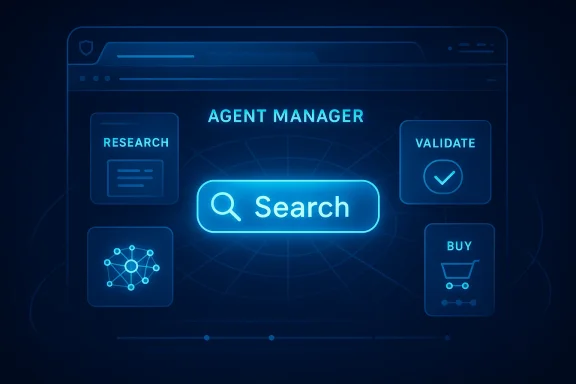
Pichai’s phrase “agent manager” is easy to misunderstand if you take it literally. Google is not saying Search will become a single robot that replaces the web; it is saying Search may become the control plane for multiple connected tasks that unfold over time. That means one session could span research, comparison, validation, and transaction steps without the user starting from scratch each time.In practice, an agent manager sounds more like a dispatcher than a doer. It would not necessarily execute every action itself; instead, it would help route tasks, preserve context, and keep related threads alive so the user can return to them later. That distinction matters because it keeps Search at the center of the experience even when the underlying work is distributed across other services and websites.
That framing also suggests a more persistent Search relationship. A user who asks about products today may continue that same thread tomorrow with price changes, inventory updates, or a follow-up question about warranties. If Google succeeds, Search becomes less of a query box and more of an ongoing project workspace. That is the real product leap, because persistence is what turns one-off assistance into daily utility.
The product logic behind the label
The phrase is useful because it separates Google’s vision from the simplistic idea that AI Search is just “chat with web results.” Google is aiming for something more ambitious: a system that can track intent across time and help resolve it. That means the search interface may become a kind of mission control for a set of subordinate agents and tools.- Single-answer search becomes multi-step task flow.
- Session memory becomes as important as ranking quality.
- User intent, not keywords, becomes the organizing principle.
- Search becomes a coordinator, not just a responder.
Gemini and Search Are Not the Same Product
Pichai’s point that Google is doing both Search and Gemini is more than corporate reassurance. It signals that Google intends to keep a clean division between the general-purpose AI model and the consumer-facing task layer. Gemini can be the broad intelligence engine, while Search becomes the more structured environment for reliable action and discovery.That separation is strategically smart. Consumers do not want every AI interaction to feel like a generic chatbot, and enterprises certainly do not want every workflow to depend on one conversational surface. By keeping both brands alive, Google gives itself room to address different jobs-to-be-done without forcing everything into one interface.
It also helps Google manage trust. Search has decades of user familiarity behind it, while Gemini is still the newer, more flexible, more experimental layer. If Google can make Search the dependable place where agentic work is supervised and Gemini the broader reasoning system behind it, the company may avoid some of the confusion that comes from overloading a single assistant with every possible role. That split is not cosmetic; it is architectural.
Coexistence as strategy
The coexistence story matters because the market often assumes new AI assistants will simply replace search. Google’s own messaging suggests the company rejects that binary. Instead, it is building a stack where Gemini and Search reinforce each other, each handling different stages of the user journey.- Gemini = general intelligence and reasoning.
- Search = coordination, discovery, and task execution.
- Chrome and Workspace = contextual surfaces that feed the system.
- Commerce protocols = the transactional proof point.
Why 2027 Keeps Coming Up
The repeated mention of 2027 in this conversation is less about a formal product launch date and more about the expected maturity window for agentic systems. Google appears to be signaling that the technologies behind agentic Search will be ready for wider mainstream use by then, even if the company is not committing to a rigid public roadmap. That is a familiar Google pattern: seed the infrastructure first, scale the experience later.That timeline also reflects the reality that agentic systems need more than model quality. They need protocols, retailer participation, browser compatibility, trust safeguards, and enough consumer behavior change to justify the workflow shift. Google’s 2026 UCP rollout is therefore important because it is not just a shopping feature; it is an ecosystem test for how well agents can coordinate across vendors and services.
A 2027 horizon also gives Google space to harden safety, privacy, and consent design. The more Search can do on behalf of a user, the more it must prove it knows when to stop, when to ask, and when to defer. That is the hidden challenge of agentic search: the technology may be capable before the market is emotionally ready to trust it.
The long runway is not an accident
Google’s product cadence suggests it prefers to stage changes through incremental launches rather than one dramatic switch. AI Overviews, AI Mode, Personal Intelligence, and UCP all look like parts of the same longer campaign. By 2027, those pieces could plausibly form a more cohesive agentic search experience, but only if users are willing to let Search do more than answer questions.- 2026 is the infrastructure year.
- 2027 looks like the likely scale-up window.
- Protocols and partnerships matter as much as model quality.
- Trust and consent will decide adoption speed.
Competitive Pressure From Microsoft and OpenAI
Google’s move is clearly shaped by what Microsoft and OpenAI are doing. OpenAI’s Operator can browse, click, and interact with websites on behalf of users, which makes browser-based task completion a direct competitive reference point. Microsoft, meanwhile, has embedded Copilot into productivity and support workflows and continues to emphasize multi-step task handling in a business context. Google does not need to copy either company, but it cannot ignore the direction the market is taking.The competition is no longer just about who has the best model. It is about who can own the interface where users express intent and approve action. Microsoft has an obvious advantage inside enterprise software, while OpenAI has a strong consumer AI brand and a fast-moving agent story. Google’s answer is to leverage Search’s unmatched scale and habit formation, turning its existing front door into the place where the next generation of tasks starts.
That is a serious advantage, but it is not automatic. Google’s challenge is that users may appreciate Search for information and Gemini for conversation, yet still hesitate when the system starts taking action on their behalf. Trust is the real battlefield. A company can own the most traffic on the web and still lose the agent layer if users feel more comfortable delegating to a rival.
Rival strengths and Google’s response
Each major player brings something different to the table. Microsoft brings enterprise control and productivity integration. OpenAI brings consumer mindshare and a fast-improving browser agent. Google brings global search scale, a massive ad business, and deep commerce infrastructure. The “agent manager” idea is Google’s attempt to convert those strengths into an orchestration advantage.- Microsoft: strong in workplace workflows and admin controls.
- OpenAI: strong in conversational agents and browser automation.
- Google: strong in search intent, shopping graphs, and distribution.
- The winner: likely the company that best unifies intent and action.
The Advertising and Commerce Question
Any change to Search has immediate implications for advertising, because Google’s search business still depends heavily on commercial intent. If agentic Search reduces the number of separate queries a user needs to make, that could compress ad touchpoints while also making each interaction more valuable. In other words, fewer searches may not mean less commercial opportunity, but they could mean a very different kind of opportunity.Google’s retail announcements suggest the company understands this. The Universal Commerce Protocol is designed to keep the retailer relationship in view from discovery to purchase, which is exactly where advertising and commerce start to blend. If Search becomes a shopping concierge, then the ad unit is no longer just a link slot; it becomes part of a guided transaction path.
That has obvious upside for advertisers who want higher-intent traffic, but it also raises difficult questions. Will agentic Search reduce user choice by steering them into narrower funnels? Will the system surface fewer independent sites if it can complete the job inside Google’s own interfaces? And how will publishers be compensated if more of the journey becomes invisible or condensed? Those are not hypothetical concerns; they are the core business tensions of AI search.
Commercial intent becomes more concentrated
The commercial journey is getting shorter and more guided. That could improve conversion rates, but it could also make search behavior less open-ended and more curated by the platform. For brands, that means winning at the recommendation layer may matter even more than winning the blue-link race ever did.- More task completion may mean fewer discrete queries.
- Higher-intent sessions could be more monetizable.
- Retailer participation becomes strategically essential.
- Publisher traffic could become more concentrated and less visible.
Enterprise Versus Consumer Impact
For consumers, agentic Search promises convenience, lower friction, and less repetitive work. The best-case experience is obvious: compare products, narrow choices, check inventory, and finish a purchase or booking without repeatedly re-explaining yourself. For casual users, that could make Search feel dramatically more helpful than traditional results pages ever did.For enterprises, though, the stakes are more complex. If Search starts coordinating tasks across work apps, it becomes a governance surface, not just a user surface. That means permissions, audit trails, identity boundaries, and policy enforcement all become part of the product story. Google’s broader AI push across Workspace and related services suggests it knows enterprise adoption will depend on that trust layer as much as on model capability.
There is also a difference in acceptable failure modes. Consumers may forgive the occasional wrong recommendation; enterprises generally will not forgive data leakage or unauthorized action. That asymmetry is why Google’s agentic Search story must balance ambition with restraint. The more useful Search becomes, the more dangerous a mistake becomes.
Different users, different tolerances
This split explains why Google is likely to move faster in consumer commerce than in high-stakes enterprise automation. Retail can tolerate experimentation; regulated workflows cannot. So the same agentic machinery may arrive first in shopping, then in broader consumer assistance, and only later in more controlled business settings.- Consumers want speed and simplicity.
- Enterprises want governance and auditability.
- Retail is the safest high-value test bed.
- Workplace adoption will depend on policy controls.
Strengths and Opportunities
Google’s strategy has several obvious advantages. It begins with an installed base that is already enormous, then layers agentic behavior onto a product people use by default. The company also has a commerce ecosystem, a browser footprint, and a model family in Gemini that can support more ambitious search experiences without rebuilding from scratch.The opportunity is not just to make Search smarter. It is to make Search the operating layer that helps users move from intent to completion with less friction and less tool-hopping. If Google can do that while preserving trust, it could extend Search relevance well into the next decade.
- Massive distribution gives Google a head start.
- Search habit makes adoption easier than with a new app.
- Gemini provides the reasoning backbone.
- Commerce protocols create a practical use case.
- Chrome and Workspace provide context across sessions.
- Ads can evolve toward higher-intent interactions.
- A unified search-to-action flow could be highly sticky.
Risks and Concerns
The biggest risk is overpromising an agentic future before the experience is ready. Users will quickly lose patience if “manager” means confusion, repeated confirmations, or unpredictable action. Google has to make the system feel dependable, not merely impressive, and that is a much harder bar to clear.There is also a business risk. If agentic Search reduces page views or reshapes referral traffic too aggressively, Google could create friction with publishers and retailers even as it improves user convenience. That tension has haunted search changes for years, and AI orchestration could make it sharper by keeping more of the user journey inside Google’s own surfaces.
Privacy and safety are equally important. The more Search remembers, sequences, and executes, the more sensitive the underlying context becomes. If Google wants users to trust it with ongoing tasks, it must make permissions, transparency, and rollback behavior feel first-class rather than optional. Without that, agentic Search risks becoming powerful but brittle.
- User trust can evaporate after a few bad agentic experiences.
- Publishers may push back if traffic gets compressed.
- Retailers may resist if Google captures too much of the funnel.
- Privacy concerns grow as context becomes more persistent.
- Complex task execution increases the risk of errors and ambiguity.
- Competing platforms may move faster in specific niches.
Looking Ahead
The next phase of this story will be about execution, not rhetoric. Google has already shown its direction with AI Overviews, AI Mode, Gemini integrations, and the Universal Commerce Protocol, but those pieces still need to converge into a coherent, trustworthy experience. If the company gets the sequencing right, Search could become the place where digital tasks begin, persist, and finish.What to watch is whether Google can scale this idea without breaking the core promise that made Search dominant in the first place. That means fast answers when users want them, but also durable task management when they need more. It means preserving openness while adding action. And it means proving that an agent manager can make the web feel simpler, not more controlled.
- Further AI Mode expansion inside Search
- More retailer integrations and checkout experiments
- Clearer Gemini/Search role separation
- Privacy and consent updates for agentic workflows
- Competitive reactions from Microsoft and OpenAI
Source: The420.in Google Search Set to Evolve Into an “Agent Manager,” Says Sundar Pichai - The420.in
Last edited:
