

Google’s NRF keynote punctuated a turning point: the company rolled out the Universal Commerce Protocol (UCP) and a new Direct Offers ad product, staking a claim that open standards — not single‑vendor lock‑in — should be the plumbing for the emerging age of agentic commerce.
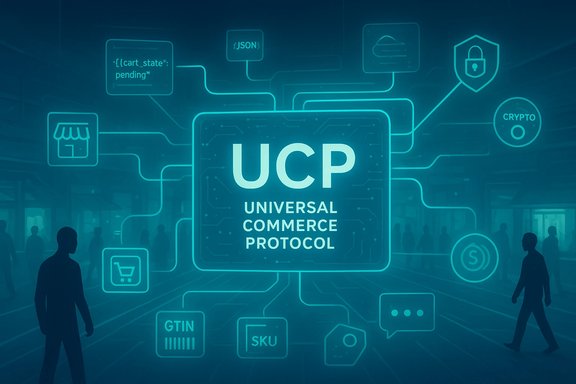
The last 18 months have been a rapid sprint from prototype to production for in‑chat and in‑assistant shopping. Large language model (LLM) platforms and commerce partners moved quickly to put discovery, cart assembly, and checkout inside conversational surfaces. That progress exposed a simple engineering problem at scale: without a common language, every assistant‑to‑merchant connection becomes an N x N integration nightmare. Google’s UCP is explicitly designed to solve that problem by providing a machine‑readable, extensible protocol that standardizes product records, cart semantics, promotions, and the checkout handshake across agents, merchants, and payment providers. Alongside UCP, Google promoted the Agent Payments Protocol (AP2) stack (the cryptographic mandate model) and announced a pilot ad product called Direct Offers, which surfaces contextual, “moment‑of‑purchase” discounts inside AI Mode and the Gemini app. Early partners named by Google and reporting outlets include Shopify, Etsy, Wayfair, Target, Walmart and payments firms such as Mastercard, PayPal, Stripe and Coinbase. This coverage synthesizes the official technical materials and contemporary reporting, evaluates the practical strengths and risks of UCP/AP2/Direct Offers, and offers a tactical playbook merchants and platform engineers can use while pilots roll toward broader commercial availability in the coming months.
Source: WinBuzzer AI Shopping: Google Launches Universal Commerce Protocol and Direct Offers, Betting on Open Standards to Win Agentic Shopping Race - WinBuzzer
 Background / Overview
The last 18 months have been a rapid sprint from prototype to production for in‑chat and in‑assistant shopping. Large language model (LLM) platforms and commerce partners moved quickly to put discovery, cart assembly, and checkout inside conversational surfaces. That progress exposed a simple engineering problem at scale: without a common language, every assistant‑to‑merchant connection becomes an N x N integration nightmare. Google’s UCP is explicitly designed to solve that problem by providing a machine‑readable, extensible protocol that standardizes product records, cart semantics, promotions, and the checkout handshake across agents, merchants, and payment providers. Alongside UCP, Google promoted the Agent Payments Protocol (AP2) stack (the cryptographic mandate model) and announced a pilot ad product called Direct Offers, which surfaces contextual, “moment‑of‑purchase” discounts inside AI Mode and the Gemini app. Early partners named by Google and reporting outlets include Shopify, Etsy, Wayfair, Target, Walmart and payments firms such as Mastercard, PayPal, Stripe and Coinbase. This coverage synthesizes the official technical materials and contemporary reporting, evaluates the practical strengths and risks of UCP/AP2/Direct Offers, and offers a tactical playbook merchants and platform engineers can use while pilots roll toward broader commercial availability in the coming months. Why UCP matters: the integration problem and a standards play
The engineering pain point
Retailers and payment processors know the cost of bespoke connectors: every time an assistant or marketplace adds a new conversational surface, merchants must rework feeds, pricing rules, shipping logic, discount and loyalty mechanics, and payment handoffs. UCP reframes those recurring elements as a single, canonical protocol with optional extensions for subscriptions, bundles, post‑purchase workflows and embedded checkout. That’s the operational value proposition: implement once, route to many agents.What UCP standardizes
- Canonical product metadata (GTINs, SKUs, variants, rich images, return policies).
- Live inventory and fulfillment windows.
- Promotion, loyalty and discount semantics.
- Cart creation, update and completion messages (unambiguous cart state transitions).
- Scoped credential negotiation for identity and payment handlers.
- Provenance links tying conversational prompts to order artifacts for audits and disputes.
Practical upside for merchants and platforms
- Reduced integration overhead: one catalog schema and checkout handshake that services multiple assistants.
- Faster time to surface: ability to appear in conversational discovery moments without bespoke engineering per channel.
- Merchant‑of‑record preservation: delegated payment tokens and cart provenance let merchants retain final fulfillment and chargeback responsibilities if implemented properly.
AP2, x402 and the cryptographic trust layer
What AP2 brings to the table
The Agent Payments Protocol (AP2) is a separate but complementary specification that focuses on payment identity, mandate semantics, and cryptographic proofs for agentic transactions. AP2 defines three verifiable mandate types:- Intent Mandate — permitted agent behaviors and spending boundaries (for delegated, human‑not‑present tasks).
- Cart Mandate — the human‑present approval of a final basket and the payment instrument.
- Payment Mandate — a settlement payload shared with issuers or settlement rails that signals agent involvement and transaction context.
Stablecoins, x402 and new settlement rails
AP2 is rail‑agnostic but launched with a production‑grade extension called x402, a stablecoin settlement rail implemented with Coinbase. x402 enables programmable settlement (micro‑payments, escrowed milestones, refunds) and is positioned as one option alongside traditional card rails, bank transfers and provider‑specific tokens. Coinbase, Google and AP2 docs show x402 demos that include Lowe’s Innovation Lab scenarios where agents discover, price and settle purchases using stablecoins for speed and programmability.Why the cryptographic approach matters
- Auditability: signed mandates make it feasible to trace a purchase back to the exact agent prompt and cart composition.
- Regulatory readiness: signed credentials and compliance hooks (sanctions checks, KYC/KYB) make it easier to present verifiable evidence to regulators or card networks.
- Risk partitioning: scoped tokens and step‑up approvals limit the exposure surface for runaway agent behavior.
Direct Offers and moment‑of‑purchase advertising
Google’s Direct Offers pilot adds a monetization layer to agentic discovery: advertisers can surface contextual discounts or bundles directly in AI Mode or Gemini at the moment a shopper shows purchase intent. Initial pilot partners include Petco, e.l.f., Samsonite, Rugs USA and Shopify merchants. Google frames Direct Offers as a natural extension of search ad mechanics to conversational surfaces, with an “agent‑aware” privacy framework to limit misuse of intent signals for targeting. Direct Offers is strategically important because it ties retail media economics to agentic moments. If platforms can reliably capture intent and convert within a conversation, the value of placement in agentic results could quickly outpace traditional search placements — assuming merchants accept any fees or placement economics imposed by the platforms. That negotiation will be central to long‑term pricing power.The competitive landscape: three architectures, one race
Three technical approaches have emerged:- Interface‑integrated checkouts (OpenAI, Microsoft): platforms embed checkout directly in the assistant UI (OpenAI’s Instant Checkout; Microsoft’s Copilot Checkout) using delegated tokens via Stripe, PayPal or other PSPs. This keeps the entire transaction inside the assistant experience and reduces friction for the consumer.
- Protocol‑based, merchant‑preserving checkout (Google UCP + AP2): Google routes agentic interactions through UCP and uses delegated tokens (Google Pay + PayPal planned) while preserving merchant‑of‑record duties by handing a structured cart and token to the merchant’s checkout or a merchant‑controlled embedded checkout. This model emphasizes merchant control and provenance.
- Platform‑agnostic syndication (Shopify): Shopify’s Agentic Storefronts and Catalog upgrades act as a syndication layer, making merchants discoverable across multiple assistants with a single admin configuration, and integrating with the different agent checkouts. Shopify’s approach aims to be neutral plumbing for merchants so they don’t have to choose a single assistant.
Market sizing, adoption signals and trust hurdles
Big‑picture forecasts
Multiple firms publish optimistic agentic commerce projections: McKinsey and others estimate global agentic commerce could influence $3–5 trillion by 2030 under moderate adoption assumptions; Morgan Stanley’s modeling suggests $190–$385 billion in U.S. e‑commerce by 2030 as a base/bull range. These estimates vary by scope (influence vs. direct transactional volume) and should be understood as directional, not deterministic.Early traction signals
- Adobe and analyst firms document massive growth in AI‑driven referral traffic during the 2024–25 holiday windows (monthly YOY increases in the hundreds to thousands of percent), though Adobe’s own reports emphasize that AI referrals started from a small baseline and that high percentage growth can overstate absolute scale. Practical Ecommerce and Reuters recommended caution when translating referral growth into durable revenue gains.
- eMarketer and others project AI‑platform share of ecommerce as still modest in 2026 (projected single‑digit share in many forecasts), highlighting that discovery shifts are happening faster than conversion shifts.
The trust gap
Survey evidence shows a material trust gap: only about 46% of shoppers fully trust AI recommendations, and most users still double‑check recommendations before buying. Shoppers consistently ask for verified sourcing, clear review provenance, and explainability of how recommendations were generated. Until that trust gap narrows, agentic systems will likely own discovery first and only gradually take on delegated purchasing for low‑risk, repeatable categories such as groceries, consumables, and routine replenishment.Strengths: what Google’s open‑standards play gets right
- Ecosystem leverage: Google’s combination of Search, Ads, Wallet (Google Pay), Cloud and Gemini creates an integrated stack where UCP can reach users at multiple touchpoints without forcing merchants into a single checkout model. This ecosystem breadth is a major commercial advantage.
- Standards-first governance: UCP’s open, extensible approach reduces vendor lock‑in risk and makes it feasible for merchants to support multiple assistants through a single integration. Government and regulator scrutiny is easier to manage if audit trails and mandate proofs exist.
- Security and auditability: AP2’s cryptographic mandates are a practical way to provide non‑repudiable proof of intent and transaction provenance — an important requirement for dispute resolution and for satisfying payments‑network compliance.
- Merchant control: Google’s design explicitly preserves merchant‑of‑record responsibilities, which helps retailers retain ownership of fulfillment, customer service and returns — a crucial reassurance for logistics‑heavy categories.
Risks and operational caveats
- Data hygiene is the gating factor. UCP presumes high‑quality, canonical catalogs. Merchants that don’t invest in attribute completeness, GTIN mapping and live inventory sync will suffer failed orders and poor visibility. Expect immediate operational friction for sellers with inconsistent feeds.
- Dispute economics and chargebacks are unresolved. Tokenization reduces exposure but does not remove fraud, accidental purchases, or disputes over mis‑sourced recommendations. Merchant agreements and PSP processes will need clear mappings to handle mandate proofs during chargebacks.
- Fee and placement governance risks. Direct Offers and agentic placement economics could concentrate power: platforms could extract new fees or favor preferred merchants. Merchants should insist on transparent fee schedules and test the economics via controlled pilots.
- Regulatory uncertainty. Consumer disclosure, liability allocation (who’s responsible when an agent misrepresents price or availability), and cross‑border settlement rules (travel rule for crypto rails) are active regulatory issues that could prompt fine‑tuning or enforcement. AP2 documentation includes compliance hooks, but legal frameworks will lag technical deployment.
- Over‑reliance on vendor uplift claims. Platform vendors will publish attractive multiplicative lift metrics early in pilots. These are directional signals — merchants should validate claims with randomized A/B tests.
Tactical checklist for merchants and platforms (practical next steps)
- Catalog audit (week 0–4): map GTIN coverage, normalize attributes, surface live inventory endpoints and shipping windows.
- Pilot subset selection (week 4–8): choose a constrained SKU set and geography; instrument conversion, ticketing load and dispute metrics.
- Implement provenance logging (week 2–10): ensure systems persist agent prompts, canonical SKU IDs and mandate receipts for every agent order.
- Simulate agent scenarios (week 4–12): run synthetic agent tests and adversarial flows to validate corner cases (bundles, subscriptions, cross‑merchant carts).
- Negotiate commercial terms (before rollout): placement fees, attribution windows, data sharing limits, and opt‑out controls for default enrollments.
- Measure, iterate, govern (ongoing): A/B test conversion and support costs; monitor chargebacks, false positives, and customer satisfaction for agent‑origin orders.
What to watch in the next 90 days
- Merchant enrollment mechanics: opt‑in vs. automatic enrollment will determine how fast assistant surfaces saturate with merchant inventory and how bargaining power evolves for platforms.
- Independent performance studies: look for third‑party A/B tests comparing agentic checkout conversion, return and dispute rates with baseline channels. Vendor statistics should be treated as directional until validated.
- Regulatory guidance: consumer protection agencies and card networks publishing clarifications about mandate evidence and liability allocation will materially affect PSP behavior.
- Cross‑platform interoperability tests: proof points where a single merchant implementation routes traffic and orders across ChatGPT, Copilot and Gemini using UCP/AP2/A2A will validate the “implement once, reach many” promise.
Strategic verdict — measured optimism with guardrails
Google’s Universal Commerce Protocol and the AP2 trust model are meaningful progress toward making agentic commerce operable at scale. The technical architecture aligns with widely‑accepted engineering primitives — canonical catalogs, delegated payments and auditable provenance — and the open‑standards approach helps guard against single‑vendor lock‑in while encouraging competition among assistants. That said, the outcome depends less on protocol design than on execution: merchant data quality, chargeback economics, fee governance, regulatory clarity and consumer trust will determine whether agentic commerce becomes a $3–5 trillion channel by 2030 or a powerful discovery surface that drives incremental revenue for a narrower set of categories. McKinsey and investment banks offer ambitious scenarios, but these are contingent on broad adoption and stable commercial terms. Treat market forecasts as directional; plan for pilot‑driven investment and rigorous measurement.Final takeaway for WindowsForum readers
- For IT leaders and platform engineers: prioritize catalog standardization and lineage tracking. The protocol era is here — teams that can produce canonical, verified product data and persist mandate proofs will be the preferred partners for agents.
- For merchant operations and support leads: prepare returns and dispute playbooks specifically for agent‑origin orders and instrument SLA tiers for agentic channels before open rollouts.
- For product and commercial teams: negotiate transparency on placement fees and pilot with a clear measurement plan. Don’t accept uplift claims without randomized control tests.
Source: WinBuzzer AI Shopping: Google Launches Universal Commerce Protocol and Direct Offers, Betting on Open Standards to Win Agentic Shopping Race - WinBuzzer
