

AI customer support is crossing a critical threshold: the goal is no longer just to answer questions, but to complete real work safely. For regulated industries, that shift is consequential because the agent is now touching identity, payments, refunds, account changes, and other actions that can carry compliance, financial, and customer-harm risk. Notch’s pitch is that this new class of action-taking AI agents can be deployed at scale without losing control, and the company says it has already processed more than 10 million tickets with up to 87% autonomous resolution within 12 months. ory of Notch is really the story of how customer support evolved from a conversation problem into an execution problem. Traditional chatbots were built to deflect tickets, suggest help articles, or route issues to humans. Notch instead positions itself as an autonomous support platform that can resolve cases end to end, which means the agent is not merely replying to customers — it is performing the workflow needed to close the loop. That distinction matters because a support interaction is no longer “done” when a message is generated; it is done when the customer’s issue is actually resolved.
That shift is especregulated sectors such as insurance, where every action needs to be auditable, policy-aligned, and repeatable. Notch’s own origin story reflects that reality: the founders built inside regulated insurance first, where they needed automation that could satisfy documentation requirements, policyholder communications, and strict auditability constraints. In that environment, a loose conversational system is not enough; the workflow must be deterministic enough to trust, but flexible enough to handle the complexity of real cases.
The company’s claim to relevance is backys its customers include more than 30 enterprise clients across insurance, SaaS, eCommerce, and gaming, and that those deployments have already passed 10 million resolved tickets, with autonomous resolution rates reported in the 70% to 87% range depending on the customer and timeframe. Those numbers do not eliminate the need for scrutiny, but they do suggest the category has moved beyond experiments and into production economics.
Microsoft’s role in the story is also important. The company is using Notch as a case study for what enterprise-ready AI support looks like when autonomy is paired with controls, and it ties that message to Azure, Microsoft Marketplace, and the Microsoft for Startups Pegasus Program. In other words, the narrative is not just “AI agents are powerful”; it is “AI agents can be sold, deployed, governed, and scaled inside a Microsoft-shaped enterprise path.”
Customer support looks simple fromulated support is closer to operations than to chat. A customer asking for a refund, a cancellation, a policy adjustment, or a benefits update is not asking for trivia; they are asking the company to change a state inside a system of record. If the AI makes the wrong move, the company can create a compliance incident rather than a bad answer.
That is why the old chatbot mindset breaks down. A deflection bot can afford to be vague, since its job is often tad. An autonomous support agent cannot afford vagueness because it is being judged on whether it actually completed the action. In regulated settings, “seems helpful” is not a useful metric; “correct, authorized, and auditable” is the only one that matters.
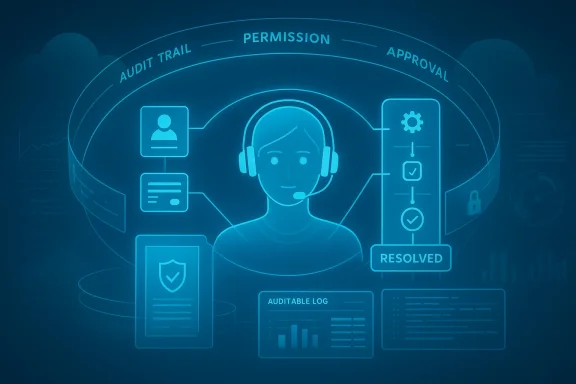
Notch’s model is built around that operational truth. The platform combines conversational AI with structured execution logic, permissid escalation paths so the agent does not improvise when the stakes are high. That approach is really a form of productized compliance: the system is designed so the safest path is also the default path.
The company says its internal foundation became an operating system for regulated industries. That is not just branding language. It implies a deeper architectural belief: that the support agent, the policy engine, the permissioniit trail should be designed together rather than bolted on after the model works. In a high-stakes domain, the control plane is the product.
This matters because regulated workflows are rarely linear. A single support case may involve identity verification, rules checks, jurisdiction-specific disclosures, back-office updates, and exception handling. A bot that can only answer one question le there. An orchestration layer that knows when to act, when to validate, and when to escalate is much closer to what enterprise buyers actually need.
The company describes five layers: conversation safety checks, defense against tricks and abuse, clear access rules, business limits for high-risk actions, and region/jurisdiction rules. Those layers work together to keep the agent from doing something it should not do, even if the conversation itself seems normal. The most important part is tht in when the system is uncertain.
This is where many enterprise AI pilots fail. They often start with a strong demo and then discover that the control plane is too weak for real production use. Security and compliance teams do not ask whether the bot can “sound smart”; they ask whether it can be constrained, audited, and turned off when necessary. Notch’s approach is designed to answer those questideployment, not after the first incident.
Microsoft for Startups Pegasus also matters because it gives a young company access to the ecosystem that large buyers already tr procurement, improve technical alignment, and make the deployment story feel less experimental. In B2B AI, the ability to buy through familiar channels is often as important as the underlying model.
This fits with Microsoft’s broader 2026 messaging around governed AI. Across its current security and AI narrative, Microsoft is emphasizing control planes, policy continuity, visibilintities, and safer deployment paths for agents. Notch’s story lands cleanly in that worldview because it treats the agent as a governed enterprise workload rather than a black-box chatbot.
That has obvious operational benefits. If a large portion of tickets can be resolved autonomously, the support team can focus on exceptions, edge cases, and escalation handling. It also changes the economics of support from one based on staffing growth to one based on system throughput, which is a much better fit for fast-growing companies.
The downside is that the margin for error gets much smaller. When an AI agent is only drafting a response, a human can intervene before anything is finalized. When the agent is taking the action, the company needs deterministic checks and a reliable rollback strategy. That is why Notch’s model leans so hard on guardrails, validation, and mandatory escalation.
Consumers, by contrast, mostly care about speed and convenience. They will judge AI support by whether it gets them to a solution quickly and politely. But they are less likely to think about the invisible safety architecture underneath, even though that architecture matters a great deal when the same system is touching account access, refunds, or personal data.
That asymmetry helps explain why regulated customer support is such a compelling enterprise AI category. The technology can create visible savings, but the real selling point is risk reduction through better control. If the system is built correctly, the company gets both benefits at once.
It also raises the bar for incumbents. CRM and help-desk platforms will increasingly have to prove that they can support action-taking agents with strong control mechanisms rather than just plugging a generic LLM into the front of the workflow. Microsoft’s broader AI and security messaging suggests it understands this transition, which is why governance and agent control are moving closer to the center of the stack.
The opportunity is real, but so is the fragility. A vendor that moves too aggressively on autonomy can create a headline risk if the agent takes an action it should not have taken. A vendor that is too cautious may never escape the chatbot category. The winners will be the companies that can show measurable resolution gains and convincing operational safeguards.
The broader industry implication is that regulated AI support may become a template for other agentic workflows. Once enterprises see that an agent can safely take actions in customer service, they will ask the same question elsewhere: can the system resolve claims, process onboarding, triage exceptions, or execute back-office work with similar controls? That makes Notch’s category much bigger than support alone.
Source: Microsoft How Notch ships action-taking AI agents safely in regulated customer support - Microsoft for Startups Blog
That shift is especregulated sectors such as insurance, where every action needs to be auditable, policy-aligned, and repeatable. Notch’s own origin story reflects that reality: the founders built inside regulated insurance first, where they needed automation that could satisfy documentation requirements, policyholder communications, and strict auditability constraints. In that environment, a loose conversational system is not enough; the workflow must be deterministic enough to trust, but flexible enough to handle the complexity of real cases.
The company’s claim to relevance is backys its customers include more than 30 enterprise clients across insurance, SaaS, eCommerce, and gaming, and that those deployments have already passed 10 million resolved tickets, with autonomous resolution rates reported in the 70% to 87% range depending on the customer and timeframe. Those numbers do not eliminate the need for scrutiny, but they do suggest the category has moved beyond experiments and into production economics.
Microsoft’s role in the story is also important. The company is using Notch as a case study for what enterprise-ready AI support looks like when autonomy is paired with controls, and it ties that message to Azure, Microsoft Marketplace, and the Microsoft for Startups Pegasus Program. In other words, the narrative is not just “AI agents are powerful”; it is “AI agents can be sold, deployed, governed, and scaled inside a Microsoft-shaped enterprise path.”
 Why regulated support changes the AI design brief
Customer support looks simple fromulated support is closer to operations than to chat. A customer asking for a refund, a cancellation, a policy adjustment, or a benefits update is not asking for trivia; they are asking the company to change a state inside a system of record. If the AI makes the wrong move, the company can create a compliance incident rather than a bad answer.That is why the old chatbot mindset breaks down. A deflection bot can afford to be vague, since its job is often tad. An autonomous support agent cannot afford vagueness because it is being judged on whether it actually completed the action. In regulated settings, “seems helpful” is not a useful metric; “correct, authorized, and auditable” is the only one that matters.
Notch’s model is built around that operational truth. The platform combines conversational AI with structured execution logic, permissid escalation paths so the agent does not improvise when the stakes are high. That approach is really a form of productized compliance: the system is designed so the safest path is also the default path.
The real difference between deflection and resolution
Deflection metrics can look impressive on a dashboard while the customer still has unresolved worion forces a harder question: did the support system actually complete the task, or did it merely move the issue around? Notch’s own messaging emphasizes that it is optimized for true resolution rather than partial automation, and that framing is central to its value proposition.- Deflection reduces inbound volume.
- Resolution completes the actual workflow.
- In regulated industries, resolution is the metric that maps to risk.
- Partial automation can e exposure behind.
- End-to-end handling is harder, but it is also more valuable.
From insurance constraints to a platform philosophy
Notch’s heritage matters because it explains why the company thinks about AI as a governed operating layer rather than a flashy interface. The insurance environment forced the founders to confront repeatability, traceability, and policy constraints early. That tends to produce a different product philosophy than a startup that begins with generic customer-service automation and only later discovers compliance.The company says its internal foundation became an operating system for regulated industries. That is not just branding language. It implies a deeper architectural belief: that the support agent, the policy engine, the permissioniit trail should be designed together rather than bolted on after the model works. In a high-stakes domain, the control plane is the product.
This matters because regulated workflows are rarely linear. A single support case may involve identity verification, rules checks, jurisdiction-specific disclosures, back-office updates, and exception handling. A bot that can only answer one question le there. An orchestration layer that knows when to act, when to validate, and when to escalate is much closer to what enterprise buyers actually need.
What insurance taught the product team
Insurance is a useful proving ground because it forces companies to think in terms of audited actions rather than abstract intelligence. If a policyholder asks for something sensitive, the system has to know not just what to say, but what it is allowed to do. That makes insurance a natural incubator for the kind of agent architecture Notch is now shipping more broadly.- Regulated workflows need reproducible outcomes.
- Business rules must be explicit, not inferred.
- Every high-risk action should be trackable.
- Escalation needs to be mandatory when policy is unclear.
- The system must respect regional and jurisdictional differences.
The five guardrails that make autonomy safer
Notch’s core safety story is that action-taking agents need layered protections, not a single “guardrail” feature. That is a mature view. In production, a company cannot depend on the model itself to stay safe; it has to combine policy, identity, execution limits, abuse tion into one integrated system.The company describes five layers: conversation safety checks, defense against tricks and abuse, clear access rules, business limits for high-risk actions, and region/jurisdiction rules. Those layers work together to keep the agent from doing something it should not do, even if the conversation itself seems normal. The most important part is tht in when the system is uncertain.
This is where many enterprise AI pilots fail. They often start with a strong demo and then discover that the control plane is too weak for real production use. Security and compliance teams do not ask whether the bot can “sound smart”; they ask whether it can be constrained, audited, and turned off when necessary. Notch’s approach is designed to answer those questideployment, not after the first incident.
1. Conversation safety checks
The first layer is behavioral awareness. If the conversation starts spiraling, showing frustration loops, or drifting into disallowed territory, the system escalates rather than trying to be endlessly helpful. That matters because many support failures begin as soft failures: the agent keeps talking even after it should have handed off.2. Defenses against manipulation
The second layer protects against prompt injection, instruction smuggling, tool abuse, and attempts to probe the model’s internal logic. This is a necessary feature in any agentic system because once the model can take actions, malicious inputs can become operational threats rather than just bad text. Microsoft’s own security messaging around AI-native threats reinforces that thi enterprise concern, not a niche worry.3. Hard access controls
The third layer is about permissions. The agent can only act when the user’s state — authentication, role, channel, region, and related identity signals — says the action is allowed. That is the right approach because autonomy without authorization is just automation with a larger blast radius.4. Business limits and approvals
The fourth layer places hard limits on high-risk actions, even for eligible users. Thresholds, rolling counters, and approvals reduce the chance that one valid request becomes a costly systemic error. In regulated support, that kind of braking system is not a nice-to-have; it is the difference between efficiency and liability.5. Jurisdiction-aware rules
The fifth layer accounts for geography and regulation. A workflow that ket may require different disclosures, limits, or escalation rules in another. That sounds obvious, but many AI systems are still too globally generic to understand how local law changes what a support agent can safely do.What Microsoft contributes to the rollout story
The Microsoft angle is less about model novelty and more about enterprise packaging. Nor models and orchestration is framed as a way to support production-grade availability, latency, and resilience, which is exactly what enterprise buyers expect when an AI agent becomes part of a live support operation.Microsoft for Startups Pegasus also matters because it gives a young company access to the ecosystem that large buyers already tr procurement, improve technical alignment, and make the deployment story feel less experimental. In B2B AI, the ability to buy through familiar channels is often as important as the underlying model.
This fits with Microsoft’s broader 2026 messaging around governed AI. Across its current security and AI narrative, Microsoft is emphasizing control planes, policy continuity, visibilintities, and safer deployment paths for agents. Notch’s story lands cleanly in that worldview because it treats the agent as a governed enterprise workload rather than a black-box chatbot.
Why Azure matters for regulated support
Cloud choice is not just about cost or convenience in this category. It is about whether the enterprise can trust thns the agent, stores the logs, and executes the workflows. Microsoft’s own security push highlights that AI systems need identity, data protection, and threat defense to work together, and that same logic applies to customer-support agents that can change account state.- Azure provides production resilience.
- Marketplace improves discoverability and procurement.
- The Microsoft ecosystem helps reduce integration friction.
- Enterprise customers prefer familiar governance patterns.
- A trusted platform can lower perceived rollout risk.
Autonomous resolution versus the old support stack
The old support stack was built around human queues, macros, routing rules, and case management. That model still works for many organizations, but it was never designed for high-volume workflow completion. Notch’s model attempts to compress the distance between intent and outcome by letting the agent execute the resolution rather than merely prepare the answer.That has obvious operational benefits. If a large portion of tickets can be resolved autonomously, the support team can focus on exceptions, edge cases, and escalation handling. It also changes the economics of support from one based on staffing growth to one based on system throughput, which is a much better fit for fast-growing companies.
The downside is that the margin for error gets much smaller. When an AI agent is only drafting a response, a human can intervene before anything is finalized. When the agent is taking the action, the company needs deterministic checks and a reliable rollback strategy. That is why Notch’s model leans so hard on guardrails, validation, and mandatory escalation.
Why support ops is becoming systems engineering
The more autonomy you introduce, the more support begins to resemble systems engineering. You need identities, permissions, logs, thresholds, rollback, and observability. That is a very different job from running a plain chat interface, and it explains why the best enterprise support AI wilike infrastructure software with a conversational front end.- Workflow completion demands backend integration.
- Support actions need deterministic validation.
- Rollback and escalation have to be designed in.
- Audits require clean operational logs.
- Reliability becomes a product feature, not just an SRE metric.
Enterprise impact versus consumer expectations
The enterprise case for autonomous support is easier to make than the consumer case because enterprises can quantify backlog, headcount, and compliance risk. Notch’s claims of up to 87% autonomous resolution and 50% support-cost reductions map directly to budget discussions. In that world, the agent is not a novelty; it is an operating expense reducer with governance attached.Consumers, by contrast, mostly care about speed and convenience. They will judge AI support by whether it gets them to a solution quickly and politely. But they are less likely to think about the invisible safety architecture underneath, even though that architecture matters a great deal when the same system is touching account access, refunds, or personal data.
That asymmetry helps explain why regulated customer support is such a compelling enterprise AI category. The technology can create visible savings, but the real selling point is risk reduction through better control. If the system is built correctly, the company gets both benefits at once.
Why enterprises buy differently
Enterprises do not buy support automation because it sounds modern. They buy it because it can reduce manual toil, improve service consistency, and stay inside policy boundaries. That means the successful vendor must speak both the language of operations and the language of control.- Enterprises want audit trails.
- They need permission scoping.
- They care about regional policy differences.
- They want the ability to stop risky behavior quickly.
- They prefer tools that fit existing security and compliance stacks.
Competitive implications for the support market
Notch’s approach puts pressure on the entire support automation market to move beyond deflection. If autonomous resolution is the new benchmark, vendors that only classify or route tickets will look incomplete. That changes the competitive conversation from “who answers fastest” to “who closes the loop most safely.”It also raises the bar for incumbents. CRM and help-desk platforms will increasingly have to prove that they can support action-taking agents with strong control mechanisms rather than just plugging a generic LLM into the front of the workflow. Microsoft’s broader AI and security messaging suggests it understands this transition, which is why governance and agent control are moving closer to the center of the stack.
The opportunity is real, but so is the fragility. A vendor that moves too aggressively on autonomy can create a headline risk if the agent takes an action it should not have taken. A vendor that is too cautious may never escape the chatbot category. The winners will be the companies that can show measurable resolution gains and convincing operational safeguards.
What competitors now have to prove
The market is entering a phase where demos are not enough. Buyers will want proof that the agent can handle policy ambiguity, respect regional constraints, and stop safely when confidence is low. That means vendors will be judged on the boring but essential details: logging, identity, thresholds, escalation, and rollback.- Can the agent act only when authorization is verified?
- Can it explain what it did?
- Can it stop before crossing policy lines?
- Can the company audit every action afterward?
- Can the system be rolled back cleanly if something goes wrong?
Strengths and Opportunities
Notch’s model has real strengths because it addresses the hardest part of enterprise AI: turning language into reliable action without surrendering control. The company is not trying to win on generic chatbot capability; it is trying to win on governed resolution, which is a far more defensible position in regulated support. Its Microsoft-aligned deployment path also helps make the story enterprise-friendly.- End-to-end resolution instead of shallow deflection.
- Auditability built into the workflow.
- Permissioning and validation as first-class product features.
- Jurisdiction-aware controls for regulated markets.
- Scalable Azure-backed deployment for production use.
- Marketplace and startup-program support that can ease procurement.
- Strong fit for high-volume support where backlog and cost reduction matter.
Risks and Concerns
The same autonomy that makes Notch attractive also creates the central risk: the system is making decisions that can have financial, compliance, or customer-service consequences. Even with layered guardrails, regulated support remains a domain where small errors can become expensive quickly. That means confidence in the model is never enough; confidence in the controls has to be there too.- Hallucinated or misread intent could trigger a bad action.
- Prompt injection and abuse attempts could target the agent’s tool use.
- Ambiguous policy cases may still require human judgment.
- Jurisdictional complexity can make scaling harder than expected.
- Over-automation could reduce the human safety net too aggressively.
- Data quality issues can undermine validation and escalation logic.
- Operational complacency could grow if teams trust the system blindly.
Looking Ahead
The next phase of this market will be about proof, not promise. Buyers will want to see whether autonomous support can sustain its performance as ticket mix changes, regulations evolve, and businesses push into more complex workflows. That means the companies with the best instrumentation, the clearest escalation paths, and the most disciplined rollout strategy are the ones most likely to keep winning.The broader industry implication is that regulated AI support may become a template for other agentic workflows. Once enterprises see that an agent can safely take actions in customer service, they will ask the same question elsewhere: can the system resolve claims, process onboarding, triage exceptions, or execute back-office work with similar controls? That makes Notch’s category much bigger than support alone.
- Track whether autonomous resolution stays high as case complexity rises.
- Watch for more evidence of jurisdiction-aware workflow controls.
- Watch how buyers respond to the pricing model tied to outcomes.
- Monitor whether Microsoft expands the ecosystem around governed agents.
- Look for competitors to copy the guardrail-first architecture.
Source: Microsoft How Notch ships action-taking AI agents safely in regulated customer support - Microsoft for Startups Blog
