

Siemens has announced that Polarion X, its next-generation Application Lifecycle Management (ALM) platform, is now available as a fully hosted SaaS offering on Microsoft Azure, marking a significant expansion of the Siemens–Microsoft cloud and AI partnership and bringing traceable, AI-assisted software lifecycle tools to regulated, safety-critical industries.
Siemens and Microsoft have steadily deepened their relationship around industrial software and cloud services in recent years, moving the Siemens Xcelerator portfolio onto Microsoft Azure and integrating Azure’s AI tooling into Siemens’ product suite. This latest step—making Polarion X available on Azure—follows prior moves to deliver Teamcenter X and NX X through Azure and aligns with a broader industry trend: vendors bringing full engineering toolchains to major cloud platforms to offer scalability, unified collaboration, and AI-enabled productivity features.
Polarion X on Azure was announced publicly on November 18, 2025 and was demonstrated at Microsoft Ignite later that month. The offering is presented as a fully Siemens-hosted SaaS deployment running on Azure infrastructure, with optional multi-region availability for premium customers. The move is explicitly positioned at organizations with stringent regulatory and safety requirements, such as aerospace, automotive, and medical-device manufacturers.
Key capabilities of the Azure-hosted Polarion X include:
Those customer-reported benefits are important signals of real-world value, but financial impact statements originating from vendor case quotes should be treated conservatively. Independent verification of claimed cost savings or productivity gains typically requires third-party audits or customer-supplied performance data under NDA. Organizations evaluating migration should replicate key metrics in pilot phases.
For vendors and system integrators, it creates new opportunities—and responsibilities—to ensure integrations, governance, and certification evidence remain reliable, transparent, and exportable. For regulators and auditors, the evolution pressures both tool vendors and auditors to align around artifact formats, data provenance standards, and AI governance best practices.
However, organizations must approach migration pragmatically: verify region and data-residency guarantees, negotiate clear contractual terms around SLAs and data handling, set robust AI governance, and validate that the platform-generated evidence satisfies specific certifying authorities. Customer cost and productivity claims reported in vendor case studies are promising but should be validated through pilots and measurable KPIs before making organization-wide commitments.
Polarion X on Azure is a logical next step in the cloudification and AI-enablement of engineering toolchains. For regulated and safety-critical industries, it represents both an opportunity to modernize and a call to practice disciplined governance when tooling becomes central to product certification and auditability.
Conclusion
Siemens’ launch of Polarion X on Microsoft Azure places a full-featured, traceability-centric ALM suite firmly inside one of the world’s largest cloud platforms, delivering AI-assisted authoring, tighter Azure DevOps integration, and cloud-scale collaboration tailored to regulated industries. The platform’s real-world value will depend on careful migration planning, explicit governance for AI and data, and proof that the artifacts produced by the platform meet the stringent demands of safety and regulatory certification. When those boxes are checked, Polarion X on Azure can shorten development cycles, reduce administrative overhead, and help engineering organizations maintain audit-ready control over their digital product lifecycles.
Source: Engineering.com Siemens brings Polarion X ALM platform to Microsoft Azure - Engineering.com
 Background
Siemens and Microsoft have steadily deepened their relationship around industrial software and cloud services in recent years, moving the Siemens Xcelerator portfolio onto Microsoft Azure and integrating Azure’s AI tooling into Siemens’ product suite. This latest step—making Polarion X available on Azure—follows prior moves to deliver Teamcenter X and NX X through Azure and aligns with a broader industry trend: vendors bringing full engineering toolchains to major cloud platforms to offer scalability, unified collaboration, and AI-enabled productivity features.Polarion X on Azure was announced publicly on November 18, 2025 and was demonstrated at Microsoft Ignite later that month. The offering is presented as a fully Siemens-hosted SaaS deployment running on Azure infrastructure, with optional multi-region availability for premium customers. The move is explicitly positioned at organizations with stringent regulatory and safety requirements, such as aerospace, automotive, and medical-device manufacturers.
What Polarion X on Azure actually delivers
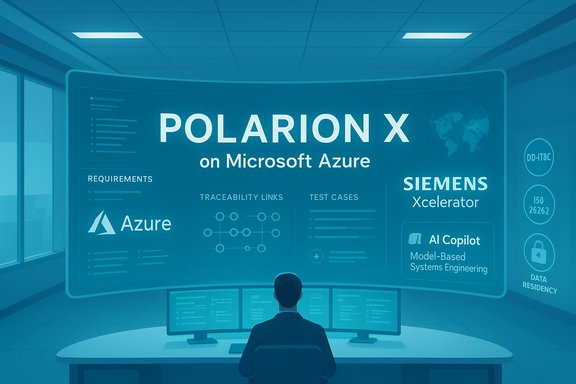
At its core, Polarion X is an ALM platform designed to provide end-to-end requirements management, traceability, change and configuration control, and compliance tooling across the software and systems engineering lifecycle. The Azure-hosted variant layers cloud-scale collaboration, Azure-native services, and Microsoft’s responsible-AI tooling onto that foundation.Key capabilities of the Azure-hosted Polarion X include:
- AI-powered assistance (integrated with Azure OpenAI and Copilot): features cited include smart requirement analysis, automated creation and maintenance of trace links, risk detection, and predictive insights to help authors write clearer requirements and identify risky gaps sooner.
- Unified lifecycle and traceability: a single-source-of-truth for requirements, test cases, defects, versioning, and change control to support audit readiness.
- Cloud-enabled collaboration and scalability: global access and real-time collaboration for distributed teams, leveraging Azure’s global footprint for performance and availability.
- Integration with Azure DevOps and Siemens Xcelerator components: orchestration across toolchains via out-of-the-box connectors to Azure DevOps and Siemens products such as Teamcenter (PLM), Designcenter (product engineering), Opcenter (MES), and Insights Hub.
- Support for Model-Based Systems Engineering (MBSE): central coordination of models and artifacts to manage systems complexity across hardware and software boundaries.
- Regulatory and standards tooling: features to help organizations prepare for audits and comply with standards like DO-178C, ISO 26262, ISO/SAE 21434, and 21 CFR Part 820, and built-in software Bill of Materials (sBOM) management.
Why Azure matters for ALM and regulated industries
Delivering Polarion X through Microsoft Azure changes several practical and strategic dynamics for customers:- Choice of cloud provider and enterprise alignment. Many enterprises standardize on one or two hyperscalers. Making Polarion X native to Azure reduces friction for organizations that have already adopted Microsoft cloud, identity, and security stacks.
- Integration with Azure DevOps and Microsoft security tooling. Tight integration with Azure DevOps provides a smoother path from requirements to code and CI/CD. Native Azure security controls, managed identity, and compliance features simplify meeting organizational governance and regulatory needs.
- Access to Azure OpenAI and responsible AI features. Embedding trusted AI assistants and Copilot experiences is easier when both the ALM vendor and the underlying AI services are architected for that platform.
- Marketplace availability and procurement simplification. Delivering Polarion X via the Azure Marketplace simplifies procurement, billing, and cloud-native deployment for enterprise customers.
- Global scale and regional deployment options. The Azure offering lists multiple strategic regions for premium customers, allowing customers to align deployments with data residency and latency requirements.
Technical and compliance details to verify
Several technical claims around Polarion X on Azure are central to customer evaluations. These include:- Azure-native AI integration: Polarion X advertises Copilot-like assistance built on Azure OpenAI for requirement analysis, trace link creation, and risk detection. This implies the platform uses Microsoft-managed models and Azure’s responsible AI controls to power assistance. Organizations should evaluate how prompt data and derived artifacts are stored and whether model telemetry is captured.
- Azure region support: Premium customers can reportedly choose from three strategic Azure regions (for example, East US, Germany West Central, and Japan East). Customers should confirm availability for their tenant and contractual region requirements.
- Marketplace availability: Polarion X on Azure is listed in Microsoft’s Marketplace, enabling standard procurement channels. Confirm whether the specific Marketplace listing covers the exact configuration and service-level terms your organization needs.
- Support for standards: Polarion X is designed to help organizations meet standards such as DO-178C, ISO 26262, ISO/SAE 21434, and 21 CFR Part 820, with integrated sBOM and audit-readiness tooling. Organizations must evaluate the specific controls, reports, and evidence artifacts produced by Polarion X to ensure they meet audit criteria for their certifying bodies.
- Integration fidelity with Azure DevOps and Siemens PLM tooling: Out-of-box connectors reduce integration work, but large enterprises typically require mapping and validation to ensure that downstream CI/CD, traceability, and change-control workflows meet internal and external audit requirements.
Customer adoption: Ziehl‑Abegg and early momentum
Siemens cited Ziehl‑Abegg—a global ventilation, control, and drive-technology manufacturer—as an early adopter that migrated to Polarion X on Azure. Ziehl‑Abegg reported operational and financial benefits from moving to the hosted SaaS solution, including reduced downtime, decreased maintenance effort, global license flexibility, and claimed annual savings described in broad terms.Those customer-reported benefits are important signals of real-world value, but financial impact statements originating from vendor case quotes should be treated conservatively. Independent verification of claimed cost savings or productivity gains typically requires third-party audits or customer-supplied performance data under NDA. Organizations evaluating migration should replicate key metrics in pilot phases.
Competitive landscape: where Polarion X fits
The ALM market for regulated engineering is crowded and differentiated by features such as traceability, auditability, systems-engineering integrations, and cloud readiness. Major players and relative positions include:- Legacy/platinum incumbents — tools from large platform vendors that emphasize enterprise controls and deep systems-engineering integration.
- Developer-oriented platforms — modern DevOps tools and code-centric platforms offer strong CI/CD but can require extensive customization to meet audit and traceability needs in regulated industries.
- Specialized ALM platforms — Polarion X fits here: engineered features for requirements management, traceability, and standards compliance combined with integrations into PLM and MES landscapes.
Potential benefits and strengths
Polarion X on Azure offers several concrete strengths for enterprise engineering teams:- Unified traceability from requirements to tests and releases reduces the administrative overhead of demonstrating compliance.
- AI-assisted authoring and analysis can reduce defects in requirements and accelerate the creation of trace links, lowering manual effort and human error.
- SaaS delivery reduces maintenance overhead for operations teams—no patching of on-prem servers, standardized upgrades, and fewer local admin tasks.
- Integration with PLM/MBSE enables a consolidated digital thread across product lifecycles, supporting multidisciplinary traceability.
- Marketplace procurement and vendor-managed hosting streamline license management and billing for enterprise customers.
- sBOM and audit-readiness features support newer regulatory expectations around software supply chains and transparency.
Risks, limitations, and governance considerations
Moving an ALM platform—especially one that supports safety-critical and regulated development—into a cloud-hosted model introduces specific risks and governance considerations that must be managed carefully:- Data residency and sovereignty: Even with multiple region options, customers must validate where controlled artifacts (requirements, test evidence, audit logs) are stored and how data is replicated. Regulatory bodies often require strict controls on data location and access.
- Vendor lock-in and integration coupling: Deep integration with Siemens and Microsoft ecosystems improves productivity but can make it harder to migrate away later. Architectural choices should preserve exportable artifacts and clear API-driven access to critical records.
- AI model governance and provenance: Using Azure OpenAI and Copilot-like features requires clarity about how prompts and derivatives are retained, whether model outputs are stored, and how to maintain a verifiable evidence chain for audits. Organizations must ensure AI-assisted changes can be traced, reviewed, and approved per regulatory process controls.
- Supply-chain and third-party risk: ALM platforms are central to product software composition and traceability. Ensuring secure supply chains, managing sBOM accuracy, and validating external integrations are essential.
- Certification and audit readiness: Tool output must satisfy certifying bodies; vendor claims of standards support do not substitute for evidence that the artifacts produced meet the letter and spirit of the specific certification process.
- Operational continuity and incident response: SaaS platforms shift operational responsibility but require customers to validate RTO/RPO, incident response coordination, and contractual SLAs for critical engineering workflows.
Practical migration checklist and recommended steps
For engineering organizations considering Polarion X on Azure, a structured migration approach reduces risk and preserves traceability:- Inventory and mapping
- Catalog current artifacts (requirements, tests, models, CI/CD pipelines, custom scripts).
- Map existing traceability links and compliance evidence to Polarion X constructs.
- Assess integrations
- Validate required integrations (Azure DevOps, PLM, MBSE tools) and identify any custom connectors or middleware.
- Data residency and compliance review
- Confirm Azure region availability and ensure the chosen region aligns with regulatory, contractual, and internal policy needs.
- Pilot migration
- Start with a representative pilot project to validate traceability, reporting, and AI-assisted features without putting critical projects at risk.
- Governance and approval workflows
- Recreate or improve change-control and approval workflows within Polarion X and verify evidence capture for audit trails.
- AI governance
- Define policies for AI use: prompt logging, model output review, approval gating for AI-suggested changes, and retention of provenance.
- sBOM and supply-chain management
- Implement sBOM practices and validate how Polarion X integrates software composition data with existing SBOM workflows.
- Training and onboarding
- Prepare role-based training for requirements engineers, architects, developers, and quality teams.
- Operational readiness
- Confirm backup, export, and disaster recovery plans; validate SLAs and support pathways with Siemens and Microsoft.
- Audit simulation
- Conduct an internal audit using the new platform to confirm that the produced artifacts meet certification evidence expectations.
Strategic implications for the industry
The availability of Polarion X as a SaaS on Azure is more than a product announcement; it signals a continuing consolidation of engineering toolchains into hyperscaler ecosystems and increasing reliance on cloud-native AI to augment engineering processes. For customers, the combination of domain-specific ALM with platform-level AI and identity management lowers the barrier to adopting AI-assisted software engineering in high-consequence domains.For vendors and system integrators, it creates new opportunities—and responsibilities—to ensure integrations, governance, and certification evidence remain reliable, transparent, and exportable. For regulators and auditors, the evolution pressures both tool vendors and auditors to align around artifact formats, data provenance standards, and AI governance best practices.
Final assessment
Polarion X on Azure delivers a compelling, enterprise-focused ALM option for organizations that require rigorous traceability, integrated systems engineering, and the ability to scale collaboration globally. The offering’s strengths include Siemens’ domain experience, native integrations with PLM and MBSE tooling, and access to Microsoft’s Azure platform and AI services.However, organizations must approach migration pragmatically: verify region and data-residency guarantees, negotiate clear contractual terms around SLAs and data handling, set robust AI governance, and validate that the platform-generated evidence satisfies specific certifying authorities. Customer cost and productivity claims reported in vendor case studies are promising but should be validated through pilots and measurable KPIs before making organization-wide commitments.
Polarion X on Azure is a logical next step in the cloudification and AI-enablement of engineering toolchains. For regulated and safety-critical industries, it represents both an opportunity to modernize and a call to practice disciplined governance when tooling becomes central to product certification and auditability.
Conclusion
Siemens’ launch of Polarion X on Microsoft Azure places a full-featured, traceability-centric ALM suite firmly inside one of the world’s largest cloud platforms, delivering AI-assisted authoring, tighter Azure DevOps integration, and cloud-scale collaboration tailored to regulated industries. The platform’s real-world value will depend on careful migration planning, explicit governance for AI and data, and proof that the artifacts produced by the platform meet the stringent demands of safety and regulatory certification. When those boxes are checked, Polarion X on Azure can shorten development cycles, reduce administrative overhead, and help engineering organizations maintain audit-ready control over their digital product lifecycles.
Source: Engineering.com Siemens brings Polarion X ALM platform to Microsoft Azure - Engineering.com
