

Siemens has begun offering its next‑generation Application Lifecycle Management platform, Polarion X, as a fully hosted SaaS on Microsoft Azure — a move that stitches traceable ALM, Azure OpenAI–enabled Copilot assistance, and out‑of‑the‑box compliance support into a single cloud delivery aimed at regulated, safety‑critical industries. The announcement positions Polarion X on Azure as part of Siemens’ Xcelerator as a Service portfolio and highlights deep integrations with Azure DevOps and Siemens’ own product engineering and PLM portfolio, while customer testimonials and Siemens’ launch messaging stress reduced maintenance overhead, global licence mobility, and improved audit readiness for distributed engineering teams.
Polarion has long been Siemens’ answer to requirements management and Application Lifecycle Management (ALM) for complex engineering organizations. The platform focuses on unifying requirements, test management, traceability, and compliance documentation across engineering lifecycles. Delivering Polarion X as a SaaS on Azure continues a broader Siemens strategy to make its Xcelerator portfolio available via hyperscalers and to bake generative AI and Copilot‑style assistants into engineering workflows. This launch builds on earlier moves to host Teamcenter X and NX X on Azure and aligns with Siemens and Microsoft’s multi‑year collaboration to bring industrial software into the cloud.
Source: IT Brief Australia Siemens brings Polarion X ALM platform to Microsoft Azure
 Background
Polarion has long been Siemens’ answer to requirements management and Application Lifecycle Management (ALM) for complex engineering organizations. The platform focuses on unifying requirements, test management, traceability, and compliance documentation across engineering lifecycles. Delivering Polarion X as a SaaS on Azure continues a broader Siemens strategy to make its Xcelerator portfolio available via hyperscalers and to bake generative AI and Copilot‑style assistants into engineering workflows. This launch builds on earlier moves to host Teamcenter X and NX X on Azure and aligns with Siemens and Microsoft’s multi‑year collaboration to bring industrial software into the cloud. What Polarion X on Azure actually delivers
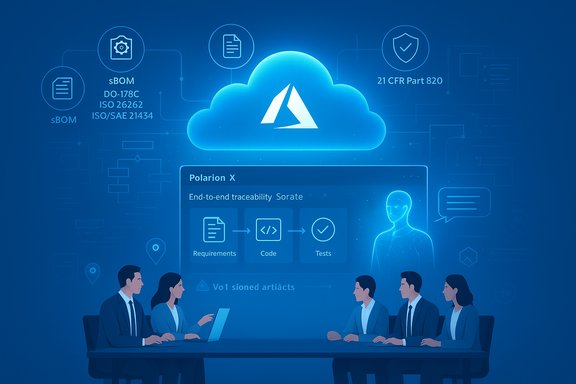
Polarion X on Azure is presented as a consolidated, cloud‑native ALM environment that combines several discrete capabilities into a single service:- Unified lifecycle traceability: End‑to‑end links from requirements to code, builds, tests and deployment artifacts, with versioning and change management designed for audit readiness.
- Azure OpenAI–backed Copilot: AI‑assisted requirement authoring, risk detection, automated trace link suggestions and predictive insights that aim to speed writing and reduce errors.
- Integration points: Connectors for Azure DevOps and links to Siemens solutions such as Teamcenter, Designcenter, Opcenter and Insights Hub for MBSE and PLM/ MES continuity.
- Compliance toolset and sBOM management: Built‑in support for software Bill of Materials (sBOM) handling and “out‑of‑the‑box” templates for regulated standards including DO‑178C, ISO 26262, ISO/SAE 21434 and 21 CFR Part 820.
- Global SaaS delivery: Offered through Azure with region options and Azure Marketplace procurement, aimed at enabling global access for distributed engineering teams.
Why this matters for regulated software development
Polarion X on Azure targets sectors where traceability and demonstrable compliance are non‑negotiable: aerospace, automotive, medical devices, and other safety‑critical domains. The fundamental propositions are:- Continuous single source of truth: By maintaining versioned artefacts and trace links in a central cloud instance, teams can reduce manual evidence collation for audits and accelerate compliance reporting.
- Standards support: Pre‑packaged workflows and templates that map to DO‑178C, ISO 26262, ISO/SAE 21434 and 21 CFR Part 820 reduce the setup burden for regulated processes.
- sBOM and supply‑chain visibility: Native sBOM management helps teams inventory third‑party components and software dependencies — a requirement increasingly demanded by regulators and customers.
AI features: potential and practical limits
Siemens positions a Copilot experience for Polarion X that leverages the Azure OpenAI Service to assist requirement authorship, link creation and risk identification. The headline benefits are faster authoring, suggested trace links to expedite traceability, and AI‑driven risk flags to surface potential compliance issues earlier. Strengths:- Productivity uplift: AI can reduce repetitive writing and suggest links and test coverage, speeding iterations across distributed teams.
- Contextual assistance: When integrated with an organisation’s artefacts (requirements, code, test cases), a Copilot can provide grounded suggestions rather than generic text.
- Hallucination and confidence: Generative models can produce plausible‑sounding but incorrect suggestions. Copilot outputs must be treated as assistive and require human verification, especially where safety or regulatory compliance is involved.
- Data residency and model access: Using Azure OpenAI implies that prompts and context may be processed by cloud models. Organisations with strict data‑sovereignty or export restrictions must validate where data flows and whether private or on‑tenant model options are required.
- Governance needs: Effective use requires audit trails for AI suggestions, model versioning, and controls to prevent automated changes being accepted without human review. This is essential for regulated workflows.
Integration, architecture and practical deployment considerations
Polarion X on Azure is designed to be the orchestration layer rather than the entire engineering toolchain. Key technical points and recommended validations:- Toolchain integrations: Confirm out‑of‑the‑box connectors for Azure DevOps, common VCS systems and Siemens PLM suite items (Teamcenter, Designcenter). Verify whether integrations are synchronous or rely on bridging middleware/APIs.
- Data model and traceability: Validate how Polarion stores artefacts (documents vs structured items), how trace links are represented, and how long histories and versions are retained and exported for long‑term archival.
- sBOM generation and provenance: Test the sBOM pipeline for accuracy and completeness, including transitive dependencies and how third‑party component metadata is captured and verified.
- Region, residency and latency choices: Azure region selection affects latency for global teams and data‑residency compliance; confirm which regions are offered for production SaaS tenants and any EU/US/Government options required by contract. Vendor materials list specific regions for Azure deployment and Marketplace availability — confirm them during procurement.
- Export and vendor exit: Confirm export formats for requirements, tests and trace links. Ensure a clear exit plan exists for moving data off the SaaS instance if organizational needs change. This is critical to avoid lock‑in for audit evidence and long‑term records.
Security and compliance: what to verify
Siemens and Microsoft emphasise enterprise cloud security and responsible AI controls as part of their joint messaging. For purchasers, the security assessment must go deeper:- Identity and access: Ensure Polarion X integrates with Microsoft Entra ID / Azure AD for role‑based access and that service principals used by Copilot or automation have least‑privilege access.
- Immutable logs and audit trails: Confirm that all user actions, AI proposals and automated changes are logged immutably and that logs are exportable to the organisation’s SIEM for long‑term retention and forensic needs.
- Encryption and key management: Validate encryption at rest and in transit, and whether customer‑controlled keys (BYOK) are supported for the tenant. This is often required for regulated workloads.
- Model governance and provenance: Ask for a model‑versioning policy and controls that record which model and embeddings produced a Copilot suggestion, so that decisions in audits can reference the AI provenance.
- Third‑party assurance: Request SOC/Security reports, penetration test summaries and any compliance certifications (for example ISO 27001 evidence) that underpin the SaaS service. Vendor statements that features exist are necessary but not sufficient; obtain supporting artifacts.
Case study: Ziehl‑Abegg’s migration to Polarion X on Azure
Siemens cites Ziehl‑Abegg — a ventilation and drive technology firm — as an early adopter. Ziehl‑Abegg says the migration reduced downtime, lowered maintenance effort, enabled global licence use, and produced annualised savings described in vendor communications. These customer comments illustrate real financial and operational incentives for moving ALM to a SaaS model: lower local maintenance, more consistent feature updates, and easier cross‑site collaboration. Caveats: customer‑reported cost savings and “best choice” assessments are single‑tenant statements and may not generalise. Independent benchmarking and a pilot of representative projects are essential to validate expected savings for other organisations.Vendor strengths and competitive positioning
Siemens brings several advantages into this offering:- Domain credibility: Long experience in PLM/ALM for aerospace, automotive and industrial sectors gives Polarion X domain‑specific templates and workflows that generalist tools often lack.
- Ecosystem integration: Tight ties to the Siemens Xcelerator family and Azure marketplace distribution create an operational story for organisations already invested in these ecosystems.
- Hyperscaler scale and AI plumbing: Running on Azure gives customers access to Microsoft’s global footprint and the Azure OpenAI Service for AI features. This simplifies procurement for enterprises already using Azure.
Practical procurement and evaluation checklist
- Run a 30–90 day pilot using a representative, regulated project with defined KPIs (time to prepare audit package, requirements‑to‑test trace coverage, mean time to close change requests).
- Validate integration tests with Azure DevOps, Git systems, build artifacts and test frameworks; simulate CI/CD failures and audit extraction.
- Confirm data residency and region options for the tenant and test latency for distributed teams.
- Review security artifacts: SOC2/ISO attestations, pen test reports, encryption & BYOK options, and Service Level Agreements (RPO/RTO).
- Assess Copilot governance: model version logging, human‑in‑the‑loop enforcement, shadow mode for suggestions, and immutable suggestion logs.
- Verify sBOM correctness by running dependency scans on real builds and checking export formats for regulator submission.
- Negotiate exit and export clauses: confirm formats (structured XML/JSON or industry standard formats), export SLA times, and data deletion policies.
- Include cost modelling for SaaS subscription, AI token/model usage, storage and egress in the total cost of ownership.
- Require a technical runbook and onboarding plan showing who (vendor or integrator) is responsible for connectors, data mapping, and pilot success criteria.
Risks and mitigation
- AI‑assisted compliance risk: Risk that AI suggestions are accepted without rigorous review. Mitigation: enforce multi‑actor approval gates and record AI provenance.
- Vendor lock‑in: Risk of proprietary artefacts that are hard to export. Mitigation: require export capabilities and standard interchange formats in contract.
- Data residency and sovereignty: Risk for organisations with local laws demanding on‑prem or local cloud hosting. Mitigation: confirm Azure region availability or private‑tenant options and contractual data residency guarantees.
- Operational dependency on Azure OpenAI: Risk that model changes or pricing shifts affect OPEX. Mitigation: negotiate model‑service stability terms, usage caps, and fallbacks for non‑AI operation.
Business impact: who benefits most
- Large, distributed engineering organisations with strict audit and traceability needs benefit from centralized traceability and global licence sharing.
- Regulated medical, automotive and aerospace teams can use the prebuilt standards templates to accelerate compliance mapping, provided they validate the artefacts in a formal engineering assurance process.
- Organisations already on Azure receive operational simplicity via marketplace procurement and integrated identity/role management.
Conclusion
Polarion X on Azure is a logical next step for Siemens’ ALM proposition: it unites requirements, builds, tests and compliance records in a SaaS model while layering in Azure OpenAI Copilot assistance and sBOM capabilities aimed specifically at regulated industries. The offering leverages Siemens’ domain knowledge and Microsoft’s cloud/AI footprint to tackle real engineering pain points — particularly audit preparation and distributed collaboration. Adopters should approach with disciplined pilots that measure traceability and audit productivity gains, insist on strong governance and provable AI provenance, and secure contractual exit and data export guarantees. Customer testimonials such as Ziehl‑Abegg’s migration illustrate practical benefits but remain customer‑reported; organisations must validate outcomes against their own projects and compliance demands. When configured and governed correctly, Polarion X on Azure can materially reduce operational overhead for regulated software development — provided buyers do the due diligence necessary to convert vendor claims into audited, reproducible results.Source: IT Brief Australia Siemens brings Polarion X ALM platform to Microsoft Azure
