

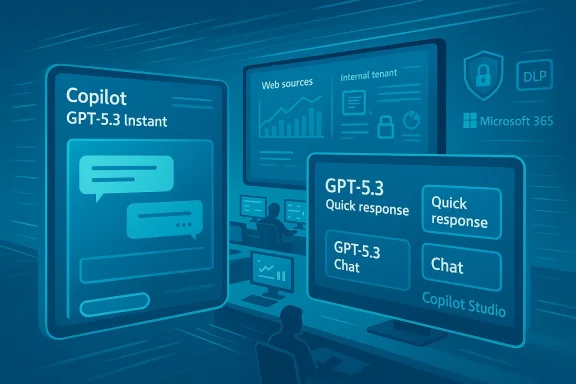
Microsoft’s Copilot stack has just entered another rapid model refresh cycle, and the implications for enterprise users are bigger than the model name might suggest. OpenAI has now positioned GPT-5.3 Instant as its default everyday model for ChatGPT, while Microsoft has folded it into Microsoft 365 Copilot and Copilot Studio as a faster, more conversational option for work. The result is a cleaner, more grounded Copilot experience that leans less on refusals and more on usable answers, especially when web content is involved. (openai.com)
Background — full context
Microsoft and OpenAI have spent the last year turning model releases into product-level upgrades, but GPT-5.3 Instant is notable because it is explicitly framed around everyday usefulness rather than benchmark chasing. OpenAI says the model is meant to improve tone, relevance, and conversational flow, and its own release notes emphasize richer, more contextually appropriate responses rather than pure technical leaderboard gains. For Microsoft, that makes the model especially attractive inside Copilot, where users care far more about getting an answer that is clear, complete, and immediately actionable than about abstract benchmark deltas. (openai.com)The timing also matters. OpenAI’s GPT-5.3 Instant rollout is broad: it is available in ChatGPT, in the API, and as the model behind Microsoft 365 Copilot’s new “Quick response” mode and Copilot Studio’s “GPT-5.3 Chat” selector. OpenAI also confirmed that GPT-5.2 Instant remains available to paid users for three months in the legacy model picker before retirement on June 3, 2026, which gives organizations a short transition window if they want to compare behaviors or preserve older workflows. (openai.com)
For Microsoft, the release is less about novelty than about fit. The company says GPT-5.3 Instant is now rolling out to Microsoft 365 Copilot licensed users with priority access, while users without a Copilot license receive standard access. Microsoft also states that GPT-5.3 Instant is available in Copilot Studio for agent makers, with updates to Thinking following later. In other words, this is not just a consumer ChatGPT update; it is a work-productivity change that affects how end users interact with Copilot and how builders create agents on top of it. (techcommunity.microsoft.com)
OpenAI’s own explanation of the model suggests why Microsoft moved quickly. GPT-5.3 Instant is described as more reliably accurate, more expressive in writing, and more direct in answers, while also better at synthesizing web results with model reasoning. Microsoft mirrors that framing and adds that the model is better at producing “focused, relevant, and immediately usable” responses. That combination is ideal for a productivity suite where people ask about policies, internal documents, meetings, emails, compliance questions, and web-backed research in the same conversation. (openai.com)
What Microsoft actually changed
A new “Quick response” layer in Copilot Chat
In Microsoft 365 Copilot Chat, GPT-5.3 Instant appears as GPT-5.3 Quick response under the model selector. Microsoft’s blog shows the response mode menu alongside Auto, Quick response, and Think deeper, with GPT-5.3 Quick response selected. That is a subtle naming choice, but it reflects an important product idea: this model is being positioned as the default fast path for people who want a concise, useful answer instead of a deliberative reasoning session. (techcommunity.microsoft.com)A Copilot Studio option for builders
For Copilot Studio, the model appears as GPT-5.3 Chat. That is significant because Microsoft is effectively exposing the model to the agent-building layer, not just the end-user surface. Builders can tune experiences around a model that is meant to be better at keeping the conversation moving, reformulating when needed, and staying grounded in task context. (techcommunity.microsoft.com)Priority access versus standard access
Microsoft says licensed Microsoft 365 Copilot users receive priority access, while users without a Microsoft 365 Copilot license get standard access. That distinction matters for enterprises because it suggests Microsoft is preserving service quality for paying customers while still letting broader audiences benefit from the same model family. It also hints at the infrastructure pressure that comes with rapid model migration at enterprise scale. (techcommunity.microsoft.com)Why GPT-5.3 Instant matters for work
Better answers with fewer dead ends
OpenAI’s release says GPT-5.3 Instant aims to reduce the model’s tendency to stall out with unnecessary refusals or overly cautious replies. Microsoft echoes that directly, saying the model helps Copilot offer useful responses when appropriate rather than defaulting to disclaimers or declining to proceed. For knowledge workers, that means fewer conversational dead ends and less time spent coaxing the assistant into being helpful. (openai.com)Stronger synthesis of web content
Microsoft highlights that when questions depend on web information, GPT-5.3 Instant better synthesizes what it finds online with its own knowledge and reasoning. That is one of the most important enterprise-facing claims in the announcement, because it suggests Copilot can do more than echo retrieved snippets. Instead, it can fuse search results, internal context, and reasoning into something closer to an answer than a bibliography. (techcommunity.microsoft.com)More useful writing help
OpenAI says the model is stronger for expressive writing, and Microsoft says it delivers “stronger and more expressive writing” in everyday conversations. That matters for Microsoft 365 because a huge share of Copilot usage is drafting-related: emails, summaries, proposals, meeting notes, customer responses, and internal communications. A model that sounds less robotic and more context-aware is more likely to be adopted by workers who are still deciding whether Copilot is a serious assistant or just a fancy autocomplete layer. (openai.com)Enterprise implications
Less friction in support and policy workflows
Microsoft explicitly says the new model is meant to support more “focused, relevant, and immediately usable” responses in work settings. That is especially valuable in support, IT, and policy workflows, where a shallow answer can be worse than no answer if it creates more follow-up work. GPT-5.3 Instant’s improved grounding and response style should reduce the amount of cleanup teams need to do after using Copilot for first-pass assistance. (openai.com)Better fit for agent builders
Copilot Studio is where Microsoft’s model strategy becomes operational. The new GPT-5.3 Chat option gives builders a model tuned for conversational reliability and web-aware synthesis, which should help when designing customer service bots, internal knowledge agents, and workflow assistants. A model that is more willing to answer safely and more able to reformulate requests can be a better foundation for multi-step agents than one that frequently hits a refusal wall. (techcommunity.microsoft.com)A cleaner handoff between fast and deep modes
The existence of Quick response and Think deeper suggests Microsoft is leaning into a hybrid interaction model: use GPT-5.3 Instant for speed and day-to-day tasks, then switch to more deliberate reasoning when the problem demands it. That kind of split is increasingly important in enterprise AI, because not every question deserves a long chain-of-thought-style response, but some absolutely do. (techcommunity.microsoft.com)What OpenAI is optimizing for
Tone, not just scorecards
OpenAI’s release notes make clear that GPT-5.3 Instant is about the shape of the experience. The company says the model improves “smoother” and more “useful everyday conversations,” and it provides examples showing a more specific, grounded poem compared with the previous version. In other words, OpenAI is signaling that conversational polish is now a product feature in its own right, not just an emergent side effect of scaling. (openai.com)More natural context handling
The model is also described as better at making responses feel like they belong to the conversation rather than just the prompt. OpenAI’s comparison text suggests GPT-5.3 Instant does a better job of maintaining structure, control, and lived-in specificity. That’s the sort of improvement that users may not describe as “AI got smarter,” but they will absolutely notice as “this feels less annoying.” (openai.com)Safety with fewer unnecessary refusals
OpenAI’s direction here is important for enterprise audiences. The company is not saying “less safe”; it is saying more proportionate. Microsoft repeats that idea by describing a model that is less likely to hide behind disclaimers. This is a subtle but meaningful move: enterprise AI customers want guardrails, but they also want the assistant to stay in the game when the request is legitimate. (openai.com)The model naming strategy is telling
“Instant” becomes “Quick response”
Microsoft did not surface the OpenAI name verbatim in Copilot Chat. Instead, it translated GPT-5.3 Instant into GPT-5.3 Quick response. That sounds cosmetic, but it is really a UX decision: Microsoft wants the model to feel like a behavior choice rather than a brand artifact. Users see an interaction style first and a model family second. (techcommunity.microsoft.com)“Chat” in Copilot Studio
By contrast, Copilot Studio uses GPT-5.3 Chat, which is a more builder-friendly label. That distinction suggests Microsoft is optimizing for two audiences at once: end users who care about response speed and tone, and developers who care about orchestration and model selection. (techcommunity.microsoft.com)The legacy window matters
OpenAI’s three-month legacy access for GPT-5.2 Instant is short enough to force action but long enough to let enterprises test. That balance matters in large deployments, where sudden model changes can alter output style, prompt behavior, and agent reliability. Microsoft’s adoption of GPT-5.3 Instant will likely be evaluated not just on quality, but on whether it preserves the predictable behavior teams have already built around GPT-5.2. (openai.com)Strengths and Opportunities
Stronger day-to-day usability
- More direct answers
- Better tone in common conversations
- Less unnecessary refusal behavior
- More natural-sounding writing
- Better handling of web-informed questions (openai.com)
Better enterprise fit
- Priority access for licensed users
- Standard access for broader users
- Copilot Studio availability for builders
- Better grounding for IT and policy tasks
- More immediate usefulness in workflow contexts (techcommunity.microsoft.com)
Useful for agent design
- Easier reformulation of ambiguous prompts
- Better answer shaping for support bots
- Stronger narrative and drafting quality
- More consistent conversational flow
- Cleaner fast-versus-deep mode separation (techcommunity.microsoft.com)
Commercial upside for Microsoft
- More attractive Copilot licensing value
- Better differentiation versus generic chatbots
- Stronger appeal for Copilot Studio adoption
- Improved customer satisfaction in work scenarios
- A visible cadence of model improvements inside Microsoft 365 (techcommunity.microsoft.com)
Risks and Concerns
Frequent model swaps can confuse users
- Model naming changes are easy to miss
- Behavior shifts may look like regressions
- Users may not know when they are on fast versus deep modes
- Legacy model windows can create version sprawl
- Training materials may lag behind model changes (openai.com)
Enterprises will still need validation
- Better tone does not guarantee factual accuracy
- Grounded answers still depend on source quality
- Internal policies may be misinterpreted
- Web synthesis can still amplify bad retrieval
- Agent outputs will need human review in sensitive workflows (openai.com)
Access tiers may create uneven experiences
- Licensed users get priority access
- Unlicensed users get standard access
- Performance may vary under load
- Different groups may report different quality
- Rollouts can complicate support and troubleshooting (techcommunity.microsoft.com)
Language quality remains a known gap
- OpenAI says some non-English languages can sound stilted or overly literal
- Tone improvements are ongoing
- Multilingual workforces may not see equal gains
- Enterprises operating globally will notice uneven behavior
- Localization may lag behind English-language polish (openai.com)
What this says about Microsoft’s Copilot strategy
Copilot is becoming more opinionated
Microsoft is no longer presenting Copilot as a single generalized assistant. It is now a layered experience with quick answers, deeper reasoning, and builder-facing model choice. GPT-5.3 Instant reinforces that direction by giving Microsoft a model that is explicitly better at staying conversational while still remaining work-appropriate. (techcommunity.microsoft.com)The company wants less “AI theater”
OpenAI’s examples show a shift away from polished but generic AI prose toward responses that feel more human, more specific, and more task-oriented. Microsoft is applying that same logic to productivity software: users should get something they can act on, not something they have to reinterpret. (openai.com)Model quality is now a product layer
A few years ago, model upgrades were mostly invisible infrastructure events. Today, they are front-and-center product changes with direct implications for licensing, UX, support, and governance. The fact that Microsoft is publicly naming where GPT-5.3 Instant appears in its products shows that model identity is now part of the Copilot value proposition. (techcommunity.microsoft.com)What to Watch Next
Updates to Thinking and Pro
OpenAI says updates to Thinking and Pro will follow after GPT-5.3 Instant, and Microsoft says those updates will also make their way into Microsoft products and services. That means this rollout is only the first stage of a larger Copilot refresh cycle. (openai.com)Enterprise rollout behavior
Watch whether licensed Copilot users actually notice priority access differences, especially under heavy load or in shared tenant environments. Microsoft’s access tiering is sensible on paper, but the real-world experience will determine whether enterprises view it as a meaningful service improvement or just a marketing distinction. (techcommunity.microsoft.com)Copilot Studio adoption
The most interesting downstream effect may be in Copilot Studio, where builders decide whether GPT-5.3 Chat is better for production agents than the models they were already using. If the answer is yes, the impact could extend far beyond Microsoft 365 Copilot chat into custom workflows across support, HR, finance, and operations. (techcommunity.microsoft.com)Legacy model retirement date
The June 3, 2026 retirement date for GPT-5.2 Instant is the practical deadline to watch. By then, organizations that care about reproducibility, output consistency, or policy-controlled behavior should have tested the new model and adjusted prompts, workflows, or guardrails accordingly. (openai.com)Bottom line
GPT-5.3 Instant is not being pitched as a dramatic leap in raw intelligence. Instead, OpenAI and Microsoft are treating it as a meaningful refinement in how AI should behave inside real work. That refinement—more grounded, more direct, less fussy, and more useful across web-backed and workplace tasks—is exactly what enterprise users have been asking for, even if they usually phrase it as wanting fewer hallucinations and less fluff. If Microsoft can keep that experience stable as the model spreads through Copilot Chat, Copilot Studio, and eventually broader enterprise surfaces, GPT-5.3 Instant could become one of those quiet upgrades that changes expectations everywhere without making much noise about it.Source: neowin.net Microsoft brings GPT‑5.3 Instant model to Microsoft 365 Copilot and Copilot Studio
Last edited:
