

OpenAI’s GPT-5.5 and GPT-5.4 are successive frontier AI model releases surfaced by StreamlineFeed’s directory pages, with GPT-5.4 introduced in March 2026 and GPT-5.5 following in late April 2026 across ChatGPT, the API, and OpenAI’s developer tooling for professional and coding work. The important story is not merely that the numbers went up. It is that OpenAI is turning model releases into an operating system for knowledge work, where the default engine underneath everyday Windows workflows can change faster than many IT departments can document. For users, developers, and administrators, that makes model versioning less like app news and more like infrastructure change.
The jump from GPT-5.4 to GPT-5.5 looks incremental on paper, but that is exactly why it matters. In the old software world, a point release usually meant bug fixes, modest performance tuning, and a safe assumption that yesterday’s workflow would behave much like today’s. In the AI platform world, a point release can mean a different reasoning profile, different coding habits, different refusal behavior, and different cost dynamics.
That creates a peculiar kind of progress. Users want the better model immediately, especially if it writes cleaner code, handles longer tasks, or hallucinates less often. Enterprises, meanwhile, want the same improvement only after procurement, security, compliance, legal, and operations teams have had a chance to understand what changed.
OpenAI is trying to satisfy both impulses by shipping models as named products, routed experiences, and specialized variants. GPT-5.4 was framed as a mainline reasoning model with stronger coding capability, while GPT-5.5 was presented as the smarter successor with gains in agentic work and professional tasks. That sounds tidy until those capabilities start showing up inside real workflows where “the model” is not an abstraction, but the thing generating PowerShell, summarizing Teams transcripts, reviewing contracts, or drafting customer-facing text.
For WindowsForum readers, the relevance is immediate. A Windows PC is increasingly just one endpoint in a mesh of cloud AI services, local accelerators, browser copilots, IDE agents, and enterprise identity controls. The model name matters because it is becoming part of the support surface.
The inclusion of Codex in the rollout was particularly important. Developers do not experience AI models as benchmark tables; they experience them as latency, diff quality, repository awareness, broken tests, and the number of times they have to say, “No, not like that.” If GPT-5.4 improved the everyday feel of coding assistants, then its impact would show up less in launch-day applause than in the gradual normalization of AI-generated patches.
That normalization has a cost. Once a model becomes good enough to be trusted for scaffolding, refactoring, documentation, and test generation, organizations need to treat it as part of the software supply chain. A developer using GPT-5.4 or GPT-5.5 inside an IDE is not merely “chatting.” They are introducing an automated contributor into the workstream.
Microsoft shops should be especially attentive here. GitHub, Visual Studio Code, Windows Terminal, PowerShell, Azure, Microsoft 365, and endpoint management all sit in the same gravitational field. The model may come from OpenAI, but the blast radius of its output often lands in Microsoft infrastructure.
The phrase default model deserves more scrutiny than it usually gets. Defaults shape behavior. If a smarter model becomes the standard ChatGPT experience, or if an API alias points developers toward the latest engine, many users will migrate without a conscious upgrade decision. That is convenient, but it also weakens the old enterprise assumption that major capability changes happen only after a formal rollout.
The practical issue is reproducibility. If a finance team used one model to generate spreadsheet logic in April and another model to revise it in June, the difference may not be visible in the file metadata. If a help desk generated troubleshooting scripts with GPT-5.4 and later regenerated them with GPT-5.5, the output may be better, but it is not necessarily equivalent.
This is where AI starts to look less like software and more like a managed service with a personality. You can pin versions in some developer contexts, but mainstream productivity users rarely think that way. They ask the assistant, accept the answer, and move on.
The answer “ChatGPT” is increasingly insufficient. Was it GPT-5.4, GPT-5.5, GPT-5.5 Pro, a cyber-focused variant, a routed experience, or a third-party wrapper exposing one of those models through another product? Each answer carries different implications for capability, data handling, reliability, and risk.
This is the administrative headache behind the marketing. The better these systems become, the more invisible they get. The more invisible they get, the harder it becomes to separate human judgment from machine suggestion after the fact.
Windows administrators have seen this movie before, though in a different genre. Patch Tuesday taught enterprises that version numbers, servicing channels, and deployment rings are not bureaucratic trivia. They are how large organizations keep change from becoming chaos. AI models now need a similar discipline.
A model that can help patch the world can also describe the world’s weak points. OpenAI and its peers know this, which is why access controls, safety evaluations, and trusted-user programs are becoming part of the rollout story. But the security community should resist the comforting fiction that access restrictions make the problem simple.
Defenders need speed. Attackers exploit latency, both technical and organizational. If an AI model can reduce the time between vulnerability discovery and patch generation, it becomes an enormous defensive advantage. If similar capability leaks, is replicated, or is approximated by open systems, it becomes another acceleration layer for offense.
For Windows environments, the likely near-term effect is not an AI that magically secures the estate. It is more prosaic and more useful: faster triage, better script generation, improved log interpretation, and more automated patch analysis. The risk is that teams will mistake fluent explanations for validated remediation.
That makes governance the real product frontier. Enterprises do not merely need smarter models; they need admin consoles that expose which models are available, where data flows, which users can access high-capability systems, and how outputs are logged. They need retention settings, model pinning, tenant controls, and clear notices when behavior changes.
The consumer AI race rewards surprise. Enterprise IT punishes it. A user may delight in discovering that ChatGPT suddenly writes better macros, but an administrator wants to know whether that improvement came with different data handling, different grounding behavior, or different exposure to plugins and tools.
This is where Microsoft has an opening. Its advantage is not that it can always ship the most dazzling model first. Its advantage is that it understands, better than most AI-native companies, that large organizations buy trust through controls. If GPT-5.5-class models become everyday infrastructure, the winning platform will be the one that makes them governable without making them useless.
The right mental model is not “AI replaces developers.” It is “AI changes the unit economics of developer attention.” More code can be produced per hour, but review, architecture, threat modeling, and maintainability become even more important. If teams respond by simply merging more machine-generated code faster, they will convert productivity gains into technical debt.
This is particularly relevant in Windows-heavy shops where automation often touches privileged systems. A PowerShell script generated by a model can save hours. It can also delete the wrong object, weaken a policy, expose a secret, or normalize a workaround that no one would have approved if it arrived in a pull request from a human contractor.
The answer is not to ban the tools. The answer is to place AI-generated work inside the same controls that already govern serious engineering: code review, test coverage, least privilege, secrets scanning, software composition analysis, and documented ownership. GPT-5.5 may be a better assistant than GPT-5.4, but it is still an assistant.
That fragmented discovery layer is useful, but messy. It helps enthusiasts compare capabilities quickly, yet it also invites confusion about what is official, what is available, what is region-limited, what is enterprise-only, and what is merely a rumor repeated with confidence. In fast-moving AI, the directory page has become the new driver-download mirror: convenient, sometimes indispensable, and not always the final authority.
The safest reading of these listings is therefore not “here is everything you need to know.” It is “this is a prompt to verify the model’s status against first-party documentation and actual tenant availability.” That distinction matters because AI products are often rolled out gradually, gated by subscription tier, geography, safety review, or customer type.
For IT pros, the lesson is simple. Treat model discovery as inventory work. If users can access GPT-5.5 through one tool, GPT-5.4 through another, and an unnamed routed model through a third, then your organization does not have one AI environment. It has an AI estate.
That policy should be specific enough to survive contact with reality. A vague statement that “AI must be used responsibly” will not help a sysadmin deciding whether to paste event logs into a chatbot, a developer deciding whether to accept an AI-authored authentication change, or a manager deciding whether AI-generated performance summaries belong in HR records.
Good AI policy will look more like operational guidance than corporate philosophy. It will distinguish public information from sensitive data, experimentation from production work, and brainstorming from decision support. It will also account for version churn, because the system a user touches in July may not be the same one they used in March.
The uncomfortable truth is that organizations cannot wait for model development to slow down. It probably will not. The administrative layer has to mature while the models are still moving.
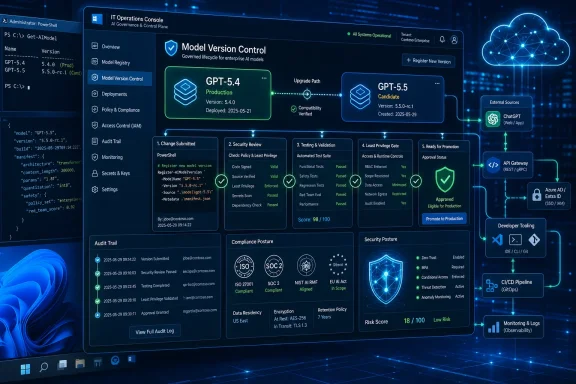 OpenAI Turns Model Drift Into Product Strategy
The jump from GPT-5.4 to GPT-5.5 looks incremental on paper, but that is exactly why it matters. In the old software world, a point release usually meant bug fixes, modest performance tuning, and a safe assumption that yesterday’s workflow would behave much like today’s. In the AI platform world, a point release can mean a different reasoning profile, different coding habits, different refusal behavior, and different cost dynamics.That creates a peculiar kind of progress. Users want the better model immediately, especially if it writes cleaner code, handles longer tasks, or hallucinates less often. Enterprises, meanwhile, want the same improvement only after procurement, security, compliance, legal, and operations teams have had a chance to understand what changed.
OpenAI is trying to satisfy both impulses by shipping models as named products, routed experiences, and specialized variants. GPT-5.4 was framed as a mainline reasoning model with stronger coding capability, while GPT-5.5 was presented as the smarter successor with gains in agentic work and professional tasks. That sounds tidy until those capabilities start showing up inside real workflows where “the model” is not an abstraction, but the thing generating PowerShell, summarizing Teams transcripts, reviewing contracts, or drafting customer-facing text.
For WindowsForum readers, the relevance is immediate. A Windows PC is increasingly just one endpoint in a mesh of cloud AI services, local accelerators, browser copilots, IDE agents, and enterprise identity controls. The model name matters because it is becoming part of the support surface.
GPT-5.4 Was the Practical Upgrade, Not the Headline Event
GPT-5.4’s role in the sequence was to make the GPT-5 generation feel less experimental and more deployable. OpenAI positioned it as a frontier model for complex professional work, and the notable emphasis was not poetry or trivia, but coding, spreadsheets, legal drafting, presentations, and long-running tasks. That was a signal to businesses: this model was meant to sit closer to revenue-generating work.The inclusion of Codex in the rollout was particularly important. Developers do not experience AI models as benchmark tables; they experience them as latency, diff quality, repository awareness, broken tests, and the number of times they have to say, “No, not like that.” If GPT-5.4 improved the everyday feel of coding assistants, then its impact would show up less in launch-day applause than in the gradual normalization of AI-generated patches.
That normalization has a cost. Once a model becomes good enough to be trusted for scaffolding, refactoring, documentation, and test generation, organizations need to treat it as part of the software supply chain. A developer using GPT-5.4 or GPT-5.5 inside an IDE is not merely “chatting.” They are introducing an automated contributor into the workstream.
Microsoft shops should be especially attentive here. GitHub, Visual Studio Code, Windows Terminal, PowerShell, Azure, Microsoft 365, and endpoint management all sit in the same gravitational field. The model may come from OpenAI, but the blast radius of its output often lands in Microsoft infrastructure.
GPT-5.5 Makes the Upgrade Cycle Feel Less Optional
GPT-5.5’s strategic function is different. Where GPT-5.4 helped stabilize the GPT-5 era, GPT-5.5 pushes the argument that users should expect the default model to keep improving under them. That is thrilling for consumers and unsettling for administrators.The phrase default model deserves more scrutiny than it usually gets. Defaults shape behavior. If a smarter model becomes the standard ChatGPT experience, or if an API alias points developers toward the latest engine, many users will migrate without a conscious upgrade decision. That is convenient, but it also weakens the old enterprise assumption that major capability changes happen only after a formal rollout.
The practical issue is reproducibility. If a finance team used one model to generate spreadsheet logic in April and another model to revise it in June, the difference may not be visible in the file metadata. If a help desk generated troubleshooting scripts with GPT-5.4 and later regenerated them with GPT-5.5, the output may be better, but it is not necessarily equivalent.
This is where AI starts to look less like software and more like a managed service with a personality. You can pin versions in some developer contexts, but mainstream productivity users rarely think that way. They ask the assistant, accept the answer, and move on.
The Model Number Is Becoming a Compliance Artifact
For regulated organizations, model identity is no longer a trivia point. It belongs in audit trails, change management records, vendor reviews, and incident postmortems. If AI output affects a customer, a patient, a legal filing, a security control, or a production system, someone eventually will ask what system produced it.The answer “ChatGPT” is increasingly insufficient. Was it GPT-5.4, GPT-5.5, GPT-5.5 Pro, a cyber-focused variant, a routed experience, or a third-party wrapper exposing one of those models through another product? Each answer carries different implications for capability, data handling, reliability, and risk.
This is the administrative headache behind the marketing. The better these systems become, the more invisible they get. The more invisible they get, the harder it becomes to separate human judgment from machine suggestion after the fact.
Windows administrators have seen this movie before, though in a different genre. Patch Tuesday taught enterprises that version numbers, servicing channels, and deployment rings are not bureaucratic trivia. They are how large organizations keep change from becoming chaos. AI models now need a similar discipline.
Security Teams Get the Sharpest Edge First
The most interesting branch of the GPT-5.5 story may be cybersecurity. OpenAI has been moving specialized cyber models into vetted environments, with language around helping defenders find vulnerabilities, generate patches, and handle advanced authorized security work. That is exactly the kind of use case where stronger reasoning is valuable and dangerous at the same time.A model that can help patch the world can also describe the world’s weak points. OpenAI and its peers know this, which is why access controls, safety evaluations, and trusted-user programs are becoming part of the rollout story. But the security community should resist the comforting fiction that access restrictions make the problem simple.
Defenders need speed. Attackers exploit latency, both technical and organizational. If an AI model can reduce the time between vulnerability discovery and patch generation, it becomes an enormous defensive advantage. If similar capability leaks, is replicated, or is approximated by open systems, it becomes another acceleration layer for offense.
For Windows environments, the likely near-term effect is not an AI that magically secures the estate. It is more prosaic and more useful: faster triage, better script generation, improved log interpretation, and more automated patch analysis. The risk is that teams will mistake fluent explanations for validated remediation.
Microsoft’s AI Future Depends on Boring Controls
Microsoft’s role in this story is both direct and indirect. Even when the model announcement comes from OpenAI, the practical adoption path for many organizations runs through Windows, Edge, Microsoft 365, Azure, GitHub, Entra ID, Intune, Defender, and Copilot-branded experiences. OpenAI may supply the engine, but Microsoft often supplies the road.That makes governance the real product frontier. Enterprises do not merely need smarter models; they need admin consoles that expose which models are available, where data flows, which users can access high-capability systems, and how outputs are logged. They need retention settings, model pinning, tenant controls, and clear notices when behavior changes.
The consumer AI race rewards surprise. Enterprise IT punishes it. A user may delight in discovering that ChatGPT suddenly writes better macros, but an administrator wants to know whether that improvement came with different data handling, different grounding behavior, or different exposure to plugins and tools.
This is where Microsoft has an opening. Its advantage is not that it can always ship the most dazzling model first. Its advantage is that it understands, better than most AI-native companies, that large organizations buy trust through controls. If GPT-5.5-class models become everyday infrastructure, the winning platform will be the one that makes them governable without making them useless.
Developers Need to Treat AI Output Like a Junior Colleague With Root Access
The coding story around GPT-5.4 and GPT-5.5 is easy to oversell and dangerous to ignore. Better coding models can absolutely improve productivity, especially for boilerplate, migration work, unfamiliar APIs, tests, and documentation. They can also produce confident nonsense that compiles just long enough to become someone else’s outage.The right mental model is not “AI replaces developers.” It is “AI changes the unit economics of developer attention.” More code can be produced per hour, but review, architecture, threat modeling, and maintainability become even more important. If teams respond by simply merging more machine-generated code faster, they will convert productivity gains into technical debt.
This is particularly relevant in Windows-heavy shops where automation often touches privileged systems. A PowerShell script generated by a model can save hours. It can also delete the wrong object, weaken a policy, expose a secret, or normalize a workaround that no one would have approved if it arrived in a pull request from a human contractor.
The answer is not to ban the tools. The answer is to place AI-generated work inside the same controls that already govern serious engineering: code review, test coverage, least privilege, secrets scanning, software composition analysis, and documented ownership. GPT-5.5 may be a better assistant than GPT-5.4, but it is still an assistant.
The StreamlineFeed Listings Are a Symptom of a New Discovery Problem
The two StreamlineFeed directory entries point to a broader shift in how people learn about AI models. Users no longer rely only on vendor blogs. They encounter models through directories, benchmark aggregators, Reddit threads, API docs, screenshots, wrapper apps, and productivity tools that may expose model names before an organization has formally briefed its users.That fragmented discovery layer is useful, but messy. It helps enthusiasts compare capabilities quickly, yet it also invites confusion about what is official, what is available, what is region-limited, what is enterprise-only, and what is merely a rumor repeated with confidence. In fast-moving AI, the directory page has become the new driver-download mirror: convenient, sometimes indispensable, and not always the final authority.
The safest reading of these listings is therefore not “here is everything you need to know.” It is “this is a prompt to verify the model’s status against first-party documentation and actual tenant availability.” That distinction matters because AI products are often rolled out gradually, gated by subscription tier, geography, safety review, or customer type.
For IT pros, the lesson is simple. Treat model discovery as inventory work. If users can access GPT-5.5 through one tool, GPT-5.4 through another, and an unnamed routed model through a third, then your organization does not have one AI environment. It has an AI estate.
The Upgrade Path Now Runs Through Policy
The most practical response to GPT-5.5 is not excitement or panic. It is policy. Organizations need to define which tasks can use frontier models, which tasks require approved tools, and which outputs need human verification before they leave the building.That policy should be specific enough to survive contact with reality. A vague statement that “AI must be used responsibly” will not help a sysadmin deciding whether to paste event logs into a chatbot, a developer deciding whether to accept an AI-authored authentication change, or a manager deciding whether AI-generated performance summaries belong in HR records.
Good AI policy will look more like operational guidance than corporate philosophy. It will distinguish public information from sensitive data, experimentation from production work, and brainstorming from decision support. It will also account for version churn, because the system a user touches in July may not be the same one they used in March.
The uncomfortable truth is that organizations cannot wait for model development to slow down. It probably will not. The administrative layer has to mature while the models are still moving.
The Upgrade Worth Having Is the One You Can Explain
GPT-5.4 and GPT-5.5 are not just bigger numbers in a model directory; they are markers in the transition from AI as a destination app to AI as a background layer in daily computing.- Organizations should record which AI models are approved for which classes of work, rather than treating all chatbot access as interchangeable.
- Developers should assume AI-generated code requires the same review, testing, and security checks as code written by a new team member.
- Windows administrators should expect AI assistants to affect scripts, policies, documentation, help desk workflows, and endpoint operations.
- Security teams should explore cyber-focused models for defensive acceleration while keeping strict controls around validation and access.
- Users should understand that a newer default model may produce better answers without producing identical answers.
References
- Primary source: streamlinefeed.co.ke
Published: 2026-06-28T06:30:16.837923
OpenAI GPT-5.5 - AI & LLM Models in San Francisco | Streamline Directory | Streamline
OpenAI GPT-5.5 is the current frontier model in OpenAI's API documentation, positioned for complex reasoning, coding, agentic workflows, lon... | AI & LLM Modelstreamlinefeed.co.ke - Related coverage: techradar.com
'We don’t believe this kind of government access process should become the long-term default': OpenAI unveils big GPT-5.6 upgrades for ChatGPT, but you can't use them yet | TechRadar
Only select partners for nowwww.techradar.com - Related coverage: axios.com
OpenAI gives GPT-5.5-Cyber more powerful cybersecurity capabilities
Even as Anthropic's Fable remains in limbo, the race to get advanced AI models in the hands of defenders continues to heat up.www.axios.com
- Related coverage: itpro.com
OpenAI expands 'Daybreak' cyber program: New tools, partnerships, and a cyber-focused GPT-5.5 aim to help 'patch the world' | IT Pro
OpenAI has expanded its Daybreak cybersecurity initiative to cover fixing vulnerabilities, not just identifying them.www.itpro.com - Official source: openai.com
Introducing GPT-5.4 | OpenAI
Introducing GPT-5.4, OpenAI’s most most capable and efficient frontier model for professional work, with state-of-the-art coding, computer use, tool search, and 1M-token context.openai.com - Related coverage: techcrunch.com
OpenAI launches GPT-5.4 with Pro and Thinking versions | TechCrunch
GPT-5.4 is billed as "our most capable and efficient frontier model for professional work."techcrunch.com
- Official source: developers.openai.com
GPT-5.4 Model | OpenAI API
 developers.openai.com
- Official source: help.openai.com
GPT-5.5 in ChatGPT | OpenAI Help Center
 help.openai.com
- Related coverage: windowscentral.com
OpenAI launches two new models, one of which runs locally | Windows Central
Windows PCs powered by Snapdragon processors or NVIDIA RTX GPUs can run OpenAI's gpt-oss-20b model natively.www.windowscentral.com - Related coverage: tomsguide.com
GPT-5.4 is here — and OpenAI just made every other AI model look slow | Tom's Guide
OpenAI's newest flagship brings native computer control, a 1-million token context window, and benchmark-shattering professional performance. Here's what actually changes for you.www.tomsguide.com - Official source: deploymentsafety.openai.com