

Artificial intelligence may have produced one of its most interesting mathematical moments yet—but the most important word is still may. A newly circulated counterexample to the long-standing Dinitz–Garg–Goemans conjecture in graph theory is being credited to conversations involving OpenAI’s GPT-5.6 Pro and, separately, xAI’s Grok 4.5 Medium. Reports that Grok recreated the result in minutes have attracted attention after Elon Musk amplified the claim, but the mathematical result itself—not the viral timeline—will determine whether this is a genuine research breakthrough.
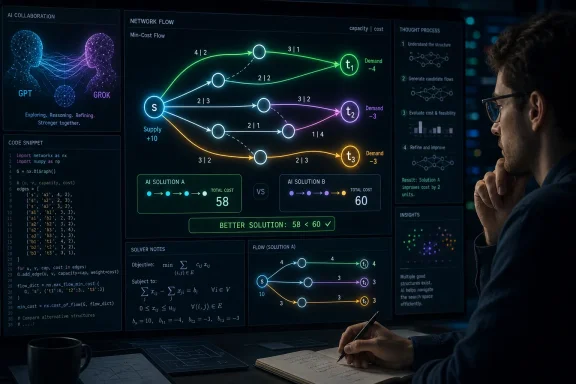
The alleged counterexample is unusually compelling because it is small, concrete, and potentially easy for independent experts to check. It claims that a fractional network-flow solution can achieve a total cost of 58, while every qualifying unsplittable-flow solution costs at least 60 under the conjecture’s permitted capacity violation. If the construction satisfies every condition in the original statement, that two-unit gap is enough to invalidate a conjecture that has influenced combinatorial optimization research for roughly three decades.
That is a major “if,” however. AI-generated mathematics has reached the point where systems can suggest sophisticated constructions, write verification code, enumerate cases, and explain proofs in polished language. None of those capabilities removes the need for expert review, reproducible calculations, and eventually a formal or peer-reviewed validation. The episode is significant precisely because it demonstrates both sides of modern AI reasoning: a remarkable ability to search mathematical spaces and a persistent risk that plausible-looking output will be mistaken for settled truth.
For Windows users, developers, researchers, and enterprise AI teams, the larger story is not simply whether Grok or GPT got there first. It is that frontier models are beginning to behave less like advanced chatbots and more like exploratory research assistants—especially when paired with code execution, exhaustive search, and human supervision.
The Dinitz–Garg–Goemans conjecture belongs to the study of single-source unsplittable flows, a foundational class of problems in graph theory and combinatorial optimization.
A graph can represent a network of roads, data links, supply routes, or communication channels. Each edge has a capacity, each destination has a demand, and a common source must route those demands through the network. In the most flexible version of the problem, a demand can be divided among multiple routes. This is called a fractional or splittable flow.
That flexibility often makes the mathematics easier. A network can send part of one demand along one path and the rest along another, using capacity efficiently and minimizing cost. Real systems, however, frequently impose indivisibility:
The difficulty is immediate. A fractional solution may distribute demand gracefully across a network, while an unsplittable solution forces all of a demand through one path and can create congestion. Finding an affordable unsplittable routing that obeys capacities is computationally hard in the general case.
A landmark result associated with Yefim Dinitz, Naveen Garg, and Michel Goemans showed that an unsplittable routing can be found if the network is allowed an additive capacity violation bounded by the largest individual demand. In simpler terms, if a network edge has a capacity of 100 and the largest demand is 15, the construction may permit an unsplittable solution that loads an edge up to 115.
The later cost-sensitive conjecture asked for more. It suggested that this rounding from fractional to unsplittable flow could preserve the original fractional solution’s total cost while retaining that limited extra capacity allowance.
That idea is elegant because it promises a powerful conversion:
The construction reportedly uses a directed graph with:
When each delivery must choose one complete route, the shared free routes become mutually incompatible. At most one delivery can use a free option without exceeding the allowed edge loading. The other two deliveries must take paid routes, pushing the total cost to at least 60.
The key issue is not merely that the unsplittable solution costs more. It is that it costs more even after granting the precise additive capacity relaxation envisioned by the conjecture.
That does not make validation automatic. The graph must be checked for unintended hybrid paths—paths formed by splicing portions of other routes together. In graph constructions, it is not enough to label two routes as the intended options. One must prove that no additional directed path lets a demand evade the claimed capacity or cost constraints.
That distinction is central to the credibility of the reported result.
The first claim is that Dmitry Rybin used a public conversation with a GPT-5-series model to develop the proposed counterexample. Accounts of that conversation describe an iterative process rather than a one-shot answer. The model reportedly explored several failed constructions, identified flaws involving extra paths, refined its search strategy, and eventually produced a compact graph along with proof-oriented verification material.
The second claim is that a Grok 4.5 Medium-based agent independently found a novel counterexample after being exposed to the same or closely related problem in an internal team discussion. The reported turnaround time was roughly eight minutes.
The third claim is social rather than mathematical: Elon Musk amplified the Grok account of the event, framing it as a model solving a decades-old graph theory conjecture.
These claims have different evidentiary standards.
A public GPT conversation can potentially be inspected for prompts, intermediate steps, and generated artifacts. A reported internal Grok result requires stronger reproducibility evidence, especially if the model was given access to a public post containing the problem, construction details, or the conclusion that a counterexample existed.
That does not diminish an independent reconstruction. Re-deriving a valid counterexample can be difficult and meaningful. But it is not necessarily the same achievement as discovering the original construction from a blank slate.
A valid publication-grade account should identify the exact model version, access mode, context provided to the model, whether tools were enabled, the prompt history, and the verification procedure. Without these details, claims of speed and model superiority remain difficult to assess.
That workflow has several stages where models can now help:
For a graph-theory conjecture, the object may be a graph with certain weights, capacities, and demands. Once a candidate is found, the result can often be checked by a finite procedure.
This resembles software testing in an important way. A programmer may believe a function works for all valid inputs; a bug finder needs only one valid input that breaks it. Likewise, a conjecture may hold across millions of instances but be false because of one carefully engineered graph.
That does not make counterexamples trivial. The search space can grow explosively, and the successful construction often reflects real mathematical insight. Still, the asymmetry matters: disproving a universal statement requires one example, while proving it requires ruling out all examples.
AI systems are well suited to explore that asymmetry, especially when researchers direct them toward a promising family of instances.
The reported candidate has several qualities that improve its prospects:
A capable setup could include:
For this class of flow problem, a Windows developer could represent the graph as structured data, use a solver to compute the fractional optimum, enumerate or optimize unsplittable choices, and compare outcomes. Such scripts can be version-controlled and rerun by third parties.
This is the direction AI-assisted technical work should move: generation by model, validation by deterministic tooling, judgment by humans.
Yet a single conjecture counterexample is a poor standalone scorecard.
Model comparisons are complicated by:
Claims surrounding competing models should therefore be treated cautiously, particularly when they include parameter counts, benchmark rankings, context-window figures, or declarations that a forthcoming model will surpass a rival. These are marketing-adjacent claims unless supported by transparent methodology and independently repeatable evaluations.
The mathematically meaningful outcome is simpler: if the counterexample stands, multiple advanced AI systems appear capable of participating in a high-level combinatorial research workflow. That is notable enough without turning an unreviewed result into a brand contest.
That does not make the underlying area less valuable. In many cases, a counterexample is productive because it reveals exactly where intuition failed.
Researchers could then ask better questions:
For real-world optimization systems, the lesson is also practical. Fractional models can provide excellent lower bounds and planning guidance, but enforcing indivisible routes can introduce unavoidable costs. Algorithms need to account for that structural gap rather than assuming every fractional optimum can be rounded without financial penalty.
At the same time, the public narrative should be separated from the mathematical record. The claim that Grok 4.5 found an independent counterexample in eight minutes is intriguing but requires transparent reproduction. The GPT-5.6-assisted discovery claim is stronger if its graph, search process, and verification artifacts can be independently inspected. Musk’s endorsement may raise visibility, but it cannot replace validation.
The real milestone will come when independent graph-theory experts reproduce the result, verify every route and constraint, and establish that the construction matches the conjecture’s exact general formulation. If that happens, this will not merely be a story about Grok, GPT, or a viral post. It will be evidence that AI systems, carefully integrated with deterministic tools and human expertise, are becoming credible partners in the search for new mathematics.
The alleged counterexample is unusually compelling because it is small, concrete, and potentially easy for independent experts to check. It claims that a fractional network-flow solution can achieve a total cost of 58, while every qualifying unsplittable-flow solution costs at least 60 under the conjecture’s permitted capacity violation. If the construction satisfies every condition in the original statement, that two-unit gap is enough to invalidate a conjecture that has influenced combinatorial optimization research for roughly three decades.
That is a major “if,” however. AI-generated mathematics has reached the point where systems can suggest sophisticated constructions, write verification code, enumerate cases, and explain proofs in polished language. None of those capabilities removes the need for expert review, reproducible calculations, and eventually a formal or peer-reviewed validation. The episode is significant precisely because it demonstrates both sides of modern AI reasoning: a remarkable ability to search mathematical spaces and a persistent risk that plausible-looking output will be mistaken for settled truth.
For Windows users, developers, researchers, and enterprise AI teams, the larger story is not simply whether Grok or GPT got there first. It is that frontier models are beginning to behave less like advanced chatbots and more like exploratory research assistants—especially when paired with code execution, exhaustive search, and human supervision.
 Background: What the Dinitz–Garg–Goemans Conjecture Actually Says
The Dinitz–Garg–Goemans conjecture belongs to the study of single-source unsplittable flows, a foundational class of problems in graph theory and combinatorial optimization.A graph can represent a network of roads, data links, supply routes, or communication channels. Each edge has a capacity, each destination has a demand, and a common source must route those demands through the network. In the most flexible version of the problem, a demand can be divided among multiple routes. This is called a fractional or splittable flow.
That flexibility often makes the mathematics easier. A network can send part of one demand along one path and the rest along another, using capacity efficiently and minimizing cost. Real systems, however, frequently impose indivisibility:
- A truckload should travel as one shipment.
- A virtual circuit may need a single route.
- A large job may need one allocation path.
- A customer order may be operationally impractical to split.
- A communication session may require a stable end-to-end route.
The difficulty is immediate. A fractional solution may distribute demand gracefully across a network, while an unsplittable solution forces all of a demand through one path and can create congestion. Finding an affordable unsplittable routing that obeys capacities is computationally hard in the general case.
A landmark result associated with Yefim Dinitz, Naveen Garg, and Michel Goemans showed that an unsplittable routing can be found if the network is allowed an additive capacity violation bounded by the largest individual demand. In simpler terms, if a network edge has a capacity of 100 and the largest demand is 15, the construction may permit an unsplittable solution that loads an edge up to 115.
The later cost-sensitive conjecture asked for more. It suggested that this rounding from fractional to unsplittable flow could preserve the original fractional solution’s total cost while retaining that limited extra capacity allowance.
That idea is elegant because it promises a powerful conversion:
- Start with a low-cost fractional solution.
- Convert every demand to a single route.
- Permit only a modest capacity overage.
- Do not pay more than the original fractional solution.
The Reported Counterexample: Why 58 Versus 60 Matters
The proposed counterexample is not based on an enormous graph or an opaque machine-learning calculation. Its reported structure is small enough to be stated in ordinary combinatorial terms.The construction reportedly uses a directed graph with:
- One shared source
- Three destinations
- Three demands
- Two meaningful route choices per demand
- A mixture of zero-cost and paid routes
- Carefully selected capacities that make certain route combinations infeasible
- A fractional flow can distribute traffic among the available paths at total cost 58.
- Any unsplittable flow that keeps each edge within the conjecture’s allowed capacity violation has a minimum cost of 60.
A routing analogy
Imagine three deliveries leaving one warehouse. Each delivery can use one of two routes:- A free route that shares a constrained road segment with other deliveries.
- A paid route that avoids the bottleneck.
When each delivery must choose one complete route, the shared free routes become mutually incompatible. At most one delivery can use a free option without exceeding the allowed edge loading. The other two deliveries must take paid routes, pushing the total cost to at least 60.
The key issue is not merely that the unsplittable solution costs more. It is that it costs more even after granting the precise additive capacity relaxation envisioned by the conjecture.
Why exhaustive checking is valuable
If every commodity genuinely has only two valid source-to-destination paths, three demands yield just eight possible unsplittable routing combinations. That creates a favorable verification scenario:- Enumerate every possible route choice.
- Calculate each edge’s load.
- Reject choices exceeding allowed capacities.
- Compare the cost of every feasible remaining choice.
- Confirm that all qualifying choices cost at least 60.
That does not make validation automatic. The graph must be checked for unintended hybrid paths—paths formed by splicing portions of other routes together. In graph constructions, it is not enough to label two routes as the intended options. One must prove that no additional directed path lets a demand evade the claimed capacity or cost constraints.
That distinction is central to the credibility of the reported result.
GPT-5.6, Grok 4.5, and the Problem of Attribution
The viral narrative surrounding the conjecture mixes several different claims that should not be collapsed into one.The first claim is that Dmitry Rybin used a public conversation with a GPT-5-series model to develop the proposed counterexample. Accounts of that conversation describe an iterative process rather than a one-shot answer. The model reportedly explored several failed constructions, identified flaws involving extra paths, refined its search strategy, and eventually produced a compact graph along with proof-oriented verification material.
The second claim is that a Grok 4.5 Medium-based agent independently found a novel counterexample after being exposed to the same or closely related problem in an internal team discussion. The reported turnaround time was roughly eight minutes.
The third claim is social rather than mathematical: Elon Musk amplified the Grok account of the event, framing it as a model solving a decades-old graph theory conjecture.
These claims have different evidentiary standards.
A public GPT conversation can potentially be inspected for prompts, intermediate steps, and generated artifacts. A reported internal Grok result requires stronger reproducibility evidence, especially if the model was given access to a public post containing the problem, construction details, or the conclusion that a counterexample existed.
That does not diminish an independent reconstruction. Re-deriving a valid counterexample can be difficult and meaningful. But it is not necessarily the same achievement as discovering the original construction from a blank slate.
The difference between solving and verifying
AI headlines often use “solved” as a catch-all phrase. In mathematics, several distinct achievements can hide behind that word:- Generating a candidate: Producing a graph that looks promising.
- Finding a counterexample: Producing a valid graph that disproves a statement.
- Verifying a candidate: Checking all cases and confirming the construction works.
- Reconstructing a result: Independently deriving a known or disclosed counterexample.
- Formalizing a proof: Encoding the result in a proof assistant so every logical step is machine-checked.
- Publishing a result: Subjecting the work to expert review and durable scholarly scrutiny.
A valid publication-grade account should identify the exact model version, access mode, context provided to the model, whether tools were enabled, the prompt history, and the verification procedure. Without these details, claims of speed and model superiority remain difficult to assess.
Why This Is More Than a Benchmark Moment
The strongest interpretation of this news is not that AI has “replaced mathematicians.” It is that advanced language models can increasingly contribute to a research workflow that combines conceptual search with computational verification.That workflow has several stages where models can now help:
- Summarizing decades of relevant literature
- Translating informal conjectures into formal constraints
- Proposing small graph structures
- Writing integer-programming or satisfiability formulations
- Generating brute-force search programs
- Identifying symmetry reductions
- Checking candidate constructions for loopholes
- Producing diagrams and LaTeX-ready proof drafts
- Explaining the counterexample in accessible language
Counterexamples are a natural early target
Counterexample discovery is particularly compatible with AI-assisted search because it has a concrete objective: find a finite object violating a universal claim.For a graph-theory conjecture, the object may be a graph with certain weights, capacities, and demands. Once a candidate is found, the result can often be checked by a finite procedure.
This resembles software testing in an important way. A programmer may believe a function works for all valid inputs; a bug finder needs only one valid input that breaks it. Likewise, a conjecture may hold across millions of instances but be false because of one carefully engineered graph.
That does not make counterexamples trivial. The search space can grow explosively, and the successful construction often reflects real mathematical insight. Still, the asymmetry matters: disproving a universal statement requires one example, while proving it requires ruling out all examples.
AI systems are well suited to explore that asymmetry, especially when researchers direct them toward a promising family of instances.
The Verification Gap Remains the Real Story
The central risk in this episode is not that a model found a false answer. Models produce false mathematical claims constantly. The real risk is that media, investors, and even technical audiences may treat a polished generated result as verified mathematics before independent specialists have examined it.The reported candidate has several qualities that improve its prospects:
- It is finite and relatively small.
- The claimed cost gap is explicit.
- The number of intended route combinations is low.
- The result can be reproduced using ordinary computational tools.
- The construction reportedly includes machine-readable data and verification code.
What independent reviewers must establish
A serious validation effort needs to confirm at least the following:- The exact statement of the conjecture
The candidate must target the correct general version of the result, including all assumptions about sources, demands, capacities, edge costs, and allowable violations. - The graph’s full path structure
Every feasible directed path from the source to each destination must be considered. Intended route labels are insufficient if the graph permits unanticipated combinations. - Fractional-flow feasibility
The proposed fractional solution must meet all original capacity limits, satisfy all demands, and truly have total cost 58. - Unsplittable-flow lower bound
Every unsplittable routing that satisfies the allowed additive capacity violation must be shown to have cost at least 60. - No hidden assumptions
The counterexample cannot quietly depend on a different capacity model, an altered definition of cost, an excluded route family, or a stronger relaxation than the conjecture permits. - Reproducibility
An independent implementation should recover the same fractional optimum and unsplittable lower bound. - Formalization where practical
Encoding the graph and its constraints in a proof assistant, solver certificate, or independently auditable program would sharply reduce ambiguity.
Implications for Windows AI Workflows
The story is also relevant beyond pure mathematics. Windows remains a major platform for technical computing, enterprise development, simulation, and AI-assisted programming. The emerging research pattern represented here is increasingly accessible on a modern Windows workstation.A capable setup could include:
- Windows 11 for desktop productivity and development
- Windows Subsystem for Linux for Linux-native mathematical tooling
- Python for graph modeling, search, and reproducible experiments
- Jupyter notebooks for interactive exploration
- Visual Studio Code for code, LaTeX, and project management
- Git for preserving prompts, scripts, results, and revisions
- Docker for reproducible environments
- Solver libraries for linear, integer, and constraint optimization
- Local or cloud AI models for ideation, code generation, and explanation
- Define a formal problem.
- Ask the model to propose candidate structures.
- Generate code that checks the candidate.
- Run the code locally or in a controlled environment.
- Inspect failures.
- Feed verified constraints back into the model.
- Preserve a complete, auditable research trail.
The value of local verification
A model may invent a graph, overlook a path, or misuse a definition. A local verifier does not care how persuasive the explanation sounds. It checks the mathematical object that was actually supplied.For this class of flow problem, a Windows developer could represent the graph as structured data, use a solver to compute the fractional optimum, enumerate or optimize unsplittable choices, and compare outcomes. Such scripts can be version-controlled and rerun by third parties.
This is the direction AI-assisted technical work should move: generation by model, validation by deterministic tooling, judgment by humans.
The Competitive Narrative Needs Restraint
The story has also been folded into the broader AI race between xAI, OpenAI, and Chinese model developers. That is understandable: frontier-model companies increasingly use mathematics, programming, and scientific reasoning as evidence of capability.Yet a single conjecture counterexample is a poor standalone scorecard.
Model comparisons are complicated by:
- Different system prompts
- Different tool access
- Different context windows
- Hidden agent scaffolding
- Search time and compute budgets
- Human steering
- Exposure to existing public discussion
- Benchmark contamination
- Differences between generating and independently verifying a result
Claims surrounding competing models should therefore be treated cautiously, particularly when they include parameter counts, benchmark rankings, context-window figures, or declarations that a forthcoming model will surpass a rival. These are marketing-adjacent claims unless supported by transparent methodology and independently repeatable evaluations.
The mathematically meaningful outcome is simpler: if the counterexample stands, multiple advanced AI systems appear capable of participating in a high-level combinatorial research workflow. That is notable enough without turning an unreviewed result into a brand contest.
What a Valid Disproof Would Change
If confirmed, the counterexample would close one path in the theory of unsplittable flows. Researchers could no longer seek a proof of the general cost-preserving conjecture because the statement would be false.That does not make the underlying area less valuable. In many cases, a counterexample is productive because it reveals exactly where intuition failed.
Researchers could then ask better questions:
- Which graph structures cause the cost-preservation guarantee to fail?
- Does the conjecture remain true for planar graphs?
- Does it hold under restricted demand patterns?
- Is a slightly larger capacity violation sufficient?
- Can the cost increase be bounded by a small factor or additive term?
- What is the smallest possible counterexample?
- Is there a corrected theorem that captures the successful cases?
For real-world optimization systems, the lesson is also practical. Fractional models can provide excellent lower bounds and planning guidance, but enforcing indivisible routes can introduce unavoidable costs. Algorithms need to account for that structural gap rather than assuming every fractional optimum can be rounded without financial penalty.
A Breakthrough Only After the Math Survives
The most responsible conclusion is neither dismissal nor hype. The reported Dinitz–Garg–Goemans counterexample has the ingredients of a potentially significant AI-assisted mathematical result: a concrete graph, explicit numerical values, a finite verification path, and a problem important enough to have remained open for decades.At the same time, the public narrative should be separated from the mathematical record. The claim that Grok 4.5 found an independent counterexample in eight minutes is intriguing but requires transparent reproduction. The GPT-5.6-assisted discovery claim is stronger if its graph, search process, and verification artifacts can be independently inspected. Musk’s endorsement may raise visibility, but it cannot replace validation.
The real milestone will come when independent graph-theory experts reproduce the result, verify every route and constraint, and establish that the construction matches the conjecture’s exact general formulation. If that happens, this will not merely be a story about Grok, GPT, or a viral post. It will be evidence that AI systems, carefully integrated with deterministic tools and human expertise, are becoming credible partners in the search for new mathematics.
References
- Primary source: finance.biggo.com
Published: 2026-07-23T07:56:32+00:00
Loading…
finance.biggo.com