

OpenAI’s GPT-5.6 model family is no longer merely “set” for public release: GPT-5.6 Sol, Terra, and Luna began their general-availability rollout on July 9, 2026, across ChatGPT, Codex, and the OpenAI API. That matters for Windows users and IT teams because the release turns a short, restricted preview into an immediately usable set of models for coding, automation, document work, and security operations—though access still depends on product, subscription plan, region, workspace policy, and a gradual account-by-account rollout.
Mashable’s July 8 report correctly captured the impending broader launch after OpenAI’s limited preview, but the calendar has moved on. OpenAI’s own July 9 launch announcement says the rollout began globally that day, while its updated support documentation cautions that eligible ChatGPT accounts may not all see GPT-5.6 Sol in the model picker yet. In other words, this is a real public release, not an announcement of one; it is simply not a universal switch flipped at the same moment for every user.
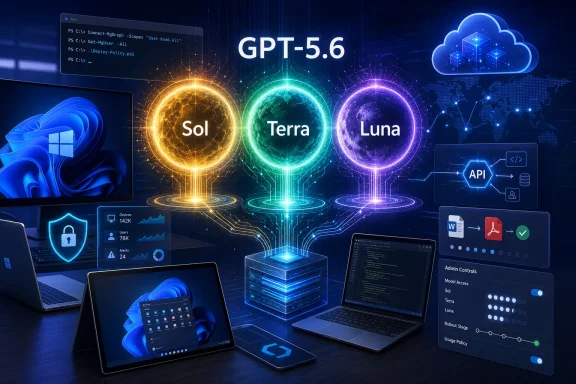
The company split the family into three tiers: Sol is the flagship reasoning model, Terra is the balanced lower-cost option, and Luna is the speed- and cost-oriented model. For administrators and developers, that product segmentation may prove more significant than the version number itself.
OpenAI began a limited GPT-5.6 preview on June 26, saying it had shared its plans and model capabilities with the U.S. government and agreed, at the government’s request, to start with trusted partners whose participation had been disclosed to officials. The company described the measure as temporary and explicitly said it did not believe a government access process should become the normal long-term model for release.
That preview period lasted less than two weeks. On July 9, OpenAI moved the family into general availability and said the global rollout would proceed over the following 24 hours. The current reality on July 16 is more nuanced than a clean before-and-after narrative: broad product access is live, but some users will still be waiting for their account entitlement, their organization’s administrator setting, or the relevant client update.
The restrictions surrounding misuse have not disappeared with broader availability. OpenAI says GPT-5.6 uses layered safeguards that combine model-level refusal behavior, real-time classifiers, account-level signals, monitoring, differentiated access, and enforcement. Some sensitive cybersecurity and biology prompts may be paused for additional review or refused altogether.
For security professionals, that creates a familiar tradeoff. Models that can assist with code review, vulnerability research, debugging, patch development, and defensive testing can materially improve defensive capacity. But the same competence raises the stakes for abuse prevention, false positives, and unpredictable refusals during legitimate red-team or incident-response work.
OpenAI says Sol did not cross its internal “Cyber Critical” threshold in testing. Its disclosure says the model could identify bugs and exploitation primitives in Chromium and Firefox testing, but did not autonomously produce a working full-chain exploit under the conditions OpenAI evaluated. That is an important qualification: benchmark performance and controlled testing are not a guarantee of safety in deployment, nor do they measure every possible combination of models, tools, and human expertise.
Those features are potentially useful to Windows-centric development shops using Codex to inspect a large codebase, work through PowerShell automation, diagnose build failures, or create and refine deployment documentation. They are not, however, a substitute for human review. The ability to reason longer can produce a more complete answer, but it can also mean more generated code, more tool calls, and more surface area to validate.
The lower tiers deserve attention because they are likely to be the more economical default for volume workloads. Terra is positioned as a capable everyday model that OpenAI says is competitive with GPT-5.5 at a lower price. Luna is the fastest and least expensive GPT-5.6 option. For tasks such as first-pass ticket triage, knowledge-base drafting, log summarization, routine scripting assistance, or application classification, organizations may find that cost and response time matter more than Sol’s maximum capability.
OpenAI’s API pricing makes the hierarchy clear:
Free and Go users do not receive GPT-5.6 Sol in standard ChatGPT chats. Terra and Luna also are not selectable in those standard conversations. OpenAI instead makes them available through ChatGPT Work, Codex, and the API, with the exact menu varying by plan.
That distinction will matter in organizations where staff assume they can reproduce a result from a developer’s API workflow inside a normal ChatGPT tab. They may not be using the same model, reasoning setting, tool access, account tier, data controls, or usage allowance.
For managed Business and Enterprise workspaces, administrators can control which models members can access. That puts GPT-5.6 alongside the usual governance questions: which groups need advanced reasoning, whether proprietary data can be submitted, what audit trail exists, who approves automation that can take actions, and how a model’s output is reviewed before it reaches production systems.
That is a concrete deployment consideration for endpoint-management teams. Before a pilot begins, confirm that the Windows desktop client is current, that the user is signed into the correct eligible account or workspace, and that the model is enabled for the organization. A missing entry in a model picker is not necessarily a broken installation; OpenAI says it can simply reflect the staged rollout, plan eligibility, or workspace administration.
The API and Codex releases add a more consequential capability for developers: OpenAI’s Responses API now supports Programmatic Tool Calling, which lets GPT-5.6 write and run in-memory programs to coordinate tools and intermediate results. OpenAI says that implementation is compatible with Zero Data Retention. A multi-agent feature is also arriving in beta, allowing concurrent subagents and a synthesized response in one request.
Those are powerful building blocks for automating routine work, but they also demand the same controls IT teams apply to any privileged automation. Keep credentials scoped, isolate development from production, log tool actions, enforce least privilege, test prompts and tools against malicious input, and require review gates before an agent can modify a live Windows environment.
The more useful question for Windows professionals is narrower: does GPT-5.6 improve a real workflow enough to justify the access tier, cost, governance overhead, and operational risk? Start with a bounded task—such as reviewing a PowerShell script, explaining a Windows event-log sequence, producing a test deployment runbook, or generating unit tests for an internal tool—and measure accuracy, time saved, and failure modes.
GPT-5.6’s public launch closes the brief government-coordinated preview chapter. The next milestone is less theatrical: whether Sol, Terra, and Luna become dependable daily tools inside managed Windows environments, where accuracy, permissions, and traceability matter far more than a benchmark headline.
Mashable’s July 8 report correctly captured the impending broader launch after OpenAI’s limited preview, but the calendar has moved on. OpenAI’s own July 9 launch announcement says the rollout began globally that day, while its updated support documentation cautions that eligible ChatGPT accounts may not all see GPT-5.6 Sol in the model picker yet. In other words, this is a real public release, not an announcement of one; it is simply not a universal switch flipped at the same moment for every user.
The company split the family into three tiers: Sol is the flagship reasoning model, Terra is the balanced lower-cost option, and Luna is the speed- and cost-oriented model. For administrators and developers, that product segmentation may prove more significant than the version number itself.
 The White House Preview Is Over, but the Safety Posture Remains
OpenAI began a limited GPT-5.6 preview on June 26, saying it had shared its plans and model capabilities with the U.S. government and agreed, at the government’s request, to start with trusted partners whose participation had been disclosed to officials. The company described the measure as temporary and explicitly said it did not believe a government access process should become the normal long-term model for release.That preview period lasted less than two weeks. On July 9, OpenAI moved the family into general availability and said the global rollout would proceed over the following 24 hours. The current reality on July 16 is more nuanced than a clean before-and-after narrative: broad product access is live, but some users will still be waiting for their account entitlement, their organization’s administrator setting, or the relevant client update.
The restrictions surrounding misuse have not disappeared with broader availability. OpenAI says GPT-5.6 uses layered safeguards that combine model-level refusal behavior, real-time classifiers, account-level signals, monitoring, differentiated access, and enforcement. Some sensitive cybersecurity and biology prompts may be paused for additional review or refused altogether.
For security professionals, that creates a familiar tradeoff. Models that can assist with code review, vulnerability research, debugging, patch development, and defensive testing can materially improve defensive capacity. But the same competence raises the stakes for abuse prevention, false positives, and unpredictable refusals during legitimate red-team or incident-response work.
OpenAI says Sol did not cross its internal “Cyber Critical” threshold in testing. Its disclosure says the model could identify bugs and exploitation primitives in Chromium and Firefox testing, but did not autonomously produce a working full-chain exploit under the conditions OpenAI evaluated. That is an important qualification: benchmark performance and controlled testing are not a guarantee of safety in deployment, nor do they measure every possible combination of models, tools, and human expertise.
Sol Is the Premium Reasoning Layer; Terra and Luna Are the Operational Choice
GPT-5.6 Sol is the headline model, positioned for difficult coding, knowledge-work, scientific, cybersecurity, computer-use, and design tasks. OpenAI has added amax reasoning option that gives Sol more time to work through difficult requests, plus an ultra mode that uses subagents for certain complex workflows.Those features are potentially useful to Windows-centric development shops using Codex to inspect a large codebase, work through PowerShell automation, diagnose build failures, or create and refine deployment documentation. They are not, however, a substitute for human review. The ability to reason longer can produce a more complete answer, but it can also mean more generated code, more tool calls, and more surface area to validate.
The lower tiers deserve attention because they are likely to be the more economical default for volume workloads. Terra is positioned as a capable everyday model that OpenAI says is competitive with GPT-5.5 at a lower price. Luna is the fastest and least expensive GPT-5.6 option. For tasks such as first-pass ticket triage, knowledge-base drafting, log summarization, routine scripting assistance, or application classification, organizations may find that cost and response time matter more than Sol’s maximum capability.
OpenAI’s API pricing makes the hierarchy clear:
- GPT-5.6 Sol costs $5 per million input tokens and $30 per million output tokens.
- GPT-5.6 Terra costs $2.50 per million input tokens and $15 per million output tokens.
- GPT-5.6 Luna costs $1 per million input tokens and $6 per million output tokens.
ChatGPT Access Is More Limited Than the Launch Language Suggests
“Available in ChatGPT” does not mean every ChatGPT user can select every GPT-5.6 model. In standard ChatGPT conversations, GPT-5.6 Sol is available to eligible paid plans as the engine behind Medium, High, and Extra High reasoning choices. GPT-5.6 Sol Pro is reserved for the Pro option, while GPT-5.5 Instant remains the fast default model.Free and Go users do not receive GPT-5.6 Sol in standard ChatGPT chats. Terra and Luna also are not selectable in those standard conversations. OpenAI instead makes them available through ChatGPT Work, Codex, and the API, with the exact menu varying by plan.
That distinction will matter in organizations where staff assume they can reproduce a result from a developer’s API workflow inside a normal ChatGPT tab. They may not be using the same model, reasoning setting, tool access, account tier, data controls, or usage allowance.
For managed Business and Enterprise workspaces, administrators can control which models members can access. That puts GPT-5.6 alongside the usual governance questions: which groups need advanced reasoning, whether proprietary data can be submitted, what audit trail exists, who approves automation that can take actions, and how a model’s output is reviewed before it reaches production systems.
Windows Developers Need the Right Codex Client Before Testing
For Codex access on Windows, OpenAI specifies a minimum ChatGPT desktop app version of 26.707.30751 when using Codex mode. The company also lists Codex CLI version 0.144.0 as the minimum supported version for GPT-5.6 access.That is a concrete deployment consideration for endpoint-management teams. Before a pilot begins, confirm that the Windows desktop client is current, that the user is signed into the correct eligible account or workspace, and that the model is enabled for the organization. A missing entry in a model picker is not necessarily a broken installation; OpenAI says it can simply reflect the staged rollout, plan eligibility, or workspace administration.
The API and Codex releases add a more consequential capability for developers: OpenAI’s Responses API now supports Programmatic Tool Calling, which lets GPT-5.6 write and run in-memory programs to coordinate tools and intermediate results. OpenAI says that implementation is compatible with Zero Data Retention. A multi-agent feature is also arriving in beta, allowing concurrent subagents and a synthesized response in one request.
Those are powerful building blocks for automating routine work, but they also demand the same controls IT teams apply to any privileged automation. Keep credentials scoped, isolate development from production, log tool actions, enforce least privilege, test prompts and tools against malicious input, and require review gates before an agent can modify a live Windows environment.
The Immediate Test Is Practical, Not Promotional
OpenAI reports strong GPT-5.6 results in computer-use, coding, cyber, and knowledge-work evaluations, including Terminal-Bench, OSWorld, and ExploitBench. Those results are useful signals, but they are vendor-reported measurements rather than proof that a model will reliably operate an organization’s environment.The more useful question for Windows professionals is narrower: does GPT-5.6 improve a real workflow enough to justify the access tier, cost, governance overhead, and operational risk? Start with a bounded task—such as reviewing a PowerShell script, explaining a Windows event-log sequence, producing a test deployment runbook, or generating unit tests for an internal tool—and measure accuracy, time saved, and failure modes.
GPT-5.6’s public launch closes the brief government-coordinated preview chapter. The next milestone is less theatrical: whether Sol, Terra, and Luna become dependable daily tools inside managed Windows environments, where accuracy, permissions, and traceability matter far more than a benchmark headline.