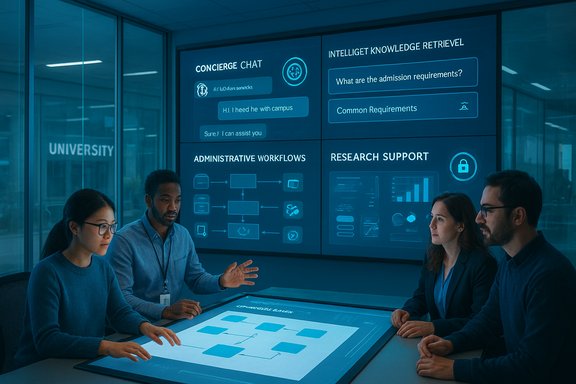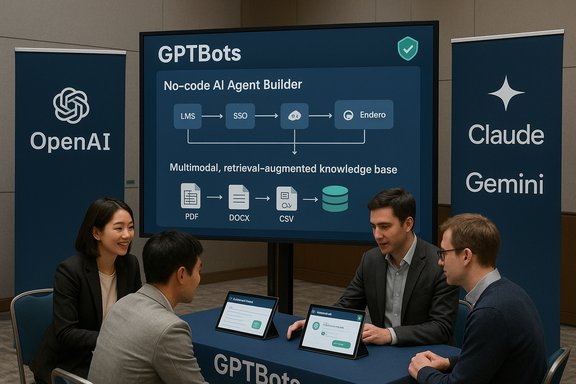
GPTBots’ no‑code AI agent platform took center stage at AXIES 2025 in Sapporo, where the company presented live demonstrations of campus‑focused agents for intelligent customer service, knowledge retrieval, administrative automation and research support—positioning its product as an enterprise‑style bridge between generative AI models and university IT operations during a three‑day conference that gathered Japan’s higher‑education IT community for a concentrated look at digital transformation.
Background
AXIES 2025 (the Academic eXchange for Information Environment and Strategy annual conference) convened on December 1–3, 2025 at the Sapporo Convention Center and assembled university IT leaders, CIOs, researchers and edtech vendors for keynote sessions, technical seminars and a vendor exhibition focused on the practical challenges of campus digitalization. Organizers projected a multi‑thousand participant program structure with a planned mix of paid registrants and invited participants that would place the total audience in the high‑hundreds to low‑thousands range across the three days.The event’s exhibitor roster included major platform vendors and cloud providers, with corporate members appearing across sponsorship tiers. Several global and Japan‑based firms used the conference to show education‑specific implementations of automation, collaboration, learning platforms and infrastructure tooling—creating a marketplace for vendors pitching both horizontal AI capabilities and domain‑specific solutions for higher education.
Against that backdrop, GPTBots—an enterprise AI agent platform marketed with a no‑code visual builder and multi‑model integrations—exhibited at AXIES and staged live demos aimed specifically at university operations teams. The company framed the demonstration around four campus scenarios: student help desks and FAQ automation, multimodal knowledge retrieval, administrative workflow automation, and research assistance.
What GPTBots showed on the AXIES floor
Practical campus scenarios emphasized
GPTBots’ exhibition concentrated on demonstrable, operational scenarios rather than exploratory research prototypes. The key use cases shown were:- Campus intelligent customer service — chat and messaging agents designed to answer routine student inquiries, triage issues and escalate to human staff when required.
- Intelligent knowledge base retrieval — a single search layer enabling faculty, staff and students to query regulations, procedures and academic resources aggregated across document formats.
- Administrative process automation — automated flows for approvals, academic affairs triggers, work‑order routing and HR queries.
- Academic research support — agents for literature retrieval, note aggregation and preliminary data organization tasks.
Messaging and positioning
GPTBots positioned itself as a pragmatic alternative to do‑it‑yourself LLM integrations, stressing no‑code visual development, multi‑model selection, multimodal knowledge management, and enterprise security controls (including options for private data residency and permissioned access). The vendor framed its offering for IT managers seeking auditable, configurable AI agents that can be integrated into existing campus systems (LMS, OA, ERP, SSO).Platform capabilities: what’s claimed and what’s verifiable
GPTBots promotes a consistent set of technical capabilities tailored for enterprise and campus use. Independent verification of several technical claims can be summarized as follows:- No‑code visual builder and workflow canvas. The platform’s product documentation describes a drag‑and‑drop builder with a visual flow canvas, prebuilt nodes for LLM invocation, knowledge retrieval, and connectors for common messaging and collaboration channels. This design is consistent with the vendor’s demo posture at AXIES and with modern enterprise agent platforms that emphasize citizen‑developer tooling.
- Multi‑model integration. GPTBots’ published model list and product documentation indicate support for commercial model APIs and a range of providers—naming OpenAI’s GPT models, Anthropic’s Claude, Google Gemini, Meta Llama and several cloud‑hosted model endpoints—together with a model management layer for key management and load balancing. That multi‑model approach permits institutions to select providers based on cost, performance or compliance preferences.
- Multimodal knowledge base and RAG (retrieval‑augmented generation). The product documentation describes ingestion pipelines for common document formats (PDF, DOCX, CSV, markdown) and a hybrid search architecture that combines sparse and dense retrieval—standard ingredients of RAG systems used to ground LLM responses in institution‑specific data.
- On‑premises / private deployment options and data residency controls. Product materials reference privatization services, choice of data center region when creating organizations, and role‑based access controls—features that indicate offerings beyond a single public SaaS tenancy. The vendor’s marketing emphasizes enterprise‑grade security and encryption; however, the exact operational model (true on‑prem software install versus private cloud managed service) and the scope of supported on‑prem integrations vary by customer contract and should be validated with the vendor for each deployment.
- Integrations with campus systems. The product documentation lists connectors and adaptation patterns for SSO providers, messaging channels and learning/campus systems, which aligns with the vendor’s asserted ability to integrate with LMS, OA and academic affairs systems. The degree of out‑of‑the‑box versus custom engineering work will vary by campus architecture.
Why AXIES mattered this year — and what GPTBots’ presence signals
AXIES is a domain‑specific conference where product teams must cross technical capability with governance and procurement realities. For higher education IT, the discussion is no longer about whether generative AI is possible—those experiments are ubiquitous—but about how to operationalize models into auditable, secure services that map to institutional process and privacy rules.GPTBots’ presence at AXIES indicates several trends:
- A shift from generic chatbots to agent orchestration: institutions want workflows and tool integrations, not purely conversational UIs.
- Growing emphasis on compliance and data residency: universities are risk‑averse about student and research data; vendors that offer private/data‑center choices and permissioned controls are more likely to enter RFPs.
- Demand for no‑code / low‑code admin tooling to empower functional teams: enabling non‑developers to assemble and maintain agents reduces dependency on scarce engineering resources.
- An expanding vendor landscape where education‑specific outcomes (student support, process automation, research assistance) are a primary battleground—alongside big platform players.
Strengths: what GPTBots brings to campus IT
- Rapid prototyping with a no‑code builder. For teams with limited developer cycles, a visual flow designer lowers the bar for building targeted agents for specific workflows.
- Model choice flexibility. The ability to route queries to different LLMs allows institutions to tailor cost/performance, experiment with multiple providers, and meet compliance considerations where certain models must be avoided or favored.
- RAG and multimodal knowledge handling. Built‑in document ingestion and vector retrieval are essential for delivering grounded answers from campus policies, course catalogs, and research repositories.
- Enterprise security posture. Advertised features such as data center selection, RBAC and encryption address primary concerns for university security teams and legal counsel.
- Integration focus. Out‑of‑the‑box connectors (SSO, messaging channels, LMS hooks) reduce integration time and help align agents with existing campus communication patterns.
Risks, limitations and areas of caution
While GPTBots and similar enterprise agent platforms offer meaningful value, several risk vectors deserve attention from university IT and procurement teams:- Model hallucination and factual accuracy. RAG mitigates hallucination risk by grounding responses in documents, but retrieval‑augmented systems still require verification layers. Institutions must design human‑in‑the‑loop gating for high‑risk knowledge domains (financial aid, legal advice, student conduct).
- Data governance and third‑party model calls. Multi‑model routing implies that data may flow to different external providers. Even when the vendor supports private deployment, default integrations with hosted LLMs can expose sensitive metadata unless carefully configured.
- Vendor lock‑in and operational complexity. No‑code tooling accelerates development but can create fragile, vendor‑specific flows that are difficult to migrate. Contract terms, exportability of training corpora, and APIs for backup/restore should be negotiated upfront.
- Overpromising ROI in early deployments. Vendors often present high automation rates or cost‑savings in marketing materials; real‑world numbers depend on dataset quality, change management, training, and the complexity of institutional processes.
- Accessibility and fairness considerations. Automated services must meet accessibility standards for students and faculty; conversational agents must avoid biases in responses that could disadvantage marginalized groups.
- Security of third‑party connectors. Outbound integrations to messaging apps and third‑party SaaS can introduce attack surface if credential management and least privilege are not enforced.
Deployment realities — cloud, private cloud, and on‑prem options
College and university IT teams face three broad deployment models for agent platforms:- Public SaaS with tenant isolation.
- Fastest to deploy; vendor manages model updates and scaling.
- Risk: external data flows and dependence on vendor security posture.
- Private cloud or dedicated region tenancy.
- Middle ground: improved data residency and contractual controls.
- Requires negotiation for SLAs, region guarantees and retention policies.
- On‑premises or self‑hosted deployment.
- Maximum control over data; preferred for sensitive research and regulated student records.
- Tradeoffs: higher operational cost, maintenance of LLM hosting (if local models used), and more complex integration.
What campus IT should evaluate before buying
When shortlisting AI agent platforms, universities should require vendors to demonstrate the following in a proof‑of‑concept:- A secure ingestion pipeline for institutional documents that preserves PII controls and retention policies.
- Clear mapping of data flow: which data leaves campus, which stays local, and where models are hosted and audited.
- Model governance controls: ability to pin model versions, disable risky providers, and route queries based on policy.
- Export and portability of knowledge bases, training logs, and agent configuration in standardized formats.
- Human‑in‑the‑loop workflows for escalation, correction and audit trails.
- Measurable KPIs for pilot programs (e.g., reduction in manual ticket volume, time‑to‑resolution, accuracy of responses).
- Accessibility compliance (screen reader compatibility, keyboard navigation, localization).
- Contractual commitments for incident response SLAs, data deletion, and breach notification timelines.
The competitive context: major vendors on the floor
AXIES’ exhibitor and sponsorship lists included cloud providers and enterprise software firms who are building education‑tailored solutions—some delivering foundational models, others packaging proprietary LLM‑enabled services. That landscape matters because:- Large cloud vendors offer deep integrations with campus identity, storage and compute—making them natural partners for universities already using those clouds.
- SaaS learning platforms are embedding generative capabilities in assignment workflows and grading pipelines, which can overlap with or complement agent platforms.
- Specialist integrators and consultants offer services to stitch together models, knowledge bases and institutional systems where out‑of‑the‑box connectors fall short.
Practical rollout recommendations for universities
- Start with a narrow, high‑impact pilot (e.g., student records FAQs or onboarding support) that has low regulatory risk and measurable metrics.
- Implement rigorous logging and auditing from day one to create an evidence trail for compliance and quality assurance.
- Use a phased approach to model selection: begin with deterministic, retrieval‑based responses and introduce generative completions only after verification steps are in place.
- Build an internal governance committee (IT, legal, registrar, research office) to define data classification rules and escalation policies.
- Invest in change management and staff training—frontline staff must know how to correct agent outputs and when to escalate to humans.
- Require exportable configurations and data from vendors to prevent lock‑in and ensure future flexibility.
Final analysis: opportunity tempered by governance
GPTBots’ AXIES exhibition highlighted an important reality: higher education is ready to operationalize AI agents, but the buyer’s emphasis has shifted from novelty toward control, compliance and integration. The platform’s no‑code builder, multi‑model support and multimodal knowledge management match the immediate needs of campus IT groups seeking to reduce routine workload and improve student service responsiveness. Those are practical strengths that can produce measurable benefits when pilots are scoped appropriately.At the same time, the technology introduces genuine governance challenges. Hallucination risk, data residency, third‑party model exposure, and potential vendor lock‑in are non‑trivial considerations for institutions that steward student records, research data and proprietary intellectual property. For universities, success will hinge not on the novelty of AI agents but on institutional discipline: precise procurement terms, rigorous pilot KPIs, layered verification workflows, and a governance model that places human accountability at the center of any automated service.
In sum, the AXIES floor offered a clear signal: vendors like GPTBots are building the toolchain universities need to operationalize generative AI, but adoption must be deliberate. The value proposition is real—automation, faster service and better knowledge access—yet these gains arrive only when matched by robust governance, transparency about model choices and a careful deployment strategy that protects students, staff and institutional missions.
Source: The Manila Times GPTBots Exhibits at AXIES Annual Conference, Empowering Digital Transformation in Higher Education