

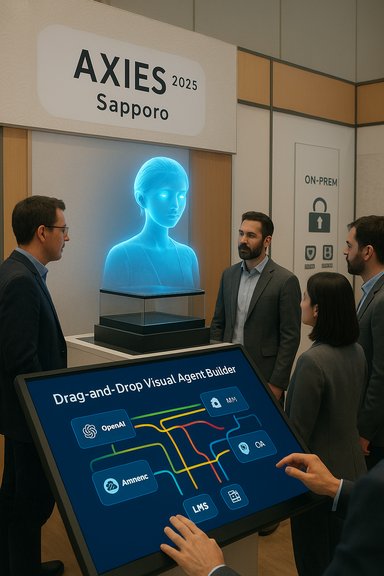
GPTBots’ presence at AXIES 2025 in Sapporo put a sharp spotlight on how AI agents are moving from vendor demos to practical campus services, and the company’s message — a no-code platform for building multimodal, multi-model agents tailored to university workflows — neatly married salesmanship with a clearer industry trend: institutions are now asking vendors for deployable, auditable solutions, not conceptual proofs of concept.
Background
The AXIES annual conference — billed as Academic eXchange for Information Environment and Strategy — staged its 15th gathering at the Sapporo Convention Center in early December 2025, with an agenda emphasizing higher-education informatization, institutional IT strategy, and campus-scale digital transformation. The host’s conference plan projected roughly the same scale of attendance that exhibitors, including GPTBots, described during the show: a large, technically literate audience of CIOs, IT leaders and campus service owners who are actively procurement-minded. GPTBots presented at AXIES alongside major platform players and positioned its product as a practical enabler for campus scenarios: intelligent customer service, knowledge-base retrieval for faculty and students, administrative process automation, and research support tools. Those scenarios reflect the most common procurement requests universities are making today as they shift from consumer-grade chatbots to governed agent architectures.Overview: what GPTBots said at AXIES and how it fits
GPTBots framed its AXIES presence around three propositions:- A no-code, visual agent builder to lower adoption friction for non-developers.
- Multi-model integration (explicitly calling out connectors to OpenAI family models and Anthropic Claude) and intelligent routing to optimize cost and capability.
- Enterprise-grade deployment choices — including on-premises options, data encryption, and role-based permissions — to address university concerns about privacy, telemetry, and compliance.
Why this matters to universities now
AI adoption has matured from curiosity to procurement
Universities have moved past the early stage of “let’s try ChatGPT” to more rigorous, institutionally governed adoption models. The dominant pattern emerging across campuses is “managed adoption”: centrally provisioned services, identity-integrated access, and governance policies that attempt to balance innovation with privacy and pedagogical integrity. Exhibitors at AXIES — including GPTBots — are responding to procurement requirements that now center on data residency, auditability, and integration with campus systems (LMS, OA, academic affairs databases).The business case is no longer theoretical
Operational use cases — student services chatbots, automated work-order routing, and document retrieval — yield measurable benefits that finance teams understand: reduced mean time to response, fewer manual approvals, and lower per-ticket cost for routine queries. Vendors that can showcase concrete KPIs from live demos or pilots gain faster buy-in from IT procurement and campus leadership.Product capabilities examined
No-code visual development
GPTBots promotes a drag-and-drop visual builder intended to let administrators model conversational flows, create tool-like connectors, and assemble multi-agent “teams” for more complex workflows. This approach reduces the need for in-house development resources and speeds iteration cycles for campus teams that typically lack large engineering squads. The company’s product documentation details features such as visual tool creation, natural-language SQL translation, and interactive data charts driven by query results. Benefits:- Faster prototyping for departmental use cases.
- Democratization of agent creation across service desks and academic units.
- Lower initial cost for pilot deployments.
- No-code tools often hide complexity — advanced integrations, custom security controls, and edge-case handling will still require engineering oversight.
- Administrators need revised operational practices (test suites, staging environments, rollback plans) to avoid brittle deployments.
Multi-model integration and intelligent scheduling
GPTBots advertises integration with multiple large language model providers and an intelligent routing layer that can pick the most appropriate model per task — for example, cheaper models for simple FAQ routing and stronger models for research-assist scenarios. Multi-model orchestration aims to balance accuracy, latency, and cost, which is attractive to budget-conscious universities. Strengths:- Cost control through model selection.
- Flexibility to swap backends as vendor offerings evolve.
- Significant operational overhead in keeping connectors, SLAs, and non-training contractual terms aligned across multiple vendors.
- Potential for inconsistent outputs if routing logic is misconfigured or observability is insufficient.
Multimodal knowledge base and RAG
Support for documents, images, and video indexing — combined with a RAG retrieval system — is central to GPTBots’ pitch for campus search: faculty and students can query institutional policies, syllabi, recorded lectures, and multimedia resources from a unified agent. The vendor describes hybrid sparse/dense search, query augmentation, and reranking to improve recall. Advantages:- Single-pane access to distributed campus knowledge.
- Potentially steep improvements in staff productivity and student self-service.
- Effective RAG deployments depend heavily on metadata hygiene, document segmentation strategy, and provenance tracking — areas where campus data is notoriously messy unless a governance uplift is undertaken first.
Visual workflow configuration and system integration
GPTBots emphasizes connectors to common enterprise and campus systems (LMS, OA, HR platforms) and visual workflow editors to route approvals and automate administrative processes. Integration ease is a decisive factor for colleges considering AI agents; connecting to student information systems and identity providers is non-negotiable for scalable deployments. Operational note:- Integration should always be treated as a project, not a click-through: identity federation, API throttling, and data classification must be explicitly mapped and tested.
Enterprise-grade security, on-premises deployment, and compliance
GPTBots lists on-premises options, data encryption, and permission management as fundamental capabilities to address institutional risk concerns. These features speak directly to procurement teams that demand documented controls over telemetry, retention, and data flows. However, vendors’ product marketing is not the same as contractual protection. Independent verification via procurement clauses is essential. Key procurement best practices:- Require enforceable contractual clauses that describe telemetry usage and non-training guarantees.
- Insist on deletion and audit rights for uploaded data.
- Validate RBAC, SSO integration, and logging behavior prior to campus-wide rollout.
What the demonstrations at AXIES actually told us
GPTBots’ booth reportedly drew university IT leaders from Hokkaido University, Shizuoka University and Chiba Institute of Technology, among others, and the demos were tailored to campus pain points — which is exactly where vendor discussions need to land. The company’s emphasis on templates for customer service bots and administrative automation aligns with the procurement pressure points universities raise in budget reviews: immediate operational return and reduced dependency on vendor-side development teams. But the presence of live demos and expressions of interest are not a substitute for proof of longitudinal performance. Universities should require staged pilots that measure:- Escalation rates to human staff.
- Latency and availability under load.
- Accuracy and provenance of retrieved content.
- Cost-per-interaction and total cost of ownership over 12–36 months.
Strengths: where GPTBots’ offering aligns with campus needs
- Speed-to-value: No-code templates and visual builders accelerate pilots and reduce friction for campus service owners.
- Flexibility: Multi-model routing and multimodal knowledge ingestion offer a pragmatic path to mix-and-match vendor models without being stuck on a single provider.
- Operational focus: The platform’s emphasis on workflow automation and integrations addresses the most pressing ROI-driven use cases for campus IT teams.
- Security posture (marketing-level): On-prem and controlled deployment options are explicitly offered, which is necessary for institutions handling student data and research IP.
Risks and red flags universities must negotiate
Vendor claims vs. contractual guarantees
Marketing claims about on-premises deployment or non-training of customer data do not equal contractual protections. Universities should insist on precise, auditable terms that cover telemetry, model-training usage, and deletion rights. Without those, the vendor-set product behavior may change following a contract renewal or backend modifications. The pattern of “enterprise” branding without enforceable contractual terms is a sector-wide hazard.Hallucinations, provenance, and academic integrity
No matter how advanced the agent, hallucinations (confident but incorrect outputs) remain an operational risk. Academic use cases — especially research support and student-facing information retrieval — require explicit provenance: the agent must cite the documents or policy sections it used and provide a path for human verification. Institutions should scale high-stakes queries to human-in-the-loop review until models and retrieval systems demonstrate reliable precision metrics.Integration complexity
Saying a platform “connects to LMS and OA” is different from delivering robust integrations that manage identity, rate limiting, and data classification. Universities must budget for integration projects and validate connectors in sandboxed environments under representative load.Vendor lock-in and governance drift
Multi-model support is a mitigation strategy for lock-in, but long-term adoption still risks dependency if the campus’s custom knowledge base and workflows are tied to the vendor’s runtime and orchestration layers. Institutions should insist on exportable, portable data formats for knowledge stores and maintain a documented rollback plan.Equity and access
AI features that rely on high-bandwidth or modern client hardware can inadvertently advantage students with better devices or home internet. For inclusive deployments, campuses should pair agent rollouts with device-lending programs and low-bandwidth alternatives.Procurement and deployment checklist for campus IT leaders
- Define KPIs up front: response time, percent handled by agent, user satisfaction, cost per interaction.
- Demand contractual guarantees for data handling: non-training, deletion, audit rights, and explicit SLAs for uptime.
- Require identity integration and RBAC as a baseline; no departmental agent should be published without SSO gating.
- Verify logging and retention policies align with institutional data classification and legal requirements.
- Stage pilots with clear rollback procedures and red-team the agent for hallucinations, data leakage, and malicious-prompts exploitation.
- Maintain a “human-in-the-loop” design for high-stakes administrative and academic procedures until reliability is proven.
- Ensure knowledge-base hygiene: metadata standards, segmentation rules, and provenance tagging before broad ingestion.
- Budget for integration: API endpoints, rate limits, and maintenance windows are real operational costs.
Where GPTBots fits in the vendor landscape
GPTBots is one of several vendors carving a niche in enterprise AI agents with a focus on no-code assembly, agent orchestration, and multimodal retrieval. The company’s marketing and press activity in 2025 positions it as an active participant in Asian market events — from Tokyo hackathons to AI expos and the AXIES conference in Sapporo — and the firm is already supplying demos and pilot-level engagement in the region. These market activities are consistent with a vendor seeking real-world traction among universities and mid-size enterprises. The most relevant comparative criterion is not feature parity but operational accountability: how well a vendor can convert a piloted workflow into a governed service with documented contractual protections and measurable campus KPIs. Vendors that combine product features with strong procurement documentation and auditability will win sustained campus deployments.Recommended evaluation framework for universities
When evaluating GPTBots or similar platforms, institutions should use a three-layer framework:1. Product fit
- Does the platform natively support the data types and source systems the campus uses?
- Are template agents available for the most common workflows (student FAQ, HR inquiries, approvals)?
2. Operational readiness
- Is the platform deployable in a tenant-contained or on-premises model?
- How are logs, retention, and user-level telemetry surfaced for audits?
- What is the vendor’s SLAs and incident response plan?
3. Governance and pedagogy
- How will the campus integrate AI literacy training and assessment redesign in parallel with agent rollout?
- Are there policies for disclosure of AI assistance in student submissions and research outputs?
Public claims verified — and the limitations of verification
Independent confirmation of the basic events is straightforward: GPTBots distributed press releases covering its AXIES exhibition and related Japanese events in 2025, and the AXIES host site confirmed the conference dates and Sapporo venue. Those independent documents corroborate the vendor’s physical presence and audience context. However, several product-specific claims — such as exact contractual protections, the degree of “on-prem” isolation, or the specifics of telemetry handling (non-training guarantees) — are marketing statements until validated in a signed procurement agreement. Prospective customers should treat such product claims as verifiable only through contractually defined terms and technical acceptance tests, and not as take-it-on-faith features. This cautionary stance is essential given the sector’s history of divergent expectations between vendor marketing and contractual reality.The bigger picture: AI agents and the future of campus services
AI agents bring a structural shift to university operations: routine, high-volume enquiries can be handled 24/7 with consistent service levels, while faculty and staff are freed for higher-value tasks. When paired with governance and pedagogical strategy, agents can improve access to institutional knowledge and reduce administrative friction. Yet the long-term academic value depends on governance depth: transparency, data protections, and curricular adaptation that teach students how to use AI responsibly.Institutions that treat agents as software-defined services — with formal KPIs, data contracts, and curricular integration — will extract the most durable value. Those that treat them as point solutions risk creating brittle dependencies and privacy exposure.
Conclusion
GPTBots’ demonstration at AXIES 2025 is a useful bellwether: it shows the vendor community responding to explicit campus needs — no-code builders for speed, multimodal retrieval for academic utility, and deployment options meant to address compliance concerns. The product narrative aligns with what university IT buyers now demand: demonstrable ROI, identity integration, and verifiable controls.At the same time, marketing claims require contractual and technical verification. Procurement teams must insist on clear, enforceable terms around telemetry, retention, and non-training guarantees, and they must design pilots that produce defensible KPIs. The opportunity for AI agents to reshape campus operations is real, but it will be realized only when vendors, legal teams, and campus educators converge on rigorous acceptance criteria and sustain governance practices that protect privacy, academic integrity, and institutional autonomy.
Source: StreetInsider GPTBots Exhibits at AXIES Annual Conference, Empowering Digital Transformation in Higher Education
