

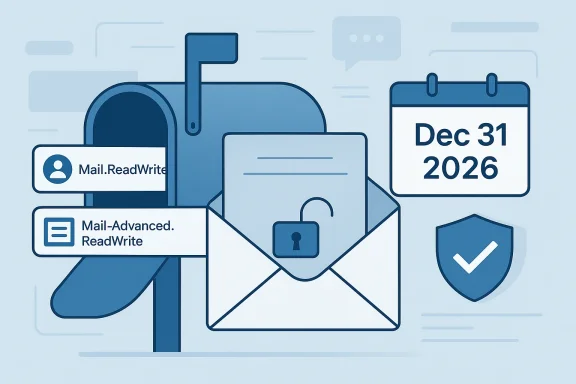
The Exchange team’s notice about upcoming Graph API enforcement is more than a narrow permissions tweak: it is a deliberate tightening of how Microsoft wants applications to treat received email. Beginning December 31, 2026, apps that attempt to modify sensitive properties on non-draft messages — including the subject, body, recipients, and other fields designated in the documentation — will need elevated Mail-Advanced.ReadWrite permissions, while ordinary draft editing will continue to work with Mail.ReadWrite. That makes this a significant breaking change for any tenant, security product, or workflow engine that has been relying on the older behavior of editing inbox messages in place. The change is aimed at preserving message immutability, but it also raises the bar for enterprise developers who have built mail-processing features around the current Graph model.
Microsoft’s announcement fits a pattern that has become familiar to Exchange administrators over the last few years: gradually narrowing legacy behavior, pushing developers toward the more explicit Microsoft Graph model, and reserving powerful mail-manipulation capabilities for vetted, consented applications. The company has repeatedly warned that older Exchange pathways are being retired, re-scoped, or given stronger enforcement boundaries, especially where mailbox content and tenant-wide privileges are concerned. This latest change extends that philosophy into the message object itself, where received mail is increasingly treated as something to be managed, not rewritten.
The practical distinction here is simple but important: drafts are editable, while received messages are supposed to be stable. Microsoft’s own Graph documentation already reflects that assumption by identifying a set of fields that are only updateable when
This is also a security story. The Exchange team specifically called out legitimate specialized use cases such as suspicious-mail investigation and privileged security workflows, which is a clear hint that Microsoft sees a small set of sanctioned scenarios where message mutation on non-draft mail is justified. Those scenarios will need the new Mail-Advanced.ReadWrite, Mail-Advanced.ReadWrite.All, or Mail-Advanced.ReadWrite.Shared permissions, all of which require tenant admin consent. That is a meaningful gate: Microsoft is not just adding an app permission, it is adding a governance checkpoint.
For enterprises, the long lead time until December 31, 2026 is helpful, but it should not encourage complacency. Large mail-processing ecosystems often contain hidden dependencies — archiving tools, security gateways, journaling workflows, threat-hunting integrations, and internal automation scripts — and those dependencies are exactly the kind that become brittle when Microsoft shifts from permissive behavior to explicit authorization. The service-side enforcement date gives organizations time to inventory and remediate, but only if they treat this as a migration project rather than a passive notification.
Historically, Microsoft has allowed broader mailbox access through different stacks, and Graph has often had to balance compatibility with stricter security boundaries. Over time, Microsoft has been pushing developers away from older mechanisms like EWS and toward Graph-based patterns with more precise permissions and clearer scopes. That broader platform direction explains why a message-editing loophole or tolerance eventually gets closed: the company wants mailbox operations to be more predictable, more auditable, and less open-ended.
There is also a subtle but important distinction between editing a draft and editing a received message. A draft is an in-progress object whose entire purpose is to change before send; a received message is a historical artifact. Microsoft’s Graph docs already encode this distinction by allowing certain properties to be updated in the draft lifecycle and effectively barring them in the post-delivery lifecycle. The new enforcement aligns runtime behavior with that model, which means the platform is becoming less forgiving of “creative” implementations that treated the inbox like a mutable workspace.
From a security perspective, this direction is logical. Email is one of the most heavily abused enterprise attack surfaces, and the ability to alter message content after delivery can complicate forensics, anti-phishing workflows, and compliance controls if it is used too broadly. Microsoft’s reference to security-domain exceptions suggests the company is trying to preserve the ability of specialized products to annotate or remediate mail while preventing general-purpose apps from silently changing core message content. That separation is not cosmetic; it is the difference between privileged analysis and unauthorized mutation.
The distinction also helps explain why the new permissions are advanced. Microsoft appears to be drawing a bright line between normal mailbox management and operations that can effectively rewrite message content. The latter category is powerful enough to require tenant-admin approval, and that makes sense because it is the kind of capability that can be abused if granted too broadly. In short, the service is moving from broad convenience to explicit privilege.
That model also suggests Microsoft is separating scope from capability. An app might have permission to act only on the signed-in user’s mailbox, on all mailboxes, or on mail the user can access, but in each case the elevated capability is still gated by the same advanced permission family. That is a sensible design for large tenants because it lets administrators choose where the app may operate without diluting the question of what the app may do.
Key takeaways:
There is also a platform consistency argument. Microsoft Graph is meant to present a coherent object model across services, and mailbox behavior that permits silent mutation of delivered content weakens that coherence. By forcing apps to use a higher-privilege permission for sensitive updates, Microsoft is aligning the service with the object model the docs already describe. In effect, this is Microsoft saying that the documentation was not just aspirational; it was a preview of the enforcement model.
This is especially relevant in modern enterprise environments where multiple systems touch the same mailbox. A message may pass through malware scanning, user-facing automation, journaling, retention, and analytics, each of which may need limited write access. Microsoft’s move suggests a desire to prevent a “lowest common denominator” permission from becoming a backdoor for content rewriting. That is a defensive design choice, and one that fits the broader trend toward least privilege.
Security vendors and managed service providers are another major group. Products that label suspicious messages, inject analysis markers, rewrite header-like content, or alter mail bodies for quarantine workflows may need to revisit both their permission model and their user experience. Because admin consent is required, even a technically simple change can become an enterprise rollout project with governance review, documentation updates, and customer communication.
Consumer-style tools, by contrast, are less likely to be doing this sort of mutation in the first place. Most end-user mail clients already treat delivered messages as immutable, aside from read state, flags, categories, or similar controls. The new behavior therefore mostly formalizes what many users already expect: after delivery, the content of the message should not be casually rewritten behind the scenes.
Potentially affected scenarios include:
The most important operational implication is that waiting until late 2026 will be risky. Admin consent can trigger internal reviews, change-management tickets, security signoff, and vendor coordination, especially in regulated industries. If the application is third-party software, customers may also need guidance from the vendor on whether the new scope is supported, tested, or even intended.
A good inventory process would typically include:
The practical code impact could be subtle. Many applications do not treat email content edits as a separate feature flag; they just call a generic update helper. If that helper applies to both drafts and non-drafts, then the application may fail in ways that are hard to spot during testing, especially if test data is mostly draft-based. The risk is latent failure: the code keeps working in development but starts returning authorization or validation errors after service enforcement.
This separation is useful because it preserves the common path for email creation while limiting post-delivery mutation. It also encourages app designers to choose a cleaner architecture: create a draft, finalize the content, then send it, instead of sending first and revising later. That is better software design even beyond Microsoft’s policy change.
It may also accelerate the shift toward sidecar metadata rather than mutating the email itself. Instead of rewriting the message body or subject, vendors may store analysis results in separate objects, labels, logs, or compliance stores. That design preserves the message record and reduces permission friction, though it can complicate user experience and search behavior. In the long run, however, it is often the more durable approach.
That could be a competitive differentiator. Products that can explain their mailbox-touching behavior cleanly — and minimize it — will likely win more trust in security-conscious environments. In other words, Microsoft’s change does not merely affect functionality; it reshapes the conversation vendors must have with buyers.
Useful test cases include:
Longer term, this change is consistent with where Microsoft has been steering the platform for some time: more Graph, more explicit permissions, fewer implicit behaviors, and stricter boundaries around sensitive operations. It would not be surprising to see further refinements in adjacent mailbox APIs as Microsoft continues to rationalize what apps may do to messages versus what they may only observe. For developers, the safest assumption is that mailbox mutability will keep shrinking unless a use case is clearly privileged and clearly justified.
Watch for these next steps:
Source: Microsoft Exchange Team Blog Upcoming Breaking Changes to Modifying Sensitive Email Properties via Graph API | Microsoft Community Hub
 Overview
Microsoft’s announcement fits a pattern that has become familiar to Exchange administrators over the last few years: gradually narrowing legacy behavior, pushing developers toward the more explicit Microsoft Graph model, and reserving powerful mail-manipulation capabilities for vetted, consented applications. The company has repeatedly warned that older Exchange pathways are being retired, re-scoped, or given stronger enforcement boundaries, especially where mailbox content and tenant-wide privileges are concerned. This latest change extends that philosophy into the message object itself, where received mail is increasingly treated as something to be managed, not rewritten.The practical distinction here is simple but important: drafts are editable, while received messages are supposed to be stable. Microsoft’s own Graph documentation already reflects that assumption by identifying a set of fields that are only updateable when
isDraft = true, and the new enforcement simply turns that documentation boundary into a service boundary. In other words, the service is moving from “the docs say don’t do this” to “the platform will stop you from doing this unless you have the right permission.” That is a classic tightening of policy into enforcement, and it tends to surprise developers who have depended on undocumented flexibility.This is also a security story. The Exchange team specifically called out legitimate specialized use cases such as suspicious-mail investigation and privileged security workflows, which is a clear hint that Microsoft sees a small set of sanctioned scenarios where message mutation on non-draft mail is justified. Those scenarios will need the new Mail-Advanced.ReadWrite, Mail-Advanced.ReadWrite.All, or Mail-Advanced.ReadWrite.Shared permissions, all of which require tenant admin consent. That is a meaningful gate: Microsoft is not just adding an app permission, it is adding a governance checkpoint.
For enterprises, the long lead time until December 31, 2026 is helpful, but it should not encourage complacency. Large mail-processing ecosystems often contain hidden dependencies — archiving tools, security gateways, journaling workflows, threat-hunting integrations, and internal automation scripts — and those dependencies are exactly the kind that become brittle when Microsoft shifts from permissive behavior to explicit authorization. The service-side enforcement date gives organizations time to inventory and remediate, but only if they treat this as a migration project rather than a passive notification.
Background
The basic principle behind the change is familiar to anyone who has worked with Exchange, Outlook, or eDiscovery for long: once a message is delivered, it should remain a record of what was actually received. Users can mark it read, flag it, categorize it, move it, or retain it, but they generally should not be able to rewrite the original content after the fact. That is not just a technical preference; it is central to trust, auditability, and message authenticity. When the body or recipient list changes in place, downstream systems lose confidence in the mailbox as a source of truth.Historically, Microsoft has allowed broader mailbox access through different stacks, and Graph has often had to balance compatibility with stricter security boundaries. Over time, Microsoft has been pushing developers away from older mechanisms like EWS and toward Graph-based patterns with more precise permissions and clearer scopes. That broader platform direction explains why a message-editing loophole or tolerance eventually gets closed: the company wants mailbox operations to be more predictable, more auditable, and less open-ended.
There is also a subtle but important distinction between editing a draft and editing a received message. A draft is an in-progress object whose entire purpose is to change before send; a received message is a historical artifact. Microsoft’s Graph docs already encode this distinction by allowing certain properties to be updated in the draft lifecycle and effectively barring them in the post-delivery lifecycle. The new enforcement aligns runtime behavior with that model, which means the platform is becoming less forgiving of “creative” implementations that treated the inbox like a mutable workspace.
From a security perspective, this direction is logical. Email is one of the most heavily abused enterprise attack surfaces, and the ability to alter message content after delivery can complicate forensics, anti-phishing workflows, and compliance controls if it is used too broadly. Microsoft’s reference to security-domain exceptions suggests the company is trying to preserve the ability of specialized products to annotate or remediate mail while preventing general-purpose apps from silently changing core message content. That separation is not cosmetic; it is the difference between privileged analysis and unauthorized mutation.
What Changes in the Graph API
The headline change is straightforward: applications will no longer be able to modify sensitive properties on non-draft email messages unless they hold one of the Mail-Advanced.ReadWrite family of permissions. Microsoft’s own permissions reference shows those scopes are specifically intended to support modification of existing non-draft mail, and all of them require admin consent. In practice, this means a standardMail.ReadWrite app will still be able to work with drafts, but it will lose the ability to patch protected fields on messages that have already been received.Sensitive properties and why they matter
The sensitive properties mentioned in the announcement include the subject, body, recipients, and other fields that Microsoft documents as draft-only updateable fields. These are not trivial metadata fields; they are the core evidentiary components of a message. If an app can replace them in a delivered item, it can alter the meaning of the message in ways that affect users, auditors, and downstream automations. That is why Microsoft’s tightening here is best understood as a trust-preserving change, not merely a permission reshuffle.The distinction also helps explain why the new permissions are advanced. Microsoft appears to be drawing a bright line between normal mailbox management and operations that can effectively rewrite message content. The latter category is powerful enough to require tenant-admin approval, and that makes sense because it is the kind of capability that can be abused if granted too broadly. In short, the service is moving from broad convenience to explicit privilege.
The permission model
The three permissions called out in the announcement are Mail-Advanced.ReadWrite, Mail-Advanced.ReadWrite.All, and Mail-Advanced.ReadWrite.Shared. The permissions reference describes them as enabling create, read, update, and delete mail including contents of non-draft emails, with variations depending on whether the app operates on the signed-in user’s mail, all mailboxes, or shared mail. All three require admin consent, which is a strong signal that Microsoft expects these to be rare, deliberate grants rather than default application permissions.That model also suggests Microsoft is separating scope from capability. An app might have permission to act only on the signed-in user’s mailbox, on all mailboxes, or on mail the user can access, but in each case the elevated capability is still gated by the same advanced permission family. That is a sensible design for large tenants because it lets administrators choose where the app may operate without diluting the question of what the app may do.
Key takeaways:
- Mail.ReadWrite will remain sufficient for draft updates.
- Mail-Advanced.ReadWrite is required for non-draft sensitive property changes.
- Admin consent is mandatory for the advanced permissions.
- The restriction applies to message update methods in Graph, not just one endpoint.
Why Microsoft Is Doing This
Microsoft’s stated rationale is the clearest clue: a received message should remain unchanged except for management-related fields like read status and flags. That is an immutability principle, and it serves both security and compliance goals. The more an organization can trust the original message object, the easier it is to investigate incidents, prove what arrived, and avoid disputes about post-delivery manipulation.There is also a platform consistency argument. Microsoft Graph is meant to present a coherent object model across services, and mailbox behavior that permits silent mutation of delivered content weakens that coherence. By forcing apps to use a higher-privilege permission for sensitive updates, Microsoft is aligning the service with the object model the docs already describe. In effect, this is Microsoft saying that the documentation was not just aspirational; it was a preview of the enforcement model.
Security and compliance implications
For security teams, the change is likely to be welcome, even if it causes short-term disruption. Message content is often part of phishing investigations, incident response, legal hold, and compliance review. If ordinary line-of-business apps can mutate subjects and bodies in place, those workflows become less reliable. Tighter permissions reduce the chance that benign automation unintentionally undermines forensic integrity, and they also make malicious abuse harder.This is especially relevant in modern enterprise environments where multiple systems touch the same mailbox. A message may pass through malware scanning, user-facing automation, journaling, retention, and analytics, each of which may need limited write access. Microsoft’s move suggests a desire to prevent a “lowest common denominator” permission from becoming a backdoor for content rewriting. That is a defensive design choice, and one that fits the broader trend toward least privilege.
Special cases and privileged workflows
Microsoft did not say that all post-delivery editing is forbidden. Instead, it explicitly referenced specialized security-domain use cases, which implies that the advanced permissions are meant to preserve those scenarios. That is an important nuance: the company is not closing the door entirely, but it is making sure the door has a lock, a key, and a paper trail. For defenders, that is the right outcome; for casual app developers, it is a reminder that mailbox mutation is not a generic capability.Who Will Be Affected
The most obvious affected group is any developer whose app updates message content after delivery. That includes tools that clean, normalize, redact, enrich, or transform emails in place. If those tools currently rely onMail.ReadWrite and standard Graph message PATCH calls, they will likely fail once enforcement begins unless they are reconsented for advanced permissions.Security vendors and managed service providers are another major group. Products that label suspicious messages, inject analysis markers, rewrite header-like content, or alter mail bodies for quarantine workflows may need to revisit both their permission model and their user experience. Because admin consent is required, even a technically simple change can become an enterprise rollout project with governance review, documentation updates, and customer communication.
Enterprise applications versus consumer-style tooling
Enterprise apps are likely to feel the greatest impact because they are the ones most often granted mailbox-wide access and the ones most likely to automate message handling at scale. If a workflow depends on altering message content in a mailbox that belongs to another user or spans shared mail, the advanced permission model becomes unavoidable. That adds friction, but it also creates the kind of explicit authorization boundary enterprises usually want.Consumer-style tools, by contrast, are less likely to be doing this sort of mutation in the first place. Most end-user mail clients already treat delivered messages as immutable, aside from read state, flags, categories, or similar controls. The new behavior therefore mostly formalizes what many users already expect: after delivery, the content of the message should not be casually rewritten behind the scenes.
Potentially affected scenarios include:
- Mail security tools that annotate or rewrite suspicious messages.
- Compliance tools that alter message content during processing.
- Middleware that normalizes received email bodies.
- Automation that edits recipients or subject lines after delivery.
- Shared-mailbox workflows that currently patch message content in place.
The Timeline Matters
Microsoft says the required permissions are already available, but the blocking behavior will not begin until December 31, 2026. That date gives teams almost nine months from the March 2026 announcement to inventory their apps, identify risky write paths, and complete tenant-admin consent flows where needed. In Microsoft terms, that is a generous runway, but it is still short enough that large estates should start now.The most important operational implication is that waiting until late 2026 will be risky. Admin consent can trigger internal reviews, change-management tickets, security signoff, and vendor coordination, especially in regulated industries. If the application is third-party software, customers may also need guidance from the vendor on whether the new scope is supported, tested, or even intended.
Why an early audit is smarter than a late fix
Organizations should treat this as an application inventory problem, not just a permissions problem. It is not enough to know which apps call Graph; teams need to know which apps update messages, which properties they modify, and whether those objects are drafts or delivered items. That distinction determines whether the existing permission set is still adequate or whether a migration to the advanced scope is required.A good inventory process would typically include:
- Identifying every app that calls
PATCHor other update methods against Graph messages. - Checking whether those calls touch subject, body, recipients, or other sensitive fields.
- Determining whether the target message is always a draft or sometimes a delivered item.
- Mapping each app to the exact permission it currently uses.
- Planning the consent and testing path for any app that needs elevated access.
Technical Impact on Developers
For developers, the crucial question is not “does my app use Graph?” but “what message fields does my app update, and under what conditions?” A Graph app that only marks mail read or updates flags is likely unaffected. An app that rewrites content on non-draft messages, however, should assume it is in scope unless it can prove otherwise. That is a different class of review entirely.The practical code impact could be subtle. Many applications do not treat email content edits as a separate feature flag; they just call a generic update helper. If that helper applies to both drafts and non-drafts, then the application may fail in ways that are hard to spot during testing, especially if test data is mostly draft-based. The risk is latent failure: the code keeps working in development but starts returning authorization or validation errors after service enforcement.
Draft workflows should remain safe
Microsoft is explicit that draft messages will continue to be updateable with Mail.ReadWrite. That means standard compose-and-send flows should not need the advanced permissions as long as they only edit drafts before sending. If your app creates drafts, updates drafts, and only then sends them, the change should be invisible from a functional standpoint.This separation is useful because it preserves the common path for email creation while limiting post-delivery mutation. It also encourages app designers to choose a cleaner architecture: create a draft, finalize the content, then send it, instead of sending first and revising later. That is better software design even beyond Microsoft’s policy change.
Advanced permissions are not a workaround; they are a contract
The advanced permissions are not just a larger version of Mail.ReadWrite. They represent a deliberate contract with the tenant administrator that the app needs the ability to manipulate non-draft mail content. Because the permissions require admin consent, every grant should be traceable to a business justification, and every use should be constrained to the smallest practical scope. That is the governance model Microsoft is signaling.Market and Ecosystem Implications
This change will likely ripple beyond direct Graph developers. Exchange adjacent products — archiving systems, security tooling, mail hygiene platforms, insider-risk solutions, and productivity add-ins — often share a common dependency pattern: they read mail, infer context, and then write something back. When Microsoft narrows what may be written back to non-draft mail, vendors will need to revisit product architecture and probably customer documentation as well.It may also accelerate the shift toward sidecar metadata rather than mutating the email itself. Instead of rewriting the message body or subject, vendors may store analysis results in separate objects, labels, logs, or compliance stores. That design preserves the message record and reduces permission friction, though it can complicate user experience and search behavior. In the long run, however, it is often the more durable approach.
Competitive consequences for vendors
Vendors that have already built around least privilege and immutable message handling will be better positioned. Those that depend on broad mailbox mutation may find themselves forced into a product redesign, a permissions upgrade, or both. Because admin consent is now part of the story, the sales cycle may also become longer: customers will ask more questions about what the app changes, why it needs advanced scopes, and how the behavior is audited.That could be a competitive differentiator. Products that can explain their mailbox-touching behavior cleanly — and minimize it — will likely win more trust in security-conscious environments. In other words, Microsoft’s change does not merely affect functionality; it reshapes the conversation vendors must have with buyers.
Practical Guidance for IT Teams
The best response is a structured audit of any app that touches mail. This is one of those changes where a quick permission inventory is not enough; teams need to understand behavior, usage patterns, and business criticality. The fact that the permissions already exist means remediation can start immediately, but only if teams know which applications truly need them.Recommended action plan
A reasonable rollout plan would look like this:- Catalog all Graph apps with mailbox access.
- Identify update operations on messages, especially
PATCHflows. - Separate draft editing from post-delivery mutation.
- Request and test advanced permissions only where genuinely required.
- Document the business case for admin consent in each tenant.
Testing scenarios you should not skip
Testing should include both “happy path” and “failure path” coverage. You want to confirm that draft editing still works under existing permissions and that non-draft sensitive updates are blocked or allowed exactly as expected depending on the granted scope. Also verify how your app behaves when it receives the new enforcement failure, because graceful degradation is better than a broken workflow.Useful test cases include:
- Editing a draft subject and body with
Mail.ReadWrite. - Attempting the same change on a sent or received message.
- Updating read status and flags on delivered mail.
- Testing shared-mailbox scenarios separately.
- Verifying admin-consent prompts and tenant policy impacts.
Strengths and Opportunities
The upside of this change is that it clarifies the rules and pushes the ecosystem toward safer designs. It rewards applications that respect message integrity, and it gives enterprises a cleaner permission boundary around a historically sensitive part of the mailbox. Just as importantly, it creates an opportunity for vendors to modernize their workflows and prove that they can operate with least privilege rather than broad write access.- Stronger message immutability for delivered email.
- Clearer separation between drafts and received mail.
- Better alignment between docs and runtime enforcement.
- Reduced risk of unauthorized content rewriting.
- More defensible compliance and audit posture.
- Incentive for vendors to redesign around metadata instead of mutation.
- Improved tenant control through admin-consent gating.
Risks and Concerns
The obvious downside is disruption. Some applications will fail when the enforcement flips on, and some of those failures will be in workflows that end users never see until something quietly stops updating. There is also a governance burden: requiring advanced permissions means more admin review, more documentation, and more room for delayed or rejected consent requests, especially in larger tenants.- Hidden dependencies may surface late in the rollout cycle.
- Third-party vendors may need time to ship updated consent models.
- Some security products may lose functionality if they are not reauthorized.
- Legacy code may assume post-delivery edits are always allowed.
- Administrators may struggle to distinguish safe from unsafe advanced scopes.
- Testing environments may not reproduce production consent behavior.
- Shared mailbox scenarios could be especially confusing during transition.
Looking Ahead
The most likely near-term outcome is a wave of application reviews across Exchange Online tenants. Security teams will want to know which apps can rewrite mailbox content, compliance teams will want to preserve auditability, and vendors will need to decide whether their products truly require post-delivery mutation or can move to a safer model. Because Microsoft has already made the advanced permissions available, the technical path is open; the work now is operational and organizational.Longer term, this change is consistent with where Microsoft has been steering the platform for some time: more Graph, more explicit permissions, fewer implicit behaviors, and stricter boundaries around sensitive operations. It would not be surprising to see further refinements in adjacent mailbox APIs as Microsoft continues to rationalize what apps may do to messages versus what they may only observe. For developers, the safest assumption is that mailbox mutability will keep shrinking unless a use case is clearly privileged and clearly justified.
Watch for these next steps:
- Vendor advisories about Graph permission changes.
- Updated Microsoft documentation for sensitive message fields.
- Admin-center guidance on advanced consent workflows.
- Break/fix reports from apps that modify non-draft mail.
- Customer education from security and compliance product teams.
Source: Microsoft Exchange Team Blog Upcoming Breaking Changes to Modifying Sensitive Email Properties via Graph API | Microsoft Community Hub
