

Grid Dynamics announced on May 19, 2026, that it has launched an AI-native modernization service on Microsoft Azure, using its GAIN Platform for SDLC to target large enterprises running mission-critical legacy systems. The announcement is not just another partner badge in the Azure ecosystem. It is a sign that the modernization market is being recast around AI-assisted engineering, automated data migration, and the industrialization of software delivery. For WindowsForum readers, the interesting part is not the press-release language, but what this says about where Azure modernization is headed: away from one-off migration projects and toward repeatable, AI-driven transformation factories.
Enterprise cloud migration used to be pitched as a destination story. Move the workload to Azure, right-size the VM, modernize the database if you can, and call the program a success when the old data center contract finally expires. That framing still exists, but it is no longer enough for vendors trying to win large enterprise transformation deals.
Grid Dynamics is positioning its new Azure modernization service around the harder problem: what happens when the legacy estate is too large, too entangled, and too business-critical to be treated as a conventional migration backlog. The company says the offering is aimed at high-transaction-volume environments, the sort of systems that sit behind financial services, retail operations, manufacturing platforms, healthcare workflows, and other domains where “legacy” often means still paying the bills.
The hook is GAIN, Grid Dynamics’ AI-Native Development Platform for the software development life cycle. In the company’s framing, this is not merely about using generative AI to help developers write code faster. It is about applying AI to requirements, analysis, test generation, code transformation, data migration, quality assurance, and the governance scaffolding around the whole process.
That distinction matters because enterprise modernization failures rarely come from a lack of enthusiasm for cloud. They come from unknown dependencies, brittle integrations, untested business rules, institutional knowledge trapped in retiring teams, and source systems whose documentation is more archaeological than operational. AI will not magically solve those problems, but it can change the economics of discovery and refactoring if it is used as part of a disciplined engineering workflow.
Grid Dynamics’ announcement lands squarely in that new market narrative. Azure is the platform. GAIN is the factory floor. The real product is the promise that large enterprises can move faster without surrendering control of systems they cannot afford to break.
That progression is important. A simple VM migration may reduce data center friction, but it does not automatically produce a modern application. A Windows Server workload moved as-is into Azure can still carry the same monolith, the same deployment bottlenecks, the same database coupling, and the same operational fragility it had on-premises. Cloud only changes the venue unless the application architecture changes too.
Grid Dynamics is trying to occupy the gap between Microsoft’s platform capabilities and the messy enterprise reality that prevents many organizations from using them well. Microsoft can provide the modernization runway, but large customers often need a partner to map the old estate, sequence the work, re-platform databases, rewrite applications, validate behavior, and keep the business running during the transition.
That is why the announcement emphasizes large enterprises rather than digital-native companies. The market here is not teams already deploying clean microservices through GitHub Actions into Kubernetes. It is organizations with decades of accumulated systems: Oracle databases, Teradata warehouses, Informatica pipelines, .NET Framework applications, Java monoliths, batch jobs, message queues, stored procedures, and vendor packages nobody wants to touch until they have to.
The Azure angle is commercially obvious, but it is also technically meaningful. Azure is already a familiar landing zone for Microsoft-heavy enterprises, especially those with Windows Server, SQL Server, Active Directory, Microsoft 365, Teams, Defender, and Entra woven through their operations. A modernization service that can translate legacy complexity into Azure-native patterns is therefore aimed at a market Microsoft knows very well: customers who want cloud transformation without detonating the operating model their business still depends on.
Data migration is often the graveyard of optimistic cloud timelines. Application code is visible, even when it is ugly. Data platforms are different. They contain years of business logic embedded in SQL, ETL jobs, scheduling conventions, reporting assumptions, exception handling, and performance hacks that nobody documented because the system itself became the documentation.
For Windows and Azure administrators, this is the layer that tends to turn a “migration” into a multi-year program. It is not enough to copy data into Azure SQL, Synapse, Fabric, or another target. The transformed platform has to preserve semantics, meet performance expectations, satisfy compliance rules, support downstream reports, and survive audit scrutiny.
AI-assisted conversion can help, especially when the work involves large volumes of repetitive transformation. Legacy SQL dialect conversion, schema mapping, dependency extraction, test scaffolding, and code documentation are all plausible domains for generative AI and agentic workflows. The upside is not that AI knows a company’s business better than its engineers; it is that AI can make the first pass through enormous technical estates faster than humans working manually.
The risk is that the first pass can look more correct than it is. SQL translation errors are not always dramatic. A subtle difference in null handling, date arithmetic, transaction behavior, precision, collation, or optimizer assumptions can produce the kind of defect that escapes a demo and fails under quarter-end pressure. In that sense, AI modernization is not a replacement for test discipline. It is a demand for more of it.
Grid Dynamics’ credibility will therefore depend less on the claim that AI can convert legacy assets and more on how the process validates those conversions. Large enterprises will want evidence of automated regression testing, reconciliation, lineage tracking, human review, rollback planning, and observability. The words “AI-native” may open the door, but production confidence will close the deal.
Grid Dynamics’ pitch reflects a more mature phase of enterprise AI adoption. The claim is not simply that a model can generate code. It is that AI agents, workflows, and controls can assist across the delivery lifecycle, connecting modernization work to requirements, engineering governance, quality assurance, and operational readiness.
That is a more interesting proposition because it acknowledges the dirty secret of developer productivity tools: if coding gets faster but everything around coding stays broken, the bottleneck just moves. Teams generate more code, but review queues grow. Tests become insufficient. Product owners cannot validate requirements fast enough. Architecture review becomes a choke point. Security teams inherit a faster-moving risk surface.
An AI-native modernization platform is therefore useful only if it treats SDLC automation as a systems problem. Code generation is the visible layer; the harder layer is coordination. Large enterprises do not need a thousand isolated AI suggestions. They need governed workflows that can be audited, repeated, measured, and improved.
This is where Grid Dynamics is trying to differentiate from a simple services story. A consultancy that says “we use AI” is now table stakes. A consultancy that brings a platform, a repeatable engagement model, and domain-specific modernization accelerators has a stronger enterprise argument. Whether GAIN delivers on that promise at scale is the question customers will test in procurement, pilots, and reference calls.
Grid Dynamics says it is a Microsoft Azure specialized partner with five advanced specializations, including infrastructure and database migration. That status matters in enterprise sales because it signals that the company has passed Microsoft’s partner validation thresholds in areas customers already care about. It does not guarantee project success, but it reduces the perceived risk of bringing a partner into a complex Azure program.
The larger trend is that Microsoft’s cloud partners are being pulled into the AI era whether they like it or not. A few years ago, the differentiator might have been cloud migration experience, DevOps maturity, Kubernetes expertise, or data platform competence. Now those capabilities are expected to be wrapped in AI-assisted delivery, AI governance, and AI-ready architecture.
This has consequences for IT buyers. The partner selection process will need to evolve from “Can this firm migrate us to Azure?” to “Can this firm prove that its AI-assisted process is reliable, secure, explainable, and compatible with our controls?” That is a more demanding bar, particularly in regulated industries where modernization programs intersect with privacy, retention, model risk, and operational resilience.
It also means Azure partners will increasingly compete on methodology rather than raw staffing. The old model of scaling a modernization project by adding more engineers will not disappear, but it will be pressured by platforms that promise to multiply engineering capacity. If those platforms work, customers get faster delivery. If they do not, customers get automated technical debt with a nicer dashboard.
In Grid Dynamics’ case, the term appears to mean that AI is embedded into the modernization workflow itself. That is a stronger claim than saying the resulting applications may use AI. The company is selling AI as a modernization mechanism, not merely as an application feature.
That is an important distinction for enterprise buyers. Many organizations are under pressure to “do AI,” but their legacy systems are the obstacle. Data is fragmented. Applications cannot expose clean APIs. Old databases cannot support modern analytics workloads. Security models were designed for a different era. In that environment, AI adoption depends on modernization before AI features can become useful.
This creates a feedback loop. Enterprises modernize because they want AI capabilities, and they use AI tools to accelerate modernization. Vendors like Grid Dynamics are trying to formalize that loop into a repeatable service. The pitch is seductive because it promises to convert the very thing blocking AI adoption into the raw material for AI-assisted transformation.
But “AI-native” also raises a governance question. If AI systems are helping rewrite code, convert SQL, generate tests, produce documentation, or recommend architecture, enterprises must decide how those outputs are reviewed and who owns the resulting risk. A generated migration artifact is still a production artifact. A machine-produced test is still only as good as its assumptions. An AI-generated explanation of legacy behavior can be useful without being authoritative.
The smart customers will not ask whether the process uses AI. They will ask where AI is allowed to act autonomously, where human approval is mandatory, how outputs are logged, how sensitive data is protected, and how the service proves functional equivalence. Those are the questions that separate an AI modernization program from an AI-themed consulting engagement.
That is why the most important word in the announcement may be “mission-critical.” When a system is mission-critical, the main enemy is surprise. Surprise downtime, surprise performance degradation, surprise data inconsistency, surprise licensing cost, surprise security exposure, surprise business-rule regression. Modernization programs fail politically when they surprise the business.
AI can reduce some surprises by surfacing dependencies and generating tests earlier. It can also introduce new ones if teams trust outputs without sufficient validation. This tension will define the next phase of AI-assisted modernization.
The best use of AI in this context is not to pretend the legacy estate is simple. It is to make complexity more visible. If AI agents can map dependencies, summarize code paths, identify dead logic, propose refactoring boundaries, generate test cases, and compare behavior before and after migration, they can give architects and administrators better leverage. That is a real operational advantage.
The worst use is to treat AI as a compression algorithm for due diligence. Enterprise IT has already learned that skipping discovery does not save time; it moves the cost to production. AI does not repeal that law. It merely changes how much discovery can be performed before the project runs out of patience.
That does not mean every workload should move to Azure or every modernization project should become an AI project. It does mean that the default assumptions in enterprise Windows environments are shifting. A legacy .NET application is no longer just a candidate for a VM migration. It may be assessed for containerization, API extraction, database modernization, GitHub-based delivery, managed identity integration, Defender coverage, observability, and eventually AI-enabled functionality.
The practical implication for sysadmins is that modernization work will increasingly cross boundaries that used to be separate. Infrastructure teams will need to understand application dependencies. Database teams will need to participate in AI-readiness conversations. Security teams will need to review AI-assisted development workflows. Developers will need to understand cloud cost and operational constraints. Platform teams will become the connective tissue.
This is where Azure’s strength can become a trap. The platform offers many paths, but too many choices can fragment architecture if nobody governs the landing zone. AI-assisted modernization may generate options faster than organizations can make decisions. Without clear standards, enterprises risk producing a more modern sprawl rather than a coherent cloud estate.
The organizations that benefit most will be the ones that treat Azure modernization as an operating model, not a project. That means repeatable landing zones, policy-as-code, identity standards, cost controls, observability requirements, data governance, and a sane approach to application lifecycle management. AI can accelerate the work, but the operating model decides whether acceleration creates value or merely motion.
That matters because modernization spending is often more durable than experimental AI spending. A pilot chatbot can be canceled when enthusiasm fades. A core systems modernization program, once funded, tends to become a multi-quarter or multi-year commitment. If Grid Dynamics can package AI-native delivery into Azure modernization work, it can move from discretionary AI experiments into the budget lines that keep enterprise IT moving.
The same logic applies across the services industry. AI has made demos cheaper, but production transformation remains expensive. Vendors that can connect AI to practical modernization outcomes have a better chance of converting hype into revenue. That is especially true when the outcome is attached to Microsoft Azure, where customers already have procurement channels, enterprise agreements, and executive cloud strategies.
For Microsoft, partners that generate Azure consumption are valuable. For Grid Dynamics, Azure provides a platform story that customers already understand. For customers, the challenge is to avoid becoming the terrain on which vendors prove their AI delivery models.
The burden of proof should be high. Enterprises should demand measurable baselines: migration velocity, defect rates, test coverage, cost variance, performance benchmarks, downtime windows, developer productivity, and post-cutover incident rates. AI-native modernization should be judged by operational results, not vocabulary.
That crowded field creates both opportunity and confusion. Buyers will hear similar claims from many vendors: faster migration, automated refactoring, AI-generated tests, lower cost, reduced risk, better governance. The differentiator will not be the presence of AI. It will be the quality of the engineering process wrapped around it.
Grid Dynamics has some advantages in this race. It has long positioned itself around digital engineering, cloud, data, and enterprise AI rather than generic outsourcing. Its announcement references concrete legacy platforms and Azure-native targets, which gives the offering more substance than broad transformation language. Its Microsoft partner credentials also help in Azure-centered accounts.
But the market will not be forgiving. Modernization buyers are skeptical because they have reason to be. They have seen automated migration tools produce partial results. They have seen refactoring programs stall. They have seen cloud costs exceed expectations. They have seen AI proofs of concept fail to survive contact with enterprise controls.
The vendors that win will be the ones that admit modernization is not magic. They will use AI aggressively but not recklessly. They will show where automation works, where humans remain accountable, and how customers can measure progress without depending on the vendor’s adjectives.
Azure customers will naturally look for assurances around identity, access control, data residency, auditability, encryption, and model usage. They will want to know whether code and data leave their tenant, whether prompts are retained, whether outputs are reproducible, and whether generated artifacts can be traced back to source evidence. In regulated sectors, those details are not procurement footnotes. They are gating criteria.
Security teams should also watch for a subtler risk: AI-generated modernization can normalize insecure patterns if the source estate contains them. If old code used weak authorization checks, brittle input validation, overprivileged service accounts, or informal data handling, an AI-assisted transformation process may preserve the wrong behavior unless security requirements are explicit. Functional equivalence is not always the goal when the original function was unsafe.
The best modernization programs will therefore combine equivalence testing with deliberate improvement. Preserve the business behavior that matters. Break the technical patterns that should not survive. That requires human judgment, security architecture, and governance rules that AI can follow but not invent on its own.
This is another reason the Azure context matters. Microsoft’s security, identity, policy, and compliance tooling gives enterprises a mature control plane if they choose to use it. But tooling is not governance. A partner-led modernization program has to map generated work into those controls from day one, not bolt them on after the first production incident.
The first hard test is discovery. Can the platform and delivery team identify dependencies across applications, databases, batch jobs, APIs, queues, and reporting systems with enough confidence to plan migration waves? Many enterprises cannot answer basic questions about their own estates without weeks of interviews and tooling reconciliation.
The second hard test is transformation quality. Can AI-assisted conversion produce code, schemas, and pipelines that are not merely syntactically valid but operationally faithful? Can it handle edge cases, performance constraints, data semantics, and business logic hidden in old implementation details?
The third hard test is change management. Even when the technical work is sound, enterprises struggle with ownership, funding, release coordination, training, support models, and political resistance. AI does not make those problems disappear. Sometimes it intensifies them by making delivery teams move faster than the organization can absorb.
The final hard test is cost. AI-assisted modernization may reduce manual effort, but Azure modernization can still produce unexpected consumption patterns. More managed services, more data movement, more observability, more environments, and more AI workloads can all raise the bill. A credible modernization service must include FinOps discipline, not just engineering acceleration.
Large enterprises do not simply need to move workloads. They need to understand systems they no longer fully understand, change them without breaking the business, and make them fit for an AI-heavy future. That is a much bigger challenge than cloud hosting, and it requires a combination of automation, engineering discipline, platform architecture, and organizational patience.
Grid Dynamics’ Azure service is an attempt to package that combination. Its success will depend on whether the company can turn AI-assisted delivery into predictable enterprise outcomes. If it can, the offering will fit neatly into the next wave of Azure modernization spending. If it cannot, it will join the long list of transformation accelerators that looked compelling until the first brittle legacy system pushed back.
For WindowsForum’s audience, the immediate lesson is practical: AI modernization is coming to the Microsoft ecosystem not as a side feature, but as a core delivery model. Administrators and architects should expect more partner proposals, more AI-assisted assessment tools, more automated refactoring claims, and more pressure to connect Windows and SQL estates to Azure-native services. The right response is neither blanket enthusiasm nor reflexive skepticism. It is disciplined evaluation.
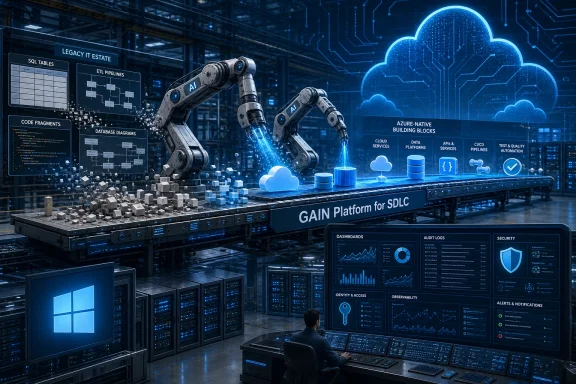 Grid Dynamics Is Selling Modernization as an AI Factory, Not a Cloud Move
Enterprise cloud migration used to be pitched as a destination story. Move the workload to Azure, right-size the VM, modernize the database if you can, and call the program a success when the old data center contract finally expires. That framing still exists, but it is no longer enough for vendors trying to win large enterprise transformation deals.Grid Dynamics is positioning its new Azure modernization service around the harder problem: what happens when the legacy estate is too large, too entangled, and too business-critical to be treated as a conventional migration backlog. The company says the offering is aimed at high-transaction-volume environments, the sort of systems that sit behind financial services, retail operations, manufacturing platforms, healthcare workflows, and other domains where “legacy” often means still paying the bills.
The hook is GAIN, Grid Dynamics’ AI-Native Development Platform for the software development life cycle. In the company’s framing, this is not merely about using generative AI to help developers write code faster. It is about applying AI to requirements, analysis, test generation, code transformation, data migration, quality assurance, and the governance scaffolding around the whole process.
That distinction matters because enterprise modernization failures rarely come from a lack of enthusiasm for cloud. They come from unknown dependencies, brittle integrations, untested business rules, institutional knowledge trapped in retiring teams, and source systems whose documentation is more archaeological than operational. AI will not magically solve those problems, but it can change the economics of discovery and refactoring if it is used as part of a disciplined engineering workflow.
Grid Dynamics’ announcement lands squarely in that new market narrative. Azure is the platform. GAIN is the factory floor. The real product is the promise that large enterprises can move faster without surrendering control of systems they cannot afford to break.
Azure Modernization Has Moved Beyond Lift-and-Shift
Microsoft has spent years building Azure into a migration and modernization platform rather than merely a place to rent compute. Azure Migrate, Azure Database Migration Service, Azure SQL, Azure App Service, Azure Kubernetes Service, Microsoft Fabric, GitHub, and the wider Azure AI stack all orbit the same strategic gravity well: get enterprise workloads into Microsoft’s cloud, then pull them upward into managed services, analytics, automation, and AI.That progression is important. A simple VM migration may reduce data center friction, but it does not automatically produce a modern application. A Windows Server workload moved as-is into Azure can still carry the same monolith, the same deployment bottlenecks, the same database coupling, and the same operational fragility it had on-premises. Cloud only changes the venue unless the application architecture changes too.
Grid Dynamics is trying to occupy the gap between Microsoft’s platform capabilities and the messy enterprise reality that prevents many organizations from using them well. Microsoft can provide the modernization runway, but large customers often need a partner to map the old estate, sequence the work, re-platform databases, rewrite applications, validate behavior, and keep the business running during the transition.
That is why the announcement emphasizes large enterprises rather than digital-native companies. The market here is not teams already deploying clean microservices through GitHub Actions into Kubernetes. It is organizations with decades of accumulated systems: Oracle databases, Teradata warehouses, Informatica pipelines, .NET Framework applications, Java monoliths, batch jobs, message queues, stored procedures, and vendor packages nobody wants to touch until they have to.
The Azure angle is commercially obvious, but it is also technically meaningful. Azure is already a familiar landing zone for Microsoft-heavy enterprises, especially those with Windows Server, SQL Server, Active Directory, Microsoft 365, Teams, Defender, and Entra woven through their operations. A modernization service that can translate legacy complexity into Azure-native patterns is therefore aimed at a market Microsoft knows very well: customers who want cloud transformation without detonating the operating model their business still depends on.
The Database Is Where the Modernization Story Gets Real
The most concrete part of the announcement is Grid Dynamics’ claim that the service includes GenAI-powered data migration automation. According to reports on the release, the platform can help convert legacy SQL, pipeline orchestration, and data schemas from systems such as Teradata, Informatica, and Oracle into Azure-native equivalents. That is where the pitch becomes more than a generic AI modernization slogan.Data migration is often the graveyard of optimistic cloud timelines. Application code is visible, even when it is ugly. Data platforms are different. They contain years of business logic embedded in SQL, ETL jobs, scheduling conventions, reporting assumptions, exception handling, and performance hacks that nobody documented because the system itself became the documentation.
For Windows and Azure administrators, this is the layer that tends to turn a “migration” into a multi-year program. It is not enough to copy data into Azure SQL, Synapse, Fabric, or another target. The transformed platform has to preserve semantics, meet performance expectations, satisfy compliance rules, support downstream reports, and survive audit scrutiny.
AI-assisted conversion can help, especially when the work involves large volumes of repetitive transformation. Legacy SQL dialect conversion, schema mapping, dependency extraction, test scaffolding, and code documentation are all plausible domains for generative AI and agentic workflows. The upside is not that AI knows a company’s business better than its engineers; it is that AI can make the first pass through enormous technical estates faster than humans working manually.
The risk is that the first pass can look more correct than it is. SQL translation errors are not always dramatic. A subtle difference in null handling, date arithmetic, transaction behavior, precision, collation, or optimizer assumptions can produce the kind of defect that escapes a demo and fails under quarter-end pressure. In that sense, AI modernization is not a replacement for test discipline. It is a demand for more of it.
Grid Dynamics’ credibility will therefore depend less on the claim that AI can convert legacy assets and more on how the process validates those conversions. Large enterprises will want evidence of automated regression testing, reconciliation, lineage tracking, human review, rollback planning, and observability. The words “AI-native” may open the door, but production confidence will close the deal.
The GAIN Platform Reflects a Bigger Shift in Software Delivery
GAIN sits in a category that is becoming increasingly important: AI systems that manage more of the SDLC than code completion. Developer copilots made AI visible to engineering teams, but they did not eliminate the upstream and downstream constraints that slow enterprise software delivery. Requirements are ambiguous. Architecture decisions are political. Test coverage is incomplete. Documentation is stale. Deployment processes carry scars from incidents long forgotten.Grid Dynamics’ pitch reflects a more mature phase of enterprise AI adoption. The claim is not simply that a model can generate code. It is that AI agents, workflows, and controls can assist across the delivery lifecycle, connecting modernization work to requirements, engineering governance, quality assurance, and operational readiness.
That is a more interesting proposition because it acknowledges the dirty secret of developer productivity tools: if coding gets faster but everything around coding stays broken, the bottleneck just moves. Teams generate more code, but review queues grow. Tests become insufficient. Product owners cannot validate requirements fast enough. Architecture review becomes a choke point. Security teams inherit a faster-moving risk surface.
An AI-native modernization platform is therefore useful only if it treats SDLC automation as a systems problem. Code generation is the visible layer; the harder layer is coordination. Large enterprises do not need a thousand isolated AI suggestions. They need governed workflows that can be audited, repeated, measured, and improved.
This is where Grid Dynamics is trying to differentiate from a simple services story. A consultancy that says “we use AI” is now table stakes. A consultancy that brings a platform, a repeatable engagement model, and domain-specific modernization accelerators has a stronger enterprise argument. Whether GAIN delivers on that promise at scale is the question customers will test in procurement, pilots, and reference calls.
Microsoft’s Partner Ecosystem Is Becoming the AI Migration Channel
Microsoft benefits from this kind of announcement even when the press release belongs to a partner. Azure modernization is not a single product SKU; it is an ecosystem motion. Microsoft needs systems integrators, specialist consultancies, ISVs, and migration partners to turn platform capabilities into industry-specific outcomes.Grid Dynamics says it is a Microsoft Azure specialized partner with five advanced specializations, including infrastructure and database migration. That status matters in enterprise sales because it signals that the company has passed Microsoft’s partner validation thresholds in areas customers already care about. It does not guarantee project success, but it reduces the perceived risk of bringing a partner into a complex Azure program.
The larger trend is that Microsoft’s cloud partners are being pulled into the AI era whether they like it or not. A few years ago, the differentiator might have been cloud migration experience, DevOps maturity, Kubernetes expertise, or data platform competence. Now those capabilities are expected to be wrapped in AI-assisted delivery, AI governance, and AI-ready architecture.
This has consequences for IT buyers. The partner selection process will need to evolve from “Can this firm migrate us to Azure?” to “Can this firm prove that its AI-assisted process is reliable, secure, explainable, and compatible with our controls?” That is a more demanding bar, particularly in regulated industries where modernization programs intersect with privacy, retention, model risk, and operational resilience.
It also means Azure partners will increasingly compete on methodology rather than raw staffing. The old model of scaling a modernization project by adding more engineers will not disappear, but it will be pressured by platforms that promise to multiply engineering capacity. If those platforms work, customers get faster delivery. If they do not, customers get automated technical debt with a nicer dashboard.
“AI-Native” Is Doing a Lot of Work Here
The phrase AI-native has become one of the technology industry’s most elastic labels. Sometimes it means a product was built around machine learning from the start. Sometimes it means a conventional product gained an AI interface. Sometimes it means a services firm wants to signal that it has moved beyond last year’s “GenAI accelerator” slide deck.In Grid Dynamics’ case, the term appears to mean that AI is embedded into the modernization workflow itself. That is a stronger claim than saying the resulting applications may use AI. The company is selling AI as a modernization mechanism, not merely as an application feature.
That is an important distinction for enterprise buyers. Many organizations are under pressure to “do AI,” but their legacy systems are the obstacle. Data is fragmented. Applications cannot expose clean APIs. Old databases cannot support modern analytics workloads. Security models were designed for a different era. In that environment, AI adoption depends on modernization before AI features can become useful.
This creates a feedback loop. Enterprises modernize because they want AI capabilities, and they use AI tools to accelerate modernization. Vendors like Grid Dynamics are trying to formalize that loop into a repeatable service. The pitch is seductive because it promises to convert the very thing blocking AI adoption into the raw material for AI-assisted transformation.
But “AI-native” also raises a governance question. If AI systems are helping rewrite code, convert SQL, generate tests, produce documentation, or recommend architecture, enterprises must decide how those outputs are reviewed and who owns the resulting risk. A generated migration artifact is still a production artifact. A machine-produced test is still only as good as its assumptions. An AI-generated explanation of legacy behavior can be useful without being authoritative.
The smart customers will not ask whether the process uses AI. They will ask where AI is allowed to act autonomously, where human approval is mandatory, how outputs are logged, how sensitive data is protected, and how the service proves functional equivalence. Those are the questions that separate an AI modernization program from an AI-themed consulting engagement.
Large Enterprises Want Speed, but They Fear Surprise
The target customer for Grid Dynamics’ Azure service is not naïve about modernization. Large enterprises have lived through ERP migrations, cloud transformations, data warehouse rebuilds, outsourcing waves, agile transformations, DevOps programs, and digital transformation initiatives that promised more than they delivered. They know speed has a cost.That is why the most important word in the announcement may be “mission-critical.” When a system is mission-critical, the main enemy is surprise. Surprise downtime, surprise performance degradation, surprise data inconsistency, surprise licensing cost, surprise security exposure, surprise business-rule regression. Modernization programs fail politically when they surprise the business.
AI can reduce some surprises by surfacing dependencies and generating tests earlier. It can also introduce new ones if teams trust outputs without sufficient validation. This tension will define the next phase of AI-assisted modernization.
The best use of AI in this context is not to pretend the legacy estate is simple. It is to make complexity more visible. If AI agents can map dependencies, summarize code paths, identify dead logic, propose refactoring boundaries, generate test cases, and compare behavior before and after migration, they can give architects and administrators better leverage. That is a real operational advantage.
The worst use is to treat AI as a compression algorithm for due diligence. Enterprise IT has already learned that skipping discovery does not save time; it moves the cost to production. AI does not repeal that law. It merely changes how much discovery can be performed before the project runs out of patience.
Windows Shops Should Read This as an Azure Signal
For Windows-heavy organizations, the announcement should be read as part of a broader Azure consolidation story. Microsoft’s stack is increasingly designed to make Azure the natural modernization path for Windows Server, SQL Server, .NET, identity, endpoint management, security, and collaboration data. Partners like Grid Dynamics are building services around that gravitational pull.That does not mean every workload should move to Azure or every modernization project should become an AI project. It does mean that the default assumptions in enterprise Windows environments are shifting. A legacy .NET application is no longer just a candidate for a VM migration. It may be assessed for containerization, API extraction, database modernization, GitHub-based delivery, managed identity integration, Defender coverage, observability, and eventually AI-enabled functionality.
The practical implication for sysadmins is that modernization work will increasingly cross boundaries that used to be separate. Infrastructure teams will need to understand application dependencies. Database teams will need to participate in AI-readiness conversations. Security teams will need to review AI-assisted development workflows. Developers will need to understand cloud cost and operational constraints. Platform teams will become the connective tissue.
This is where Azure’s strength can become a trap. The platform offers many paths, but too many choices can fragment architecture if nobody governs the landing zone. AI-assisted modernization may generate options faster than organizations can make decisions. Without clear standards, enterprises risk producing a more modern sprawl rather than a coherent cloud estate.
The organizations that benefit most will be the ones that treat Azure modernization as an operating model, not a project. That means repeatable landing zones, policy-as-code, identity standards, cost controls, observability requirements, data governance, and a sane approach to application lifecycle management. AI can accelerate the work, but the operating model decides whether acceleration creates value or merely motion.
The Financial Subtext Is Larger Enterprise Deal Flow
Grid Dynamics is a public company, and the business subtext is hard to miss. Reports around the announcement note that AI accounted for 29% of the company’s revenue in the first quarter of 2026, up from 25% in 2025. The new Azure modernization service is therefore not just a technical offering; it is part of a strategy to attach AI services to larger enterprise transformation budgets.That matters because modernization spending is often more durable than experimental AI spending. A pilot chatbot can be canceled when enthusiasm fades. A core systems modernization program, once funded, tends to become a multi-quarter or multi-year commitment. If Grid Dynamics can package AI-native delivery into Azure modernization work, it can move from discretionary AI experiments into the budget lines that keep enterprise IT moving.
The same logic applies across the services industry. AI has made demos cheaper, but production transformation remains expensive. Vendors that can connect AI to practical modernization outcomes have a better chance of converting hype into revenue. That is especially true when the outcome is attached to Microsoft Azure, where customers already have procurement channels, enterprise agreements, and executive cloud strategies.
For Microsoft, partners that generate Azure consumption are valuable. For Grid Dynamics, Azure provides a platform story that customers already understand. For customers, the challenge is to avoid becoming the terrain on which vendors prove their AI delivery models.
The burden of proof should be high. Enterprises should demand measurable baselines: migration velocity, defect rates, test coverage, cost variance, performance benchmarks, downtime windows, developer productivity, and post-cutover incident rates. AI-native modernization should be judged by operational results, not vocabulary.
The Competitive Pressure Is Coming From Every Direction
Grid Dynamics is not alone in seeing AI-assisted modernization as a major market. Microsoft itself is pushing AI into development and modernization workflows through GitHub Copilot, Azure Migrate integrations, cloud assessment tooling, and partner programs. Major systems integrators are building their own AI delivery platforms. Cloud rivals are doing the same around AWS and Google Cloud. Specialist vendors are attacking slices of the problem, from code translation to mainframe modernization to data pipeline conversion.That crowded field creates both opportunity and confusion. Buyers will hear similar claims from many vendors: faster migration, automated refactoring, AI-generated tests, lower cost, reduced risk, better governance. The differentiator will not be the presence of AI. It will be the quality of the engineering process wrapped around it.
Grid Dynamics has some advantages in this race. It has long positioned itself around digital engineering, cloud, data, and enterprise AI rather than generic outsourcing. Its announcement references concrete legacy platforms and Azure-native targets, which gives the offering more substance than broad transformation language. Its Microsoft partner credentials also help in Azure-centered accounts.
But the market will not be forgiving. Modernization buyers are skeptical because they have reason to be. They have seen automated migration tools produce partial results. They have seen refactoring programs stall. They have seen cloud costs exceed expectations. They have seen AI proofs of concept fail to survive contact with enterprise controls.
The vendors that win will be the ones that admit modernization is not magic. They will use AI aggressively but not recklessly. They will show where automation works, where humans remain accountable, and how customers can measure progress without depending on the vendor’s adjectives.
Security and Governance Will Decide Whether AI Modernization Scales
Every AI-assisted modernization program eventually runs into the same uncomfortable question: what data, code, and architecture information is the AI system allowed to see? Legacy systems often contain sensitive business logic, customer data paths, security assumptions, secrets mishandled by old code, and undocumented compliance controls. Feeding that context into AI workflows requires serious governance.Azure customers will naturally look for assurances around identity, access control, data residency, auditability, encryption, and model usage. They will want to know whether code and data leave their tenant, whether prompts are retained, whether outputs are reproducible, and whether generated artifacts can be traced back to source evidence. In regulated sectors, those details are not procurement footnotes. They are gating criteria.
Security teams should also watch for a subtler risk: AI-generated modernization can normalize insecure patterns if the source estate contains them. If old code used weak authorization checks, brittle input validation, overprivileged service accounts, or informal data handling, an AI-assisted transformation process may preserve the wrong behavior unless security requirements are explicit. Functional equivalence is not always the goal when the original function was unsafe.
The best modernization programs will therefore combine equivalence testing with deliberate improvement. Preserve the business behavior that matters. Break the technical patterns that should not survive. That requires human judgment, security architecture, and governance rules that AI can follow but not invent on its own.
This is another reason the Azure context matters. Microsoft’s security, identity, policy, and compliance tooling gives enterprises a mature control plane if they choose to use it. But tooling is not governance. A partner-led modernization program has to map generated work into those controls from day one, not bolt them on after the first production incident.
The Real Test Will Be the First Ugly Portfolio
Announcements like this are easiest to evaluate in abstraction. The service sounds plausible. The market need is real. The Azure alignment makes sense. The AI-native framing is timely. None of that tells us how well it performs against a genuinely ugly enterprise portfolio.The first hard test is discovery. Can the platform and delivery team identify dependencies across applications, databases, batch jobs, APIs, queues, and reporting systems with enough confidence to plan migration waves? Many enterprises cannot answer basic questions about their own estates without weeks of interviews and tooling reconciliation.
The second hard test is transformation quality. Can AI-assisted conversion produce code, schemas, and pipelines that are not merely syntactically valid but operationally faithful? Can it handle edge cases, performance constraints, data semantics, and business logic hidden in old implementation details?
The third hard test is change management. Even when the technical work is sound, enterprises struggle with ownership, funding, release coordination, training, support models, and political resistance. AI does not make those problems disappear. Sometimes it intensifies them by making delivery teams move faster than the organization can absorb.
The final hard test is cost. AI-assisted modernization may reduce manual effort, but Azure modernization can still produce unexpected consumption patterns. More managed services, more data movement, more observability, more environments, and more AI workloads can all raise the bill. A credible modernization service must include FinOps discipline, not just engineering acceleration.
The Modernization Pitch Has Finally Caught Up With the Legacy Problem
The useful way to read Grid Dynamics’ announcement is not as a claim that AI has solved legacy modernization. It has not. The useful reading is that the vendor market has finally admitted the old migration narrative was too small for the problem customers actually face.Large enterprises do not simply need to move workloads. They need to understand systems they no longer fully understand, change them without breaking the business, and make them fit for an AI-heavy future. That is a much bigger challenge than cloud hosting, and it requires a combination of automation, engineering discipline, platform architecture, and organizational patience.
Grid Dynamics’ Azure service is an attempt to package that combination. Its success will depend on whether the company can turn AI-assisted delivery into predictable enterprise outcomes. If it can, the offering will fit neatly into the next wave of Azure modernization spending. If it cannot, it will join the long list of transformation accelerators that looked compelling until the first brittle legacy system pushed back.
For WindowsForum’s audience, the immediate lesson is practical: AI modernization is coming to the Microsoft ecosystem not as a side feature, but as a core delivery model. Administrators and architects should expect more partner proposals, more AI-assisted assessment tools, more automated refactoring claims, and more pressure to connect Windows and SQL estates to Azure-native services. The right response is neither blanket enthusiasm nor reflexive skepticism. It is disciplined evaluation.
The Azure Modernization Buyer Now Has a New Checklist
Grid Dynamics’ announcement gives enterprise IT leaders a useful preview of the questions they should be asking as AI-native modernization offerings multiply. The marketing language will vary, but the evaluation criteria should become more concrete.- Enterprises should ask exactly which modernization tasks are automated, which are AI-assisted, and which still require human engineering ownership.
- Azure customers should require proof that generated code, converted SQL, migrated pipelines, and transformed schemas are validated through repeatable testing and reconciliation.
- Security teams should review how source code, data samples, prompts, model outputs, and generated artifacts are stored, logged, protected, and audited.
- Platform teams should connect modernization work to Azure landing zones, identity standards, policy controls, observability, backup, disaster recovery, and FinOps rules before production cutover.
- Buyers should measure AI-native modernization by production outcomes such as defect rates, downtime, performance, cost variance, migration velocity, and post-launch incident volume.
- Organizations should treat AI as leverage for modernization discipline, not as a waiver from architecture, governance, testing, or operational accountability.
References
- Primary source: Moomoo
Published: Tue, 19 May 2026 21:05:57 GMT
- Related coverage: griddynamics.com
Grid Dynamics Launches NVIDIA AI Solution Center
Grid Dynamics introduces the NVIDIA Solution Center, delivering enterprise-ready edge and datacenter AI solutions for retail and manufacturing.www.griddynamics.com - Related coverage: ca.investing.com
Grid Dynamics launches AI modernization service on Azure By Investing.com
Grid Dynamics launches AI modernization service on Azureca.investing.com - Related coverage: es.investing.com
Grid Dynamics lanza un servicio de modernización con IA en Azure Por Investing.com
Grid Dynamics lanza un servicio de modernización con IA en Azurees.investing.com - Related coverage: id.investing.com
Grid Dynamics luncurkan layanan modernisasi AI di Azure Oleh Investing.com
Grid Dynamics luncurkan layanan modernisasi AI di Azureid.investing.com - Related coverage: fr.investing.com
Grid Dynamics lance un service de modernisation IA sur Azure Par Investing.com
Grid Dynamics lance un service de modernisation IA sur Azurefr.investing.com
- Related coverage: s24.q4cdn.com
- Official source: microsoft.com
Microsoft-logo_cmyk_c-wht
Furture alternative electricity source:windmill and solar energy-----concept of sustainable resources on a sunny day, Jiangsu,Chinawww.microsoft.com
- Official source: cdn-dynmedia-1.microsoft.com
The Next Wave of AI Innovation: Microsoft Introduces Azure AI Foundry, A New Unified AI, and GenAI Platform at Ignite 2024
PDF documentcdn-dynmedia-1.microsoft.com
