

The moment you can hand a chatbot access to your medical records, you should treat that click like signing away a piece of your privacy — and right now, the risks are bigger, noisier, and less well‑regulated than most people realize. Recent reporting and vendor moves show mainstream assistants are aggressively pushing ways to connect to health data — promising convenience and personalized guidance — even as independent audits, bug disclosures, and legal gaps make the proposition fraught for patients, clinicians, and IT teams alike. atbots have graduated from novelty answer engines to active participants in health workflows. Vendors now advertise integrations that let users link electronic health records (EHRs), patient portals, wearable data, and billing histories to conversational AI so the assistant can "personalize" recommendations, translate medical jargon, or suggest next steps. Microsoft, OpenAI, Google and other major players have added explicit health features or "Copilot for Health" offerings that lean on licensed medical content and model fine‑tuning to present themselves as trustworthy helpers.
That commercial push arrives at the same moment multiple independent audits and peer‑reviewed studies have flagged real safety problems: chatbots can hallucinate diagnoses, omit critical warning signs, and provide inconsistent triage advice compared with standard symptom‑checkers or clinician review. Academic red‑teaming and benchmarking work shows the rate of problematic health answers remains material across major LLMs, even when those systems are tuned for medical contexts. Those findings raise a dual problem: quality of clinical output and the privacy / governance risks of the data required to make those outputs appear personalized.
Security research has also demonstrated active exploits that can turn assistants into tooling for exfiltration. A “one‑click” or “reprompt” style attack can cause an agent to fetch and transmit data silently; proof‑of‑concept research and vendor advisories show attackers continually probe agentic systems for precisely these failure modes. Those attack patterns show the difference between designing for privacy and assuming privacy will hold.
Policymakers should consider:
Conclusion: AI can help with health — but handing over your records is a decision that deserves the same scrutiny as giving a stranger the keys to your house.
Source: The New York Times https://www.nytimes.com/2026/03/12/technology/personaltech/microsoft-copilot-health-ai-chatbots.html
That commercial push arrives at the same moment multiple independent audits and peer‑reviewed studies have flagged real safety problems: chatbots can hallucinate diagnoses, omit critical warning signs, and provide inconsistent triage advice compared with standard symptom‑checkers or clinician review. Academic red‑teaming and benchmarking work shows the rate of problematic health answers remains material across major LLMs, even when those systems are tuned for medical contexts. Those findings raise a dual problem: quality of clinical output and the privacy / governance risks of the data required to make those outputs appear personalized.
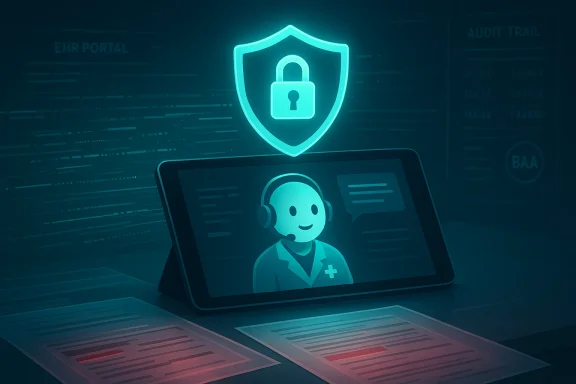 What vendors are offering — and promising
The convenience pitch
Vendors frame health integrations as convenience plus safety: AI can decode lab values, summarize clinic notes, reconcile medications, and produce patient‑friendly explanations of care plans. In Microsoft’s narrative, for example, Copilot for Health will surface licensed content from medical publishers (cited examples include Harvard Health and peer‑reviewed journals) to make answers more authoritative and auditable. The pitch is simple: give the assistant your records and it becomes a smarter, time‑saving companion for everyday healthcare tasks.The technical pathways
There are three dominant technical patterns for connecting records to chatbots:- Local client upload (manual file drops or secure app‑level access to health‑app exports).
- API integration with health platforms and portals (OAuth connections that allow ongoing pull access to EHR or wearable data).
- Enterprise connectors embedded in clinical software (vendor tools integrated with hospital EHRs or practice management systems).
The immediate and visible hazards
1) Data‑security failures: examples that should alarm IT
Recent operational incidents show how quickly protective assumptions can fail. Microsoft confirmed a code defect in Microsoft 365 Copilot that let the assistant read and summarize emails marked confidential, bypassing Data Loss Prevention (DLP) and sensitivity labels — an issue tracked internally as CW1226324 and patched after weeks of exposure. That incident is a cautionary tale: even well‑resourced vendors can ship logic errors that render enterprise controls ineffective.Security research has also demonstrated active exploits that can turn assistants into tooling for exfiltration. A “one‑click” or “reprompt” style attack can cause an agent to fetch and transmit data silently; proof‑of‑concept research and vendor advisories show attackers continually probe agentic systems for precisely these failure modes. Those attack patterns show the difference between designing for privacy and assuming privacy will hold.
2) Clinical safety failures: wrong advice with real consequences
Even absent deliberate attacks, the clinical output itself is a risk. Controlled studies and red‑teaming efforts find that chatbots can provide unsafe, inconsistent, or incomplete medical advice in a non‑trivial share of cases. Benchmarks show rates of problematic responses that vary by model and tuning, but the aggregate message is clear: these systems are not yet reliable clinical decision tools. For patients relying on chatbots for triage or dosing guidance, hallucinations or omission errors are not theoretical.3) Regulatory and legal ambiguity
Health data in the United States is governed by HIPAA and related rules, but most consumer chatbots operate outside that framework unless explicitly contracted as a business associate. That means a consumer who uploads records to a consumer‑grade chatbot may have considerably less legal protection than they assume. Meanwhile, health systems that integrate third‑party agents must wrestle with contractual obligations, breach reporting rules, and the complexity of auditing a multi‑vendor AI pipeline. Regulators and professional societies have issued guidance urging caution, but rulemaking is still catching up to the technology’s pace.Why the tradeoff is harder than it looks
Data minimization vs. personalization
Personalized answers often require granular PHI: medication lists, recent labs, problem lists, imaging reports. But the more detail you share, the harder it is to guarantee that the assistant — or its cloud storage, logs, or model‑improvement pipelines — won’t retain or leak sensitive elements. The legal principle of data minimization is at odds with the product pitch of “more context = better advice.”Auditability and provenance
A medical answer needs provenance: where did the system get its facts, and why did it recommend this action? Vendors are working on techniques to label sources and show citations, and some (including Microsoft) have licensed curated content from reputable publishers as a guardrail. Those steps help, but provenance for clinical reasoning remains immature: an explanation that says “based on your labs and Harvard Health” does not guarantee clinical validity or that the model didn’t hallucinate intermediate steps.The human oversight gap
Clinical decision‑making requires context that models do not reliably possess: patient values, comorbidities that are poorly coded, or recent events that haven’t been captured in the EHR. Vendor roadmaps often assume clinician review is the failsafe, but real‑world workflows are messy — if AI triage is used to prioritize care, a missed red flag could cascade. The current training datasets and evaluation frameworks do not yet close that oversight gap.Strengths: why some institutions are still piloting and investing
It’s not all danger and blame. There are concrete benefits that explain the rush:- Efficiency gains: AI can summarize long, poorly structured notes and surface medication discrepancies quickly.
- Accessibility: Chatbots can translate medical jargon and produce easier patient instructions for low‑health‑literacy populations.
- Research acceleration: De‑identified conversational data can help build better triage models if governance is strong.
- Integration potential: Clinical agents embedded in EHRs (with proper controls) can reduce clinician burnout by automating routine documentation tasks.
Critical incidents and what they teach us
- Copilot DLP bypass (CW1226324) — shows that sensitivity labels and DLP rules are not infallible when code defects interact with complex access logic; remediation required vendor patching and tenant outreach.
- Reprompt / “one‑click” exfiltration proofs of concept — demonstrate that agentic features (the ability to act across tabs, click links, and fetch remote content) create unique attack vectors absent strict UI and execution boundaries.
- Benchmarked medical response failures — underline that even best‑in‑class models can produce unsafe recommendations, particularly for edge cases or when asked to triage serious conditions.
What patients and consumers should do right now
- Be skeptical about handing full EHR access to consumer chatbots. If a feature requires OAuth access to your patient portal, treat it like giving someone the keys to your medical file.
- Prefer trusted, HIPAA‑covered channels when sharing PHI. If a health system or clinician offers an AI feature inside its protected environment, that’s a safer starting point than a standalone consumer chatbot.
- Audit permissions and purge history. If you connected a chatbot to a health app or portal, review the app’s privacy settings and delete conversation histories where possible.
- Use chatbots for administrative and educational tasks, not for treatment decisions. Ask the assistant to summarize a clinic note or produce questions to bring to your clinician — but don’t accept diagnosis or dosing advice without clinician confirmation.
- Keep copies of your records offline. If you must upload a file for AI analysis, consider removing identifiers or using redaction tools to limit unnecessary exposure.
What IT leaders and health systems must demand
For hospitals, clinics, and payers, implementing AI health features requires a different posture than consumer‑grade rollouts:- Contractual clarity: Insist on Business Associate Agreements (BAAs) where PHI is involved and require explicit change‑control, audit rights, and breach notification timelines.
- Technical boundaries: Use short‑lived tokens, strict OAuth scoping, and intermediate de‑identification layers; route sensitive queries through on‑prem or private cloud enclaves when feasible.
- Robust DLP and active monitoring: Treat AI connectors as high‑risk network endpoints; test DLP stacks against agentic attack patterns and implement anomaly detection tuned to AI behavior.
- Continuous red‑teaming: Adopt adversarial testing programs that simulate reprompt/exfiltration attacks and evaluate model responses on clinical vignettes.
- Clinician‑in‑the‑loop design: Require clinician sign‑off for any AI output that changes patient care, and ensure audit trails capture clinician overrides.
Regulatory and policy implications
Regulators are moving, but slowly. HIPAA governs covered entities and their business associates, but many popular AI chatbots operate outside that regime unless explicitly onboarded into clinical contracts. State governments and professional associations have issued cautionary advisories; the WHO and professional bodies have argued for transparency, auditability, and burden‑of‑proof rules for medical AI. Absent clearer rules, litigation and enforcement actions will likely define the contours of acceptable practice — a slow and painful path for patients who suffer harms in the meantime.Policymakers should consider:
- Minimum safety standards (benchmarks for clinical accuracy and triage performance).
- Data‑use transparency (obligations to tell users when their data will be used to improve models).
- Mandatory breach reporting specific to AI pipelines.
- Certification pathways for AI health tools akin to medical‑device regulation where risk is high.
Concrete technical mitigations vendors and deployers should adopt
- Contextual redaction: Before records are shipped to a model, run deterministic redaction to remove unnecessary identifiers and PII.
- On‑device or private inference: Where feasible, run the model on the user's device or inside a tenant‑controlled private cloud so raw PHI never leaves the healthcare boundary.
- Differential privacy and safe logging: Ensure logs used for product improvement are differentially private and scrubbed of identifiers.
- Provenance metadata: Attach secure provenance chains to every generated recommendation (explicitly state which clinical sources, guidelines, or labs were used).
- Execution sandboxing: Prevent agents from taking actions (clicking links, fetching remote code) unless explicitly authorized by an audited policy.
Balanced verdict: proceed with prepared caution
There is real utility in AI for health — time savings, better patient engagement, and improved access to health information are not small things. But the technology is not yet mature enough to justify unfettered access to PHI by consumer assistants or poorly governed connectors. Recent incidents, including DLP bypasses and exploit demonstrations, show that design assumptions about protections can fail in production. Clinical quality benchmarks show improvements in core capabilities but also persistent safety gaps. Together, these facts argue for a staged approach: pilot within strong governance and keep consumer features narrowly scoped until independent, transparent evaluations demonstrate consistent clinical safety and robust privacy controls.Practical checklist: a step‑by‑step for safe adoption
- Inventory: Identify all systems, connectors, and personnel accessing PHI and any AI components that process it.
- Classification: Tag data by sensitivity and prohibit AI connectors from accessing categories that are not strictly necessary.
- Contract: Insist on BAAs, right to audit, and specific security obligations for model providers and integrators.
- Test: Run adversarial red‑team and clinical‑safety benchmarks before roll‑out.
- Monitor: Implement real‑time telemetry and alerts for anomalous accesses or exfiltration patterns.
- Train: Educate clinicians and patients about the limits of AI outputs and require clinician confirmation for care‑changing recommendations.
Closing thoughts
The AI assistants that now promise to “know you” are asking to hold some of the most intimate, legally sensitive, and consequential data about people: their medical records. That promise is powerful — and businesses and clinicians are right to explore it — but the technology’s operational failures and safety limitations mean that who controls the connectors, how data is stored and audited, and what legal protections apply will determine whether this innovation helps patients or harms them. Users should not be rushed into granting record access; IT professionals should treat AI connectors as first‑class security threats; and regulators should accelerate clear rules for clinical accuracy, auditability, and data stewardship. Move forward, but move forward with engineering rigor, legal clarity, and an unwavering focus on patient safety.Conclusion: AI can help with health — but handing over your records is a decision that deserves the same scrutiny as giving a stranger the keys to your house.
Source: The New York Times https://www.nytimes.com/2026/03/12/technology/personaltech/microsoft-copilot-health-ai-chatbots.html
