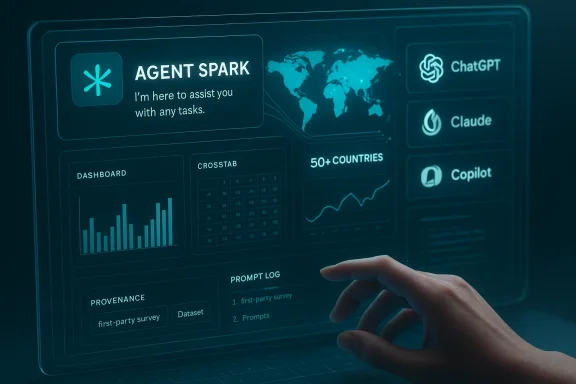
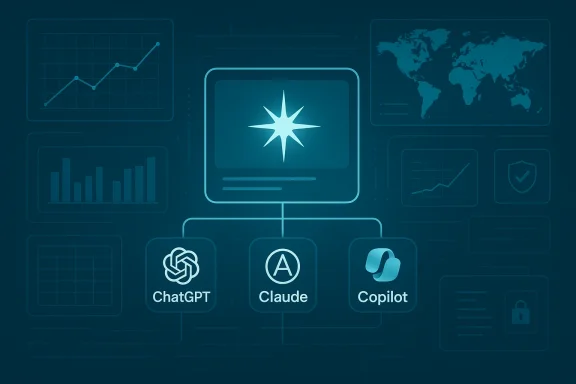
GWI has launched Agent Spark, an “always‑on” insights agent that embeds the company’s proprietary audience data directly into major conversational AI platforms — including ChatGPT, Anthropic’s Claude and Microsoft Copilot — promising marketer‑grade audience analysis in seconds by querying what GWI bills as billions of verified responses and more than 35 billion data points.
GWI (formerly GlobalWebIndex) is a long‑running audience‑research business that collects survey responses and audience profiles across many markets. The company positions Agent Spark as a bridge between controlled, first‑party research data and the conversational interfaces increasingly used for research, strategy and creative ideation. Agent Spark is available inside the GWI platform and via connectors for ChatGPT, Claude and Microsoft Copilot today, with further platform integrations planned. Why this matters: marketing and insights teams are standardising on workflow‑embedded AI — tools that live where users already work. By integrating a validated dataset directly into those interfaces, GWI aims to remove platform hopping, speed up decision cycles and reduce the risk of relying on openn‑web or synthetic sources when teams need defensible audience evidence.
However, buyers must not confuse the presence of a governed connector with automatic correctness. Even anchored retrieval systems can misrepresent nuance if methodological limits aren’t surfaced or if human oversight is removed from critical decision paths. For regulated outputs, public claims or legal reporting, insist on methodological transparency, audit logs and contractual protections before deploying Agent Spark at scale.
Source: IT Brief Australia https://itbrief.com.au/story/gwi-unveils-agent-spark-to-power-ai-with-real-audience-data/
 Background
GWI (formerly GlobalWebIndex) is a long‑running audience‑research business that collects survey responses and audience profiles across many markets. The company positions Agent Spark as a bridge between controlled, first‑party research data and the conversational interfaces increasingly used for research, strategy and creative ideation. Agent Spark is available inside the GWI platform and via connectors for ChatGPT, Claude and Microsoft Copilot today, with further platform integrations planned. Why this matters: marketing and insights teams are standardising on workflow‑embedded AI — tools that live where users already work. By integrating a validated dataset directly into those interfaces, GWI aims to remove platform hopping, speed up decision cycles and reduce the risk of relying on openn‑web or synthetic sources when teams need defensible audience evidence. What Agent Spark claims to be and do
Analyst‑grade insight in a chat window
Agent Spark is presented as an “insights agent” that uses natural‑language queries to produce audience breakdowns, behaviour trends and cultural signals, returning analyst‑quality answers without requiring users to leave their AI chat environment. GWI says the system can query more than 35 billion data points in seconds and is built on more than a decade of survey research and 1.4M+ annual survey responses. The company emphasises that outputs are first‑party and not derived from web scraping or synthetic data. Key product messages include:- Human‑grounded insights: answers are backed by verified, respondent‑level survey data rather than scraped web text.
- Embedded workflows: connectors for ChatGPT, Claude and Microsoft Copilot let teams ask questions in the tools they already use.
- Speed and scale: GWI advertises step‑change reductions in investigator time — analyses that once took days can be reduced to minutes.
Platform and architecture notes
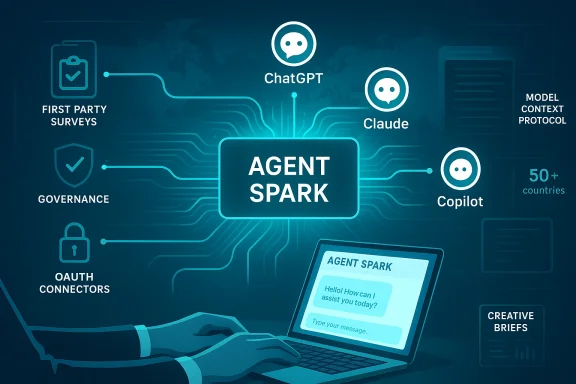
GWI describes Agent Spark as delivered via connector patterns and a Model Context Protocol (MCP) server that supplies structured, governed context to LLMs and agent frameworks. The company’s help documentation outlines connector setup flows and OAuth‑based authentication for enterprise workspaces. That MCP approach mirrors an industry trend of packaging curated data via secure, auditable endpoints for model consumption rather than embedding raw datasets into model training corpora.Who will use it — target roles and workflows
GWI expects adoption across a broad set of practitioners:- Brand and performance marketers seeking fast audience slices for creative briefs and media targeting.
- Product managers and UX teams wanting behaviour insight to prioritise features.
- Sales leaders and go‑to‑market teams who may want micro‑segment intelligence for outreach.
- Traditional insights teams and analysts who can use Agent Spark to speed hypothesis testing and exploratory analysis.
The credibility claims: what GWI says, and what’s verifiable
GWI’s public statements make three core technical claims that steer customer evaluation:- Scale: Agent Spark can surface insights from “35 billion data points” and “billions of verified responses across 50+ countries.” This figure appears consistently in GWI’s press materials and product pages.
- First‑party provenance: GWI states outputs are grounded in first‑party survey data, not scraped or synthetic sources, and describes quality checks and representative sampling as foundational to the product. The company’s platform pages and help centre reiterate that the connector delivers controlled, survey‑based signals into LLM workflows.
- Integrated connectors and governance: Agent Spark uses connector patterns (ChatGPT custom connectors, Claude custom connector, and Microsoft Copilot Studio onboarding via MCP) with OAuth and tenant‑level publication controls so organisations can govern who can call the agent. GWI’s help documentation provides setup steps and admin controls.
How this fits into the wider market for data + LLM workflows
Trend: curated datasets enter the model workflow
Across 2024–2026 the market evolved from ad‑hoc prompt engineering to data‑aware AI workflows where enterprises inject curated datasets (product catalogs, proprietary surveys, regulatory archives) into RAG and agent pipelines. Vendors and consultancies are packaging dataset connectors, Model Context Protocol endpoints and auditable feeds so that LLMs can answer with traceable, governed context rather than freeform web scraping. GWI’s Agent Spark is aligned with that pattern.Governance is now table stakes
As enterprises scale agentic automation and Copilot deployments, procurement demands clear data lineage, explicit usage rights and auditability. Industry playbooks emphasise metadata, lineage mapping and RBAC for any dataset used in AI decisioning. Without those governance artifacts, organisations risk non‑compliance, biased outputs and legal exposure if sensitive data is mishandled. GWI’s MCP connector model addresses several practical governance needs — but organisations must still verify the vendor’s attestations and contract terms.Model mix and multi‑platform strategy
Microsoft’s Copilot and other enterprise products increasingly support multiple model families (OpenAI, Anthropic, others), and platform openness creates room for vendors like GWI to supply context across model endpoints rather than tying data to a single model stack. That plurality reduces lock‑in but increases the need for uniform data definitions and consistent taxonomies so different models interpret the same signal the same way. GWI highlights audience taxonomies and standardised definitions as a feature designed to preserve consistency across teams.Strengths: what Agent Spark brings to teams right now
- Speed to insight: embedding survey‑level evidence directly into chat tools cuts cycles drastically for exploratory work; this is valuable for tight creative sprints and last‑minute briefs.
- Defensible evidence base: where buyers require traceable, survey‑based assertions (brand lift, attitude shifts, intent signals), an intentional first‑party dataset reduces the risk of unverifiable claims that can arise from open‑web prompts.
- Operational fit: connectors for ChatGPT, Claude and Copilot align the product with widely adopted enterprise workflows; the MCP connector model supports governance and tenant control.
- Agency and activation use cases: early partner commentary shows how Agent Spark can power creative ideation, automated creative evaluation and even agentic media activation when combined with other orchestration layers — a practical path from insight to execution.
Risks and unanswered questions — what buyers must validate
- Methodology transparency and auditability
- Why it matters: survey‑based providers vary in sampling frames, weighting and fraud detection. Enterprises using Agent Spark for critical claims need methodological appendices, sampling frames by market, and access to quality metrics (response quality scores, de‑duplication logic, weighting parameters). GWI’s launch materials promise rigour but buyers should request the underlying docs or an independent audit.
- Scope and freshness of data
- Why it matters: a dataset that is large but stale can still mislead. Confirm how frequently the underlying surveys are refreshed per market and per topic. Also clarify whether Agent Spark can surface time‑series and trend data with date stamps so teams can verify recency. GWI’s materials highlight scale but are light on refresh cadences in the headline messaging.
- Overreliance and hallucination risk inside LLMs
- Why it matters: even when a retrieval layer supplies grounded context, downstream LLM composition can still produce overconfident summaries or conflate signals. Organisations must enforce human‑in‑the‑loop checks, confidence thresholds and provenance displays so that consumers of Agent Spark outputs can see the evidence and validate claims. Several industry playbooks stress human approval for high‑impact actions.
- Governance and licensing terms
- Why it matters: clarify contractual terms about derivative rights, whether GWI data may be used to further train or fine‑tune third‑party models, and what guarantees exist for data retention, deletion and access logs (audit trails). Well‑crafted procurement language should include non‑training clauses if enterprises do not want vendor or model providers to retain or use query inputs for model improvement.
- Integration and operational complexity
- Why it matters: connecting Agent Spark to an autonomous agent network or an activation stack requires engineering work, identity governance and monitoring. Pilot runs should test export fidelity, latency, and the composition logic used when other systems invoke Agent Spark inside multi‑agent flows. Omnicom’s preview commentary shows the ambition but also the integration work required.
Practical evaluation checklist for IT and procurement teams
- Request the full methodology dossier: sampling frames, weighting routines, quality controls and coverage by market. Ask for third‑party audit evidence if available.
- Define allowed use cases and risk tiers: decide which classes of outputs require human sign‑off (e.g., external reporting, legal claims, paid creative testing).
- Insist on traceability: ensure query logs, evidence links, and dataset versioning are available for every Agent Spark answer used in a decision.
- Negotiate non‑training clauses and data‑usage limits if you plan to run sensitive corporate queries through connectors.
- Pilot in low‑risk workflows: creative ideation, internal brief writing and segmentation hypothesis testing before rolling into regulated or revenue‑critical processes.
What success looks like — realistic ROI scenarios
- Marketing creative teams reduce “time to first concept” from days to hours by using Agent Spark to generate audience profiles and testing prompts that feed creative A/B candidates. Measurable KPIs: concept throughput, review cycles and time from brief to final creative.
- Media planners use Agent Spark to validate micro‑segments before activation, shortening planning cycles and improving initial targeting lift. Measurable KPIs: campaign setup time, click‑through improvements in first two weeks.
- Insights teams accelerate exploratory research by using Agent Spark as a first pass for hypothesis generation, focusing human analysts on deep dives and validation. Measurable KPIs: number of validated hypotheses per analyst per quarter and reduction in ad‑hoc survey budgets.
Final assessment — where Agent Spark fits in enterprise AI stacks
Agent Spark is a productised, pragmatic response to an urgent need: give conversational AI something trustworthy to reference. Its design reflects three contemporary priorities: governance (connectors, MCP), evidence (survey‑based, first‑party data) and workflow integration (ChatGPT, Claude, Copilot). For organisations that require defensible, human‑grounded audience insight and want to operationalise it inside agentic workflows, Agent Spark is a strong candidate — provided due diligence is conducted.However, buyers must not confuse the presence of a governed connector with automatic correctness. Even anchored retrieval systems can misrepresent nuance if methodological limits aren’t surfaced or if human oversight is removed from critical decision paths. For regulated outputs, public claims or legal reporting, insist on methodological transparency, audit logs and contractual protections before deploying Agent Spark at scale.
Takeaway for WindowsForum readers and enterprise teams
- Agent Spark surfaces a predictable next step for audience data vendors: treat LLMs as the UI and deliver structured, auditable data behind them. That meets users where they work and reduces friction.
- It is a meaningful alternative to ad‑hoc web scraping or purely synthetic approaches where evidence and auditability matter — but success depends on operational controls, contractual clarity and independent validation of methodology.
- Teams evaluating Agent Spark should adopt a staged rollout, validate methodology, and ensure human‑in‑the‑loop checkpoints for any decision that materially affects customers, brand reputation or compliance posture.
Source: IT Brief Australia https://itbrief.com.au/story/gwi-unveils-agent-spark-to-power-ai-with-real-audience-data/