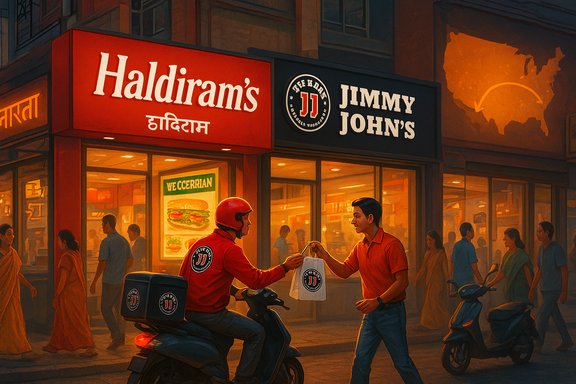
Haldiram’s is in advanced discussions to bring US sandwich chain Jimmy John’s to India through an exclusive franchise partnership with Inspire Brands, a move that would mark Haldiram’s first large-scale foray into Western-style quick‑service restaurants (QSRs) and position the century‑old snacks and restaurant group to take on international rivals such as Subway and Tim Hortons.
Haldiram’s is best known as India’s largest ethnic food services company, with a sprawling business that spans household FMCG snacks, sweets and a restaurant network. Over recent months the group has consolidated its FMCG operations into Haldiram Snacks Food Pvt Ltd and attracted institutional interest, moves widely seen as prelude to a larger capital‑markets event. The company’s Registrar of Companies filings show Haldiram Snacks Food reported ₹12,800 crore in revenue and ₹1,400 crore in net profit for FY24 — figures that underpin investor interest in the brand and its diversification play. Jimmy John’s, founded in 1983, is a delivery‑focused sandwich and wrap chain that operates thousands of locations across North America and select international markets. It has been part of Inspire Brands since 2019, and Inspire today manages a global multi‑brand portfolio including Arby’s, Buffalo Wild Wings, Sonic, Dunkin’ and Baskin‑Robbins — a network the company reports as tens of thousands of restaurants and tens of billions in system sales. The practical upshot: Jimmy John’s brings an established QSR playbook and a parent company with global scale.
Haldiram’s possible tie‑up with Jimmy John’s is a consequential story because it combines an iconic, domestically rooted food conglomerate with a delivery‑first American sandwich brand backed by a multi‑brand global operator. The potential for rapid national expansion and category disruption is real — but success hinges on disciplined execution: tight supply‑chain integration, careful menu localisation, conservative store economics and clear franchise governance. Until an agreement is signed and pilots deliver repeatable unit economics, this remains a high‑potential strategic bet that deserves cautious optimism rather than certainty.
Source: Storyboard18 Haldiram’s in talks to bring Jimmy John’s to India, eyes competition with Subway, Tim Hortons
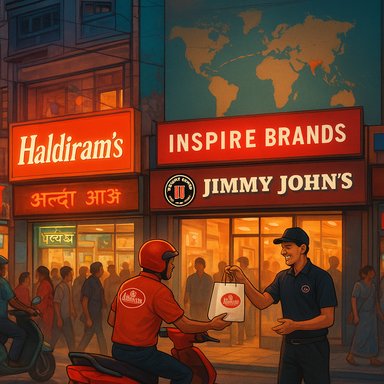 Background / Overview
Haldiram’s is best known as India’s largest ethnic food services company, with a sprawling business that spans household FMCG snacks, sweets and a restaurant network. Over recent months the group has consolidated its FMCG operations into Haldiram Snacks Food Pvt Ltd and attracted institutional interest, moves widely seen as prelude to a larger capital‑markets event. The company’s Registrar of Companies filings show Haldiram Snacks Food reported ₹12,800 crore in revenue and ₹1,400 crore in net profit for FY24 — figures that underpin investor interest in the brand and its diversification play. Jimmy John’s, founded in 1983, is a delivery‑focused sandwich and wrap chain that operates thousands of locations across North America and select international markets. It has been part of Inspire Brands since 2019, and Inspire today manages a global multi‑brand portfolio including Arby’s, Buffalo Wild Wings, Sonic, Dunkin’ and Baskin‑Robbins — a network the company reports as tens of thousands of restaurants and tens of billions in system sales. The practical upshot: Jimmy John’s brings an established QSR playbook and a parent company with global scale. Why this deal matters: strategic rationale for Haldiram’s
A deliberate pivot from ethnic to western QSR formats
Haldiram’s has been a dominant force in India’s traditional snacks and sweets market for decades. The proposed Jimmy John’s partnership signals a strategic attempt to broaden the company’s addressable market by entering the Western quick‑service sandwich segment — a category that benefits from high frequency purchases and easy menu standardization. Franchising an international concept lets Haldiram’s leverage its existing supply chains, retail real estate experience and brand distribution muscle while tapping a new, younger consumer base attracted to café‑style, on‑the‑go formats.Capture of delivery and campus/office demand
Jimmy John’s core advantage in the US has been rapid delivery and a streamlined menu that suits delivery economics. In India, urban consumption patterns — rising delivery penetration, expanding office and campus footfall, and two‑wheeler delivery networks — create a favorable demand environment for sandwich chains that can offer speed, value and consistent quality. Haldiram’s existing restaurant arm (over 150 outlets, ~₹2,000 crore valuation) creates a launchpad for rapid roll‑out and multi‑format experiments (dine‑in, takeaway, delivery‑only kitchens).Deal mechanics and what’s public vs. unverified
- Reported structure: discussions are described as centring on an exclusive franchise partnership giving Haldiram’s rights to operate Jimmy John’s across India; if consummated, the new chain would be housed under Haldiram’s restaurant division, separate from the FMCG entity.
- Company statements: Haldiram’s publicly described the conversations as exploratory and emphasised potential collaboration on sourcing and fulfilment value chains; the company stopped short of confirming a final franchise deal. Because the negotiations are ongoing and commercially sensitive, many operational and financial terms remain confidential and should be treated as unverified until formal agreements are announced.
- Haldiram’s engagement with Inspire Brands is reported by multiple outlets; this confirms media reporting of talks but not a signed agreement.
- Haldiram Snacks Food FY24 revenue and profit numbers are reflected in RoC filings cited by press coverage. These RoC figures have been widely reported in business press.
- Jimmy John’s scale (2,600+ locations) and Inspire Brands’ system sales estimates are drawn from company and industry reporting; these figures are consistent across corporate disclosures and trade press, but the precise counts vary by date so readers should treat them as point estimates rather than static totals.
Market fit and competition: Subway, Tim Hortons, and the Indian QSR landscape
Direct competitors and how Jimmy John’s would slot in
- Subway remains the largest global sandwich brand and has an entrenched but variable footprint in India; Tim Hortons represents another multi‑category entrant focused on coffee + sandwiches and has targeted the Indian market via franchise partners. A Jimmy John’s entry backed by a native giant like Haldiram’s could amplify competition in urban delivery corridors, college towns and IT/office clusters.
- From a menu positioning perspective, Jimmy John’s emphasises freshly made, simple cold and toasted sandwiches with an operational model optimised for high throughput and delivery. Against Subway’s custom‑build model and Tim Hortons’ hybrid café approach, Jimmy John’s could claim a niche around speed + delivery reliability. Whether that niche scales in India will depend on pricing, localisation, and delivery economics.
Why Haldiram’s is a credible rival
Haldiram’s already runs a national restaurant network, has deep procurement reach — including international supply relationships — and brand recognition that resonates across many Indian consumer segments. Those strengths reduce several friction points typical for new franchises: sourcing consistency, regulatory compliance, and local marketing. Haldiram’s also has experience managing both retail and quick‑service formats that can be adapted to franchise standards.Operational realities: supply chain, sourcing and localisation
Sourcing and fulfilment: the secret sauce (and risk)
Haldiram’s has emphasised the potential to support Inspire Brands’ sourcing and fulfilment chains using its international culinary supply ecosystem. In practice this could mean:- Developing localized ingredient supply for breads, proteins and sauces that meet Jimmy John’s brand specifications.
- Using Haldiram’s cold‑chain and QSR distribution networks to lower input costs and ensure consistency.
- Centralising menu R&D to deliver India‑appropriate innovations (vegetarian sandwiches, regional flavours) while preserving core brand attributes.
Real estate and format playbook
A credible roll‑out will likely combine:- Flagship dine‑in stores in premium malls and high streets for brand signalling.
- Compact delivery‑first kitchens (dark kitchens) near urban clusters to optimise delivery times and reduce rent.
- Campus and office kiosks for grab‑and‑go volume.
Financial implications for Haldiram’s and investors
Haldiram’s consolidation of its FMCG operations and reported FY24 results (₹12,800 crore revenue; ₹1,400 crore net profit) strengthen the company’s balance sheet narrative and likely increase appetites for strategic expansion and private investment. Bringing an international franchise into the restaurant arm can serve multiple corporate objectives:- Diversify revenue streams away from legacy FMCG cyclicality.
- Increase the restaurant division’s valuation ahead of any potential public listing.
- Leverage investor interest (Temasek and private capital have been mentioned in recent transactions) to fund expansion.
Regulatory and franchise governance considerations
- Franchise agreements with global brands typically contain strict operational covenants, supply approvals, auditing rights and marketing contributions. Haldiram’s will need to negotiate territory protections, transfer pricing for intercompany supplies and exit clauses that preserve shareholder value if the concept underperforms.
- Food safety and labelling regulations in India have become more stringent; aligning Jimmy John’s processes with FSSAI norms and local municipal licences will add compliance overhead, especially for perishable supply chains.
Competitive response: what incumbents may do
- Subway: may double down on loyalty, value meals and strategic pricing in urban markets where Jimmy John’s would compete directly for sandwich spend.
- Tim Hortons and other café‑hybrids: could accelerate menu localisation or offer bundled promotions to hold share in coffee + snack occasions.
- Local independents and homegrown chains: may compete on price and hyper‑local menus, especially in non‑metros where global brands have higher unit economics.
Risks — ranked and explained
- Execution risk: misaligned supply chains or failure to secure franchisor approvals for local sourcing can derail operations early.
- Unit economics risk: high rents and delivery commission pressure can compress margins and slow breakeven.
- Brand risk: any food‑safety or quality lapse under an international brand will have outsized reputational impact for both Haldiram’s and the franchisor.
- Regulatory & compliance risk: municipal licensing, FSSAI compliance, and evolving food‑service rules add cost and timeline unpredictability.
- Strategic dilution: overextension across too many formats without disciplined channel economics can distract from Haldiram’s core strengths.
What success would look like — practical metrics and a staged roll‑out
A pragmatic launch plan Haldiram’s could follow:- Pilot phase (6–12 months): 10–20 stores in Tier‑1 cities with a mix of flagship and delivery kitchens to validate menu, pricing and delivery times.
- Optimisation phase (12–24 months): refine supply chain, introduce India‑specific menu items (vegetarian options, regionally inspired sauces), and negotiate better delivery commissions.
- Scale phase (24–60 months): expand into Tier‑2 cities with a mix of franchised and company‑owned stores once unit economics are stable.
- Unit breakeven month and payback period.
- Average order value (AOV) and delivery time (minutes).
- Same‑store sales growth and contribution margin per order.
- Supply chain fill‑rate and waste percentages.
Consumer impact and menu localisation
To win in India, Jimmy John’s via Haldiram’s would almost certainly need to adapt its menu:- Vegetarian core offerings (multiple vegetarian sandwich choices) to meet a sizeable market segment.
- Price variants (smaller sandwiches, combo meals) to hit lower price thresholds common in India.
- Regional promotions and local flavours (e.g., chutney variants or spice profiles).
Lessons for international franchisors and local partners
- Franchisors benefit from strong national partners who bring procurement scale, local regulatory know‑how, and established retail footprints. Haldiram’s profile matches these needs.
- Local partners must accept franchisor discipline: rigorous menu specifications, quality audits and marketing standards. The balance between global consistency and local relevance is the crux of successful international franchising.
- Contracts should clarify sourcing rights, transfer pricing, territory exclusivity, and co‑investment obligations for store capex and marketing to avoid downstream disputes.
Final assessment: upside, plausibility and caveats
The strategic logic for Haldiram’s to partner with Inspire Brands and pilot Jimmy John’s in India is strong: it leverages Haldiram’s supply chain strength, restaurant experience and distribution scale while tapping into a high‑frequency QSR category that dovetails with rising delivery demand. The deal — if signed — could quickly change competitive dynamics in the Indian sandwich and café segment. However, several caveats remain:- Public reports describe talks and exploratory discussions, not a completed legal agreement; terms, territory rights and timelines are therefore unverified. Treat media reports as well‑sourced reporting rather than definitive fact until an official franchise announcement is made.
- Brand and unit economics must be stress‑tested in India’s unique cost structure; strong heritage in packaged snacks does not automatically translate to low‑margin, high‑service QSR success.
- Inspire Brands’ global scale is a powerful resource — but it also brings strict compliance rules that can lengthen the ramp to profitable operations.
What to watch next
- Official franchise announcement from Haldiram’s or Inspire Brands that confirms territory, financial terms and launch timeline.
- Pilot store openings and initial same‑store sales performance in key cities (Delhi/NCR, Mumbai, Bengaluru, Hyderabad).
- Any supply‑chain tie‑ups or capital raises earmarked to fund the restaurant roll‑out; these will indicate how aggressively Haldiram’s plans to scale.
Haldiram’s possible tie‑up with Jimmy John’s is a consequential story because it combines an iconic, domestically rooted food conglomerate with a delivery‑first American sandwich brand backed by a multi‑brand global operator. The potential for rapid national expansion and category disruption is real — but success hinges on disciplined execution: tight supply‑chain integration, careful menu localisation, conservative store economics and clear franchise governance. Until an agreement is signed and pilots deliver repeatable unit economics, this remains a high‑potential strategic bet that deserves cautious optimism rather than certainty.
Source: Storyboard18 Haldiram’s in talks to bring Jimmy John’s to India, eyes competition with Subway, Tim Hortons