

Haleon, the UK-based owner of Sensodyne, Panadol, Advil, Centrum and other consumer-health brands, said on June 30, 2026, that it will expand its use of Microsoft cloud, data and AI tools through a new five-year collaboration across its global business. The announcement is not about an AI toothbrush or a chatbot doctor. It is about something more consequential for enterprise Windows and Microsoft 365 customers: AI moving from pilot theater into the operating model of a regulated, brand-sensitive multinational. Microsoft’s bet is that Copilot becomes less a shiny assistant and more the connective tissue of everyday corporate work.
The most interesting part of the Haleon deal is not that another large company has signed another multi-year Microsoft agreement. That is now the rhythm of enterprise AI: announce a strategic collaboration, cite productivity, invoke responsible AI, and promise new use cases. The pattern is familiar enough that readers can be forgiven for tuning it out.
But Haleon is a useful case study because it sits in a category where AI hype collides with very ordinary human needs. Tooth sensitivity, pain relief, vitamins, cold remedies and digestive health are not abstractions. They are products that sit in bathroom cabinets, supermarket aisles, pharmacies and clinical recommendation workflows across a vast number of countries.
That makes the collaboration more than a software procurement story. Haleon says its brands reach about 1.4 billion consumers worldwide and that it operates across 170 markets. If AI changes how that company reads consumer behavior, manages supply constraints, develops claims, coordinates marketing, or supports field teams, the effects will not stay inside a PowerPoint deck.
Microsoft, for its part, gets exactly the kind of customer it wants for the next phase of Copilot. The early market for generative AI was built on astonishment: write me an email, summarize this meeting, draft this document. The next market is built on integration. It asks whether AI can live inside identity systems, data estates, compliance boundaries, Teams chats, Office files and business processes without turning into a governance migraine.
Haleon’s announcement suggests that the answer Microsoft wants to sell is not a single model or a single app. It is the Microsoft stack as a managed environment for enterprise AI adoption.
Generative AI’s most durable enterprise use may not be dramatic replacement. It may be compression. The tool trims the time between a meeting and a brief, between a research question and a first synthesis, between a sales update and an action plan, between a spreadsheet and a narrative that executives can actually read.
For WindowsForum readers who live in Microsoft 365, that distinction matters. Copilot is not just competing with rival AI tools; it is competing with old work habits. It is trying to turn the existing Microsoft estate — Outlook, Word, Excel, PowerPoint, Teams, SharePoint, OneDrive, Entra ID, Purview and Azure — into an AI substrate that feels safer and more manageable than stitching together consumer-grade tools.
That is the real pitch to companies like Haleon. The AI does not have to be magical every minute. It has to be available where employees already work, constrained by the permissions they already have, and useful enough often enough that adoption spreads beyond early enthusiasts.
This is where many enterprise AI rollouts will either succeed or quietly become expensive shelfware. A company-wide Copilot push can look impressive on a procurement line. It only becomes meaningful if the organization redesigns mundane workflows around it.
That gives the Microsoft-Haleon partnership a different risk profile from a generic office productivity rollout. AI-generated meeting summaries are one thing. AI-assisted consumer insights, claims analysis, innovation pipelines and commercial execution are another. In health-adjacent businesses, a confident mistake can become a reputational problem very quickly.
The obvious concern is not that Copilot will start inventing drug labels. Large companies have review processes, regulatory teams and legal controls precisely because product claims are sensitive. The subtler concern is that AI systems can influence the upstream work: which patterns analysts notice, which consumer complaints rise to the surface, which product ideas seem promising, which markets appear to need more attention.
That does not make AI inappropriate. It makes governance central. Haleon and Microsoft can talk about “responsible AI” in the usual polished language, but the operational question is harder: who validates outputs, which datasets are allowed into which workflows, how are prompts and responses monitored, and where does the organization draw a bright line between assistance and decision-making?
For Microsoft, these are not side issues. They are the basis of its enterprise advantage. The company wants customers to believe that AI inside Microsoft 365 and Azure can be governed with the same seriousness as email retention, data-loss prevention, identity access and endpoint management.
For most employees in a company like Haleon, AI will not arrive as a research model or a developer API. It will arrive in the tools they already open every morning: Teams meetings, Outlook threads, Word documents, Excel workbooks and PowerPoint decks. That means the endpoint still matters, because the endpoint is where identity, policy, data access and user behavior meet.
Windows administrators should read deals like this as a signal. Microsoft’s AI strategy is making the managed desktop more, not less, important. Devices must be patched, identities hardened, browsers controlled, data boundaries enforced, and employees trained not to paste sensitive information into the wrong place.
The marketing phrase is “AI transformation.” The sysadmin translation is more prosaic: more services to license, more policy surfaces to configure, more audit logs to understand, more user expectations to manage, and more pressure to explain why a feature that works in a demo may not be allowed in a given tenant.
Copilot adoption also increases the premium on clean information architecture. If SharePoint is a junk drawer, if permissions are sloppy, if stale files live forever, AI has more opportunity to surface the wrong thing to the wrong person. Generative AI does not create information governance problems from nothing. It exposes the ones organizations tolerated because search was bad and humans were too busy to notice.
AI can plausibly help here, though not in the cartoonish “the model runs the factory” sense. The more realistic value is synthesis across messy signals: demand forecasts, market disruptions, promotional calendars, inventory positions, supplier issues, regulatory constraints and logistics data. If employees can interrogate that data faster and coordinate responses across regions, the business benefit can be material.
That is also why Microsoft wants these collaborations to go beyond Microsoft 365 Copilot. The office assistant is the visible layer. The deeper play is Azure data infrastructure, analytics, security, custom agents and integration with enterprise systems that hold operational truth.
Haleon’s broader technology modernization matters here. The company has also been moving parts of its enterprise infrastructure through major platform decisions, including SAP-related transformation. In a large multinational, Microsoft AI will not live in isolation. It will have to coexist with ERP systems, manufacturing data, product lifecycle tools, regulatory workflows and regional market systems.
That is where enterprise AI becomes less glamorous and more valuable. The hard work is not producing a fluent paragraph. It is getting the right data, from the right system, under the right permissions, into the right workflow at the right time.
That distinction matters. Microsoft does not need to claim that Copilot diagnoses patients in order to make money from health. It can sell cloud infrastructure, productivity tools, identity systems, analytics, AI development platforms and governance services to organizations that operate around health.
Consumer health may be especially attractive because it blends scale with complexity. Haleon’s products are sold globally, but the company has to navigate local languages, market norms, regulations, retail channels and consumer behaviors. That is fertile ground for AI tools that summarize, translate, cluster, compare and assist decision-making.
There is also a reputational benefit for Microsoft. AI in health can sound unsettling when framed as machines making clinical calls. AI helping employees improve accessibility, analyze consumer needs, reduce administrative friction or manage supply chains is a softer story. It lets Microsoft associate its technology with everyday health outcomes without stepping directly into the most controversial parts of medical AI.
Still, the boundary will need watching. As consumer health companies use AI to understand people’s needs more intimately, the distance between helpful personalization and manipulative targeting can narrow. The companies that handle this well will be explicit about where AI improves service and where human review remains non-negotiable.
Accessibility is one of the areas where AI can be genuinely transformative without requiring speculative leaps. Reading labels, recognizing products, surfacing dosage information and making packaging more usable can reduce friction for people who have historically been poorly served by standard product design.
That history gives the new five-year collaboration a useful benchmark. The question is not whether the companies can produce an impressive press release. The question is whether future AI use cases are as tangible as making product information easier to access.
It also reminds us that not all AI value is measured in headcount reduction or meeting minutes saved. Some value comes from making systems less hostile to people with different needs. For a consumer health company, that should not be peripheral. It should be part of the product promise.
The challenge is that AI savings are often diffuse. An employee saves 12 minutes on a meeting recap, 20 minutes on a draft, 10 minutes triaging email, and maybe an hour building a presentation outline. That feels useful, but it does not automatically appear as lower cost, faster launches or better margins.
To make the Haleon collaboration more than an executive productivity story, the companies will need to tie AI usage to business outcomes. Faster consumer insight cycles, better demand planning, shorter innovation timelines, more consistent commercial execution and fewer administrative bottlenecks are measurable in principle. Whether they are measured rigorously is another matter.
This is where enterprises should be skeptical without being cynical. AI can absolutely improve knowledge work. It can also become a tax: another tool employees are expected to learn, another source of output they must verify, another system that generates plausible text requiring human cleanup.
The winners will not be the companies with the most Copilot licenses. They will be the ones that redesign workflows so the AI has a clear role and employees know when to trust it, when to challenge it and when to ignore it.
But “your data is already there” is not the same as “your data is ready.” Large companies accumulate duplicated files, inconsistent taxonomies, legacy repositories, regional silos and permission schemes that made sense five reorganizations ago. AI turns that mess into a strategic problem.
Haleon’s stated ambition to scale digital, data and AI capabilities implies that the collaboration cannot just be a Copilot rollout. It has to involve data quality, architecture, governance and change management. Otherwise the AI layer will be limited to generic productivity tasks and disconnected experiments.
For IT pros, this is the uncomfortable truth behind the AI boom. The glamorous layer depends on boring foundations. Identity, access control, classification, retention, endpoint security, data lineage and user training are no longer merely compliance chores. They are what determine whether AI is useful or dangerous.
Microsoft benefits from this reality because it sells much of the foundation. Customers benefit only if they do the hard internal work rather than assuming the platform will solve organizational disorder by itself.
A consumer insights team may use AI to summarize regional feedback. A marketing group may use it to draft campaign variants. A supply chain analyst may use it to interpret disruption reports. A product team may use it to scan research and generate early concepts. Each step has a human in the loop, but the machine is shaping the terrain.
That is why auditability matters. If AI-assisted work leads to a successful campaign or a flawed assumption, organizations need to know how the work was produced. Which data was used? Which prompts shaped the answer? Which human reviewed it? Which outputs were discarded?
Microsoft has been emphasizing enterprise-grade controls because this is the objection sophisticated buyers raise. It is not enough for AI to be powerful. It must be governable. In regulated or reputation-sensitive sectors, ungoverned usefulness is not a feature; it is a liability.
Haleon’s challenge will be cultural as much as technical. Employees need permission to use AI, but also permission to slow down when the output feels wrong. An organization that treats AI as an infallible accelerator will eventually discover that speed can scale mistakes too.
Google has Gemini in Workspace and Cloud. Amazon has Bedrock and a deep enterprise infrastructure base. Salesforce, ServiceNow, SAP, Oracle, Adobe and countless vertical software vendors are embedding AI into their own platforms. OpenAI, Anthropic and other model providers want direct enterprise relationships. Every vendor wants to be the place where work gets augmented.
Microsoft’s advantage is distribution. It already owns the daily work surface for many organizations. If Copilot becomes good enough, and if procurement prefers a consolidated vendor story, Microsoft can turn incumbency into AI share.
That does not mean the best AI experience will always come from Microsoft. Specialized workflows may favor specialized tools. Developers may prefer different coding assistants. Data scientists may want model flexibility. Business units may already rely on AI features inside line-of-business platforms.
But Microsoft does not need to win every use case. It needs to win the default layer. A five-year collaboration with a company like Haleon helps reinforce the message that serious enterprises can standardize AI around Microsoft while still building custom use cases where necessary.
Before broad rollout, organizations need to review access permissions, sensitivity labels, sharing policies, guest access, retention rules and endpoint posture. They need to understand which users can invoke AI over which data. They need a plan for training employees who may not understand that Copilot’s output is bounded by permissions but still dependent on the quality and appropriateness of accessible content.
The most dangerous AI deployment is not the one that fails. It is the one that appears to work while quietly surfacing overshared data, reinforcing stale assumptions or generating polished summaries of unreliable material. That risk is not unique to Microsoft, but Microsoft’s reach makes it especially important.
This is also where Windows endpoint management remains part of the AI story. If employees access AI-assisted workflows from unmanaged devices, outdated browsers or poorly secured endpoints, the governance promise weakens. Cloud AI does not eliminate endpoint risk; it changes the shape of it.
IT teams should expect more pressure from business units that want AI capabilities quickly. The right response is not reflexive obstruction. It is a phased approach that pairs enablement with controls, telemetry and visible rules of the road.
That indirectness is typical of enterprise AI. The technology disappears into processes. A better forecast means shelves are stocked. A better insight loop means a product variation launches sooner. A better accessibility workflow means someone can understand a label without assistance. A better commercial process means promotions line up more effectively with local demand.
The danger is that companies over-attribute normal business improvement to AI and under-discuss the human systems around it. A supply chain gets better because planners, data engineers, procurement teams and regional operators use better tools in better workflows. AI is part of that, not a wand waved over the enterprise.
For Haleon, the opportunity is to make “everyday health” a little less fragmented. That could mean better internal coordination, more inclusive product information, faster response to consumer needs and more disciplined innovation. The risk is that the AI program becomes another layer of corporate abstraction unless it produces changes people can actually experience.
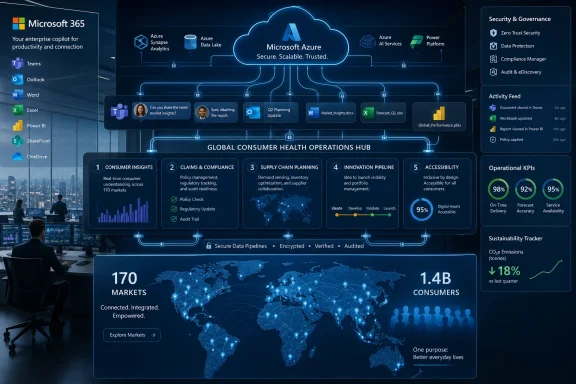 Microsoft’s AI Pitch Has Moved From Demo Magic to Organizational Plumbing
The most interesting part of the Haleon deal is not that another large company has signed another multi-year Microsoft agreement. That is now the rhythm of enterprise AI: announce a strategic collaboration, cite productivity, invoke responsible AI, and promise new use cases. The pattern is familiar enough that readers can be forgiven for tuning it out.But Haleon is a useful case study because it sits in a category where AI hype collides with very ordinary human needs. Tooth sensitivity, pain relief, vitamins, cold remedies and digestive health are not abstractions. They are products that sit in bathroom cabinets, supermarket aisles, pharmacies and clinical recommendation workflows across a vast number of countries.
That makes the collaboration more than a software procurement story. Haleon says its brands reach about 1.4 billion consumers worldwide and that it operates across 170 markets. If AI changes how that company reads consumer behavior, manages supply constraints, develops claims, coordinates marketing, or supports field teams, the effects will not stay inside a PowerPoint deck.
Microsoft, for its part, gets exactly the kind of customer it wants for the next phase of Copilot. The early market for generative AI was built on astonishment: write me an email, summarize this meeting, draft this document. The next market is built on integration. It asks whether AI can live inside identity systems, data estates, compliance boundaries, Teams chats, Office files and business processes without turning into a governance migraine.
Haleon’s announcement suggests that the answer Microsoft wants to sell is not a single model or a single app. It is the Microsoft stack as a managed environment for enterprise AI adoption.
Haleon Is Not Buying a Chatbot; It Is Buying a Workflow Argument
The language around the deal is carefully corporate: Haleon will scale digital, data and AI capabilities; employees will automate administrative work; teams will streamline collaboration; the companies will co-create high-impact use cases across consumer insights, innovation, supply chain and commercial execution. None of that sounds revolutionary, which is precisely why it matters.Generative AI’s most durable enterprise use may not be dramatic replacement. It may be compression. The tool trims the time between a meeting and a brief, between a research question and a first synthesis, between a sales update and an action plan, between a spreadsheet and a narrative that executives can actually read.
For WindowsForum readers who live in Microsoft 365, that distinction matters. Copilot is not just competing with rival AI tools; it is competing with old work habits. It is trying to turn the existing Microsoft estate — Outlook, Word, Excel, PowerPoint, Teams, SharePoint, OneDrive, Entra ID, Purview and Azure — into an AI substrate that feels safer and more manageable than stitching together consumer-grade tools.
That is the real pitch to companies like Haleon. The AI does not have to be magical every minute. It has to be available where employees already work, constrained by the permissions they already have, and useful enough often enough that adoption spreads beyond early enthusiasts.
This is where many enterprise AI rollouts will either succeed or quietly become expensive shelfware. A company-wide Copilot push can look impressive on a procurement line. It only becomes meaningful if the organization redesigns mundane workflows around it.
Consumer Health Makes AI More Sensitive Than the Average Productivity Story
Haleon is not a hospital, but it is also not selling shoes. Consumer health occupies an awkward middle ground: it is commercial, regulated, personal and emotionally charged. People may buy toothpaste casually, but they do not feel casual about pain, illness, dosage instructions or whether a product is safe for a child.That gives the Microsoft-Haleon partnership a different risk profile from a generic office productivity rollout. AI-generated meeting summaries are one thing. AI-assisted consumer insights, claims analysis, innovation pipelines and commercial execution are another. In health-adjacent businesses, a confident mistake can become a reputational problem very quickly.
The obvious concern is not that Copilot will start inventing drug labels. Large companies have review processes, regulatory teams and legal controls precisely because product claims are sensitive. The subtler concern is that AI systems can influence the upstream work: which patterns analysts notice, which consumer complaints rise to the surface, which product ideas seem promising, which markets appear to need more attention.
That does not make AI inappropriate. It makes governance central. Haleon and Microsoft can talk about “responsible AI” in the usual polished language, but the operational question is harder: who validates outputs, which datasets are allowed into which workflows, how are prompts and responses monitored, and where does the organization draw a bright line between assistance and decision-making?
For Microsoft, these are not side issues. They are the basis of its enterprise advantage. The company wants customers to believe that AI inside Microsoft 365 and Azure can be governed with the same seriousness as email retention, data-loss prevention, identity access and endpoint management.
The Copilot Expansion Is Also a Windows Story
At first glance, a global consumer health AI deal might seem far removed from the Windows desktop. It is not. The future Microsoft is selling depends on Windows remaining the front door to enterprise work, even as the intelligence layer increasingly lives in the cloud.For most employees in a company like Haleon, AI will not arrive as a research model or a developer API. It will arrive in the tools they already open every morning: Teams meetings, Outlook threads, Word documents, Excel workbooks and PowerPoint decks. That means the endpoint still matters, because the endpoint is where identity, policy, data access and user behavior meet.
Windows administrators should read deals like this as a signal. Microsoft’s AI strategy is making the managed desktop more, not less, important. Devices must be patched, identities hardened, browsers controlled, data boundaries enforced, and employees trained not to paste sensitive information into the wrong place.
The marketing phrase is “AI transformation.” The sysadmin translation is more prosaic: more services to license, more policy surfaces to configure, more audit logs to understand, more user expectations to manage, and more pressure to explain why a feature that works in a demo may not be allowed in a given tenant.
Copilot adoption also increases the premium on clean information architecture. If SharePoint is a junk drawer, if permissions are sloppy, if stale files live forever, AI has more opportunity to surface the wrong thing to the wrong person. Generative AI does not create information governance problems from nothing. It exposes the ones organizations tolerated because search was bad and humans were too busy to notice.
The Supply Chain Angle Is Where the Deal Gets Operational
The announcement’s reference to supply chain use cases deserves more attention than the usual productivity boilerplate. For a global consumer health company, supply chain is not a back-office abstraction. It is the difference between having pain relief on shelves during flu season and explaining why demand signals were missed.AI can plausibly help here, though not in the cartoonish “the model runs the factory” sense. The more realistic value is synthesis across messy signals: demand forecasts, market disruptions, promotional calendars, inventory positions, supplier issues, regulatory constraints and logistics data. If employees can interrogate that data faster and coordinate responses across regions, the business benefit can be material.
That is also why Microsoft wants these collaborations to go beyond Microsoft 365 Copilot. The office assistant is the visible layer. The deeper play is Azure data infrastructure, analytics, security, custom agents and integration with enterprise systems that hold operational truth.
Haleon’s broader technology modernization matters here. The company has also been moving parts of its enterprise infrastructure through major platform decisions, including SAP-related transformation. In a large multinational, Microsoft AI will not live in isolation. It will have to coexist with ERP systems, manufacturing data, product lifecycle tools, regulatory workflows and regional market systems.
That is where enterprise AI becomes less glamorous and more valuable. The hard work is not producing a fluent paragraph. It is getting the right data, from the right system, under the right permissions, into the right workflow at the right time.
Microsoft’s Health Play Is Broader Than Hospitals
Microsoft has spent years trying to convince the market that it can be a serious health technology provider without becoming a healthcare provider. Its partnerships span providers, researchers, pharmaceutical companies, public health bodies and now consumer health businesses. The Haleon deal fits that strategy neatly because it expands Microsoft’s health-adjacent footprint while keeping the focus on platforms rather than clinical judgment.That distinction matters. Microsoft does not need to claim that Copilot diagnoses patients in order to make money from health. It can sell cloud infrastructure, productivity tools, identity systems, analytics, AI development platforms and governance services to organizations that operate around health.
Consumer health may be especially attractive because it blends scale with complexity. Haleon’s products are sold globally, but the company has to navigate local languages, market norms, regulations, retail channels and consumer behaviors. That is fertile ground for AI tools that summarize, translate, cluster, compare and assist decision-making.
There is also a reputational benefit for Microsoft. AI in health can sound unsettling when framed as machines making clinical calls. AI helping employees improve accessibility, analyze consumer needs, reduce administrative friction or manage supply chains is a softer story. It lets Microsoft associate its technology with everyday health outcomes without stepping directly into the most controversial parts of medical AI.
Still, the boundary will need watching. As consumer health companies use AI to understand people’s needs more intimately, the distance between helpful personalization and manipulative targeting can narrow. The companies that handle this well will be explicit about where AI improves service and where human review remains non-negotiable.
The Accessibility Thread Gives This Partnership a Longer Memory
Haleon and Microsoft are not starting from zero. The companies previously worked together on accessibility efforts involving Microsoft’s Seeing AI technology, designed to help people who are blind or have low vision access product information. That earlier collaboration is important because it shows a more concrete version of “AI for everyday health” than most corporate slogans.Accessibility is one of the areas where AI can be genuinely transformative without requiring speculative leaps. Reading labels, recognizing products, surfacing dosage information and making packaging more usable can reduce friction for people who have historically been poorly served by standard product design.
That history gives the new five-year collaboration a useful benchmark. The question is not whether the companies can produce an impressive press release. The question is whether future AI use cases are as tangible as making product information easier to access.
It also reminds us that not all AI value is measured in headcount reduction or meeting minutes saved. Some value comes from making systems less hostile to people with different needs. For a consumer health company, that should not be peripheral. It should be part of the product promise.
The Productivity Math Still Needs Proof
Every large Copilot deployment runs into the same unanswered question: what is the return on investment after the novelty fades? Microsoft can point to pilots, customer anecdotes and broad claims about time savings. Customers can point to reduced administrative burden and faster collaboration. But enterprise software buyers know the gap between a promising trial and durable organizational productivity.The challenge is that AI savings are often diffuse. An employee saves 12 minutes on a meeting recap, 20 minutes on a draft, 10 minutes triaging email, and maybe an hour building a presentation outline. That feels useful, but it does not automatically appear as lower cost, faster launches or better margins.
To make the Haleon collaboration more than an executive productivity story, the companies will need to tie AI usage to business outcomes. Faster consumer insight cycles, better demand planning, shorter innovation timelines, more consistent commercial execution and fewer administrative bottlenecks are measurable in principle. Whether they are measured rigorously is another matter.
This is where enterprises should be skeptical without being cynical. AI can absolutely improve knowledge work. It can also become a tax: another tool employees are expected to learn, another source of output they must verify, another system that generates plausible text requiring human cleanup.
The winners will not be the companies with the most Copilot licenses. They will be the ones that redesign workflows so the AI has a clear role and employees know when to trust it, when to challenge it and when to ignore it.
The Data Estate Is the Real Product
Microsoft’s enterprise AI strategy rests on a simple but powerful claim: your data is already in Microsoft’s world, so your AI should be too. For many large organizations, that claim is at least partly true. Email, documents, meetings, calendars and collaboration history often sit inside Microsoft 365, while Azure increasingly hosts analytics, applications and security tooling.But “your data is already there” is not the same as “your data is ready.” Large companies accumulate duplicated files, inconsistent taxonomies, legacy repositories, regional silos and permission schemes that made sense five reorganizations ago. AI turns that mess into a strategic problem.
Haleon’s stated ambition to scale digital, data and AI capabilities implies that the collaboration cannot just be a Copilot rollout. It has to involve data quality, architecture, governance and change management. Otherwise the AI layer will be limited to generic productivity tasks and disconnected experiments.
For IT pros, this is the uncomfortable truth behind the AI boom. The glamorous layer depends on boring foundations. Identity, access control, classification, retention, endpoint security, data lineage and user training are no longer merely compliance chores. They are what determine whether AI is useful or dangerous.
Microsoft benefits from this reality because it sells much of the foundation. Customers benefit only if they do the hard internal work rather than assuming the platform will solve organizational disorder by itself.
The Risk Is Not That AI Replaces Everyone; It Is That It Becomes Invisible
The public debate around AI often fixates on replacement: which jobs disappear, which workers are automated, which professions are next. In enterprise deployments like Haleon’s, a more immediate issue is invisibility. AI may become embedded in enough small decisions that no single moment feels consequential, even though the aggregate effect is large.A consumer insights team may use AI to summarize regional feedback. A marketing group may use it to draft campaign variants. A supply chain analyst may use it to interpret disruption reports. A product team may use it to scan research and generate early concepts. Each step has a human in the loop, but the machine is shaping the terrain.
That is why auditability matters. If AI-assisted work leads to a successful campaign or a flawed assumption, organizations need to know how the work was produced. Which data was used? Which prompts shaped the answer? Which human reviewed it? Which outputs were discarded?
Microsoft has been emphasizing enterprise-grade controls because this is the objection sophisticated buyers raise. It is not enough for AI to be powerful. It must be governable. In regulated or reputation-sensitive sectors, ungoverned usefulness is not a feature; it is a liability.
Haleon’s challenge will be cultural as much as technical. Employees need permission to use AI, but also permission to slow down when the output feels wrong. An organization that treats AI as an infallible accelerator will eventually discover that speed can scale mistakes too.
The Competitive Subtext Is Microsoft Against Everyone Else’s AI Stack
The Haleon announcement also sits inside a broader land grab. Microsoft is not merely selling Copilot as a product. It is trying to make Microsoft 365 and Azure the default enterprise AI environment before competitors can peel off workloads.Google has Gemini in Workspace and Cloud. Amazon has Bedrock and a deep enterprise infrastructure base. Salesforce, ServiceNow, SAP, Oracle, Adobe and countless vertical software vendors are embedding AI into their own platforms. OpenAI, Anthropic and other model providers want direct enterprise relationships. Every vendor wants to be the place where work gets augmented.
Microsoft’s advantage is distribution. It already owns the daily work surface for many organizations. If Copilot becomes good enough, and if procurement prefers a consolidated vendor story, Microsoft can turn incumbency into AI share.
That does not mean the best AI experience will always come from Microsoft. Specialized workflows may favor specialized tools. Developers may prefer different coding assistants. Data scientists may want model flexibility. Business units may already rely on AI features inside line-of-business platforms.
But Microsoft does not need to win every use case. It needs to win the default layer. A five-year collaboration with a company like Haleon helps reinforce the message that serious enterprises can standardize AI around Microsoft while still building custom use cases where necessary.
For Windows Administrators, the AI Rollout Starts Before the License Assignment
The practical impact for Windows and Microsoft 365 administrators is straightforward: AI adoption is now a governance project. It is tempting for executives to view Copilot as a feature that can be switched on after procurement. Admins know better.Before broad rollout, organizations need to review access permissions, sensitivity labels, sharing policies, guest access, retention rules and endpoint posture. They need to understand which users can invoke AI over which data. They need a plan for training employees who may not understand that Copilot’s output is bounded by permissions but still dependent on the quality and appropriateness of accessible content.
The most dangerous AI deployment is not the one that fails. It is the one that appears to work while quietly surfacing overshared data, reinforcing stale assumptions or generating polished summaries of unreliable material. That risk is not unique to Microsoft, but Microsoft’s reach makes it especially important.
This is also where Windows endpoint management remains part of the AI story. If employees access AI-assisted workflows from unmanaged devices, outdated browsers or poorly secured endpoints, the governance promise weakens. Cloud AI does not eliminate endpoint risk; it changes the shape of it.
IT teams should expect more pressure from business units that want AI capabilities quickly. The right response is not reflexive obstruction. It is a phased approach that pairs enablement with controls, telemetry and visible rules of the road.
The Consumer Will Feel the Effects Indirectly First
Most consumers will not know or care that Haleon has a five-year Microsoft collaboration. They will notice only if products become easier to find, instructions become clearer, packaging becomes more accessible, campaigns feel more relevant, or innovation moves faster. They may also notice if AI-assisted decisions make the company seem creepier, less transparent or too eager to personalize health-related messaging.That indirectness is typical of enterprise AI. The technology disappears into processes. A better forecast means shelves are stocked. A better insight loop means a product variation launches sooner. A better accessibility workflow means someone can understand a label without assistance. A better commercial process means promotions line up more effectively with local demand.
The danger is that companies over-attribute normal business improvement to AI and under-discuss the human systems around it. A supply chain gets better because planners, data engineers, procurement teams and regional operators use better tools in better workflows. AI is part of that, not a wand waved over the enterprise.
For Haleon, the opportunity is to make “everyday health” a little less fragmented. That could mean better internal coordination, more inclusive product information, faster response to consumer needs and more disciplined innovation. The risk is that the AI program becomes another layer of corporate abstraction unless it produces changes people can actually experience.
The Sensodyne Deal Shows Where Copilot’s Next Test Will Be Fought
The Haleon-Microsoft collaboration is not a consumer gadget launch, and that is why it is worth watching. It shows how enterprise AI is settling into the less theatrical but more consequential work of changing how large organizations operate.- Haleon’s five-year Microsoft collaboration is best understood as a company-wide workflow and data transformation effort, not merely a Microsoft 365 Copilot expansion.
- The most immediate employee-facing impact will likely come from automating administrative work, improving collaboration and speeding the production of internal knowledge work.
- The highest-value use cases may sit deeper in the business, including consumer insights, innovation, supply chain planning and commercial execution.
- The health-adjacent nature of Haleon’s products raises the importance of governance, review processes and clear boundaries around AI-assisted decision-making.
- Windows and Microsoft 365 administrators should treat broad Copilot adoption as an identity, permissions, data governance and endpoint-security project before they treat it as a productivity feature.
- Consumers will feel the results indirectly, through product availability, accessibility, clearer information and faster response to market needs, rather than through a visible “AI” label on the shelf.
References
- Primary source: Technology Magazine
Published: 2026-06-30T15:50:13.065639
Loading…
technologymagazine.com - Official source: ukstories.microsoft.com
Haleon to accelerate AI-powered transformation with new five-year Microsoft collaboration
Haleon, a consumer health company solely focused on better everyday health, has announced a new five-year collaboration with Microsoft to scale digital, data and AI capabilities across the business and accelerate delivery of its global 'Win as One' strategy.ukstories.microsoft.com - Official source: news.microsoft.com
- Related coverage: nasdaq.com
Loading…
www.nasdaq.com - Related coverage: investor.iconplc.com
ICON selects Microsoft as a preferred technology partner to power AI-enabled clinical development | ICON plc
DUBLIN --(BUSINESS WIRE)--Jun. 22, 2026-- ICON plc (NASDAQ: ICLR) today announced that it has selected Microsoft as a preferred technology partner – further advancing ICON’s previously announced plan to invest in digital innovation and AI over the next three years. investor.iconplc.com
- Related coverage: businesswire.com
Loading…
www.businesswire.com

- Related coverage: techtarget.com
Loading…
www.techtarget.com