

Haleon announced a five-year collaboration with Microsoft in June 2026 to expand its use of Azure, Microsoft 365 Copilot, agentic AI, identity, security, and governance tools across its global consumer health business. The deal is not merely another enterprise Copilot rollout; it is Microsoft’s preferred 2026 sales pitch in miniature. The software giant is no longer selling AI as a clever assistant beside the worker, but as a managed operating layer for the whole company. Haleon, for its part, is betting that the next stage of consumer health growth will be won not just in labs, pharmacies, and supermarkets, but in the data flows between them.
For the first year of the Copilot era, Microsoft’s enterprise AI story was easy to understand because it was easy to demo. A worker asked Outlook to summarize a thread, Word to draft a memo, Teams to recap a meeting, or Excel to explain a spreadsheet. It was a productivity story, and like most productivity stories, it lived in the gap between plausible time savings and provable business impact.
The Haleon agreement shows how quickly that story has changed. Microsoft is now positioning Copilot, Azure, identity, security, and agent management as the connective tissue for what large companies increasingly call an AI-powered enterprise. In plain English, that means AI is being pushed out of the individual app window and into the processes that decide what gets researched, manufactured, marketed, stocked, and sold.
That shift matters for WindowsForum readers because it explains why Microsoft’s AI roadmap increasingly feels less like a set of optional features and more like an enterprise platform transition. Copilot in Office was the beachhead. Agentic AI, governed through Microsoft’s cloud and identity stack, is the campaign.
Haleon is a useful test case because consumer health is neither pure software nor pure healthcare. It sits in a messy middle ground of regulated claims, brand trust, supply chains, retail execution, scientific evidence, and consumer behavior. If Microsoft can make its AI stack valuable there, it strengthens the argument that Copilot and Azure AI are not narrow office tools but general-purpose business infrastructure.
That distinction is important. Large companies have spent years buying cloud services under the banner of transformation, often with uneven results. What is different in this wave is that executives are tying AI programs directly to operating cadence: faster research, faster content creation, faster forecasting, faster decisions, and faster response to consumer demand.
Haleon says the Microsoft agreement will support AI use cases across consumer insights, innovation, research and development, supply chain, marketing, commercial execution, and decision-making. That is a broad canvas, but it is not a random one. These are precisely the areas where consumer health companies must combine scientific credibility with mass-market speed.
A toothpaste, vitamin, pain relief, or digestive health brand does not succeed only because a lab produces evidence or a marketing team produces a campaign. It succeeds because claims, packaging, channel strategy, demand forecasts, retail availability, and consumer trust line up at scale. Haleon’s AI bet is that better data movement and faster synthesis can make those alignments less accidental.
In the old enterprise software model, data lived in systems of record and decision-making happened around them. Humans exported reports, reconciled spreadsheets, held meetings, and pushed work through workflows. Generative AI, when safely integrated, promises a different model in which systems can summarize, recommend, draft, compare, flag, and eventually act across those workflows.
That is where Microsoft’s “agentic” language enters the picture. An AI agent is not simply a chatbot that responds to a prompt. In the enterprise vision, an agent can pursue a task over multiple steps, interact with business systems, and operate under policies that define what it can see, do, escalate, or automate.
For Haleon, that could mean agents that assist with clinical content development, help marketing teams personalize materials, surface demand anomalies, support forecasting, or alert teams to supply chain risks. The immediate value may be mundane rather than magical. The biggest gains in enterprise AI often come from removing delay, duplication, and coordination drag.
But that mundane work is also where companies spend astonishing amounts of money. If AI can compress the time between insight and execution, it becomes more than a writing assistant. It becomes a management system.
That matters because the economics of enterprise AI are not limited to per-seat Copilot licensing. The deeper money is in cloud consumption, data platforms, model orchestration, security, governance, and integration. A company that standardizes AI development on Azure is not just buying features; it is committing architectural gravity.
For Microsoft, this is the post-Windows enterprise playbook updated for the AI era. Windows and Office made Microsoft unavoidable at the desktop. Azure, Entra, Purview, Defender, Fabric, Copilot Studio, and related AI services aim to make Microsoft unavoidable in the decision layer of the enterprise.
Haleon’s announcement points to advanced analytics, scalable infrastructure, and enterprise-grade security as core benefits. That is the responsible way to describe it. The sharper interpretation is that Haleon is letting Microsoft provide much of the trust boundary for AI adoption.
In an AI deployment, trust is not a slogan. It is identity, permissions, data classification, logging, auditability, retention, threat detection, model governance, prompt controls, and human oversight. The winners in enterprise AI will not simply be the companies with the most impressive models. They will be the vendors that convince CIOs and CISOs they can put those models to work without losing control of the business.
Microsoft understands this better than most vendors because it already sits inside the permissions model of millions of organizations. The company’s AI argument is inseparable from its security argument: if Copilot and agents inherit enterprise identity, respect existing access controls, and operate within managed governance systems, then AI can be scaled without creating a shadow IT disaster.
That is the theory, at least. In practice, enterprise AI rollouts often expose messy data estates. Copilot can only be as safe as the permissions, labels, and information architecture beneath it. If a company has overshared SharePoint sites, stale Teams channels, poorly classified documents, or weak lifecycle management, AI does not create the underlying problem. It makes the problem easier to discover, query, and misuse.
This is where the Haleon deal becomes relevant beyond Haleon. Every large organization experimenting with Copilot eventually faces the same uncomfortable truth: AI readiness is data governance readiness. The tool may arrive as a productivity upgrade, but the real project is cleaning up identity, access, retention, and information boundaries.
Microsoft’s advantage is that it can turn that pain into a platform sale. Need AI? Then you need better identity. Need agents? Then you need agent governance. Need secure workflows? Then you need cloud security posture management, endpoint protection, compliance tooling, and audit trails. The stack sells itself by turning AI ambition into an infrastructure checklist.
Marketing content creation, for example, sounds like an obvious generative AI use case. AI can draft variations, localize messaging, summarize consumer research, and help teams test different creative approaches. But in consumer health, every claim carries potential compliance implications, especially when products are associated with relief, prevention, treatment, or scientific evidence.
The same applies to clinical content development. Faster drafting and synthesis may help teams work more efficiently, but scientific and regulatory review cannot become a decorative afterthought. AI can accelerate the production of content; it cannot replace accountability for whether that content is accurate, substantiated, and appropriate for the market where it appears.
That is why the language of “responsibly, safely and at scale” appears so prominently in these announcements. It is not boilerplate, or at least it should not be treated as boilerplate. The more AI moves into research, content, forecasting, and commercial execution, the more companies must prove that humans remain accountable for judgment.
For administrators and security teams, this means the AI program will not be confined to a lab. It will touch compliance, legal, quality, marketing operations, supply chain, and regional business units. The governance challenge is not just technical. It is organizational.
This is classic Microsoft, but updated for a more skeptical enterprise buyer. The company knows that CIOs do not want another disconnected AI experiment. They want use cases that can be defended in budget meetings, integrated with existing systems, and governed by existing controls. Microsoft’s pitch is that it can provide the horizontal platform and enough industry partnership to make the use cases credible.
Haleon gives Microsoft a consumer health example with recognizable stakes. The company talks about deeper consumer insights, faster innovation, better forecasting, and improved product availability. Those benefits are understandable to business leaders because they map to growth and margin rather than novelty.
The danger, of course, is that every enterprise AI partnership now sounds the same. “Unlocking value from data,” “scaling securely,” and “improving productivity” have become the press-release dialect of the age. The hard evidence will come later, when companies disclose whether AI programs changed cycle times, reduced costs, improved forecast accuracy, shortened content production, or helped launch products faster.
Until then, the most credible reading is cautious optimism. Haleon is not claiming that agents will reinvent healthcare overnight. It is claiming that AI can help a large consumer health company operate with more speed and coherence. That is less dramatic, but probably more realistic.
The future Microsoft is selling to Haleon and other large customers is more delegated than conversational. Instead of asking AI to help with a single artifact, employees and teams will assign outcomes to governed agents that can perform sequences of work. The agent becomes a participant in the workflow, not just a writing aid.
That is why Microsoft’s recent emphasis on agent management and control planes matters. Once companies have dozens, hundreds, or thousands of agents operating across departments, the problem becomes less about model intelligence and more about lifecycle management. Who created the agent? What data can it access? What actions can it take? Who reviews its output? When is it retired? What happens when it fails?
Windows administrators will recognize the shape of this problem. It resembles endpoint management, identity governance, application control, and automation policy all colliding at once. AI agents may be new, but the enterprise management challenge is familiar: inventory, permission, monitor, patch, audit, and contain.
The irony is that the most successful agentic AI deployments may be the least glamorous. The winning agents might not be digital geniuses. They may be well-scoped workflow assistants that chase approvals, reconcile inputs, prepare drafts, monitor exceptions, and hand off uncertain cases to humans.
Large companies accumulate data in layers: ERP systems, CRM platforms, manufacturing systems, research repositories, marketing tools, spreadsheets, documents, emails, supplier feeds, retailer data, and regional reporting structures. The promise of AI is that it can help synthesize across those layers. The constraint is that the layers were rarely designed to be synthesized cleanly.
Microsoft’s platform pitch is powerful because it spans much of that terrain. A company already using Microsoft 365 has a vast amount of institutional knowledge in Teams, Outlook, SharePoint, OneDrive, Word, Excel, and PowerPoint. A company using Azure can connect that knowledge to structured enterprise data, analytics, and custom AI services.
But access is not understanding. The risk in AI transformation is assuming that because data can be reached, it can be trusted. Forecasting models, marketing personalization, and supply chain recommendations depend on data quality, lineage, context, and business interpretation.
For Haleon, the test will be whether AI can bridge functions without flattening expertise. Consumer insights, R&D, supply chain, and commercial teams do not merely hold different data; they operate with different assumptions, incentives, and definitions of success. AI can make information travel faster, but leadership still has to decide whose interpretation wins.
The Haleon agreement speaks the language of board-level transformation. It connects AI to growth, productivity, innovation, shareholder returns, and the 2030 ambition to reach more consumers. That is a more strategic story, but it also creates more strategic accountability.
If AI becomes a core enabler of “Win as One,” then results cannot be measured only in adoption dashboards. Haleon will need to show whether AI improves decision speed, reduces friction, strengthens execution, or changes business outcomes. Microsoft will want the same proof because every successful enterprise case study helps sell the next deal.
This is where the next phase of AI adoption becomes more demanding. In 2023 and 2024, experimentation itself was often enough. In 2025 and 2026, pilots turned into rollouts. By 2027, large organizations will face a harder question: which AI deployments are genuinely changing the operating model, and which are expensive theater?
Haleon’s five-year horizon is sensible because transformation at this scale does not happen in a quarter. It also gives both companies time to move beyond easy use cases. Drafting, summarization, and ideation are the starting line, not the destination.
That means permissions reviews, data classification, conditional access policies, endpoint security, logging, incident response planning, AI acceptable-use policies, training, vendor management, and change control. It means deciding when a use case belongs in Microsoft 365 Copilot, when it needs a custom Azure AI implementation, and when it should not be automated at all. It means watching for prompt leakage, oversharing, inaccurate outputs, and employees who assume a fluent answer is a verified answer.
The administrative burden will not be evenly distributed. Some teams will be asked to accelerate AI adoption while simultaneously reducing risk. Others will be asked to support business units that hear “agentic AI” and imagine automation without limits.
The companies that handle this well will treat AI governance as product management, not paperwork. Agents and Copilot extensions should have owners, scopes, review cycles, telemetry, and retirement paths. A forgotten agent with stale permissions is not fundamentally different from a forgotten service account or abandoned application integration.
This is also where Windows endpoints remain part of the story. AI may live in the cloud, but workers experience it through PCs, browsers, Office apps, Teams, and identity prompts. The endpoint is still where data is viewed, copied, downloaded, pasted, and mishandled. Cloud governance without endpoint discipline is only half a control model.
That has advantages. A deeply integrated stack can reduce fragmentation, simplify procurement, and make governance more coherent. For a global company, having AI capabilities tied to familiar enterprise controls may be the difference between pilot purgatory and operational deployment.
It also has risks. The more AI workflows are built around one cloud, one productivity suite, and one identity fabric, the harder it becomes to unwind that dependency later. Enterprises have lived through this pattern before. Convenience becomes standardization, standardization becomes lock-in, and lock-in becomes a budget line nobody can realistically remove.
That does not mean Haleon is making the wrong choice. It means the choice is larger than the press release makes it sound. A five-year AI collaboration is an architecture decision, a governance decision, a procurement decision, and a cultural decision wrapped in the language of transformation.
For Microsoft, that is the point. The company does not want to be the app employees occasionally ask for help. It wants to be the managed AI substrate beneath how enterprises work.
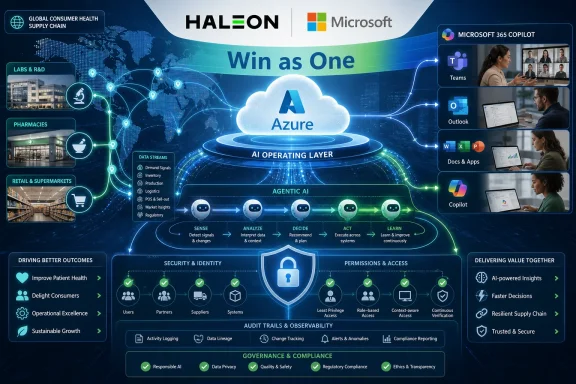 Microsoft’s AI Strategy Has Moved From Desks to Operating Models
For the first year of the Copilot era, Microsoft’s enterprise AI story was easy to understand because it was easy to demo. A worker asked Outlook to summarize a thread, Word to draft a memo, Teams to recap a meeting, or Excel to explain a spreadsheet. It was a productivity story, and like most productivity stories, it lived in the gap between plausible time savings and provable business impact.The Haleon agreement shows how quickly that story has changed. Microsoft is now positioning Copilot, Azure, identity, security, and agent management as the connective tissue for what large companies increasingly call an AI-powered enterprise. In plain English, that means AI is being pushed out of the individual app window and into the processes that decide what gets researched, manufactured, marketed, stocked, and sold.
That shift matters for WindowsForum readers because it explains why Microsoft’s AI roadmap increasingly feels less like a set of optional features and more like an enterprise platform transition. Copilot in Office was the beachhead. Agentic AI, governed through Microsoft’s cloud and identity stack, is the campaign.
Haleon is a useful test case because consumer health is neither pure software nor pure healthcare. It sits in a messy middle ground of regulated claims, brand trust, supply chains, retail execution, scientific evidence, and consumer behavior. If Microsoft can make its AI stack valuable there, it strengthens the argument that Copilot and Azure AI are not narrow office tools but general-purpose business infrastructure.
Haleon Wants AI to Become the Wiring Behind “Win as One”
Haleon’s stated ambition is expansive: reach one billion more consumers by 2030 while delivering industry-leading shareholder returns. That target sits behind the company’s “Win as One” strategy, which emphasizes growth, productivity, brand strength, and faster execution across a global business. The new Microsoft collaboration is being framed as a digital accelerator for that strategy rather than a stand-alone IT modernization project.That distinction is important. Large companies have spent years buying cloud services under the banner of transformation, often with uneven results. What is different in this wave is that executives are tying AI programs directly to operating cadence: faster research, faster content creation, faster forecasting, faster decisions, and faster response to consumer demand.
Haleon says the Microsoft agreement will support AI use cases across consumer insights, innovation, research and development, supply chain, marketing, commercial execution, and decision-making. That is a broad canvas, but it is not a random one. These are precisely the areas where consumer health companies must combine scientific credibility with mass-market speed.
A toothpaste, vitamin, pain relief, or digestive health brand does not succeed only because a lab produces evidence or a marketing team produces a campaign. It succeeds because claims, packaging, channel strategy, demand forecasts, retail availability, and consumer trust line up at scale. Haleon’s AI bet is that better data movement and faster synthesis can make those alignments less accidental.
The Real Prize Is Not a Smarter Chatbot
The most interesting phrase in Haleon’s announcement is not “Copilot.” It is “decision-intelligent enterprise.” That phrase may sound like consultant-grade abstraction, but it points to the real ambition behind the agreement. The objective is not just to give employees an AI assistant; it is to change how the company turns information into action.In the old enterprise software model, data lived in systems of record and decision-making happened around them. Humans exported reports, reconciled spreadsheets, held meetings, and pushed work through workflows. Generative AI, when safely integrated, promises a different model in which systems can summarize, recommend, draft, compare, flag, and eventually act across those workflows.
That is where Microsoft’s “agentic” language enters the picture. An AI agent is not simply a chatbot that responds to a prompt. In the enterprise vision, an agent can pursue a task over multiple steps, interact with business systems, and operate under policies that define what it can see, do, escalate, or automate.
For Haleon, that could mean agents that assist with clinical content development, help marketing teams personalize materials, surface demand anomalies, support forecasting, or alert teams to supply chain risks. The immediate value may be mundane rather than magical. The biggest gains in enterprise AI often come from removing delay, duplication, and coordination drag.
But that mundane work is also where companies spend astonishing amounts of money. If AI can compress the time between insight and execution, it becomes more than a writing assistant. It becomes a management system.
Azure Is the Quiet Center of the Deal
Microsoft 365 Copilot gets the public attention because workers can see it. Azure is the quieter strategic asset because executives and IT teams build around it. Haleon’s agreement names Azure as its core cloud platform, which tells us where Microsoft expects the high-value AI workload to land.That matters because the economics of enterprise AI are not limited to per-seat Copilot licensing. The deeper money is in cloud consumption, data platforms, model orchestration, security, governance, and integration. A company that standardizes AI development on Azure is not just buying features; it is committing architectural gravity.
For Microsoft, this is the post-Windows enterprise playbook updated for the AI era. Windows and Office made Microsoft unavoidable at the desktop. Azure, Entra, Purview, Defender, Fabric, Copilot Studio, and related AI services aim to make Microsoft unavoidable in the decision layer of the enterprise.
Haleon’s announcement points to advanced analytics, scalable infrastructure, and enterprise-grade security as core benefits. That is the responsible way to describe it. The sharper interpretation is that Haleon is letting Microsoft provide much of the trust boundary for AI adoption.
In an AI deployment, trust is not a slogan. It is identity, permissions, data classification, logging, auditability, retention, threat detection, model governance, prompt controls, and human oversight. The winners in enterprise AI will not simply be the companies with the most impressive models. They will be the vendors that convince CIOs and CISOs they can put those models to work without losing control of the business.
Security Is the Sales Argument That Makes Agentic AI Possible
Agentic AI raises the stakes because it changes the risk profile. A chatbot that drafts a paragraph can hallucinate. An agent that accesses business data, initiates workflows, or influences decisions can create operational, legal, and reputational exposure at scale. That is why Haleon’s announcement emphasizes identity, governance, threat protection, and secure deployment.Microsoft understands this better than most vendors because it already sits inside the permissions model of millions of organizations. The company’s AI argument is inseparable from its security argument: if Copilot and agents inherit enterprise identity, respect existing access controls, and operate within managed governance systems, then AI can be scaled without creating a shadow IT disaster.
That is the theory, at least. In practice, enterprise AI rollouts often expose messy data estates. Copilot can only be as safe as the permissions, labels, and information architecture beneath it. If a company has overshared SharePoint sites, stale Teams channels, poorly classified documents, or weak lifecycle management, AI does not create the underlying problem. It makes the problem easier to discover, query, and misuse.
This is where the Haleon deal becomes relevant beyond Haleon. Every large organization experimenting with Copilot eventually faces the same uncomfortable truth: AI readiness is data governance readiness. The tool may arrive as a productivity upgrade, but the real project is cleaning up identity, access, retention, and information boundaries.
Microsoft’s advantage is that it can turn that pain into a platform sale. Need AI? Then you need better identity. Need agents? Then you need agent governance. Need secure workflows? Then you need cloud security posture management, endpoint protection, compliance tooling, and audit trails. The stack sells itself by turning AI ambition into an infrastructure checklist.
Consumer Health Gives AI Less Room for Error
Haleon’s industry makes the collaboration more interesting than a generic corporate AI deal. Consumer health companies operate in an environment where public trust is central and claims must be handled carefully. The line between useful personalization and irresponsible health messaging can be thin.Marketing content creation, for example, sounds like an obvious generative AI use case. AI can draft variations, localize messaging, summarize consumer research, and help teams test different creative approaches. But in consumer health, every claim carries potential compliance implications, especially when products are associated with relief, prevention, treatment, or scientific evidence.
The same applies to clinical content development. Faster drafting and synthesis may help teams work more efficiently, but scientific and regulatory review cannot become a decorative afterthought. AI can accelerate the production of content; it cannot replace accountability for whether that content is accurate, substantiated, and appropriate for the market where it appears.
That is why the language of “responsibly, safely and at scale” appears so prominently in these announcements. It is not boilerplate, or at least it should not be treated as boilerplate. The more AI moves into research, content, forecasting, and commercial execution, the more companies must prove that humans remain accountable for judgment.
For administrators and security teams, this means the AI program will not be confined to a lab. It will touch compliance, legal, quality, marketing operations, supply chain, and regional business units. The governance challenge is not just technical. It is organizational.
Microsoft Is Building the Enterprise AI Flywheel One Industry at a Time
The Haleon collaboration fits a broader Microsoft pattern. Rather than pitching AI as a single product, Microsoft is stitching together industry-specific transformation stories around a common platform base: Microsoft 365 Copilot for knowledge work, Azure for cloud and AI infrastructure, agentic tools for workflow automation, and security products for governance.This is classic Microsoft, but updated for a more skeptical enterprise buyer. The company knows that CIOs do not want another disconnected AI experiment. They want use cases that can be defended in budget meetings, integrated with existing systems, and governed by existing controls. Microsoft’s pitch is that it can provide the horizontal platform and enough industry partnership to make the use cases credible.
Haleon gives Microsoft a consumer health example with recognizable stakes. The company talks about deeper consumer insights, faster innovation, better forecasting, and improved product availability. Those benefits are understandable to business leaders because they map to growth and margin rather than novelty.
The danger, of course, is that every enterprise AI partnership now sounds the same. “Unlocking value from data,” “scaling securely,” and “improving productivity” have become the press-release dialect of the age. The hard evidence will come later, when companies disclose whether AI programs changed cycle times, reduced costs, improved forecast accuracy, shortened content production, or helped launch products faster.
Until then, the most credible reading is cautious optimism. Haleon is not claiming that agents will reinvent healthcare overnight. It is claiming that AI can help a large consumer health company operate with more speed and coherence. That is less dramatic, but probably more realistic.
Copilot’s Future Is Less About Asking and More About Delegating
For end users, the early Copilot mental model was conversational. Ask a question, get an answer. Summarize this meeting, rewrite this email, generate this table, draft this presentation. That remains useful, but it is not where Microsoft is trying to end up.The future Microsoft is selling to Haleon and other large customers is more delegated than conversational. Instead of asking AI to help with a single artifact, employees and teams will assign outcomes to governed agents that can perform sequences of work. The agent becomes a participant in the workflow, not just a writing aid.
That is why Microsoft’s recent emphasis on agent management and control planes matters. Once companies have dozens, hundreds, or thousands of agents operating across departments, the problem becomes less about model intelligence and more about lifecycle management. Who created the agent? What data can it access? What actions can it take? Who reviews its output? When is it retired? What happens when it fails?
Windows administrators will recognize the shape of this problem. It resembles endpoint management, identity governance, application control, and automation policy all colliding at once. AI agents may be new, but the enterprise management challenge is familiar: inventory, permission, monitor, patch, audit, and contain.
The irony is that the most successful agentic AI deployments may be the least glamorous. The winning agents might not be digital geniuses. They may be well-scoped workflow assistants that chase approvals, reconcile inputs, prepare drafts, monitor exceptions, and hand off uncertain cases to humans.
Haleon’s Data Problem Is the Enterprise’s Data Problem
Every AI transformation story eventually returns to data. Haleon says the collaboration will help unlock more value from its data and allow insights to flow more seamlessly across the business. That is exactly the right ambition, and exactly the hard part.Large companies accumulate data in layers: ERP systems, CRM platforms, manufacturing systems, research repositories, marketing tools, spreadsheets, documents, emails, supplier feeds, retailer data, and regional reporting structures. The promise of AI is that it can help synthesize across those layers. The constraint is that the layers were rarely designed to be synthesized cleanly.
Microsoft’s platform pitch is powerful because it spans much of that terrain. A company already using Microsoft 365 has a vast amount of institutional knowledge in Teams, Outlook, SharePoint, OneDrive, Word, Excel, and PowerPoint. A company using Azure can connect that knowledge to structured enterprise data, analytics, and custom AI services.
But access is not understanding. The risk in AI transformation is assuming that because data can be reached, it can be trusted. Forecasting models, marketing personalization, and supply chain recommendations depend on data quality, lineage, context, and business interpretation.
For Haleon, the test will be whether AI can bridge functions without flattening expertise. Consumer insights, R&D, supply chain, and commercial teams do not merely hold different data; they operate with different assumptions, incentives, and definitions of success. AI can make information travel faster, but leadership still has to decide whose interpretation wins.
The Productivity Story Is Finally Meeting the Boardroom Story
Microsoft’s early Copilot case often leaned on individual productivity: minutes saved per meeting, emails summarized, drafts created faster. Those metrics are useful but insufficient. A board does not transform a company because workers write emails 12 percent faster.The Haleon agreement speaks the language of board-level transformation. It connects AI to growth, productivity, innovation, shareholder returns, and the 2030 ambition to reach more consumers. That is a more strategic story, but it also creates more strategic accountability.
If AI becomes a core enabler of “Win as One,” then results cannot be measured only in adoption dashboards. Haleon will need to show whether AI improves decision speed, reduces friction, strengthens execution, or changes business outcomes. Microsoft will want the same proof because every successful enterprise case study helps sell the next deal.
This is where the next phase of AI adoption becomes more demanding. In 2023 and 2024, experimentation itself was often enough. In 2025 and 2026, pilots turned into rollouts. By 2027, large organizations will face a harder question: which AI deployments are genuinely changing the operating model, and which are expensive theater?
Haleon’s five-year horizon is sensible because transformation at this scale does not happen in a quarter. It also gives both companies time to move beyond easy use cases. Drafting, summarization, and ideation are the starting line, not the destination.
IT Teams Will Carry the Part Nobody Puts in the Quote
The executive quotes in announcements like this are understandably upbeat. They talk about pace, purpose, smarter decisions, consumer benefit, and responsible scale. Beneath that optimism sits the operational reality that IT teams will have to make the environment safe enough, reliable enough, and comprehensible enough for AI to become ordinary.That means permissions reviews, data classification, conditional access policies, endpoint security, logging, incident response planning, AI acceptable-use policies, training, vendor management, and change control. It means deciding when a use case belongs in Microsoft 365 Copilot, when it needs a custom Azure AI implementation, and when it should not be automated at all. It means watching for prompt leakage, oversharing, inaccurate outputs, and employees who assume a fluent answer is a verified answer.
The administrative burden will not be evenly distributed. Some teams will be asked to accelerate AI adoption while simultaneously reducing risk. Others will be asked to support business units that hear “agentic AI” and imagine automation without limits.
The companies that handle this well will treat AI governance as product management, not paperwork. Agents and Copilot extensions should have owners, scopes, review cycles, telemetry, and retirement paths. A forgotten agent with stale permissions is not fundamentally different from a forgotten service account or abandoned application integration.
This is also where Windows endpoints remain part of the story. AI may live in the cloud, but workers experience it through PCs, browsers, Office apps, Teams, and identity prompts. The endpoint is still where data is viewed, copied, downloaded, pasted, and mishandled. Cloud governance without endpoint discipline is only half a control model.
The Haleon Deal Shows Where Microsoft Thinks the Market Is Going
The strategic signal is clear: Microsoft believes enterprise AI will consolidate around vendors that can combine productivity software, cloud infrastructure, identity, security, data governance, and agent management. Haleon’s collaboration is a public example of that thesis. It is also a reminder that AI adoption is becoming less about choosing a model and more about choosing an ecosystem.That has advantages. A deeply integrated stack can reduce fragmentation, simplify procurement, and make governance more coherent. For a global company, having AI capabilities tied to familiar enterprise controls may be the difference between pilot purgatory and operational deployment.
It also has risks. The more AI workflows are built around one cloud, one productivity suite, and one identity fabric, the harder it becomes to unwind that dependency later. Enterprises have lived through this pattern before. Convenience becomes standardization, standardization becomes lock-in, and lock-in becomes a budget line nobody can realistically remove.
That does not mean Haleon is making the wrong choice. It means the choice is larger than the press release makes it sound. A five-year AI collaboration is an architecture decision, a governance decision, a procurement decision, and a cultural decision wrapped in the language of transformation.
For Microsoft, that is the point. The company does not want to be the app employees occasionally ask for help. It wants to be the managed AI substrate beneath how enterprises work.
The Five-Year Bet Comes Down to Six Practical Tests
Haleon and Microsoft are describing a broad transformation, but the success of the collaboration will be judged in practical terms. The next few years will show whether this is a durable operating-model shift or another ambitious enterprise technology program that produces pockets of value without changing the whole.- Haleon is using Microsoft’s AI stack to support its “Win as One” strategy, not simply to add Copilot features to office work.
- The collaboration places Azure, Microsoft 365 Copilot, identity, security, and agentic AI in the same transformation frame.
- The most important use cases will likely sit in cross-functional workflows such as consumer insights, marketing, R&D, forecasting, and supply chain execution.
- The security story is central because agentic AI only scales when identity, permissions, governance, and auditability are treated as design requirements.
- The hardest work will be data readiness, because AI can expose weak information architecture faster than it can fix it.
- The business case will need to move beyond time saved and show measurable improvements in speed, quality, availability, decision-making, or growth.
References
- Primary source: Microsoft UK Stories
Published: 2026-06-29T09:34:10.981500
Haleon to accelerate AI-powered transformation with new five-year Microsoft collaboration
Haleon, a consumer health company solely focused on better everyday health, has announced a new five-year collaboration with Microsoft to scale digital, data and AI capabilities across the business and accelerate delivery of its global 'Win as One' strategy.ukstories.microsoft.com - Related coverage: haleon.com
- Official source: developer.microsoft.com
Microsoft 365 Copilot | Extend and Customize Copilot
Extend, enrich, and customize Microsoft Microsoft 365 Copilot. Explore Copilot extensibility options such as agents, API plugins, and Copilot connectors to expand AI-powered productivity, skills, and creativity.developer.microsoft.com - Official source: support.microsoft.com
Use Copilot in shared mailboxes and delegate mailboxes | Microsoft Support
Use Copilot in shared mailboxes and delegate mailboxessupport.microsoft.com - Official source: learn.microsoft.com
Create files with Word, Excel, and PowerPoint Agents in Microsoft 365 Copilot | Microsoft Learn
Create files with Word, Excel, and PowerPoint Agents in Microsoft 365 Copilot.learn.microsoft.com - Official source: news.microsoft.com

- Related coverage: investing.com
Haleon targets growth with ’Win as One’ strategy By Investing.com
Haleon targets growth with ’Win as One’ strategywww.investing.com - Related coverage: investor.iconplc.com

ICON selects Microsoft as a preferred technology partner to power AI-enabled clinical development | ICON plc
DUBLIN --(BUSINESS WIRE)--Jun. 22, 2026-- ICON plc (NASDAQ: ICLR) today announced that it has selected Microsoft as a preferred technology partner – further advancing ICON’s previously announced plan to invest in digital innovation and AI over the next three years.
investor.iconplc.com
- Related coverage: windowscentral.com
Microsoft Copilot Wave 3 adds AI agents and E7 Frontier Suite | Windows Central
Microsoft Copilot is rolling out more agentic AI control and model support in a new subscription tier for Microsoft 365.www.windowscentral.com - Related coverage: techradar.com
Microsoft 365 confirms new premium tier focused on AI and productivity | TechRadar
Microsoft adds new E7 plan to cope with AI usagewww.techradar.com - Official source: microsoft.com
</rdf:Alt> </dc:title> <dc:description> <rdf:Alt> <rdf:li xml:lang="x-default"/> </rdf:Alt> </dc:description> <dc:creator> <rdf:Seq> <rdf:li>Lukas V
</rdf:Alt> </dc:description> <dc:creator> <rdf:Seq> <rdf:li>Lukas Velushwww.microsoft.com