

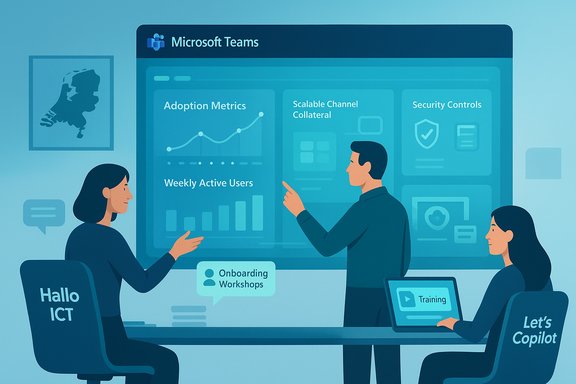
Hallo, ALSO Nederland and Let’s Copilot have launched a coordinated initiative to accelerate Microsoft Copilot Chat adoption among Dutch small and medium-sized enterprises (SMEs), combining channel enablement, gamified employee training and a packaged customer‑adoption route that partners can roll out quickly to their SME customer bases. The program positions Hallo as the customer-facing integrator, Let’s Copilot as the gamified adoption engine embedded in Microsoft Teams, and ALSO Nederland as the channel and go‑to‑market (GTM) enabler — a three‑way play intended to turn pilot projects into measurable, scaled Copilot deployments across the Dutch SME market.
Microsoft Copilot Chat is now a core part of the Microsoft 365 productivity stack and is being pitched as the enterprise‑grade alternative to consumer chat AIs. For SMEs, Copilot promises to shorten administrative workloads, speed content creation, surface insights from internal data and automate routine workflows — all within the apps teams already use. But adoption is not automatic: SMEs routinely cite training, trust, governance and unclear ROI as primary barriers to adopting generative AI at scale.
The Hallo–ALSO–Let’s Copilot initiative directly targets those barriers. It bundles three essential elements that SMEs need to move from curiosity to productive use:
Benefits of this approach:
However, success will depend on disciplined governance, precise tenant configuration and careful measurement. The initiative is not a silver bullet; it is a sensible, pragmatic playbook that can shift SME adoption from experimentation to habitual use — provided partners and customers do the hard work of measuring outcomes, iterating on prompts and templates, and enforcing simple but effective data rules.
For Microsoft‑centric SMEs and channel partners, this partnership is a useful blueprint: it scales partner enablement, embeds practical learning into the flow of work, and speaks directly to the security concerns that keep many smaller organisations on the sidelines. For IT decision‑makers, the recommendation is to pilot deliberately, require governance and insist on measurable outcomes before committing to wide seat purchases.
Source: Telecompaper Halllo, Also, Let's Copilot team up on AI adoption for SMEs
 Background: why this matters for SMEs and the channel
Microsoft Copilot Chat is now a core part of the Microsoft 365 productivity stack and is being pitched as the enterprise‑grade alternative to consumer chat AIs. For SMEs, Copilot promises to shorten administrative workloads, speed content creation, surface insights from internal data and automate routine workflows — all within the apps teams already use. But adoption is not automatic: SMEs routinely cite training, trust, governance and unclear ROI as primary barriers to adopting generative AI at scale.The Hallo–ALSO–Let’s Copilot initiative directly targets those barriers. It bundles three essential elements that SMEs need to move from curiosity to productive use:
- Channel enablement and GTM support so reseller partners can offer Copilot solutions with packaged marketing and sales materials.
- Gamified, personalized training to accelerate real user skill development and change behaviour rather than simply deploy technology.
- Customer adoption and onboarding support — templates, workshops and a playbook to translate early wins into measurable productivity gains.
Overview: the three partners and what each brings
Hallo — the SME integrator
Hallo (positioned as Hallo ICT, with a strong national footprint) is the customer‑facing systems integrator in the partnership. Hallo brings deep SME relationships, experience running managed digital workplace services and an existing base of regional customers that prefer a single trusted supplier for cloud, security and communications.- Role: customer onboarding, delivering workshops, tailoring Copilot into customer workflows.
- Strength: trusted regional presence and operational experience with Microsoft 365 deployments.
- Typical approach: combined discovery, proof‑of‑value and staged rollout.
ALSO Nederland — channel activation and scale
ALSO (the European technology distributor and platform operator) supplies the channel reach, partner enablement programs, and the ready GTM assets that help resellers sell Copilot add‑ons and service packages.- Role: partner enablement, GTM collateral, partner incentives and scaling through reseller networks.
- Strength: large partner ecosystem and marketplace capabilities to distribute cloud subscriptions and packaged services.
- Note: public reporting positions ALSO as one of Europe’s largest technology providers following recent consolidation; this is relevant for scale claims but should be read as a market position driven by acquisitions and consolidation.
Let’s Copilot — gamified adoption training
Let’s Copilot provides the gamified learning experience that sits inside Microsoft Teams as a Teams app. The product is explicitly designed to shift users from trial to daily habit through short interactive lessons, personalized learning paths and hands‑on exercises tied to real work tasks.- Role: employee adoption, learning engagement and behavior change.
- Strength: embedded Teams experience, measurable learning journeys and case stories from early adopters.
What the initiative actually offers — features and delivery model
The packaged offering being marketed to partners and customers focuses on three practical pillars:- Channel and partner enablement:
- Prebuilt GTM campaigns, partner playbooks and ready‑to‑use demo scenarios.
- Workshops and train‑the‑trainer sessions for reseller sales and technical teams.
- Introductory programs allowing partners to offer Let’s Copilot trials during customer onboarding.
- Gamified adoption and training:
- A Teams‑integrated app delivering short lessons, practical tasks and progress tracking.
- Role‑based learning paths (sales, HR, finance, operations) that map Copilot capabilities to job tasks.
- Metrics dashboards to show weekly active Copilot users and productivity indicators.
- Customer adoption and governance support:
- Onboarding templates and staged pilot plans (pilot → focused roll‑out → enterprise scale).
- Security and compliance checklists to align Copilot use with organizational data policies.
- A whitepaper and supporting materials for customer executives that explain ROI expectations, training schedules and governance controls.
Why gamified training matters (and what it looks like)
Simple awareness and one‑off demos seldom drive continuous usage. The partners’ strategy focuses on behavioral adoption — not just licensing. Gamified training addresses three persistent problems:- Low engagement with traditional e‑learning.
- Lack of context in generic AI tutorials.
- Difficulty converting early wins into team‑wide usage.
Benefits of this approach:
- Faster time‑to‑value from pilot to measurable productivity gains.
- Better risk control because users learn safe prompting and data hygiene in a supervised environment.
- Easier measurement and reporting to business stakeholders.
Security, privacy and governance: the critical technical checks
A central sales argument in the campaign is that Microsoft Copilot Chat is an enterprise‑grade alternative to public consumer chatbots, with contractual and technical protections that prevent organizational data from being used to train public foundation models. That claim aligns with Microsoft’s enterprise documentation and common governance guidance:- Organizational Microsoft 365 accounts are handled under enterprise data protection promises; prompts and outputs tied to organizational Copilot interactions are, by design and contract, not used to train Microsoft’s foundation LLMs.
- Administrators can use Microsoft Purview and other compliance tools to manage retention, deletion and visibility of Copilot interaction data.
- Using Entra ID and correct tenant configuration is central: the “protected experience” cues in the UI indicate whether a chat session is operating within enterprise boundaries.
- Ensure users sign in with Entra (Azure AD) accounts to guarantee enterprise protections are applied.
- Configure Purview retention and data‑loss prevention (DLP) policies for Copilot activity history.
- Define allowed data classes for prompts (e.g., no regulated personal data in prompts) and enforce via training and policy.
- Audit and monitor use for potentially risky prompts or data uploads.
Practical roadmap: how SMEs should approach Copilot adoption (a recommended 6‑step plan)
- Prepare leadership and set measurable goals
- Define 2–3 business outcomes (e.g., reduce drafting time for proposals by X%, cut meeting‑note processing time).
- Choose a pilot group and use case
- Start with a single team or function (sales proposals, customer support responses, monthly reporting).
- Enable secure tenant configuration
- Verify Entra ID sign‑ins, Purview retention rules and DLP policies before giving wide access.
- Run a gamified adoption campaign
- Deploy Let’s Copilot for the pilot cohort and run a 4–6 week engagement program with coached sessions.
- Measure, iterate and expand
- Use activity dashboards and qualitative feedback; refine prompts and templates; expand to adjacent teams.
- Institutionalize governance and change management
- Add usage guidelines to employee handbooks, retention policies to compliance frameworks, and regular training refreshers.
The partner playbook: how resellers and MSPs can monetize Copilot adoption
Resellers and managed service providers will be the engines for scaled SME adoption. The combined initiative provides them with a replicable commercial model:- Offer a low‑cost pilot bundle: Copilot seats (trial), Let’s Copilot training for 6 weeks, and a two‑hour governance workshop.
- Charge for outcome‑based services after pilot: advisory, customization, and ongoing adoption coaching.
- Package managed Copilot: regular health checks, content template libraries, and monthly usage reporting.
- Upsell to adjacent services: secure file management, data classification, and automated agents built via Copilot Studio.
Strengths of the initiative
- Integrated approach: combining GTM, training and customer services reduces the typical friction between technology availability and real‑world adoption.
- Teams‑first training: embedding lessons in Teams drastically lowers the friction for end users and increases immediate relevance.
- Channel leverage: ALSO’s partner scale and Hallo’s SME relationships accelerate customer reach more than vendor‑only programs.
- Security‑forward messaging: positioning Copilot as a protected enterprise experience addresses the single largest barrier for conservative SME buyers: data governance.
Risks, limitations and unanswered questions
Despite the promise, several practical and strategic risks remain:- Nuanced privacy promises: enterprise claims that Copilot interactions are not used to train foundation models are contractual and bounded by configuration. SMEs often lack the in‑house skills to validate settings; partners must ensure tenants are correctly configured and audited.
- Governance maturity: many SMEs lack formal data classification policies. Rolling out Copilot without simple, enforceable guardrails could lead to accidental exposure of regulated data.
- Hallucination and trust: generative AI can produce incorrect or misleading outputs. Training must emphasise validation, sourcing and verification workflows.
- License and cost complexity: Copilot licensing models and tiered features create price friction; partners must design predictable commercial offers for cost‑sensitive SMEs.
- Dependency and lock‑in: deep integration of Copilot into workflows can create dependency on Microsoft’s stack; SMEs should be advised on fallback procedures and exportability of content.
- Measurement of ROI: “time saved” metrics are easy to claim but harder to substantiate. Good measurement design (baseline metrics, control groups) is required.
Competitive context: how this compares to other Copilot adoption efforts
Microsoft and its partner ecosystem have been pursuing numerous Copilot adoption models: direct Microsoft programs, independent consultancies building Copilot agents, and a growing marketplace for Copilot‑focused training. The Hallo–ALSO–Let’s Copilot initiative distinguishes itself by:- Prioritizing channel enablement (not just vendor push).
- Using a gamified, Teams‑native training product rather than standard e‑learning.
- Packaging a clear path from pilot to scale for SMEs.
Checklist for IT decision‑makers evaluating the offering
- Verify tenant configuration: confirm Entra ID sign‑in and enterprise protections are active.
- Review contractual data usage: ensure the Copilot license and any reseller agreements reflect non‑training commitments for enterprise data.
- Demand a clear pilot scope: known baseline metrics, duration (4–6 weeks) and success criteria.
- Require governance templates: DLP rules, prompt guidelines and guidance for file uploads.
- Confirm measurement and reporting: weekly active users, examples of outputs, time‑saved estimates and qualitative feedback loops.
- Pilot a high‑impact use case first: proposals, customer responses or standard operating procedures that show visible wins.
Final assessment: pragmatic acceleration with guarded optimism
The Hallo, ALSO Nederland and Let’s Copilot collaboration represents a pragmatic, partner‑centric model for accelerating AI adoption in SMEs. It addresses the most common failure modes — poor training, unclear governance and lack of partner GTM readiness — by combining provider, distributor and a behavioural training platform. For SMEs that have been reluctant, the package lowers the barrier of entry and provides a replicable route from pilot to scale.However, success will depend on disciplined governance, precise tenant configuration and careful measurement. The initiative is not a silver bullet; it is a sensible, pragmatic playbook that can shift SME adoption from experimentation to habitual use — provided partners and customers do the hard work of measuring outcomes, iterating on prompts and templates, and enforcing simple but effective data rules.
For Microsoft‑centric SMEs and channel partners, this partnership is a useful blueprint: it scales partner enablement, embeds practical learning into the flow of work, and speaks directly to the security concerns that keep many smaller organisations on the sidelines. For IT decision‑makers, the recommendation is to pilot deliberately, require governance and insist on measurable outcomes before committing to wide seat purchases.
Source: Telecompaper Halllo, Also, Let's Copilot team up on AI adoption for SMEs
