

Former Microsoft executive Mat Velloso reportedly said on May 17, 2026, that Microsoft has “missed the AI wave,” arguing that Copilot adoption, Windows 11 integration, and enterprise AI execution have not matched the company’s spending or rhetoric. The charge lands because it does not come from an outside skeptic cheering for Redmond’s decline, but from someone who spent years inside Microsoft and later worked near the center of Google and Meta’s AI machinery. His argument is not that Microsoft is doomed. It is that Microsoft may once again be mistaking distribution for product-market fit.
Microsoft has spent the last three years behaving as though the future could be installed through the taskbar. Copilot appeared in Windows, Office, Edge, Teams, and even on new keyboards, an unusually literal expression of the company’s belief that AI would become a default layer of computing if it could simply be placed close enough to the user.
That strategy made sense on paper. Microsoft controls the operating system on hundreds of millions of PCs, owns the productivity suite through which much of corporate work still flows, and has deep hooks into identity, compliance, file storage, and enterprise administration. If any company could make generative AI unavoidable, it was Microsoft.
But unavoidable is not the same thing as wanted. The uncomfortable theme running through Velloso’s critique is that Microsoft’s AI rollout has been shaped more by placement than by compulsion. Copilot has often felt less like a new computing primitive than a sidebar looking for permission to matter.
That distinction matters because Windows users have a long memory. They remember features that became essential because they solved a recurring problem, and they remember features that became prominent because Microsoft had a strategic priority. Copilot, so far, has too often looked like the second kind.
That update complicates the “nobody uses Copilot” line, but it does not invalidate the broader concern. Twenty million paid seats is impressive for a new enterprise product and underwhelming for a supposedly epochal layer baked into the world’s dominant office suite. Both things can be true.
The harder question is not whether Microsoft can sell Copilot licenses. It can. The question is whether customers are buying an indispensable tool or purchasing an option on the future because their enterprise agreement, vendor relationship, or CIO mandate makes the experiment easier to approve than to resist.
Microsoft’s own framing has leaned heavily on growth rates, daily habits, and customer momentum. Those metrics matter, but they also leave room for ambiguity. A fast-growing product can still be far from mainstream adoption, especially when the addressable base is so vast that even tens of millions of users represent a modest slice of the installed estate.
This is where the comparison to earlier waves stings. Microsoft did not miss the internet in the sense that it vanished; it built Internet Explorer and later Azure. It did not miss mobile in the sense that it never shipped phones; it shipped too many strategies too late. The pattern Velloso is pointing to is subtler: Microsoft often survives platform shifts, but survival is not the same as leading the user experience that defines them.
That made Microsoft’s decision to push Copilot into Windows 11 both logical and risky. The company wanted to signal that AI was not a feature bolted onto apps, but a new interaction model for the PC itself. Yet many users saw something less glamorous: another icon, another web-backed experience, another Microsoft service occupying space in an operating system still missing customization options people had asked for since Windows 11 launched.
The reported scaling back of unnecessary Copilot entry points should be read less as retreat from AI and more as tacit admission that presence alone had become counterproductive. If a feature appears everywhere before it is useful everywhere, it teaches users to ignore it. Worse, it trains them to resent it.
This is the part Microsoft should understand better than anyone. Windows succeeds when it fades into the background until needed. The Start menu, taskbar, File Explorer, window management, device settings, notifications, and update flow are not glamorous, but they define trust. AI that interrupts those flows without clearly improving them spends down that trust.
The irony is that Windows enthusiasts have been asking for many of these fixes since 2021. The inability to move the Windows 11 taskbar was not a niche complaint invented by nostalgia addicts. It was a visible symbol of a broader design philosophy that stripped out mature customization in pursuit of a cleaner, more controlled shell.
Now, as AI enthusiasm collides with adoption reality, Microsoft is making a show of listening. That does not mean every recent Windows change is a reaction to Copilot’s struggles, nor should every Insider build be interpreted as boardroom panic. But timing matters. When a company starts restoring old affordances while trimming AI clutter, it is reasonable to infer that the operating system team has been given permission to prioritize user sentiment again.
For WindowsForum readers, this may be the most concrete outcome of the whole fight. The debate over whether Microsoft “missed AI” is abstract. A taskbar that moves, a Start menu that wastes less space, and inbox apps that behave like native Windows software are not abstract at all.
There are valid reasons to move AI workloads onto devices. Cloud inference is expensive, network-dependent, and not always suitable for sensitive data. Local models will matter for accessibility, search, image processing, developer tools, system automation, and offline productivity. In the long run, NPUs are likely to become as boring and expected as GPUs.
The problem is the gap between that long-run logic and current user value. Many buyers still struggle to name the killer Windows feature that makes an NPU-equipped laptop meaningfully better today than a strong conventional laptop. Recall was supposed to be one answer, but its initial security and privacy controversy turned it from flagship demo into cautionary tale.
OEMs can tolerate some amount of speculative platform investment. They do it with new ports, displays, wireless standards, and processor features all the time. But AI PC marketing becomes fragile when the silicon arrives before the software earns its keep. Microsoft asked the ecosystem to bet on the future; Velloso is arguing that Redmond has not yet delivered enough present tense.
Enterprise software is not won by a better demo alone. It is won through identity, permissions, audit logs, retention policies, compliance certifications, procurement channels, admin controls, migration paths, partner ecosystems, and support organizations that can absorb the messiness of real companies. Microsoft has spent decades embedding itself into that mess.
That is why the OpenAI angle is so interesting. If OpenAI and other frontier labs build their own deployment arms, they are not merely selling models; they are moving toward the consulting and integration layer where enterprise transformation actually happens. The lab that helps a bank rewire document review, customer support, compliance workflows, and internal knowledge retrieval is no longer just a model provider. It becomes a strategic vendor.
Microsoft knows this terrain better than almost anyone. But its partnership with OpenAI has always contained tension: Microsoft wants to be the enterprise wrapper, cloud backbone, and productivity interface for AI, while OpenAI has every incentive to own the customer relationship directly where it can. That does not make the partnership doomed. It makes it complicated in precisely the places where the money is likely to be.
The danger for Microsoft is not that a former executive posted a spicy critique. Large companies attract criticism, and ex-insiders often see both real problems and personal grievances with unusual clarity. The danger is that the critique maps onto what many users already feel.
Windows 11 users have seen too many prompts, too many promotional surfaces, too many defaults that seem designed around Microsoft account strategy rather than user intent. Microsoft 365 customers have watched Copilot arrive with real promise but also with licensing complexity, governance questions, and uneven results depending on data hygiene. Developers have embraced AI coding tools while also worrying about reliability, cost, and workflow disruption.
A factory reset, in this context, does not mean abandoning AI. It means rebuilding the argument for AI from user value upward instead of from corporate urgency downward. That is a very different posture from putting a Copilot button everywhere and waiting for habit to form.
Mobile was more damaging. Windows Phone had elegant ideas, but Microsoft failed to create a viable app ecosystem, misread the speed of the iPhone and Android shift, and could not turn its enterprise strength into consumer relevance. The company adapted by making Office, identity, and cloud services work across rival platforms, but the operating system layer was gone.
AI could rhyme with either history. Microsoft could overplay distribution, annoy users, and watch the defining AI experiences emerge elsewhere. Or it could absorb the early backlash, use its enterprise muscle, and turn Copilot into a practical layer across work, development, security, and administration.
The outcome is not predetermined. What is clear is that Microsoft does not get to declare victory just because it has the most visible button. Platform shifts are won when users change behavior voluntarily. If they need to be constantly reminded that a feature exists, the feature has not yet become infrastructure.
But even there, the pressure is rising. Reliability, latency, model quality, cost of goods, and competition from other AI coding tools all matter. Developers are unusually willing to experiment, but they are also unusually fast to switch when a tool becomes slow, expensive, or less capable than alternatives.
The lesson for Windows and Microsoft 365 is not that every Copilot surface should copy GitHub. It is that AI adoption accelerates when the product meets a user in a task they already understand and improves it without demanding a new belief system. GitHub Copilot works best when it feels like a power tool, not a campaign.
That distinction is especially important for sysadmins and IT pros. The most compelling AI in the Microsoft stack may not be chat in the taskbar. It may be better log analysis, safer PowerShell assistance, policy explanation, endpoint troubleshooting, Intune remediation, identity risk triage, and documentation generation. Those are not keynote-friendly consumer moments, but they are the kinds of tasks that make administrators quietly renew licenses.
That changes the burden of proof. In the classic Windows and Office model, software margins were extraordinary once development costs were absorbed. In the AI model, every query can carry meaningful infrastructure cost. A product can be popular and still financially awkward if usage grows faster than monetization or efficiency.
Microsoft’s answer is that AI demand is real, Azure growth is strong, Copilot seats are expanding, and customers are moving from experimentation to deployment. That may be true. But investors and customers are right to ask whether the spending produces durable advantage or merely keeps Microsoft in an arms race where everyone buys the same scarce hardware to serve increasingly commoditized model experiences.
For Windows users, the financial angle may sound remote, but it affects product design. If Microsoft needs Copilot to justify enormous AI investment, the temptation to push it into more surfaces will remain. If Microsoft learns that forced prominence creates backlash, it may instead focus on fewer, better integrations that can survive on usefulness rather than placement.
It also means treating local AI as a platform capability rather than a marketing slogan. If NPUs are going to matter, developers need stable APIs, clear performance targets, sensible privacy models, and enough installed hardware to justify investment. Users need features that are faster, safer, or impossible without on-device acceleration.
Most of all, Microsoft needs to restore a sense of craftsmanship to Windows. AI cannot compensate for shell regressions, inconsistent UI frameworks, slow inbox apps, confusing settings, or update anxiety. A smarter assistant sitting on top of a frustrating platform does not make the platform feel intelligent. It makes the assistant feel implicated.
The good news is that Microsoft still has the ingredients for a comeback inside the comeback. It has Windows, Microsoft 365, Azure, GitHub, security products, developer tools, partner channels, and enterprise trust at a scale competitors envy. The bad news is that those assets can encourage complacency. Distribution can buy time, but it cannot buy affection.
Source: Windows Latest Former Microsoft VP says Microsoft missed the AI wave like the internet and mobile, as Copilot scales back in Windows 11
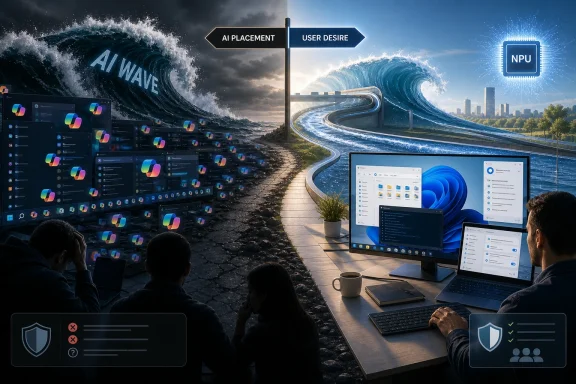 Microsoft’s AI Problem Is Not Access, It Is Desire
Microsoft has spent the last three years behaving as though the future could be installed through the taskbar. Copilot appeared in Windows, Office, Edge, Teams, and even on new keyboards, an unusually literal expression of the company’s belief that AI would become a default layer of computing if it could simply be placed close enough to the user.That strategy made sense on paper. Microsoft controls the operating system on hundreds of millions of PCs, owns the productivity suite through which much of corporate work still flows, and has deep hooks into identity, compliance, file storage, and enterprise administration. If any company could make generative AI unavoidable, it was Microsoft.
But unavoidable is not the same thing as wanted. The uncomfortable theme running through Velloso’s critique is that Microsoft’s AI rollout has been shaped more by placement than by compulsion. Copilot has often felt less like a new computing primitive than a sidebar looking for permission to matter.
That distinction matters because Windows users have a long memory. They remember features that became essential because they solved a recurring problem, and they remember features that became prominent because Microsoft had a strategic priority. Copilot, so far, has too often looked like the second kind.
The Numbers Are Better Than the Narrative, and Still Not Good Enough
The sharpest claim in the Windows Latest report is the adoption math: Microsoft 365 Copilot had around 15 million paid seats earlier this year against a commercial Microsoft 365 base often described at roughly 450 million users, implying paid penetration in the low single digits. Microsoft later told investors that Microsoft 365 Copilot had passed 20 million paid seats by the quarter ended March 31, 2026, which is real growth and not trivial revenue.That update complicates the “nobody uses Copilot” line, but it does not invalidate the broader concern. Twenty million paid seats is impressive for a new enterprise product and underwhelming for a supposedly epochal layer baked into the world’s dominant office suite. Both things can be true.
The harder question is not whether Microsoft can sell Copilot licenses. It can. The question is whether customers are buying an indispensable tool or purchasing an option on the future because their enterprise agreement, vendor relationship, or CIO mandate makes the experiment easier to approve than to resist.
Microsoft’s own framing has leaned heavily on growth rates, daily habits, and customer momentum. Those metrics matter, but they also leave room for ambiguity. A fast-growing product can still be far from mainstream adoption, especially when the addressable base is so vast that even tens of millions of users represent a modest slice of the installed estate.
This is where the comparison to earlier waves stings. Microsoft did not miss the internet in the sense that it vanished; it built Internet Explorer and later Azure. It did not miss mobile in the sense that it never shipped phones; it shipped too many strategies too late. The pattern Velloso is pointing to is subtler: Microsoft often survives platform shifts, but survival is not the same as leading the user experience that defines them.
Windows 11 Became the Wrong Battlefield for Copilot
Windows was always going to be the most politically charged home for Copilot. Office users might accept AI as an assistant for drafting, summarizing, and searching across work artifacts. Developers might embrace GitHub Copilot because code completion delivers an immediate feedback loop. But Windows is intimate territory. The shell is not just another app surface; it is where users notice friction first.That made Microsoft’s decision to push Copilot into Windows 11 both logical and risky. The company wanted to signal that AI was not a feature bolted onto apps, but a new interaction model for the PC itself. Yet many users saw something less glamorous: another icon, another web-backed experience, another Microsoft service occupying space in an operating system still missing customization options people had asked for since Windows 11 launched.
The reported scaling back of unnecessary Copilot entry points should be read less as retreat from AI and more as tacit admission that presence alone had become counterproductive. If a feature appears everywhere before it is useful everywhere, it teaches users to ignore it. Worse, it trains them to resent it.
This is the part Microsoft should understand better than anyone. Windows succeeds when it fades into the background until needed. The Start menu, taskbar, File Explorer, window management, device settings, notifications, and update flow are not glamorous, but they define trust. AI that interrupts those flows without clearly improving them spends down that trust.
The Taskbar’s Return to Sanity Is a Signal, Not a Side Quest
The sudden attention to long-requested Windows 11 features, including movable taskbar experiments and Start menu improvements, is not merely fan service. It is a strategic correction. Microsoft appears to be rediscovering that the PC platform cannot be treated as a captive distribution channel for whatever corporate priority is ascendant this year.The irony is that Windows enthusiasts have been asking for many of these fixes since 2021. The inability to move the Windows 11 taskbar was not a niche complaint invented by nostalgia addicts. It was a visible symbol of a broader design philosophy that stripped out mature customization in pursuit of a cleaner, more controlled shell.
Now, as AI enthusiasm collides with adoption reality, Microsoft is making a show of listening. That does not mean every recent Windows change is a reaction to Copilot’s struggles, nor should every Insider build be interpreted as boardroom panic. But timing matters. When a company starts restoring old affordances while trimming AI clutter, it is reasonable to infer that the operating system team has been given permission to prioritize user sentiment again.
For WindowsForum readers, this may be the most concrete outcome of the whole fight. The debate over whether Microsoft “missed AI” is abstract. A taskbar that moves, a Start menu that wastes less space, and inbox apps that behave like native Windows software are not abstract at all.
NPUs Were Sold Before the Use Case Arrived
Velloso’s criticism of NPUs cuts close to another uncomfortable truth: the PC industry has been asked to build hardware for a software future that still feels underdeveloped. Copilot+ PCs and neural processing units were pitched as the foundation for local AI experiences, lower-latency inference, better privacy, and new classes of Windows features. The hardware story was crisp. The daily-user story has been fuzzier.There are valid reasons to move AI workloads onto devices. Cloud inference is expensive, network-dependent, and not always suitable for sensitive data. Local models will matter for accessibility, search, image processing, developer tools, system automation, and offline productivity. In the long run, NPUs are likely to become as boring and expected as GPUs.
The problem is the gap between that long-run logic and current user value. Many buyers still struggle to name the killer Windows feature that makes an NPU-equipped laptop meaningfully better today than a strong conventional laptop. Recall was supposed to be one answer, but its initial security and privacy controversy turned it from flagship demo into cautionary tale.
OEMs can tolerate some amount of speculative platform investment. They do it with new ports, displays, wireless standards, and processor features all the time. But AI PC marketing becomes fragile when the silicon arrives before the software earns its keep. Microsoft asked the ecosystem to bet on the future; Velloso is arguing that Redmond has not yet delivered enough present tense.
Copilot’s Enterprise Challenge Is the Last Mile
The strongest counterargument to the doom narrative is Microsoft’s enterprise distribution. Velloso himself reportedly acknowledged that Microsoft is not dying and that its moat remains formidable. That point deserves more than a perfunctory nod, because it is the reason Microsoft can stumble in public and still remain central to the AI race.Enterprise software is not won by a better demo alone. It is won through identity, permissions, audit logs, retention policies, compliance certifications, procurement channels, admin controls, migration paths, partner ecosystems, and support organizations that can absorb the messiness of real companies. Microsoft has spent decades embedding itself into that mess.
That is why the OpenAI angle is so interesting. If OpenAI and other frontier labs build their own deployment arms, they are not merely selling models; they are moving toward the consulting and integration layer where enterprise transformation actually happens. The lab that helps a bank rewire document review, customer support, compliance workflows, and internal knowledge retrieval is no longer just a model provider. It becomes a strategic vendor.
Microsoft knows this terrain better than almost anyone. But its partnership with OpenAI has always contained tension: Microsoft wants to be the enterprise wrapper, cloud backbone, and productivity interface for AI, while OpenAI has every incentive to own the customer relationship directly where it can. That does not make the partnership doomed. It makes it complicated in precisely the places where the money is likely to be.
The “Factory Reset” Line Hurts Because It Sounds Plausible
Velloso’s “factory reset” phrase works because it compresses several anxieties into one image. It suggests leadership churn, product confusion, customer fatigue, and the need to return to first principles. It also echoes Microsoft’s own modern mythology: Satya Nadella’s Hit Refresh era, which presented cultural renewal as the foundation for Microsoft’s cloud revival.The danger for Microsoft is not that a former executive posted a spicy critique. Large companies attract criticism, and ex-insiders often see both real problems and personal grievances with unusual clarity. The danger is that the critique maps onto what many users already feel.
Windows 11 users have seen too many prompts, too many promotional surfaces, too many defaults that seem designed around Microsoft account strategy rather than user intent. Microsoft 365 customers have watched Copilot arrive with real promise but also with licensing complexity, governance questions, and uneven results depending on data hygiene. Developers have embraced AI coding tools while also worrying about reliability, cost, and workflow disruption.
A factory reset, in this context, does not mean abandoning AI. It means rebuilding the argument for AI from user value upward instead of from corporate urgency downward. That is a very different posture from putting a Copilot button everywhere and waiting for habit to form.
Microsoft’s Past Misses Are Warnings, Not Destiny
The internet and mobile comparisons are emotionally satisfying, but they need careful handling. Microsoft’s internet-era story is not simply failure. The company was late to grasp the web’s strategic meaning, then responded with ferocity, then spent years dealing with antitrust consequences and browser stagnation. It eventually built Azure, one of the defining cloud platforms of the modern era.Mobile was more damaging. Windows Phone had elegant ideas, but Microsoft failed to create a viable app ecosystem, misread the speed of the iPhone and Android shift, and could not turn its enterprise strength into consumer relevance. The company adapted by making Office, identity, and cloud services work across rival platforms, but the operating system layer was gone.
AI could rhyme with either history. Microsoft could overplay distribution, annoy users, and watch the defining AI experiences emerge elsewhere. Or it could absorb the early backlash, use its enterprise muscle, and turn Copilot into a practical layer across work, development, security, and administration.
The outcome is not predetermined. What is clear is that Microsoft does not get to declare victory just because it has the most visible button. Platform shifts are won when users change behavior voluntarily. If they need to be constantly reminded that a feature exists, the feature has not yet become infrastructure.
GitHub Shows Both the Promise and the Pressure
GitHub Copilot remains the best evidence that Microsoft’s AI strategy can work when the product is close to a real workflow. Developers did not need a philosophical lecture about agentic computing to understand code completion, boilerplate generation, test suggestions, and contextual help. The value was immediate enough to create a habit.But even there, the pressure is rising. Reliability, latency, model quality, cost of goods, and competition from other AI coding tools all matter. Developers are unusually willing to experiment, but they are also unusually fast to switch when a tool becomes slow, expensive, or less capable than alternatives.
The lesson for Windows and Microsoft 365 is not that every Copilot surface should copy GitHub. It is that AI adoption accelerates when the product meets a user in a task they already understand and improves it without demanding a new belief system. GitHub Copilot works best when it feels like a power tool, not a campaign.
That distinction is especially important for sysadmins and IT pros. The most compelling AI in the Microsoft stack may not be chat in the taskbar. It may be better log analysis, safer PowerShell assistance, policy explanation, endpoint troubleshooting, Intune remediation, identity risk triage, and documentation generation. Those are not keynote-friendly consumer moments, but they are the kinds of tasks that make administrators quietly renew licenses.
The Market Is Asking for Proof, Not Poetry
Microsoft’s AI spending has become one of the central financial questions around the company. Capital expenditure, data center buildout, GPU supply, power constraints, and model-serving costs are no longer background details. They are part of the product story because generative AI is expensive to deliver at scale.That changes the burden of proof. In the classic Windows and Office model, software margins were extraordinary once development costs were absorbed. In the AI model, every query can carry meaningful infrastructure cost. A product can be popular and still financially awkward if usage grows faster than monetization or efficiency.
Microsoft’s answer is that AI demand is real, Azure growth is strong, Copilot seats are expanding, and customers are moving from experimentation to deployment. That may be true. But investors and customers are right to ask whether the spending produces durable advantage or merely keeps Microsoft in an arms race where everyone buys the same scarce hardware to serve increasingly commoditized model experiences.
For Windows users, the financial angle may sound remote, but it affects product design. If Microsoft needs Copilot to justify enormous AI investment, the temptation to push it into more surfaces will remain. If Microsoft learns that forced prominence creates backlash, it may instead focus on fewer, better integrations that can survive on usefulness rather than placement.
Redmond’s Real Choice Is Discipline
The next phase of Microsoft’s AI strategy should be less theatrical and more disciplined. That means accepting that not every app needs a Copilot button, not every Windows surface benefits from conversational AI, and not every user wants the operating system to behave like a sales funnel for cloud inference.It also means treating local AI as a platform capability rather than a marketing slogan. If NPUs are going to matter, developers need stable APIs, clear performance targets, sensible privacy models, and enough installed hardware to justify investment. Users need features that are faster, safer, or impossible without on-device acceleration.
Most of all, Microsoft needs to restore a sense of craftsmanship to Windows. AI cannot compensate for shell regressions, inconsistent UI frameworks, slow inbox apps, confusing settings, or update anxiety. A smarter assistant sitting on top of a frustrating platform does not make the platform feel intelligent. It makes the assistant feel implicated.
The good news is that Microsoft still has the ingredients for a comeback inside the comeback. It has Windows, Microsoft 365, Azure, GitHub, security products, developer tools, partner channels, and enterprise trust at a scale competitors envy. The bad news is that those assets can encourage complacency. Distribution can buy time, but it cannot buy affection.
The Copilot Backlash Has Finally Given Windows Users Leverage
The most important practical lesson from this episode is that user resistance appears to be working. Microsoft’s recent movement on Windows fundamentals suggests the company has noticed that enthusiasm for AI does not erase frustration with the basics. For a community that has spent years asking for common-sense fixes, that is a meaningful shift.- Microsoft 365 Copilot’s paid seat growth is real, but its penetration remains modest relative to the enormous Microsoft 365 commercial base.
- Windows 11’s AI push has exposed the difference between a feature being available and a feature becoming part of daily behavior.
- The renewed attention to taskbar, Start menu, native app performance, and user feedback suggests Microsoft understands that platform trust must be repaired.
- NPUs may still become important, but Microsoft and OEMs have not yet shown enough everyday Windows experiences that make the hardware feel essential.
- OpenAI and other AI labs moving deeper into enterprise deployment could pressure Microsoft in the very services layer where it has historically been strongest.
- Microsoft’s enterprise moat remains formidable, which means the company has time to correct course if it chooses discipline over saturation.
Source: Windows Latest Former Microsoft VP says Microsoft missed the AI wave like the internet and mobile, as Copilot scales back in Windows 11
