

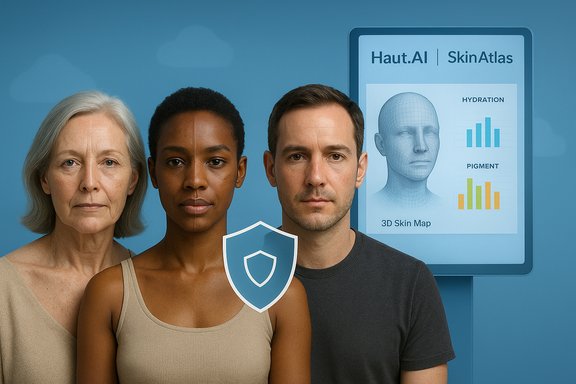
Haut.AI’s SkinGPT and patented Skin Atlas have pushed generative AI from novelty to real-world productization in skincare, promising hyper-realistic skin simulations, privacy-preserving image anonymization, and enterprise-ready personalization built on Microsoft Azure — a development that has already attracted major retail partners and industry awards while raising important questions about scientific validation, privacy, regulatory risk, and responsible deployment.
Background / Overview
Haut.AI was founded in Tallinn, Estonia in 2018 and has evolved from academic computer‑vision roots into a B2B SaaS provider for beauty brands, retailers, and contract research organizations. The company’s platform blends machine vision, dermatological science, and generative models to deliver skin analysis, product matching, and predictive simulations intended for both R&D and consumer-facing experiences. Microsoft for Startups has been an accelerator and infrastructure partner in Haut.AI’s growth, and Haut.AI explicitly runs its AI stack on Microsoft Cloud services. Haut.AI’s public roadmap centers on two headline innovations:- SkinGPT — a generative AI engine that simulates how a user’s skin may respond to products, treatments, lifestyle, and environment over time, first commercially launched in January 2025.
- Skin Atlas — a patented anonymization system that removes personally identifying visual features while preserving skin pixels for accurate analysis, designed to protect privacy without degrading algorithmic performance. The underlying patent appears as US20220335252A1 and describes facial keypoint detection, segmentation of skin vs. non-skin pixels, and generative reconstruction to produce anonymized, analyzable images.
How the integrated solution works
Architecture and tooling
Haut.AI trains and deploys models using cloud-based infrastructure and developer tooling commonly used in enterprise AI stacks. The company has publicized its use of Microsoft cloud services for training, job execution, and product hosting — citing Azure AI tools, Machine Learning services, and Visual Studio tooling as core elements of their engineering pipeline. That relationship has been formalized through Microsoft for Startups and related programs that provide credits, technical guidance, and GTM support. At a technical level, Haut.AI’s stack combines:- High‑throughput image ingestion and standardization, guided capture UX (to ensure photos are usable for analysis).
- Segmentation and biomarker extraction models that derive numeric metrics (hydration, redness, wrinkle scores, pigmentation indices) from images.
- Generative modeling layers that synthesize photorealistic imagery for anonymization (Skin Atlas) and time‑forward simulations (SkinGPT).
- Recommendation engines that map measured and predicted skin trajectories to product formulations and claims‑backed outcomes.
SkinGPT: simulation pipeline
SkinGPT is described as a generative engine that models both biological and perceptual changes in the skin. The pipeline, as presented by the vendor and PR coverage, includes:- Ingesting a standardized selfie and baseline metrics.
- Running predictive models that account for aging, UV exposure, ingredient mechanisms, and lifestyle variables.
- Rendering hyper‑realistic simulated images to visualize short‑ and long‑term changes and to show product impact in before/after style visualizations.
Skin Atlas: anonymization and privacy-first imaging
Skin Atlas is a generative anonymization technique designed to replace non‑skin facial regions (eyes, hair, background) with photorealistic skin texture so the resulting image cannot be re‑identified while retaining the skin signals crucial for analysis. The method — backed by the US patent publication US20220335252A1 — outlines detection of facial keypoints, segmentation of skin vs. non‑skin pixels, generation of synthetic skin patterns, and concatenation to produce a privacy‑preserving result optimized for downstream analysis. The patent’s claims and published diagrams are explicit about the algorithmic steps and intended use for clinical and commercial skin studies.Go‑to‑market traction and partnerships
Haut.AI positioned SkinGPT for commercial use at the start of 2025 and reported immediate interest from global beauty brands and retailers. The company has publicly announced partnerships and pilots with household names in beauty retail and CPG, including a strategic collaboration with Ulta Beauty to co‑create personalized digital skin experiences, and later commercial collaborations publicized with other major brands. Industry coverage and company press releases corroborate the Ulta‑Haut.AI relationship and note enterprise pilots and in‑store / digital integrations. Haut.AI’s launch activity has been accompanied by PR momentum: commercial press releases, interactive demos (Generative.Skin), and award recognition from industry bodies for technology innovation. These market signals indicate strong vendor PR execution and early buyer interest; they do not substitute for independent clinical studies that measure product‑level accuracy or consumer behavior lift in a controlled setting.What Haut.AI gets right — strengths and business impact
- Practical, commercial focus on personalization and visualization. Virtual try‑ons and predictive imagery are high‑leverage features for beauty commerce; converting abstract product claims into personalized visuals addresses a major purchase barrier for skincare shoppers. Haut.AI’s early adoption by retailers signals commercial plausibility.
- Privacy by design via Skin Atlas. The Skin Atlas patent provides a credible technical route to balance visual personalization with re‑identification risk mitigation. For brands and CROs running image‑based studies, anonymization that preserves analytic signal would ease ethical and regulatory friction. The patent record gives the company defensible IP and a documented methodology.
- Platformized enterprise stack on Azure. Building on Microsoft Cloud (Azure AI, Machine Learning services, and Microsoft for Startups support) lowers infrastructure barriers, enables scale, and opens enterprise GTM channels. The Microsoft endorsement through its startups program provides technical and commercial credibility for enterprise buyers.
- Multi‑modal product set for different buyer needs. Haut.AI’s combination of clinical‑grade metrics, consumer UX, and generative simulation supports R&D, marketing, and retail use-cases, creating multiple business lines and revenue paths for B2B contracts, integrations, and SaaS subscriptions.
Risks, gaps, and caution points
1. Scientific validation vs. commercial claims
Many of Haut.AI’s product statements are presented with confident, scientific language (“scientifically accurate”, “hyper‑realistic”, “first‑of‑its‑kind”), but independent, peer‑reviewed clinical validation of predictive accuracy is limited in public record. Company datasets, model training details, and clinical evaluation protocols are not fully transparent in press materials; independent RCTs or published validation studies would be required for regulatory‑grade claims. The company’s own technical and marketing assets provide strong internal evidence, but external validation should be sought before accepting performance claims for clinical or medical decision support.2. Perception vs. biological reality
Generative simulations can be very persuasive visually, but human perception and skin biology are not identical. Simulated imagery that captures perceptual cues (texture smoothing, tone changes) could overstate functional results (e.g., biochemical repair, dermal remodeling). Brands must be careful that visualizations do not imply unproven clinical efficacy; marketing and regulatory teams should align on permissible messaging and substantiation. This is a classic advertising‑claims risk amplified by photorealistic AI outputs.3. Re‑identification and privacy assurance
Although Skin Atlas addresses anonymization, the privacy landscape is complex. Generative reconstruction of non‑skin regions raises technical questions: does the anonymized image leak biometric invariants that could be reverse‑engineered? What controls prevent linkage attacks across datasets? The patent provides a method, but operational privacy depends on robust access controls, data retention policies, logging, and independent security audits. Vendors and customers should require threat modeling and third‑party privacy assessments before deploying at scale.4. Regulatory and compliance exposure
Skincare is regulated differently across markets; claims about preventing, treating, or diagnosing conditions may trigger medical device or cosmetics claims oversight. Generative outputs that simulate long‑term anti‑aging or treatment outcomes could invite regulatory scrutiny if consumers perceive them as therapeutic promises. Brands should coordinate legal, regulatory, and clinical teams to craft compliant product descriptions and avoid inadvertent medical positioning.5. Bias and dataset representativeness
Haut.AI reports synthetic data augmentation and training on large datasets to support diverse skin tones and conditions. Nonetheless, model bias remains an industry‑wide risk, especially for visual AI trained on imbalanced sources. Transparent reporting of dataset composition, evaluation by skin tone and age cohorts, and open bias metrics would help brands assess fairness and mitigate reputation risk. Until external audits are public, buyers should request bias testing reports and hold vendors to auditability standards.Operational considerations for brands and retailers
Brands or retailers evaluating integration with Haut.AI should consider the following checklist:- Data governance and security:
- Confirm on‑cloud hosting region, encryption at rest and in transit.
- Require SOC2 / ISO27001 evidence and request independent penetration testing.
- Privacy and consent:
- Review Skin Atlas anonymization flow, retention policies, and data deletion guarantees.
- Ensure explicit consent capture flows for consumer image use and secondary analytics.
- Scientific evidence:
- Ask for validation studies, sample sizes, performance across demographic cohorts, and the methodology used for measuring predictive accuracy.
- Regulatory mapping:
- Align marketing language with cosmetics vs. medical device frameworks; pre‑clear claims with legal and regulatory counsel.
- UX and capture quality:
- Evaluate on-device guidance, lighting checks, and mobile capture flow — the quality of input images is a primary determinant of output fidelity.
- A/B testing:
- Pilot in a controlled cohort (e.g., loyalty members) and measure conversion lift, return rates, and NPS vs. control before broad rollout.
Competitive landscape and industry implications
Generative AI in beauty is a rapidly proliferating space. Haut.AI’s strategy — combining proprietary anonymization IP, enterprise Azure stack integration, and retail partnerships — creates a defensible niche at the intersection of privacy and photorealistic simulation. But competitors and adjacent players (large platform vendors, niche vision startups, and big CPG R&D teams) are investing heavily in similar tooling. The differentiators for Haut.AI are its patent portfolio, enterprise Azure alignment (reducing integration friction), and early retail-grade deployments. For retailers, the strategic value is threefold:- Better conversion through more confident purchases when consumers see expected outcomes.
- First‑party data capture (with consent) to offset cookie deprecation and build long‑term customer understanding.
- New omnichannel features (in‑store consultant augmentation, in‑app personalization) that drive loyalty and basket size.
Case study snapshot: Ulta Beauty collaboration
Haut.AI announced a co‑creation partnership with Ulta Beauty to bring AI‑driven skin experiences to Ulta customers. The partnership is presented as a collaborative effort to embed SkinGPT‑style intelligence into Ulta’s digital skin tools and customer journeys, reflecting a push by major retailers to differentiate on personalized experiences. Media coverage and company announcements corroborate the collaboration, and Haut.AI’s enterprise positioning on Azure supports the feasibility of scale across digital and in‑store channels. Retailers considering similar integrations should inspect pilot success metrics (conversion lift, incremental AOV, in‑store engagement time) and the partnership’s commercial terms before committing to full rollouts.What to watch next — practical milestones and validation signals
Companies, investors, and product teams tracking Haut.AI should watch for:- Publication of independent validation studies or third‑party audits demonstrating predictive accuracy across diverse cohorts.
- Detailed privacy audit reports or certifications that validate Skin Atlas anonymization in adversarial settings.
- Measured retailer KPIs from pilots (conversion lift, return reduction, A/B tested consumer outcomes).
- Regulatory guidance or enforcement actions related to generative product simulations that redefine advertising compliance in beauty.
- Continued ecosystem integrations (e.g., partnerships with large CPG brands and health platforms) that show traction beyond PR announcements.
Conclusion
Haut.AI is a prominent example of how generative AI is being productized in consumer verticals: combining dermatological science, generative models, and enterprise cloud tooling to create differentiated experiences for brands and shoppers. The company’s SkinGPT and patented Skin Atlas address two core industry problems — making product efficacy tangible for consumers and protecting personal identity in image‑driven workflows. The Microsoft for Startups / Azure integration gives Haut.AI a credible enterprise‑grade foundation and routes to major retail partnerships.At the same time, major caveats remain. Marketing language and PR momentum are strong, but independent clinical validation, rigorous privacy audits, and careful regulatory alignment are the next necessary steps for trust, long‑term adoption, and defensible claims. For brands and retailers, the opportunity is significant — and the due diligence required is non‑trivial. Moving from pilot to scale will hinge on measurable business outcomes, transparent validation of model performance across diverse populations, and robust operational controls to manage privacy and compliance risk.
Key product and company claims verified in this analysis:
- Haut.AI founded in 2018, headquartered in Tallinn, Estonia (company and Microsoft profiles).
- SkinGPT commercial availability announced January 15, 2025 (press release / company blog).
- Skin Atlas anonymization method described and published as US patent application US20220335252A1 (patent record).
- Haut.AI’s Microsoft for Startups participation and operational reliance on Microsoft Cloud tooling (Microsoft startup materials and company statements).
- Strategic collaborations and retail pilots, including Ulta Beauty partnership announcements (company blog and industry press).
Source: Microsoft Haut.AI revolutionizes skincare customer experience with AI insights using Azure AI | Microsoft Customer Stories
