

HCLTech has won Microsoft’s new Copilot Specialization, joining the first wave of Global System Integrators Microsoft is publicly recognizing for demonstrated, production-grade capability across Microsoft 365 Copilot, Copilot Chat, Copilot Studio and agentic extensibility.
Microsoft introduced the Copilot Specialization in mid‑2025 as a workload‑specific credential that sits on top of the Solutions Partner model to help enterprise buyers identify partners that can move Copilot from experimentation into governed, measurable production deployments. The specialization’s intent and basic gates are published in Microsoft’s partner guidance and Partner Center program pages. The Copilot Specialization is explicitly designed to measure three core dimensions that matter in production AI programs:
Enterprises considering HCL (or any specialization partner) should treat the Copilot Specialization as a starting filter: require dated Partner Center evidence, certified staff rosters, telemetry extracts and at least three validated customer references (including an agentic case) before committing to an enterprise rollout. When those artifacts are supplied and validated, the specialization becomes a practical tool for reducing vendor risk and accelerating safe Copilot adoption at scale.
Source: Capital Market https://www.capitalmarket.com/marke...ves-Microsoft-Copilot-Specialization/1652725/
 Background
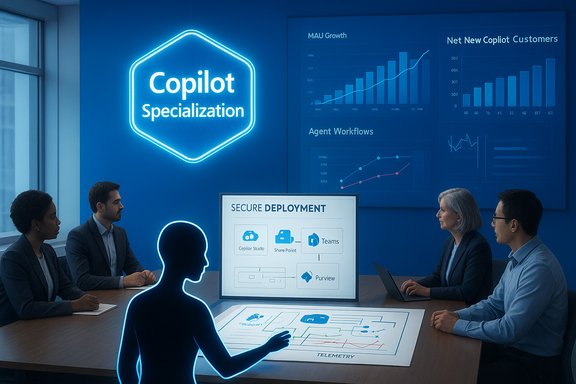
Microsoft introduced the Copilot Specialization in mid‑2025 as a workload‑specific credential that sits on top of the Solutions Partner model to help enterprise buyers identify partners that can move Copilot from experimentation into governed, measurable production deployments. The specialization’s intent and basic gates are published in Microsoft’s partner guidance and Partner Center program pages. The Copilot Specialization is explicitly designed to measure three core dimensions that matter in production AI programs:- Performance / adoption: measurable monthly active user (MAU) growth and net‑new Copilot customers attributable to the partner.
- Skilling: a bench of certified practitioners mapped to role exams (productivity, security, Copilot Studio/agent skills).
- Customer references / audit evidence: verifiable customer outcomes, with at least one example of an agentic implementation that transformed a business process.
What HCLTech announced
HCLTech’s corporate newsfeed states the company achieved the Microsoft Copilot Specialization on November 11, 2025, and positions the award as validation of its global Copilot delivery capabilities across advisory, secure deployment, adoption and custom agent development. The release highlights specific customer outcomes—examples include a global biopharma deployment with 5,000+ M365 Copilot users and an AI Claims Processing Agent for a digital payments customer that improved throughput by roughly 50%—that HCL says underpinned its qualification. The announcement also notes HCLTech now holds 23 Microsoft specializations across Azure, Microsoft 365, Dynamics 365 and Security, and quotes Microsoft and HCL executives emphasizing strategic alignment and the role of Copilot in accelerating workplace productivity and business automation. Because the user-provided CapitalMarket link returned an error, the HCLTech release and Microsoft partner documentation are the authoritative, directly verifiable sources used for this feature.Why the Copilot Specialization matters (overview for IT decision‑makers)
Earning the Copilot Specialization signals that a partner can not only advise on Copilot use cases but can also deliver the people, telemetry and governance artifacts Microsoft expects for enterprise rollouts. For buyers, that matters in three practical ways:- Shorter shortlists: the specialization provides a measurable baseline to filter vendors, reducing time spent validating capability claims.
- Procurement artifacts: the program ties partner claims to Partner Center evidence (MAU growth, certified headcount, references) that procurement can request and verify.
- Elevated operational expectations: partners must show human‑in‑the‑loop controls, telemetry and secure tenant configurations to qualify—traits that are essential for regulated environments.
What the program requires (technical specifics)
Microsoft’s published guidance and Tech Community posts detail the mechanics partners must satisfy to earn the Copilot Specialization. Key, verifiable elements include:- Adoption / performance gates: partners typically must show MAU growth and a minimum number of net-new Copilot customers in the trailing twelve months, associated via accepted partner association types (for example, CPOR or CSP links). The public briefing lists MAU and net-new thresholds as core performance measures.
- Skilling and mapped exams: the Copilot Specialization maps specific role exams and requires multiple certified individuals across those mapped exams (productivity admin, security/compliance readiness, and Copilot Studio/agent extensibility certifications). These skilling thresholds prevent “single‑person” claims and force bench depth.
- References / audit evidence: partners must provide customer references, typically including at least one agent implementation that demonstrably changed a business process. In other specializations Microsoft sometimes requires a third‑party audit; for Copilot, the reference and telemetry evidence are central.
- One‑year validity: specializations are subject to annual renewal; partners must maintain the performance and skilling gates to keep their badge active. That makes the specialization a rolling snapshot of capability rather than a permanent award.
Verifying HCLTech’s claims: cross‑checking the record
HCLTech’s press release is the primary announcement and contains concrete customer examples and executive commentary. The company’s pressfeed explicitly links the award to successful customer engagements that drove measurable user adoption and automated workflows at scale. Independent corroboration is also available in partner program documentation and market coverage: Microsoft’s Partner Center pages and Tech Community posts confirm the Copilot Specialization’s introduction, requirements and program mechanics, which align with the evidence HCL says it supplied. Market news aggregators and regional outlets also reported HCLTech’s achievement on November 11, 2025, reinforcing the date and the public nature of the announcement. Because press releases and program pages are the primary evidence for specializations, procurement teams should still insist on the Partner Center artifacts behind HCL’s claim (MAU dashboards, certification rosters and customer references) as part of contracting.Strengths in HCLTech’s positioning
HCL’s public materials and product footprint suggest several concrete strengths that make the Copilot Specialization credible and potentially valuable to enterprise customers:- Scale and delivery depth: HCLTech is a true GSI with a large global delivery organization and a history of packaging enterprise AI services, which makes it technically and operationally plausible that they can staff, deploy and support Copilot programs at scale. HCL’s public revenue and employee counts included in the release illustrate that scale.
- Prior Microsoft alignment and product integration: HCLTech already lists multiple Microsoft specializations and has published examples of Copilot and Azure AI work (including fabric and security-adjacent projects). That prior alignment reduces integration risk in many Azure‑centric deployments.
- End‑to‑end capability claims: the HCL release describes advisory, readiness, custom agent development and adoption programs—services that cover the Copilot lifecycle Microsoft expects partners to support. When true, that breadth lowers the number of third‑party vendors required to go live.
- Marketplace and GTM leverage: HCL’s broader strategy to package HCLSoftware assets and services on Azure Marketplace (in related announcements) signals familiarity with Microsoft’s commercial channels, which can help procurement and billing alignment for customers who prefer marketplace transactions.
Risks, limits and what to validate
Specializations are purposeful but limited. The following issues are essential to evaluate before awarding HCL (or any partner) a major Copilot program contract:- Point‑in‑time verification: a specialization is valid for a year and reflects the partner’s status at audit time. Ask for the date of HCL’s Partner Center award and the telemetry period used to qualify. Verify that MAU growth and net‑new customer counts are current and apply to the account profiles you care about.
- Opaque public examples: press releases often highlight a small set of high‑impact wins while omitting the broader distribution of customer outcomes. Request detailed anonymized decks or a recorded customer reference call to assess operational maturity beyond headline metrics.
- Governance and data risks: agentic Copilot implementations can escalate governance exposure (data access, exfiltration, PII handling). Confirm tenant‑level controls (Entra SSO, Purview/DLP integration), RAG architecture that enforces data boundaries, and human‑approval gates for high‑impact agent actions.
- Hidden costs and long‑term TCO: licensing for Microsoft 365 Copilot, Azure inference/model hosting (Azure AI Foundry or Azure OpenAI), integration costs, and ongoing managed‑service fees can be material. Require a three‑year TCO model that includes Copilot licensing, inference/Foundry spend, and managed‑service run rates.
- Operational ownership and vendor lock‑in: agentic workflows, integrations with ServiceNow/Workday and curated knowledge indexes can create long‑term dependencies. Insist on exportable artifacts, documented APIs, knowledge transfer plans and clear SLAs for managed services and handovers.
Practical vetting checklist for procurement teams
- Request Partner Center proof that the Copilot Specialization was awarded and note the award date.
- Obtain a dated skills matrix listing certified staff and certification IDs that meet Microsoft’s role‑mapped exam requirements.
- Ask for telemetry extracts or dashboards showing MAU growth and net‑new Copilot customers attributed to the partner for the trailing 12 months.
- Get at least three customer references; one must be an agentic deployment that changed a business process and supply before/after KPIs.
- Review the partner’s RAG architecture, data access controls, and human‑in‑the‑loop gating with senior engineers.
- Require a responsible AI and model governance policy (red‑team tests, retention, prompt security, telemetry).
- Insist on a three‑year TCO model including Microsoft Copilot licensing, Azure model inference/Foundry costs, and managed service fees.
Suggested implementation playbook (high‑level, pragmatic)
Phase 1 — Readiness & Scoping- Run focused Copilot Readiness workshops to identify 3–5 high‑value use cases.
- Perform tenant security and data classification checks; map data flows and compliance controls.
- Define measurable KPIs (time saved, task completion improvements, MAU targets).
- Deploy a narrow-scope Copilot pilot or single agent via Copilot Studio with human‑in‑the‑loop approvals.
- Ground responses on versioned, indexed corpora (Fabric, SharePoint, knowledge graphs) to minimize hallucinations.
- Implement telemetry and observability (prompt lineage, error rates, human override metrics).
- Expand pilots to role‑based copilots and automated agents; formalize SLAs for monitoring and incident response.
- Institutionalize continuous validation and red‑team reviews; maintain a scheduled recertification or auditing cadence.
- Move to managed service runbooks with explicit handover artifacts and exportable knowledge stores.
Market and commercial implications
Microsoft’s Copilot Specialization is shaping partner differentiation in 2025 and beyond: early badge‑holders (global systems integrators and leading consultancies) will likely capture more enterprise Copilot programs because the credential reduces shortlisting friction and signals Microsoft‑aligned delivery playbooks. Multiple partners (SoftwareOne, Devoteam and others) published similar specialization announcements after the program launched, showing the credential is already moving into mainstream partner GTM strategies. For customers, the specialization can speed procurement and increase the availability of partner IP (playbooks, pre‑built agents, adoption frameworks) that accelerates time‑to‑value—provided buyers insist on the verification artifacts that validate the badge’s claims. At the same time, the specialization intensifies competition among partners, pushing them to invest more in governance, telemetry and reproducible agent engineering to stand out in a crowded market.Conclusion
HCLTech’s announcement that it has achieved Microsoft’s Copilot Specialization is a meaningful commercial milestone: the badge signals the company has demonstrated adoption, skilling and customer outcomes in the new Copilot services category and aligns with Microsoft’s intention to create verifiable partner signals for enterprise Copilot procurement. The award is fully consistent with Microsoft’s published Copilot Specialization criteria and HCLTech’s own public case examples, but it is not a substitute for procurement‑level verification.Enterprises considering HCL (or any specialization partner) should treat the Copilot Specialization as a starting filter: require dated Partner Center evidence, certified staff rosters, telemetry extracts and at least three validated customer references (including an agentic case) before committing to an enterprise rollout. When those artifacts are supplied and validated, the specialization becomes a practical tool for reducing vendor risk and accelerating safe Copilot adoption at scale.
Source: Capital Market https://www.capitalmarket.com/marke...ves-Microsoft-Copilot-Specialization/1652725/
