

A small, easily overlooked piece of memory-management logic in the HDF5 C library has been rewarded with a CVE and a fast upstream fix: CVE-2025-2925 identifies a double‑free in the HDF5 function H5MM_realloc (src/H5MM.c) that can be triggered when a caller passes an effective size of zero. The issue affects HDF5 releases through 1.14.6, a wide-enough population that downstream distributors (Ubuntu, Debian, SUSE and others) and the HDF Group addressed it quickly; a public proof‑of‑concept and an upstream commit that eliminates the double‑free condition are available.
HDF5 (Hierarchical Data Format v5) is a ubiquitous binary container and C library used across scientific computing, high performance computing (HPC), data analysis toolchains, and many commercial products to store and retrieve large, multidimensional datasets and rich metadata. Because HDF5 is commonly linked directly into tools and services that process files from untrusted sources (ingest pipelines, cloud preview services, image/tile processing, research compute nodes), memory-safety defects in its native code are operationally significant.
CVE‑2025‑2925 was published on 28 March 2025 and catalogued by multiple registries. The vulnerability is localized to the file src/H5MM.c in the function H5MM_realloc; the specific problem is that a call pattern can result in the library freeing an allocation and later attempting to free the same pointer again, producing a double‑free. The vulnerability requires local invocation or a server context that automatically parses uploaded files; public reproductions exist and vendors have classified the risk as medium‑low depending on deployment.
HDF5’s ubiquity raises the practical stakes. A denied or crashed hdf5‑linked process can be a single desktop application crash or a critical outage for an automated ingestion service that decodes uploaded .h5 files. Because HDF5 is often statically linked into long‑lived binaries or used in server agents with elevated privileges, a local memory‑corruption primitive can matter. Multiple trackers and distribution pages emphasize availability and integrity impacts first, while noting that RCE remains speculative absent additional defects or stronger environmental control.
Operators should treat this CVE as a straightforward patching priority for affected ingestion services and static builds: inventory HDF5 usage, apply vendor updates that include the upstream commit, rebuild statically linked artifacts, and isolate HDF5 parsing where possible until deployments are confirmed patched. The public reporting, upstream commit and distributor tracking together give a high degree of confidence in both the diagnosis and the remedy; the remaining operational risk is largely a function of how quickly patched builds are rolled out across diverse packaging and embedded ecosystems.
Source: MSRC Security Update Guide - Microsoft Security Response Center
 Background / Overview
HDF5 (Hierarchical Data Format v5) is a ubiquitous binary container and C library used across scientific computing, high performance computing (HPC), data analysis toolchains, and many commercial products to store and retrieve large, multidimensional datasets and rich metadata. Because HDF5 is commonly linked directly into tools and services that process files from untrusted sources (ingest pipelines, cloud preview services, image/tile processing, research compute nodes), memory-safety defects in its native code are operationally significant.CVE‑2025‑2925 was published on 28 March 2025 and catalogued by multiple registries. The vulnerability is localized to the file src/H5MM.c in the function H5MM_realloc; the specific problem is that a call pattern can result in the library freeing an allocation and later attempting to free the same pointer again, producing a double‑free. The vulnerability requires local invocation or a server context that automatically parses uploaded files; public reproductions exist and vendors have classified the risk as medium‑low depending on deployment.
Why this matters: the double‑free class and HDF5’s role
Double‑free bugs are a classic memory‑management error in C. Freeing the same heap pointer twice corrupts allocator metadata and commonly leads to immediate crashes (SIGSEGV) or undefined allocator behavior. Under highly favourable conditions and with sophisticated heap grooming, such a corruption can become a route to achieve arbitrary writes or code execution, but turning a double‑free into reliable remote code execution is typically nontrivial and platform-dependent.HDF5’s ubiquity raises the practical stakes. A denied or crashed hdf5‑linked process can be a single desktop application crash or a critical outage for an automated ingestion service that decodes uploaded .h5 files. Because HDF5 is often statically linked into long‑lived binaries or used in server agents with elevated privileges, a local memory‑corruption primitive can matter. Multiple trackers and distribution pages emphasize availability and integrity impacts first, while noting that RCE remains speculative absent additional defects or stronger environmental control.
Technical analysis — what went wrong
The immediate root cause (in plain terms)
- The function H5MM_realloc wraps C realloc semantics for the HDF5 project and is used to resize or (re)allocate buffer storage.
- In C, calling realloc(ptr, 0) has implementation-specific behavior: some platforms behave like free(ptr) and return NULL; others return a unique pointer that must be freed later. That platform variation is why robust code must treat size==0 carefully.
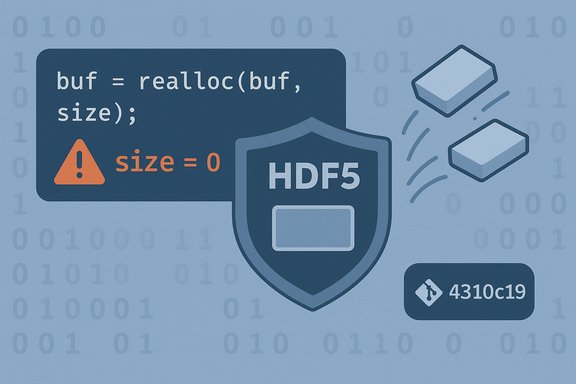
- In the HDF5 call chain that triggered CVE‑2025‑2925, a zero‑length condition (actual_len + H5C_IMAGE_EXTRA_SPACE == 0) caused H5MM_realloc to free the current image buffer; control returned to the caller before the new pointer was safely assigned, and later cleanup code attempted to free the same pointer again — a textbook double‑free. The upstream analysis and issue report clearly explain this sequence.
The concrete code flow (summary)
- A cache-loading function (H5C__load_entry / H5C__load_entry-like flow) computed a required image length and then called H5MM_realloc(image, computed_len + H5C_IMAGE_EXTRA_SPACE).
- If the computed length was 0, some libc implementations of realloc freed the old pointer and returned NULL. The loader code then reached an error or cleanup path that called the library’s free wrapper (H5MM_xfree) on the original pointer — which had already been freed — producing a double‑free and heap corruption.
- The root logic error is not realloc itself; it's the lack of precondition checks and the assumption that realloc would always behave in a particular way for size==0, plus not nullifying the old pointer after a reallocation that effectively freed it.
What the upstream change did
Upstream fixed the issue with a defensive precondition check in the cache-loading code: verify that the requested buffer length is non‑zero before calling H5MM_realloc. In other words, avoid calling realloc with a zero size in the first place; if the computed length is zero treat it as a bad value and error out earlier. This keeps ownership semantics clear and prevents the sequence that led to the double‑free. The fix is small, surgical, and preserves existing semantics while removing the edge‑case that produced free‑twice behavior. The commit that implements the fix is available in the HDFGroup repository (commit 4310c19).Corroborating evidence and confidence in the diagnosis
Multiple, independent signals corroborate the vulnerability and its remediation:- The National Vulnerability Database (NVD) entry records CVE‑2025‑2925 and describes the double‑free in H5MM_realloc.
- The HDFGroup GitHub issue that reported the bug (#5383) contains a detailed analysis, steps to reproduce and an explicit explanation of how realloc(size==0) behavior produced the free/cleanup race.
- The HDFGroup’s upstream commit (PR #5739, commit 4310c19) implements the defensive checks in H5C__load_entry and documents the rationale — preventing calls into H5MM_realloc when the requested size would be zero. That commit is the canonical patch.
- Distributors and vendor trackers (Ubuntu, Debian, SUSE, Debian’s security tracker) indexed the CVE and mapped upstream commits into distribution triage tasks. That ecosystem mapping shows practical triage and verification across independent maintainers.
Exploitability, impact, and realistic attacker models
- Attack vector: Local by default. The vulnerable call chain is triggered when HDF5 parses certain on‑disk structures that lead to a computed buffer length of zero; an attacker must get the vulnerable code to open or process a malicious .h5 file.
- Remote trigger: plausible in server contexts. If a remote‑facing service automatically opens or processes uploaded HDF5 files in an unprivileged but long‑lived worker, attackers can weaponize the PoC to crash or destabilize that service by uploading specially crafted files.
- Impact: Availability (DoS) is the most immediate and well‑supported impact — a double‑free commonly results in crashes. Integrity consequences (data corruption) are possible if heap metadata is corrupted and later writes clobber data. Claims of reliable RCE are speculative without additional primitives but should be treated as an elevated risk in high‑value, multi‑tenant deployments because heap corruption can be chained in some environments.
- Difficulty: Causing a crash is low-to-moderate complexity (PoC exists). Escalating to reliable arbitrary code execution would require platform‑specific heap‑grooming and favorable allocator behavior; modern mitigations (ASLR, hardened allocators, RELRO/PIE) increase the bar significantly.
Patch status and what operators should do now
Where the fix lives
- The upstream HDFGroup repository contains PR #5739 / commit 4310c19 which explicitly addresses CVE‑2025‑2925 by checking for zero-length image buffers before calling H5MM_realloc. Use that commit as the authoritative reference for the upstream fix.
Distribution status
- Major distributors’ trackers (Ubuntu, Debian, SUSE) have entries for CVE‑2025‑2925 and are triaging or backporting the fix. Administrators should monitor vendor security advisories for packages that include the patched commit. Debian’s tracker and Ubuntu’s CVE page list the issue and provide package‑level statuses where available.
Immediate remediation checklist
- Inventory: identify all binaries, containers and appliances that include HDF5 1.14.x (especially 1.14.6) — include static and dynamic linkages.
- Patch: apply vendor-supplied updates that list CVE‑2025‑2925 or include the upstream commit ID. If vendor packages are not yet available, pull the upstream commit, rebuild HDF5 and rebuild any statically linked deliverables.
- Rebuild static artifacts: any static build that bundles HDF5 must be rebuilt and redeployed to eliminate the vulnerability.
- Isolate processing of untrusted .h5 files: move ingestion to sandboxed or ephemeral workers, or disable automatic decoding of uploaded HDF5 files until patched.
- Monitor: enable crash detection and aggregated logging for services that use HDF5; watch for repeated crashes, OOMs, or unusual allocator failures.
- Vet third‑party tools: downstream projects and language bindings (h5py, MATLAB bindings, vendor appliances) may include HDF5 as an embedded library — verify their vendor advisory and patch schedule.
Short‑term mitigations
- Stop automatic processing of untrusted HDF5 files on internet‑facing endpoints.
- Apply runtime isolation (containers with strict capabilities, seccomp, or unprivileged containers) for HDF5‑linked jobs.
- Restrict who can upload files that will be parsed automatically and perform input validation for obvious anomalies (zero‑length images/entries).
Detection and verification (how to confirm a host is fixed)
- For packaged systems: confirm the installed hdf5 package version in vendor repositories; check the distribution changelog or advisory for CVE‑2025‑2925 or upstream commit 4310c19.
- For compiled from source: inspect the HDF5 source in your build tree for the changes to H5C__load_entry (the guard that rejects zero-length image buffers before calling H5MM_realloc). If that guard is present, the dangerous path is closed. The upstream commit and PR note the exact file and lines changed.
- Functional verification: run the upstream fuzzer harness or the PoC in a safe test environment and ensure that the previous crash path no longer trips on patched builds. The original issue reporter included an AddressSanitizer-enabled reproducer to demonstrate the double‑free; rebuild and run that test in staging to confirm remediation.
Risks, tradeoffs and remaining uncertainties
- The upstream fix is intentionally minimal and correctly conservative: it avoids calling realloc with size==0 rather than changing allocator semantics or heavy refactors. That makes the change low risk for regressions.
- The main residual risk is incomplete rollout: many vendors and embedded devices ship older HDF5 builds or statically embedded copies, so remediation may lag in real‑world fleets.
- Claims that a double‑free equals guaranteed remote code execution are speculative. While double frees are a powerful primitive in exploit development, reliably exploiting one for RCE depends on allocator internals, platform mitigations, and potentially other exploitable conditions. Public trackers caution that DoS is the primary, confirmed impact while RCE remains an unproven escalation in most environments.
- Some public trackers present differing CVSS scores and urgency; triage decisions should be based on deployment exposure (are you auto‑processing untrusted .h5 files?, not just the numeric score.
Practical playbook for sysadmins and developers
- Developers:
- Audit calls into HDF5 in your codebase. Avoid swallowing uncontrolled file data into a shared HDF5 worker process.
- For static builds, vendor upstream patches or rebase your vendored HDF5 tree to include the commit that fixes CVE‑2025‑2925.
- Add unit tests that cover zero‑length buffer scenarios and error paths in cache/load logic to guard against regressions.
- SRE / Ops teams:
- Prioritize patching ingestion/preview tiers that accept untrusted files.
- Where patches can’t be immediately applied, move parsing into isolated worker pools (short‑lived containers, limited privileges) that limit blast radius.
- Deploy crash monitoring and core capture to help triage potential attacks targeting the double‑free path.
- Security teams:
- Update vulnerability management systems to flag any asset with HDF5 <= 1.14.6.
- Validate vendor notices and require demonstrable inclusion of the upstream fix (commit ID) before marking assets remediated.
- If your environment processes external datasets (collaborative research, journal repositories, public datasets), treat those ingestion pipelines as high priority.
Conclusion
CVE‑2025‑2925 is an instructive example of how small assumptions about low‑level allocator semantics lead to real vulnerabilities in widely used native libraries. The defect is well‑understood, reproducible, and fixed upstream by a targeted change that prevents realloc with zero size from corrupting ownership semantics. The practical damage profile is dominated by denial‑of‑service and potential data‑integrity consequences — but the presence of a public PoC elevates urgency for any organization that automatically processes untrusted HDF5 files.Operators should treat this CVE as a straightforward patching priority for affected ingestion services and static builds: inventory HDF5 usage, apply vendor updates that include the upstream commit, rebuild statically linked artifacts, and isolate HDF5 parsing where possible until deployments are confirmed patched. The public reporting, upstream commit and distributor tracking together give a high degree of confidence in both the diagnosis and the remedy; the remaining operational risk is largely a function of how quickly patched builds are rolled out across diverse packaging and embedded ecosystems.
Source: MSRC Security Update Guide - Microsoft Security Response Center
