

A stack-based buffer overflow in the HDF5 library — tracked as CVE-2025-6857 — was disclosed against HDF5 1.14.6 and centers on the H5G__node_cmp3 routine in src/H5Gnode.c; the flaw causes a stack overflow when specially crafted input is parsed, a public proof-of-concept exists, and the vulnerability is exploitable from a local context where an attacker can cause a vulnerable process to open or parse a malicious .h5 file.
HDF5 (Hierarchical Data Format version 5) is a ubiquitous open‑source library and binary file format used across scientific computing, engineering, and enterprise data pipelines to store large multi-dimensional arrays and structured metadata. Because HDF5 is often linked directly into command-line tools, services that ingest user data, and long-lived daemons that process uploaded files, memory-safety defects in HDF5 can have outsized operational impact. Several HDF5 issues were disclosed around the same release cycle for 1.14.6, so this CVE should be evaluated in the context of a cluster of memory-safety findings affecting that release.
The specific report for CVE-2025-6857 identifies the vulnerable function as H5G__node_cmp3 in src/H5Gnode.c and classifies the bug as a stack-based buffer overflow. Multiple public trackers, distribution security pages, and vendor mirrors captured the CVE after a public disclosure and a researcher-supplied reproducer was posted to GitHub. The National Vulnerability Database (NVD) and several distro trackers list the CVE and describe the exploitability model as local with a public proof-of-concept.
Source: MSRC Security Update Guide - Microsoft Security Response Center
 Background
HDF5 (Hierarchical Data Format version 5) is a ubiquitous open‑source library and binary file format used across scientific computing, engineering, and enterprise data pipelines to store large multi-dimensional arrays and structured metadata. Because HDF5 is often linked directly into command-line tools, services that ingest user data, and long-lived daemons that process uploaded files, memory-safety defects in HDF5 can have outsized operational impact. Several HDF5 issues were disclosed around the same release cycle for 1.14.6, so this CVE should be evaluated in the context of a cluster of memory-safety findings affecting that release.The specific report for CVE-2025-6857 identifies the vulnerable function as H5G__node_cmp3 in src/H5Gnode.c and classifies the bug as a stack-based buffer overflow. Multiple public trackers, distribution security pages, and vendor mirrors captured the CVE after a public disclosure and a researcher-supplied reproducer was posted to GitHub. The National Vulnerability Database (NVD) and several distro trackers list the CVE and describe the exploitability model as local with a public proof-of-concept.
What the bug is — technical anatomy
Where in the code it lives
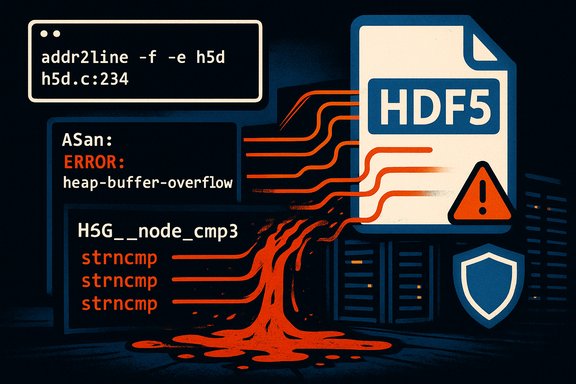
The vulnerable routine, H5G__node_cmp3, is part of HDF5’s group indexing and B‑tree lookup machinery. The publicly filed GitHub issue includes AddressSanitizer output and a clear reproduction sequence: compiling HDF5 with sanitizers, building the OSS‑Fuzz h5_extended_fuzzer harness, and feeding a crafted input triggers a stack overflow originating in a call to strncmp invoked inside H5G__node_cmp3. The sanitizer trace shows the overflow happening at src/H5Gnode.c line ~415 during string comparisons used by the node-compare routine. That reproduction is explicit, reproducible, and included by the reporter in the upstream issue.How the overflow occurs (high-level)
- The routine performs name/node comparisons as part of B‑tree traversal (the H5B_find code path eventually calls H5G__node_cmp3).
- Under crafted inputs, the comparisons run past the bounds that the code expects and end up invoking a library string comparison function (strncmp) on data that overruns a stack buffer.
- The net effect — observed under AddressSanitizer — is a stack overflow that leads to immediate process aborts or undefined behavior; repeated or forced triggering can cause persistent denial‑of‑service for processes that open the malicious file.
Reproducibility and PoC status
The disclosure includes step-by-step build-and-run instructions using Clang/AddressSanitizer and the OSS‑Fuzz harness; maintainers and third‑party trackers have reproduced the crash and linked to crash logs and PoC artifacts. Because a working proof‑of‑concept exists, defenders should treat the vulnerability as practically exploitable for denial‑of‑service, and — depending on runtime and allocation layout — potentially escalatable to memory‑corruption exploitation sequences, although reliable remote code execution is not demonstrated in vendor advisories.Impact and severity: divergent scoring and real‑world risk
Public trackers disagree slightly on numeric severity, but they align on the core facts: local attack vector, public PoC, and availability impact.- NVD’s summary reflects the canonical CVE text and notes public disclosure; the CVE description maps the bug to a stack-based overflow in H5G__node_cmp3.
- Distribution trackers such as Ubuntu and Debian list the CVE with a low/medium operational priority (Ubuntu’s entry lists a CVSS v3 score of 3.3 and labels upstream’s assessment as low priority; Debian’s tracker points to the upstream GitHub issue and notes the CVE’s presence in 1.14.6).
- Commercial scanners and vulnerability aggregators show variation: Tenable highlights higher v3-level scores in some of their derived metrics while Snyk assigns a CVSS v4 summary of 4.8 (Medium) and notes no released fixed version at the time of its entry. This variation is common: scoring differs by assessor and by whether analysts assume exploitability beyond DoS.
Who and what is affected
- Affected upstream: HDF5 1.14.6 is explicitly identified by the CVE. If your software links to that exact release or uses a vendor package based on it, you are potentially in scope.
- Affected consumers: any application, service, or batch pipeline that links to HDF5 and accepts untrusted files (scientific data ingestion services, web-based preview/thumbnail generators, automated converters, HPC job input handlers, desktop tools that open unverified .h5 files).
- Packaging caveats: many Linux distributions and language bindings repackage or backport fixes; at the time of disclosure, some distributor trackers indicated the issue remained unfixed in their trees and recommended evaluation. Check your distribution’s security tracker for the precise package version mapping.
Confirmed facts and cross‑checks
This assessment is grounded in multiple independent sources:- A public, reproducible crash report and issue filed against the HDFGroup/hdf5 repository includes sanitizer output that pinpoints the overflow at H5G__node_cmp3.
- National and distribution trackers (NVD, Ubuntu, Debian) list CVE‑2025‑6857 and describe the same vulnerable function and local attack vector.
- Third‑party aggregators and security services (Tenable, Snyk, VulDB and others) have indexed the CVE and published PoC/impact summaries, corroborating the exploitability and the existence of reproducible crashes. These sources also document divergence in scoring (CVSS v3 vs v4) and in vendor packaging status.
Remediation and mitigation guidance (practical, prioritized)
Immediate priorities are inventory, containment, and applying fixes where available.1. Inventory and exposure mapping (first 24–72 hours)
- Identify all hosts and services that ship or bundle HDF5. Common places to check:
- System packages (apt/dpkg, rpm/yum/dnf); check hdf5 package versions and changelogs.
- Containers and images used in data pipelines — scan images for HDF5 artifacts or languages (Python wheels linking hdf5).
- Applications that statically link HDF5 (some vendor binaries and appliances).
- Flag any publicly accessible ingestion endpoints (uploads, web-based previews, server-side conversion) and prioritize them for mitigation.
2. Temporary containment / compensating controls
- Block or strictly restrict file uploads that include HDF5/.h5 until you can verify or patch the library in the consumer process.
- Sandbox or isolate processes that parse user-supplied HDF5 files. Run them in containers with strict seccomp/AppArmor profiles and memory/time limits.
- For desktop workflows, adopt policies: do not open untrusted .h5 files; quarantine files and scan with defensive engines before processing.
3. Apply patches or rebuild from upstream source
- Check your distribution vendor advisories for a packaged fix. Some trackers indicated the issue was not yet packaged at disclosure time; others will publish backports soon. If an official package is released, deploy it per your patch schedule.
- If no vendor package exists and you have in‑house build capacity, consider rebuilding HDF5 from upstream source at a commit that includes the upstream corrective changes (the GitHub issue shows upstream acknowledgment and closure; track the linked fix/PR in the HDFGroup repository). Rebuilding allows immediate mitigation while you wait for distro updates. Note: rebuilding can produce ABI differences; test carefully in non‑production first.
4. Hardening and runtime mitigations
- Ensure processes parsing files are built (or deployed) with modern exploit mitigations enabled: stack canaries, ASLR, RELRO/PIE, DEP/NX. These do not remove the bug but raise exploitation difficulty for code‑execution privilege escalation.
- Run untrusted parsing in least‑privileged accounts and inside process-isolation primitives (containers, VMs). Limit filesystem and network access for those processes.
5. Detection and monitoring
- Instrument and monitor for crashes, repeated process restarts, or OOMs in file-processing services. The PoC causes immediate crashes under sanitizers; in production you may see worker churn or segfaults.
- Audit logs and EDR telemetry for anomalous process behavior after file ingest events. Correlate with incoming file hashes and sources.
Step‑by‑step remediation checklist (runnable)
- Run “rpm -qa | grep -i hdf5” or “apt list --installed | grep hdf5” to enumerate system packages.
- For containers, use “docker scan/image-inspect” or a supply-chain scanner to flag images that include HDF5 1.14.6 binaries or dev artifacts.
- If a vendor package is available, schedule and deploy the update via your patch management system.
- If no package is available:
- Obtain the upstream commit/PR that resolves the issue from the HDFGroup repo and rebuild HDF5 with your distro’s toolchain.
- Run a quick functional test on a staging node using representative workloads.
- Roll the rebuilt artifact to production with canary scope.
- Enforce file ingestion hardening: sandboxed parser, timeouts, resource limits.
- Re-run the inventory and verify no remaining nodes are using vulnerable artifacts.
Why this matters to Windows users and mixed environments
While much of the immediate discussion has focused on Linux distributions and server-side pipelines, HDF5 is embedded widely enough that Windows desktops, HPC clusters, and cross-platform tools (Python packages, MATLAB HDF5 bindings) can be implicated. Windows users who run tools that link HDF5 (scientific workstations, data-visualization services, or Windows-hosted container runtimes) should treat this as an actionable risk: inventory local installs, avoid opening untrusted .h5 files, and coordinate with vendors for updated builds or guidance. Distribution packaging timelines differ by platform; do not assume a quick vendor update unless explicitly announced.Strengths of the public disclosure — and what to worry about
Notable strengths- The issue was responsibly disclosed with a clear reproduction case and sanitizer trace showing the overflow; the GitHub issue provides enough detail to allow maintainers to triage and testers to validate fixes. That level of transparency speeds remediation.
- Multiple independent trackers (NVD, distro security pages, commercial scanners) recorded and cross‑indexed the CVE quickly, which helps operations teams find the vulnerability in asset inventories and vulnerability management tools.
- Several public summaries and scanners diverge in CVSS scoring for reasonable technical reasons — some assume the possibility of exploitation beyond DoS and score higher, others focus on the local vector and DoS and score lower. The numeric score should not replace an operational exposure analysis.
- At disclosure, not all distros or vendors had released a packaged fix; some commercial advisories noted no fixed version available and suggested rebuilding from upstream commits if urgent. That means many environments will face manual remediation choices (rebuild vs wait for packages).
- Public PoCs reduce the attacker lead time for weaponization. While the immediate, reliable outcome is DoS, attackers with local access or ability to cause file ingestion may be able to use memory‑corruption techniques to pivot under favorable conditions. Treat escalation-to-RCE claims as possible but unproven until reproduced by independent exploit writeups.
Practical recommendations for defenders (clear and prioritized)
- Prioritize servers that automatically process user uploads or provide preview/thumbnail services: these are high‑value targets for DoS and potential exploit attempts.
- If you run shared infrastructure (batch converters, CI runners), assume untrusted files may be processed and add immediate sandboxing and resource limits.
- Where vendor packages are unavailable, coordinate with engineering teams to rebuild HDF5 from the upstream commit that contains the fix; if that is not possible, mitigate by removing HDF5-based processing from public surfaces until patched.
- Update threat and detection playbooks to flag unusual hdf5-related crashes, worker restarts, or logs showing repetitive file parse failures.
- Communicate with third‑party vendors and cloud providers to obtain timelines for updated images and packages; vendors that ship prebuilt toolchains may need time to rebuild and test.
Conclusion
CVE‑2025‑6857 is a concrete, reproducible stack-based buffer overflow in HDF5 1.14.6’s H5G__node_cmp3 routine that manifests as a local‑vector crash with an available proof-of-concept. The disclosure is well-documented and confirmed by multiple independent trackers and a GitHub sanitizer trace, which raises the urgency for environments that parse untrusted HDF5 files. Organizations should inventory HDF5 usage immediately, contain parsing surfaces, and either deploy vendor fixes or rebuild upstream code that incorporates the corrective changes. While the dominant, confirmed impact is denial‑of‑service, defenders must treat public PoCs as a real escalation risk and harden parsers, sandbox file‑processing flows, and monitor for exploitation attempts until all affected artifacts are updated.Source: MSRC Security Update Guide - Microsoft Security Response Center
