

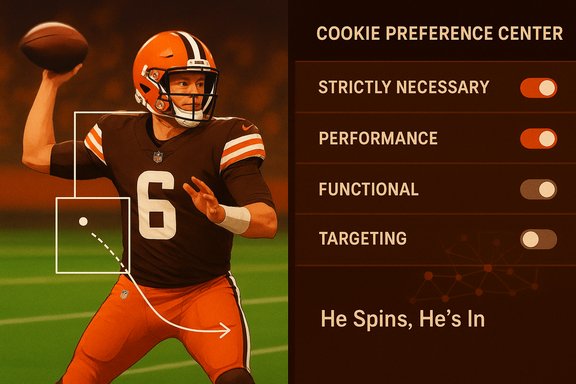
The Browns’ Week 7 “Call of the Game” clip — branded with the giddy caption “He Spins, He’s In!” — does what great highlight packages are supposed to do: it freezes a high-leverage moment, publishes a concise teachable narrative about execution, and packages it inside a modern web player that is funded by ad technologies. The result is two parallel stories worth unpacking: one about football craft (a timing throw that flips the field and a short, decisive run to finish) and another about how sports media delivery, cookies, and tracking pixels shape what fans actually exchange for that free, polished content. The clip teaches coaches and fans alike; the hosting page teaches a separate lesson about consent, tracking, and the tradeoffs of ad-supported publishing.
The highlight’s football thesis is straightforward and repeatable: create a clean protection window, run a stem-and-leverage timing route to induce linebacker hesitation, secure the contested catch, then use a downhill run to finish with low variance. That two-play sequence — field‑flipping throw + controlled run finish — is the clip’s pedagogical core and the reason the highlight functions as both entertainment and micro‑film study. The team’s commentary and the edited replay focus viewers on three teachable elements: protection simplicity, route stem and leverage, and contested‑catch fundamentals.
At the same time, the page hosting the clip makes clear the commercial plumbing under the image: cookie categories, a cookie preference center, and language that tells users they can opt out of certain cookies (including targeting cookies that might be treated as a “sale” or “sharing” under some U.S. rules). That copy is not incidental — it is the visible contract between a fan’s attention and the ad ecosystem that pays for the content.
He spins. He’s in. The play is worth saving to a film folder; the privacy choices are worth saving somewhere you’ll remember to check before you press play.
Source: Cleveland Browns "He Spins, He's In!" Call of the Game - Week 7 vs. Dolphins
 Background: the clip, the context, and the framing
The highlight’s football thesis is straightforward and repeatable: create a clean protection window, run a stem-and-leverage timing route to induce linebacker hesitation, secure the contested catch, then use a downhill run to finish with low variance. That two-play sequence — field‑flipping throw + controlled run finish — is the clip’s pedagogical core and the reason the highlight functions as both entertainment and micro‑film study. The team’s commentary and the edited replay focus viewers on three teachable elements: protection simplicity, route stem and leverage, and contested‑catch fundamentals.At the same time, the page hosting the clip makes clear the commercial plumbing under the image: cookie categories, a cookie preference center, and language that tells users they can opt out of certain cookies (including targeting cookies that might be treated as a “sale” or “sharing” under some U.S. rules). That copy is not incidental — it is the visible contract between a fan’s attention and the ad ecosystem that pays for the content.
Play-by-play: what the clip actually shows and why coaches like it
The anatomy of the two-play sequence
The highlight compresses a sequence many offenses practice for late-game, high-leverage moments:- Protection is simplified to provide a 3–3.5 second timing window for the quarterback.
- The passing concept relies on a stem‑and‑break route that forces linebacker indecision, creating a YAC corridor after a contested reception.
- The receiver locates the catch point under pressure, secures the ball, then turns upfield to convert a medium completion into a field‑flipping gain.
- The follow‑up play is a short, downhill run that exploits widened pursuit angles created by the previous play.
Why protection simplicity matters
Timing concepts are fragile: they require a narrow pocket and predictable rush windows. When protection rules are simplified — slide protections or man‑max principles with an RB chip-and-release, for example — the offense increases the likelihood that the quarterback will have the exact rhythm the route concept demands. The clip’s commentary explicitly calls out that the protection gave the QB the clean look needed to place a sideline dart that minimized catch difficulty and maximized YAC opportunity. This principle appears consistently in independent film-room writeups: protection clarity converts scheme into execution.Route engineering: leverage over speed
The highlight’s schematic lesson is subtle but important: route stems are designed to manipulate defender posture more than to simply outrun them. A receiver who forces a linebacker into a split decision — respect the underneath or honor depth — can create a narrow alley for YAC even without elite separation speed. The clip demonstrates how stem-and-break concepts convert positional leverage into explosive gains when the receiver attacks the catch point with proper hand placement and body control. Film-room analysts repeatedly flag these micro-traits (catch technique, immediate transition to YAC) as coachable and repeatable.The finish: run to seal and reduce variance
Once a timing pass shortens the field, the highest-probability way to score is often a downhill, high‑percentage run that trusts combo blocks and decisive reads from the back. The clip models that script: take the chunk, then finish at the point of attack. Coaches prefer this because it reduces turnover risk, consumes clock, and relies on fundamentals rather than improvisation. Film rooms call this sequencing a “two‑play script” and recommend rehearsing it until it becomes muscle memory.Strengths visible in the highlight
- Repeatable tactical template: It maps directly to practiceable checks — protection rules, route stems, contested-catch technique, and combo-block finishes. When these elements align, coaches can reasonably expect more consistent outcomes.
- Low-variance finishing: Using a designed run to finish after a field‑flipping pass reduces the number of volatile outcomes late in games.
- Clear teaching value: The highlight is an excellent short-form coachable clip that isolates micro‑execution points (line communication, chip work, catch mechanics) that are actionable in practice sessions.
Fragility and risks the highlight masks
- Receiver variance: A single contested catch does not erase a season of inconsistent target handling. Highlight packages isolate success; the larger sample often shows drop variance that can neutralize these plays. Film rooms caution against overfitting to single plays.
- Protection fragility: Timing routes live and die by protection. If pre-snap identification or interior communication breaks down, the same concept shrinks materially in effectiveness. The clip’s success is contingent on those preconditions.
- Turnover dependence: Many close wins are decided by defensive takeaways or special-teams plays. Reliance on turnovers is statistically fragile and often regresses; teams need sustainable offense to avoid fragile win models.
The non-football story: privacy, cookies, and the user experience
The Browns’ highlight page (and similar team video pages) includes a cookie preference center and plain-language categories — Strictly Necessary, Performance, Functional, and optional targeting cookies — that explain what the site collects and how you can opt out. The copy explicitly tells users that turning off targeting cookies will not stop ads but may reduce personalization, and that opt-outs can be managed through the preference interface. This is a standard approach for ad‑supported media and mirrors practices across team and league sites.What the cookie categories mean in practice
- Strictly Necessary: Essential for the site to function (session state, playback controls). These are typically not optional.
- Performance: Metrics and analytics that tell publishers which pages perform best, helping them prioritize content. Turning these off can reduce the publisher’s ability to measure reach.
- Functional: Enhancements like personalization or embedded third‑party services (e.g., chat, enhanced players). Disabling these can degrade playback or site features.
- Targeting/Advertising: Cookies and pixels used by ad tech to build behavioral profiles, serve relevant ads, and enable programmatic bidding. These cookies are the ones often implicated in data-sharing or “sale” language under some privacy laws.
Why it matters to Windows users
On Windows, ad networks and analytics vendors rely heavily on persistent browser profiles and cookie storage. Blocking or pruning cookies changes the signals ad tech receives; it also changes whether your opt‑outs persist across sessions. Practical Windows-focused guidance is increasingly common in film-room writeups that note these tradeoffs and provide step-by-step privacy advice to fans who want to watch without overexposing browsing signals.Practical, game‑day privacy checklist for Windows fans
The clip’s hosting page gives you toggles — but for fans who want stronger control on a Windows PC, here’s a compact checklist that mirrors expert recommendations and the site’s own guidance:- Use the page’s cookie preference center before pressing play: toggle off targeting/advertising cookies and confirm your choice. Keep the tab open long enough for the setting to persist.
- Enable browser-level tracking protections:
- Microsoft Edge: Settings > Cookies and site permissions > Block third‑party cookies; set Tracking prevention to Strict.
- Google Chrome: Settings > Privacy and security > Cookies and other site data > Block third‑party cookies.
Note: blocking third‑party cookies may affect some player functionality. - Consider sending a Global Privacy Control (GPC) signal via a browser extension or built‑in feature where available. Not every site honors GPC yet, but adoption is growing.
- Test playback quality with extensions disabled temporarily. Some privacy extensions block scripts necessary for video players; if playback fails, selectively re-enable the minimum scripts required.
- Use a dedicated browser profile for sports and media sites. Keep a “lean” profile for banking and sensitive accounts. This reduces cross‑site signal correlation.
The ad-tech tradeoff: what you give up and what you keep
Watching team‑produced highlights for free is paid for by ad-supported delivery systems. That means:- Publishers can offer high-quality, editorially rich clips because ad networks underwrite production and hosting costs.
- The same ad systems collect behavioral signals (pages visited, player interactions, ad engagement) that feed programmatic targeting and measurement.
- Turning off targeting cookies reduces profiling but does not stop ads; it typically only makes them less personalized.
Editorial analysis: strengths, disclosure, and where team media does well
Team-produced film-room packages are valuable because they:- Translate playcraft into digestible, coachable moments that fans and analysts can use to evaluate micro‑execution.
- Make technical points accessible: protection windows, route stems, and finish mechanics are shown, not just described.
- Now provide clearer privacy controls on their web pages, which is a step toward more transparent publishing practices.
- Highlights are editorial: they isolate success. Converting micro‑execution into macro‑consistency requires a larger sample and independent verification, which the film-room narratives themselves often acknowledge.
- Cookie preference centers can be confusing or ephemeral — opt-outs can vanish if you clear cookies, change devices, or switch browsers. The copy on team pages commonly flags this shortcoming; users must act intentionally to maintain long‑term settings.
Recommendations for teams, publishers, and fans
For teams and publishers
- Make opt-out choices persistent and cross-device where feasible, or provide clear guidance that opt-outs are profile‑bound and explain how to replicate settings across devices. The current UI model leaves users to discover ephemeral behavior on their own.
- Publish short, plain‑English notes about which features degrade when cookies are off so users can make an informed tradeoff between playback quality and privacy.
For fans and analysts
- Use the highlight as a teaching clip, not definitive proof. Cross-check film-room claims with box score and play‑by‑play data before elevating a single play into a broader narrative.
- Harden your Windows browsing profile on game day with tracking prevention, a separate browser profile, and a close read of the site’s cookie UI. If you must block scripts, pilot-test to confirm the minimum set of scripts that preserve playback.
Final verdict: a useful clip and a timely reminder
“He Spins, He’s In!” is exactly the kind of highlight football people love: a compact demonstration of timing, technique, and situational football that translates directly to coaching practice and fan conversation. The film‑room value is real — protection clarity, route leverage, contested-catch technique, and a low‑variance finish are all visible and teachable. But the clip is also a reminder that great content sits on top of modern ad ecosystems. Team sites now surface cookie preferences and explicitly tell fans they can opt out of certain tracking, but the tradeoffs remain: convenience and free content in exchange for measurement and targeting signals. Fans who want both a clean playback experience and better privacy will need to be proactive — using site toggles, browser tracking protections, and considered browsing habits — to control what they share while still enjoying the highlight packages that make fall Sundays feel electric.He spins. He’s in. The play is worth saving to a film folder; the privacy choices are worth saving somewhere you’ll remember to check before you press play.
Source: Cleveland Browns "He Spins, He's In!" Call of the Game - Week 7 vs. Dolphins
