

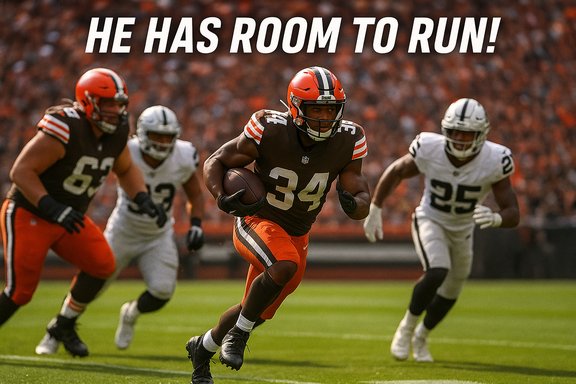
The Cleveland Browns’ “Call of the Game” clip that opens with the booth call “Larvadain — he has room to run!” is more than a brief highlight: it’s a concentrated illustration of how a single special-teams moment can swing field position, influence scoring, and become the narrative hook for a team win — and it also exposes the modern trade-offs between free team media and user privacy.
The Browns beat the Las Vegas Raiders 24–10 in Week 12, a game defined by an overwhelming pass rush and a handful of decisive non-offensive plays that set the tone early. The defensive front produced a staggering ten sacks, while Cleveland’s special teams produced field-flipping returns that directly set up scoring chances. Embedded in the Browns’ short-form media package — the “Call of the Game” highlight reel — is a clip focused on Gage Larvadain’s punt-return work, packaged with the announcer’s breathless line about him having “room to run.” That single moment encapsulates the two-sided story of the game: explosive, game-changing plays that don’t appear on every box score line and the privacy-and-ad-supported web environment that delivers those clips to fans.
For readers focused on the game itself, the Week 12 win was proof that Cleveland’s defensive front can carry a team while special teams flip field position at opportune moments. For those focused on media and privacy, the highlight page’s cookie preference center and ad-supported delivery model are a reminder: free highlights are funded by attention and data, and the modern fan must choose where to draw the line between convenience and control.
Source: Cleveland Browns "Larvadain, He has room to run!" Call of the Game - Week 12 vs. Raiders
 Background / Overview
The Browns beat the Las Vegas Raiders 24–10 in Week 12, a game defined by an overwhelming pass rush and a handful of decisive non-offensive plays that set the tone early. The defensive front produced a staggering ten sacks, while Cleveland’s special teams produced field-flipping returns that directly set up scoring chances. Embedded in the Browns’ short-form media package — the “Call of the Game” highlight reel — is a clip focused on Gage Larvadain’s punt-return work, packaged with the announcer’s breathless line about him having “room to run.” That single moment encapsulates the two-sided story of the game: explosive, game-changing plays that don’t appear on every box score line and the privacy-and-ad-supported web environment that delivers those clips to fans.What happened: the play and the box-score context
The scoreboard and the signature moments
- Final score: Cleveland Browns 24, Las Vegas Raiders 10.
- Team sacks: Cleveland recorded 10 sacks on Geno Smith in the game; Myles Garrett led the way and pushed the franchise single-season sack mark further upward.
- Special teams: Gage Larvadain returned multiple punts for significant yardage, including a 44-yard return that helped set up Cleveland’s first touchdown and a total of four returns for 81 yards on the day. Those returns materially improved Cleveland’s field-position leverage.
Why the return mattered in-game
Special-teams plays are frequently underrated in live narratives because they don’t always produce points directly. In this game, Larvadain’s long return did exactly what special teams are supposed to do: it shortened the field and created a high-leverage scoring opportunity without the offense needing to march 60–80 yards. The Browns cashed that field position in two plays, turning a single non-offensive action into seven points. That kind of leverage is why clubs highlight returns and why film rooms treat them as teachable moments.The player: Gage Larvadain’s arc and role
From undrafted rookie to playmaker
Gage Larvadain’s arrival on the Browns’ active roster was itself a recent development: he signed with Cleveland as an undrafted free agent and was promoted from the practice squad to the active roster late in September. The roster move established his role as a special-teams contributor first, with occasional offensive snaps as needed. The team’s own announcements and sports media coverage confirm the timeline and roster status. What the Week 12 clip shows is exactly how undrafted rookie contributors earn their stripes: by creating a single high-value play and forcing coaches to trust them with more opportunities. Larvadain’s return metrics for the game — multiple returns and a long of 44 yards — are the sort of stat line that makes managers take notice.How coaches use these moments
Coaching staffs watch clips like the “Larvadain” highlight for very specific lessons:- Execution of blocking lanes and micro-angles on the return team.
- The returner’s decisiveness in choosing lanes and breaking contact.
- Situational deployment: when to call for a directional or fair-catch approach versus letting a returner attempt a breakaway.
The highlight as editorial product — strengths and caveats
What the clip does well
- Emotional clarity: The commentary line “He has room to run!” is a perfect micro-story hook — it communicates momentum in three words.
- Coaching value: The clip isolates the elements of a successful return: blocking, lane selection, and finishing. That makes it useful for teaching both technique and situational decision-making.
What the clip can mislead viewers about
- Small-sample risk: A single return doesn’t prove season-long efficiency. Highlights are inherently curated, and teams select moments that maximize emotion. Analysts warn against extrapolating a player’s long-term value from a single clip without a larger sample of snaps and context.
- Caption and yardage variance: Team media captions sometimes vary from the official gamebook; always cross-check yards and attribution against the official play-by-play and league box score for accuracy. The team clip might say “44 yards” in the video overlay while a play-by-play could list slightly different placement after penalties or spot adjustments. Treat highlight yardage as editorial shorthand until verified.
Privacy, cookies, and the fan experience: the hidden cost of highlights
The disclosure you saw on the video page
Team video pages — including the Browns’ highlight pages — commonly present a cookie preference center that breaks tracking into buckets (e.g., Strictly Necessary, Performance, Functional, Targeting). The site invites users to opt out of optional cookies, but warns that disabling targeting cookies can make ads less relevant while still leaving ads visible. That exact cookie UI language is part of the highlight page packaging fans encounter when pressing play.What that means in practice
- Free, high-quality content comes with ad infrastructure. Team videos are funded by ad networks and measurement pixels that collect engagement data to make the content economically viable.
- Opting out reduces personalization but does not always stop all data flows. Site-level toggles are a helpful privacy tool, but third-party scripts and network-level trackers can continue to exchange signals unless you take additional steps.
Practical, Windows-focused privacy steps for fans
- Use a modern browser with built-in tracking prevention (Microsoft Edge or Firefox recommended).
- Open the page in a private session (InPrivate in Edge, Private Window in Firefox) before accepting cookie toggles for one-off viewing.
- Toggle off optional cookie categories in the site’s cookie preference center (Performance, Functional, Targeting) if you prioritize privacy.
- Consider privacy extensions such as uBlock Origin or Privacy Badger — but test playback quality first, as aggressive blocking can sometimes break video players.
- If you need the official facts (stats, play-by-play), verify with league or team recaps rather than relying on in-video overlays alone.
Tactical analysis: how the Browns used non-offensive plays to win
Defense set the tone
Cleveland’s ten-sack performance in Week 12 was the engine of this win. Pressure rate and consistent rush lanes forced errors and repeatedly put the Raiders into negative scripts. Myles Garrett’s multi-sack outing and the interior pressure that freed him up were textbook examples of coordinated front-seven design. Those pressures created the field-position and turnover margins the Browns needed.Special teams and opportunistic scoring
Larvadain’s returns were not incidental; they were catalytic. The 44-yard return that set up a short touchdown drive removed the need for Cleveland’s offense to manufacture long, time-consuming drives while the defense continued to apply pressure. In tightly contested games, this kind of synergy — defense getting stops, special teams flipping the field, offense finishing in one or two plays — is often the difference between a win and a loss.Offense: flashes versus sustainability
While the Browns produced big plays (including a 66-yard score later in the game), the offense still left room for improvement in sustained drives and third-down conversions. The team’s reliance on chunk plays and short-field chances means coaches will need to adapt the play-calling balance if they want consistent offensive efficiency going forward. That’s an organizational planning problem as much as a schematic one.What this clip tells us about roster construction and coaching choices
- Value of specialists: Undrafted or practice-squad players like Larvadain can add immediate, measurable value in special teams. A single reliable returner is cheaper and often more impactful than a marginal offensive pickup.
- Workload management on the edge: When a team leans on elite pass-rushers to create wins, it must balance snap counts and rotation to avoid late-season wear-and-tear. The film-room success of Week 12 underscores the need for depth and medical prudence.
- Recruiting for three phases: Success in the NFL increasingly demands talent and coaching across defense, offense, and special teams. Highlight clips show how the thirds interact — a point front offices should account for in roster valuation.
How to watch and verify highlights responsibly (a short playbook)
- Watch the highlight for what it is: a compressed, editorialized moment designed to show a high-leverage event.
- Cross-reference the play with the official play-by-play or box score before quoting yardage or claiming season-changing impact. Use at least two independent recap sources for verification.
- If privacy matters, adjust cookies and use privacy-focused browser modes or extensions. Test playback after toggles to ensure the viewer experience remains acceptable.
Strengths, risks, and what to watch next
Strengths (what the clip and game prove)
- High-impact special teams play: Larvadain’s return turned field position into immediate scoring, a textbook special-teams win.
- Elite pass rush: A 10-sack team effort is a sustainable lever for short-term wins if managed correctly.
- Narrative value: Short-form clips do exactly what they’re supposed to do — supply instant emotional resonance for fans and a coaching checklist for staff.
Risks (what the clip does not prove)
- Not a substitute for offensive stability: One return and a handful of explosive plays do not replace the need for consistent first-down production and third-down conversions. The box score shows the offense still had limited sustained drives.
- Privacy trade-offs: Fans who consume lots of team video content without adjusting cookie settings contribute data that fuels targeted ads and measurement ecosystems. The convenience of free content is not costless.
- Highlight sampling bias: Teams will show moments that cast performance in the best light; without cross-verification, highlight-based narratives can mislead even experienced observers.
Conclusion
The “Larvadain — he has room to run!” clip is an archetype of modern sports media: immediate, shareable, and emotionally exact. It highlights a rookie special-teamer delivering a game-altering play and offers coaches and fans a focused moment to dissect. But the clip also illustrates two connected truths: first, that single plays — even when they produce points — must be weighed inside a larger sample before altering strategic conclusions; and second, that consuming those moments comes with privacy trade-offs that fans should actively manage if they care about telemetry and tracking.For readers focused on the game itself, the Week 12 win was proof that Cleveland’s defensive front can carry a team while special teams flip field position at opportune moments. For those focused on media and privacy, the highlight page’s cookie preference center and ad-supported delivery model are a reminder: free highlights are funded by attention and data, and the modern fan must choose where to draw the line between convenience and control.
Source: Cleveland Browns "Larvadain, He has room to run!" Call of the Game - Week 12 vs. Raiders
