

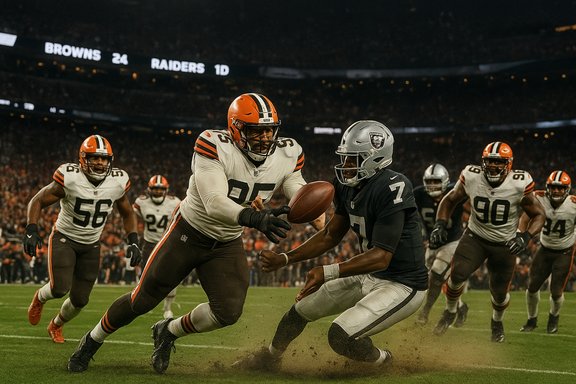
The strip-sack by Myles Garrett that punctuated the Cleveland Browns’ Week 12 win over the Las Vegas Raiders was more than a single highlight clip — it was the clearest encapsulation of a game in which Cleveland’s defensive identity dominated, rewrote a franchise record book, and reshaped the narrative around a rookie quarterback’s first NFL start.
The Browns traveled to Allegiant Stadium for their Week 12 matchup and left with a 24–10 victory that was decided on the back of an all-out pass-rush clinic. Rookie quarterback Shedeur Sanders made his first regular-season start, completing 11 of 20 passes for 209 yards and delivering a 66-yard touchdown on a screen to Dylan Sampson. Meanwhile, Cleveland’s defensive front recorded an eye-catching 10 sacks on Raiders quarterback Geno Smith, with Myles Garrett credited with three sacks in the game and surpassing the franchise single-season sack mark to sit at 18 sacks on the year. The result snapped a losing run for the Browns and marked a particularly bruising outing for Las Vegas’ offense.
This piece breaks down the play, situates Garrett’s performance in historical context, evaluates strategic and personnel takeaways from the game, and highlights potential short- and long-term risks for both teams.
The play combined three critical elements:
Comparative context:
Strengths shown:
Key observations:
Diagnosing the issues:
Other risks:
A few points of reference:
Myles Garrett’s Week 12 performance provided a renewed sense of possibility — both for record-setting individual achievements and for a Browns unit that can still dictate the tempo of games. Yet for the team to translate flashes into sustained success, the coaching staff and front office must pair defensive excellence with offensive planning that prioritizes consistency, protects developing quarterbacks, and manages the health of their most impactful players.
The Week 12 victory will be revisited not only as a highlight reel moment but also as a strategic inflection point: it confirmed that Cleveland’s defense can carry the team on any given Sunday, but it also clarified the work remaining to build a balanced roster that can win week after week.
Source: Cleveland Browns "Strip Sack! Myles Garrett!" Call of the Game - Week 12 vs. Raiders
 Background / Overview
The Browns traveled to Allegiant Stadium for their Week 12 matchup and left with a 24–10 victory that was decided on the back of an all-out pass-rush clinic. Rookie quarterback Shedeur Sanders made his first regular-season start, completing 11 of 20 passes for 209 yards and delivering a 66-yard touchdown on a screen to Dylan Sampson. Meanwhile, Cleveland’s defensive front recorded an eye-catching 10 sacks on Raiders quarterback Geno Smith, with Myles Garrett credited with three sacks in the game and surpassing the franchise single-season sack mark to sit at 18 sacks on the year. The result snapped a losing run for the Browns and marked a particularly bruising outing for Las Vegas’ offense.This piece breaks down the play, situates Garrett’s performance in historical context, evaluates strategic and personnel takeaways from the game, and highlights potential short- and long-term risks for both teams.
The Play: “Strip Sack! Myles Garrett!”
What happened on the field
On the defining sequence late in the first half — the highlight clipped and replayed in stadiums and social feeds as “Strip Sack! Myles Garrett!” — Garrett beat his one-on-one assignment, reached Geno Smith, and executed a textbook strip that delivered a sudden change-of-possessions moment. The forced fumble was recovered by Cleveland, flipped field position, and helped throttle the Raiders’ momentum.The play combined three critical elements:
- Initial alignment and leverage: Garrett’s alignment and quick first step created an inside angle that prevented Smith from stepping up.
- Hand placement and technique: Rather than merely wrapping up for a sack, Garrett targeted the football — a deliberate technique that maximizes turnover potential.
- Situational timing: Occurring just before halftime, the forced turnover compressed the Raiders’ comeback window and gave the Browns both scoreboard and psychological advantage.
Tactical reading
This was not an isolated demonstration of power; it was the result of a coordinated scheme. The Browns mixed stunts and inside pressure from their interior defensive line — a pattern that repeatedly forced Geno Smith to hesitate or reset his footwork, making him vulnerable to edge penetrators like Garrett. The strip itself was the payoff of consistent pressure throughout the drive: when a passer’s pocket collapses repeatedly, the difference between a sack and a forced fumble often comes down to technique and intent — both were on display.By the numbers: What the box score really tells us
- Final score: Cleveland Browns 24, Las Vegas Raiders 10.
- 10 sacks on Geno Smith — a staggering team total in any era.
- Myles Garrett: 3 sacks, 2 forced fumbles (game total included multiple pressures and tackles for loss), and—critically—the Browns’ single-season sack record pushed to 18 for Garrett.
- Shedeur Sanders: 11-of-20, 209 passing yards, 1 TD (66-yard screen to Dylan Sampson) and 1 INT.
- Quinshon Judkins: Two rushing TDs coming out of wildcat packages.
- Andre Szmyt: a 53-yard field goal that extended Cleveland’s lead.
- Geno Smith finished with 285 passing yards and a late touchdown drive that reduced the final margin.
Context: Garrett’s season and franchise history
Myles Garrett’s performance in Week 12 was more than a single-game triumph — it represented a sustained climb toward elite, record-level production. With 18 sacks through 11 games, Garrett pushed past the franchise single-season mark and sits among the league’s most productive pass-rushers for the year.Comparative context:
- Garrett’s pace places him on track with some of the best single-season pass-rush campaigns in modern NFL history.
- The official NFL single-season sack record sits at 22.5 sacks, a mark tied in recent history and the benchmark for anyone chasing seasonal dominance.
- Garrett’s recent five-game surge has produced double-digit sack numbers across that stretch, underscoring both peak performance and durability concerns that every frontline defender faces when carrying a heavy snap and pass-rush load.
Defensive schematics: Why Cleveland dominated the pocket
Front-seven synergy
Cleveland’s pass-rush did not rely on Garrett alone. The game showcased a unit-level approach in which multiple defenders contributed pressures and sacks. The Browns mixed:- Stunts and twists to create interior disruption that funneled quarterbacks into Garrett’s lane.
- Controlled edge setting by outside linebackers and tackles, forcing Geno Smith’s eyes to move and reducing platform time.
- Quarterback spy responsibilities when necessary, limiting scramble lanes while still committing to aggressive rush concepts.
Play-calling and coordinator influence
The Browns’ defensive coordinator dialed up pressure packages that leveraged both pure speed and disguised zone rushes. Several pressures came from delayed blitzes, showing patience and timing that exploited the Raiders’ protection calls. The usage of stunts up front forced Geno Smith to process multiple rush windows, and Cleveland’s pass-rush metrics — pressures, quarterback hits, and hurry-to-sack conversions — reflected a coherent plan executed at a high level.Shedeur Sanders’ debut: Immediate gains vs. lingering questions
Shedeur Sanders’ first regular-season start carried a substantial amount of narrative weight. He delivered a performance with big-play flashes and the situational savvy of a prepared rookie.Strengths shown:
- Explosive playmaking: The 66-yard screen-to-TD was a perfectly timed play that capitalized on defender pursuit angles and excellent blocking by the personnel group.
- Composure under pressure: Facing an aggressive Raiders pass rush, Sanders showed the ability to extend plays and make on-field adjustments.
- Upside: Sanders’ arm strength and vision were evident on pocket escapes and long throws.
- Completion percentage and decision-making: 11-of-20 passing indicates intermittent accuracy and instances of conservative play-calling or indecision under duress.
- Turnover tendencies: The interception and situational reads that forced incompletions are reminders that rookie QBs face a steep learning curve.
- Offensive support: The Browns’ offense produced only a modest number of first downs; reliance on special teams and defensive takeaways was heavy. Long-term quarterback success requires a steadier flow of drives and play diversity.
Offensive identity: explosive plays hide underlying issues
Cleveland’s scoreboard-friendly moments — a long screen touchdown, two wildcat rushing TDs, and a long field goal — painted a picture of opportunistic offense. But an 11-first-down, eight-punt game plan suggests a unit still fragile when opponents take away the quick-strike options.Key observations:
- The offense leaned on creative schematic wrinkles (wildcat snaps, designed screens) to manufacture scoring opportunities.
- The offensive line pass protection held up better than expected versus Geno Smith’s pressure-producing rush, but created few sustained drives outside of chunk plays.
- Wide receiver production was limited beyond the breakout play, indicating that consistent separation and route-concept execution remain work in progress.
Raiders’ collapse: protection, execution, and schematic mismatches
Las Vegas’ offensive line imploded under repeated pressure. The ten-sack figure is not an isolated breakdown; it is a symptom of schematic mismatches, gap-control failures, and inconsistent in-game adjustments.Diagnosing the issues:
- Pass protection breakdowns: Communication and slide protection were inconsistent, leaving interior gaps that invited stunts and rip-throughs.
- Play-calling predictability: Scripted plays that failed to manipulate Cleveland’s alignment allowed defenders to play with confidence and commit to rush lanes.
- In-game adjustments: The Raiders struggled to chip or roll protection in ways that would mitigate one-on-one edge mismatches against Garrett and company.
Coaching and personnel implications
For Cleveland
- Defensive validation: The defensive coordinator’s approach gained immediate credibility; scheme design and execution created repeated advantages. That success suggests Cleveland can reliably leverage its front-seven strengths to win low-variance games.
- Offensive coaching task: The staff must determine whether to keep the creative packages that produced quick scores or to lean into longer-developing, high-percentage constructs that aid rookie QB development.
- Roster rotations: Depth across the defensive line paid dividends; preserving personnel health while keeping pressure levels high is now a central management task.
For Las Vegas
- Offensive overhaul pressure: The coaching staff will need to adjust protection schemes, implement quicker release options, and possibly alter blocking assignments to protect Geno Smith.
- Front office assessment: If pass protection remains a recurring liability, personnel upgrades in free agency or the trade market will become priorities.
Health, sustainability, and risk factors
High-level pass-rush volume has a cost: wear-and-tear. For Garrett and his fellow front-liners, the near-constant high-effort plays raise questions about long-term durability across the season. Even as sacks pile up, teams must manage snap counts and recovery to avoid late-season declines.Other risks:
- Quarterback health: Repeated hits and strip attempts increase the risk that a future opponent will capitalize on a forced injury.
- Offensive stagnation: If the offense continues to rely heavily on defense and special teams, the team’s ability to close out games against stronger opponents will be limited.
- Record-chasing narrative: While individual milestones (franchise and league records) animate headlines, they can alter usage patterns and invite opponents to gameplan specifically to neutralize a pass rusher — opponents may run more or prioritize quick-passing schemes to reduce Garrett’s opportunities.
Historical perspective: where Garrett sits among great seasons
Garrett’s current pace places him within conversation for an elite single-season pass-rush campaign. Historically, climactic sack seasons have required a convergence of individual skill, favorable schematic use, and consistent matchups.A few points of reference:
- Exceptional seasons are rare and often accompanied by strong interior pressure that allows edge rushers to thrive.
- A player’s health across the final third of the season is critical — late-season performance often determines whether records fall.
- Defensive scheming and opponent game-planning can materially affect opportunities; savvy offensive play-callers will prioritize quick throws and double teams to blunt a pass rusher.
What this means for the Browns’ season outlook
A performance like Week 12’s offers both a path forward and a reality check.- Short term: the Browns can win through defense and timely offense. The defensive line is a legitimate top-tier unit capable of swinging game outcomes.
- Medium term: sustained success requires offensive stabilization. Rookie QB development must be matched by consistent play-calling that reduces turnover risk and increases third-down conversions.
- Long term: roster construction should prioritize offensive line depth and receiving upgrades to ensure Garrett’s pass-rush production can be complemented by a complementary offensive identity.
Takeaways: strengths, weaknesses, and watch-points
- Strengths
- Dominant pass rush capable of producing turnovers and flipping field position.
- Big-play explosive potential on offense that can close drives quickly.
- Depth on the defensive line, which allowed multiple players to register sacks.
- Weaknesses
- Offensive inconsistency beyond explosive plays; low first-down production and heavy punting indicate a fragility in sustaining drives.
- Potential over-reliance on defense and special teams to provide scoring opportunities.
- Durability concerns for high-usage defensive assets if snap counts and recovery are not managed.
- Watch-points
- How Cleveland evolves its offensive game plan to support rookie QB development.
- Whether the pass-rush can remain as prolific once opponents game-plan specifically to avoid Garrett’s lane.
- Health and snap management for the defensive front as the season moves into its final stretch.
Closing analysis
The “Strip Sack! Myles Garrett!” highlight was emblematic of a game where Cleveland’s defense imposed its will repeatedly and decisively. It was also a microcosm of a franchise at a crossroads: elite defensive flashes are easily visible, while offensive coherence and quarterback stability remain works in progress.Myles Garrett’s Week 12 performance provided a renewed sense of possibility — both for record-setting individual achievements and for a Browns unit that can still dictate the tempo of games. Yet for the team to translate flashes into sustained success, the coaching staff and front office must pair defensive excellence with offensive planning that prioritizes consistency, protects developing quarterbacks, and manages the health of their most impactful players.
The Week 12 victory will be revisited not only as a highlight reel moment but also as a strategic inflection point: it confirmed that Cleveland’s defense can carry the team on any given Sunday, but it also clarified the work remaining to build a balanced roster that can win week after week.
Source: Cleveland Browns "Strip Sack! Myles Garrett!" Call of the Game - Week 12 vs. Raiders
