

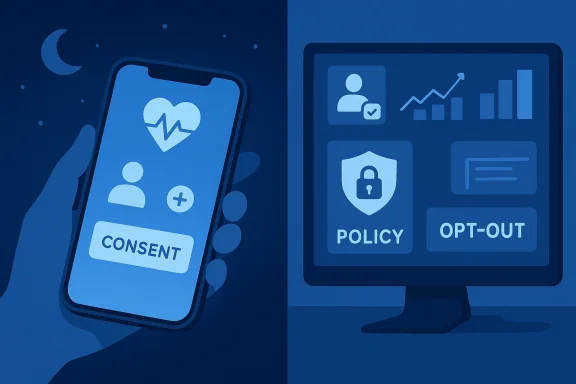
Health questions are among the fastest‑growing and most intimate prompts people now take to AI assistants — and Microsoft’s own Copilot data shows a striking split: when users reach for answers on their phones, they’re far more likely to ask urgent, emotionally sensitive, and personally specific health questions than when they use a desktop.
People have been turning to chatbots for health guidance for years, but 2026 has shifted the conversation from curiosity to practical reliance. In January, OpenAI launched a dedicated ChatGPT Health product that lets users connect medical records and fitness apps to a private health workspace, signaling an industry move toward richer, personalized health experiences in consumer AI.
Microsoft’s internal analysis — shared first with Axios — examined more than 500,000 Copilot conversations flagged as health‑ or well‑being‑related from January 2026. The pattern was clear: mobile prompts skew toward immediate symptom interpretation and family caregiving scenarios, while desktop queries tend to be broader research or reference requests. Those differences matter for privacy, safety, and product design.
At the same time, Microsoft has been grappling with hard lessons about data governance in production: a high‑profile bug in Microsoft 365 Copilot allowed the assistant to process and summarize emails that had been labeled confidential, bypassing data loss prevention controls. That incident — detected internally in late January and patched in early February — underlines how the promise of helpful, context‑aware assistants collides with technical complexity and compliance obligations.
Why does this happen? Phones are with us all the time. A sudden fever, an anxious midnight panic about chest tightening, or an urgent question while caring for a small child naturally push people to the fastest available tool. The mobile UI and conversational voice assistants reduce friction: users can ask aloud or tap a quick question and get an immediate, readable answer. That convenience shapes behavior — and risk.
Microsoft’s privacy FAQ is explicit about the controls:
That event matters for consumer‑facing health uses as well. If an enterprise assistant can bypass sensitive‑data protections, consumer health conversations — often captured in logs and processed for product improvement unless excluded — could be exposed by coding errors, misconfiguration, or surprising interactions between services. The incident also showed that fixes can be deployed, but questions remain about retrospective exposure windows and auditability.
The path forward requires both technological rigor and humane product design. If AI vendors and organizations take the Copilot lessons seriously — hardening enforcement, simplifying privacy controls, and designing for the very real emotional moments that spur mobile health queries — these assistants can become safer companions. If they do not, a string of avoidable incidents will erode trust and invite heavy‑handed regulation, making it harder for the technology to deliver its promised benefits.
The immediate, practical advice is simple: assume your health prompts may be stored or processed, use privacy controls proactively, avoid sharing third‑party medical records in chat, and for organizations, verify DLP and sensitivity label enforcement across every client and service. The tools are evolving; governance, testing, and honest communication must evolve faster.
Source: Axios Exclusive: People turn to phones for more personal health questions on Copilot
 Background
People have been turning to chatbots for health guidance for years, but 2026 has shifted the conversation from curiosity to practical reliance. In January, OpenAI launched a dedicated ChatGPT Health product that lets users connect medical records and fitness apps to a private health workspace, signaling an industry move toward richer, personalized health experiences in consumer AI.Microsoft’s internal analysis — shared first with Axios — examined more than 500,000 Copilot conversations flagged as health‑ or well‑being‑related from January 2026. The pattern was clear: mobile prompts skew toward immediate symptom interpretation and family caregiving scenarios, while desktop queries tend to be broader research or reference requests. Those differences matter for privacy, safety, and product design.
At the same time, Microsoft has been grappling with hard lessons about data governance in production: a high‑profile bug in Microsoft 365 Copilot allowed the assistant to process and summarize emails that had been labeled confidential, bypassing data loss prevention controls. That incident — detected internally in late January and patched in early February — underlines how the promise of helpful, context‑aware assistants collides with technical complexity and compliance obligations.
Why device matters: phones, privacy, and prompt intent
Mobile prompts are more personal, immediate, and emotional
Microsoft’s snapshot shows that mobile users are disproportionately likely to ask about symptoms affecting themselves or someone close to them. Around 11% of health‑tagged conversations were highly specific symptom‑interpretation questions, and roughly 1 in 7 symptom/condition management conversations were made on behalf of someone else — often a child, aging parent, or partner. These are not abstract queries; they’re situational, time‑sensitive, and emotionally charged.Why does this happen? Phones are with us all the time. A sudden fever, an anxious midnight panic about chest tightening, or an urgent question while caring for a small child naturally push people to the fastest available tool. The mobile UI and conversational voice assistants reduce friction: users can ask aloud or tap a quick question and get an immediate, readable answer. That convenience shapes behavior — and risk.
Desktop queries trend toward research and planning
By contrast, desktop interactions with Copilot skewed toward broader condition, treatment, and system navigation questions. Desktop prompts often reflect a different use case: deliberate research, planning for appointments, or working through insurance and administrative issues where users can copy detailed documents or read longer responses more comfortably. The device context changes the expectation of depth and permanence in the exchange.The caregiving factor: not all data is about you
One sobering finding in Microsoft’s analysis is that a significant share of health prompts involve third parties. When family caregivers ask about a child’s symptoms or an elderly parent’s medication schedule, they are voluntarily sharing other people’s health data into services that may not be legally or technically prepared to protect it. That raises both ethical and legal questions — caregivers may not realize that by entering another person’s details they are exposing a different individual’s sensitive information to a platform’s data practices.What Microsoft says it can and cannot do with health signals
Microsoft’s public documentation frames Copilot as a privacy‑aware assistant: personalization settings can be turned off, there are opt‑outs for model training under certain conditions, and the company states that Copilot is designed not to personalize interactions based on sensitive categories, including health status. That said, Microsoft also explains that conversation data may be used for model training for many categories of users unless they opt out. The nuance is critical: aggregated research and product feature work can happen using de‑identified or opt‑out‑excluded data while still respecting direct personalization constraints. (support.microsoft.com)Microsoft’s privacy FAQ is explicit about the controls:
- Personalization is available for signed‑in users and can be disabled in Copilot settings.
- Conversation content is excluded from model training for many enterprise and protected user groups, and for users who opt out.
- The company removes identifiable fields from content used for training and applies filters to sensitive categories. (support.microsoft.com)
The hard lesson: production bugs and the limits of controls
Confidential email bug: a wake‑up call about enforcement gaps
In February 2026, Microsoft confirmed a code error in Microsoft 365 Copilot that caused the assistant to summarize email contents labeled as confidential, circumventing DLP and sensitivity labels that organizations had explicitly configured. The bug was tracked internally as CW1226324, first observed in late January, and Microsoft rolled out a server‑side fix in early February. Security and compliance teams described this as a clear example of why AI governance controls must be independent from a single AI pipeline.That event matters for consumer‑facing health uses as well. If an enterprise assistant can bypass sensitive‑data protections, consumer health conversations — often captured in logs and processed for product improvement unless excluded — could be exposed by coding errors, misconfiguration, or surprising interactions between services. The incident also showed that fixes can be deployed, but questions remain about retrospective exposure windows and auditability.
Exploits and research disclosures: additional threat vectors
Beyond misapplied policies, security researchers have documented exploits (for example, the "Reprompt" exploit described by Varonis Threat Labs) that could extract data from Copilot contexts if left unpatched. Although vendors patch known vulnerabilities, the scale and novelty of generative AI surfaces create many new attack paths for data exfiltration and privilege escalation. Organizations must treat AI services as first‑class security targets.Legal and regulatory contours: HIPAA, consumer data, and the gaps
HIPAA does not automatically cover consumer AI chats
Health data transmitted to your insurer or doctor via covered channels is typically protected under HIPAA. But the law does not extend to consumer‑facing AI chats where users voluntarily paste or narrate symptoms and records. That legal gap means sensitive medical information shared with Copilot or ChatGPT may not receive the same safeguards it would within an electronic health record system. OpenAI’s ChatGPT Health and Microsoft’s healthcare integrations are trying to bridge that gap, but consumer behavior is racing ahead of regulatory clarity.Enterprise and healthcare customers have tools — but they’re complex
Microsoft offers enterprise controls, tenant boundaries, sensitivity labels, and integration paths that can make Copilot safer for regulated health workflows — including availability under certain Business Associate Agreements for specialized Copilot offerings. But implementing those protections requires substantial configuration, testing, and continuous verification across clients and cloud services. Hospitals and large health systems that choose Copilot for internal workflows must treat deployment as a major compliance project, not a drop‑in feature.International patchwork and policy risk
Privacy and AI rules are evolving globally; limitations on model training, data residency requirements, and consumer protection laws vary by jurisdiction. Vendors have begun to restrict personalization or model training in certain countries, and national regulators are scrutinizing product behavior. For organizations operating across borders, a conservative, policy‑driven approach is now essential. (support.microsoft.com)Product and design implications for AI health assistants
Design for context — not only accuracy
The device differences Microsoft observed imply product teams should design distinct experiences per context:- On mobile, prioritize safe triage, immediate harm‑avoidance prompts, and clear "do not use as a substitute" disclaimers.
- On desktop, permit deeper research, citations, and workflows that facilitate clinician consultations and documentation exports.
Transparency and consent must be explicit and persistent
Short, one‑time popups are not enough. Users must have accessible, clear settings to control personalization, model training opt‑outs, and data deletion, and the product must make the consequences of those choices understandable (for example, what opting out of training does and does not prevent). Microsoft offers these controls, but uptake depends on education and UI clarity. (support.microsoft.com)Logging, audit trails, and forensic readiness
Enterprises and consumer platforms alike must maintain rigorous audit trails for AI processing: which conversations were routed into model training, which flows touched sensitive metadata, and what remedial actions were taken after incidents. The Copilot email bug showed that being able to answer those questions quickly is essential for risk management and regulatory response.Concrete mitigation: what users and organizations should do now
For everyday users
- Turn off personalization in Copilot if you are uncomfortable with the assistant remembering details. Check Copilot settings in the mobile app or web UI. (support.microsoft.com)
- Opt out of model training where available if you don’t want your conversations used to improve models. Note that opt‑outs may not delete existing logs. (support.microsoft.com)
- Avoid pasting or uploading full medical records, billing statements, or identifying photos into chat interfaces unless you understand the service’s retention and training policies. (support.microsoft.com)
- Use AI for preparation and navigation (e.g., what to ask your doctor, how to read a lab report), but rely on clinicians for diagnosis and treatment decisions.
For IT and security teams
- Treat AI features as high‑risk services: include Copilot in threat modeling, DLP rule testing, and red‑team exercises. The confidential‑email bug shows DLP can fail not just from misconfiguration but from server‑side logic errors.
- Validate sensitivity label enforcement end‑to‑end across clients (desktop, web, mobile). Run routine tests to confirm that protected content is not processed by AI layers.
- Limit integration of consumer AI features into clinical workflows unless they are covered by appropriate agreements and technical controls (e.g., BAA, tenant isolation, Purview configuration).
For product teams and vendors
- Build and test policy enforcement layers that operate independently of model pipelines. Safeguards attached only to a single application layer are fragile.
- Use explicit consent and persistent settings for sensitive categories. Avoid burying crucial privacy behaviors behind complex menus.
- Publish transparency reports and incident disclosures that clearly state the scope, timeline, and remediation steps of any exposure involving sensitive data.
The market and public policy implications
Consumers are voting with prompts
The surge in health prompts to AI assistants is a market signal: people want immediate, accessible help for health navigation, symptom interpretation, and caregiving. That demand will drive product investment and competition: OpenAI’s ChatGPT Health, Microsoft’s Copilot explorations, and related industry moves show firms are racing to own that user relationship.Regulators will have to make hard choices
Policy makers face a dual challenge: protect individuals’ sensitive health data and allow innovation that could expand access to health information. Regulators may require:- Clear labeling and limits on medical advice from consumer AI.
- Minimum standards for data handling, retention, and deletion for health‑tagged conversations.
- Certification paths or BAA‑type frameworks for AI products used in clinical contexts.
The liability question remains unsettled
Who is responsible when an AI assistant gives poor or harmful health guidance? Vendors, platform integrators, clinicians, and users all share some responsibility. Legal standards will evolve through litigation and regulation, but for now firms must design defensively and document safeguards thoroughly.Strengths, weaknesses, and the middle way
Notable strengths
- AI assistants can increase access to health information outside clinic hours and provide practical navigation help — a real public‑interest benefit. Microsoft’s analysis underscores that people often turn to assistants when clinicians aren’t available, and that quick, evidence‑backed guidance can reduce anxiety and help triage nonurgent issues.
- Enterprise controls and product opt‑outs exist. Tools such as personalized settings, model‑training opt‑outs, Purview controls, and BAAs for specialized products give organizations pathways to safe deployment if they commit resources. (support.microsoft.com)
Key risks and weaknesses
- Functional gaps and bugs can and do occur. The Copilot confidential‑email incident shows that even mature enterprise controls can be bypassed by server‑side logic errors. That fragility is dangerous when dealing with health data.
- Consumer chats are often outside HIPAA and regulatory safe harbors. Users and caregivers may inadvertently expose other people’s sensitive data without realizing the legal or ethical implications.
- Security exposure surface is large and evolving. Novel exploit techniques targeting AI contexts — and the sheer volume of sensitive prompts — mean defenders must treat AI as critical infrastructure.
A practical middle way
The balance is not binary. Organizations and vendors should:- Prioritize core safety engineering: independent policy enforcement layers, rigorous testing, and end‑to‑end verification.
- Design conservative defaults: minimize data collection, require explicit consent for sharing third‑party health details, and make opt‑outs prominent.
- Commit to transparent incident reporting: fast, clear disclosure and remediation reduce risk and build trust.
Conclusion: a crossroads for AI in health
Microsoft’s Copilot data — and industry moves like OpenAI’s ChatGPT Health — make one thing clear: consumers are increasingly comfortable asking AI about health, and they do so most intimately on the devices they carry in their pockets. That behavioral shift creates enormous potential: better access to information, faster triage, and practical support for caregivers. It also creates urgent responsibilities: vendors must engineer robust, independent safeguards; organizations must treat AI as a primary risk vector; regulators must fill legal gaps for consumer health data; and users must be better informed about what they share.The path forward requires both technological rigor and humane product design. If AI vendors and organizations take the Copilot lessons seriously — hardening enforcement, simplifying privacy controls, and designing for the very real emotional moments that spur mobile health queries — these assistants can become safer companions. If they do not, a string of avoidable incidents will erode trust and invite heavy‑handed regulation, making it harder for the technology to deliver its promised benefits.
The immediate, practical advice is simple: assume your health prompts may be stored or processed, use privacy controls proactively, avoid sharing third‑party medical records in chat, and for organizations, verify DLP and sensitivity label enforcement across every client and service. The tools are evolving; governance, testing, and honest communication must evolve faster.
Source: Axios Exclusive: People turn to phones for more personal health questions on Copilot
