

Hertz’s early experiments with Microsoft Power Platform show how a global mobility operator can turn frontline friction into measurable automation and AI wins — a pragmatic, low‑code route from tactical fixes to strategic modernization that is already delivering faster support and clearer operational visibility.
Background / Overview
Hertz is a global mobility and vehicle‑rental operator with a large, distributed frontline workforce and a complex, high‑volume operational footprint: public filings show roughly 11,000–11,400 rental locations across about 160 countries and a headcount near 26,000 employees, supporting a fleet measured in the hundreds of thousands of vehicles. These scale numbers are material to any automation strategy because they determine the multiplication factor for small time‑savings and the required robustness of integration and governance. Facing these constraints, Hertz’s technology modernization program prioritized rapid, high‑impact wins rather than a “big bang” re‑architecture. A central pillar has been adopting Microsoft Power Platform — specifically Power Apps, Power Automate, Dataverse, and Copilot Studio — to enable low‑code apps and agentic AI that sit inside Microsoft Teams and integrate with Microsoft Shifts. That combination shortens the path from prototype to production and lowers adoption friction for frontline hourly workers who already use Microsoft 365 tools. Microsoft’s published customer story and Hertz’s internal descriptions highlight two representative projects that illustrate the pattern: a shift planning and daily operations app (branded internally as “Start My Day” or “Plan My Day”) and an AI‑driven roadside assistance/vehicle help agent (internally named “Manny”). The pilot metrics — notably a reported >15% reduction in time‑to‑resolution for supported customer queries — are clear examples of short‑cycle, measurable outcomes that can justify further investment.What Hertz built: concrete solutions and architecture
The “Start My Day” app — a single pane for frontline planning
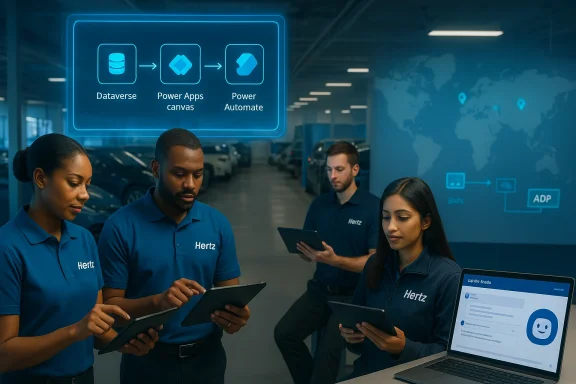
Hertz used Power Apps to replace a patchwork of Excel huddle sheets, manual shift lists, and fragile rekeying processes with a consolidated planning interface. Key technical elements:- Power Apps UI surfaced inside Microsoft Teams for easier adoption by hourly staff.
- Dataverse used as the canonical data store to aggregate shift rosters, daily “huddle sheet” signals, and local operational metrics.
- Power Automate flows synchronized Microsoft Shifts roster changes back into Dataverse and wrote approved updates into ADP (payroll), eliminating duplicate manual entries.
“Manny” — a Copilot Studio agent for vehicle and roadside help
Hertz used Copilot Studio to assemble a natural‑language agent that helps customer service representatives answer vehicle‑specific questions quickly. The design decisions that made Manny practical:- Narrow, trusted knowledge sources: manufacturer manuals, a government VIN lookup site, and instructional video links were curated to ground responses and limit hallucination risk.
- Iterative development: an initial browser‑connected prototype evolved to source content directly from manufacturer sites to boost reliability and speed.
- Human‑in‑the‑loop refinement: makers tuned prompt instructions and topic boundaries inside Copilot Studio rather than exposing broad web access.
Why Power Platform made strategic sense for Hertz
Hertz’s choice of Power Platform reflects several pragmatic tradeoffs that often matter for large, distributed service businesses:- Tight Microsoft 365 integration — Teams and Shifts are native endpoints for hourly workers; embedding apps and agents in Teams reduces behavioral friction and training overhead.
- Speed of delivery — low‑code + citizen makers accelerate time‑to‑value and allow small teams to deliver high‑impact features quickly. The Manny agent’s creation by a relatively inexperienced developer is a live example.
- Incremental modernization — Power Platform lets Hertz modernize user experiences and workflows without ripping out underlying systems of record (e.g., ADP payroll), thereby limiting project scope and risk.
- Governance tooling — Copilot Studio and Managed Environments provide admin surfaces, access controls, and environment routing that help balance experimentation with auditability. This is essential when agents may touch PII or customer records.
Measured benefits and limitations
Measured, short‑cycle wins
Hertz’s early pilots produced tangible outcomes:- Faster frontline planning and reduced manual payroll corrections by synchronizing Shifts updates into ADP via Dataverse and Power Automate.
- A >15% reduction in time‑to‑resolution for supported roadside and vehicle queries during the Manny pilot. This decreased handle time frees reps to focus on complex cases and improves speed of customer assistance.
What the numbers mean — and what they don’t
While pilot percentages are useful directional signals, there are important caveats:- Pilot metrics are context specific: a 15% reduction measured in a controlled pilot at one location may not transfer identically across diverse markets, languages, and vehicle types. Treat pilot numbers as directional evidence that warrants instrumentation at scale.
- Vendor‑brand TEI/ROI studies can show large theoretical returns for Power Platform at scale, but those analyses use modeled assumptions and composite organizations; independent validation in an organization’s own environment is essential before wide extrapolation. Flag such claims for deeper audit.
Technical considerations and a practical architecture checklist
Hertz’s implementation and recommended best practices provide a practical checklist for other operational businesses considering a similar path:- Use Dataverse as the canonical store for consolidated roster and operational signals.
- Surface roster and operational summaries inside Power Apps hosted in Microsoft Teams for adoption gains.
- Use Power Automate to build reliable sync flows between Shifts, Dataverse, and downstream systems (e.g., ADP).
- Build agents in Copilot Studio but restrict knowledge sources initially to a small set of trusted pages and internal manuals.
- Enforce telemetry: log prompts, source documents, model versions, query latency, and accuracy feedback loops.
- Apply RBAC and machine identity management for agent connectors and service principals.
- Implement Managed Environments and a Center of Excellence (CoE) to control sprawl, enforce ALM patterns, and manage capacity/cost.
Governance, costs, and risk management
Low‑code and agentic AI amplify both opportunity and risk. Hertz’s approach illustrates prudent guardrails and exposes persistent challenges every IT leader should address:- Vendor concentration and lock‑in: deep integration with Microsoft simplifies delivery but concentrates commercial and architectural risk. Negotiate exit clauses, ensure data exportability, and design abstraction layers for critical services to reduce future migration friction.
- Model and data consumption costs: Copilot and agent features can generate variable model usage and API costs. Implement environment‑level caps, consumption alerts, and separate budget lines for Dataverse storage and agent credits.
- Data governance and privacy: agents that access VIN data, vehicle manuals, or customer records must follow PII rules and regional regulations (GDPR, local privacy laws). Maintain prompt logs, retention policies, and prompt redaction for sensitive data.
- Hallucination risk and source quality: bounding agents to a curated corpus — manufacturer sites and official VIN lookup tools — is an effective early defense; however, scaling to more languages and content types requires stricter metadata, versioning, and periodic human review.
- Shadow IT and sprawl: democratization fosters innovation but can create hundreds or thousands of maker artifacts. A CoE and Managed Environments are necessary to register use cases, enforce ALM, and retire stale assets.
A practical rollout playbook for similar travel & mobility operators
Hertz’s experience maps onto a pragmatic, repeatable playbook for operations‑centric companies:- Identify one high‑frequency pain point with clear, observable metrics (shift swaps, daily huddle reporting, or common customer triage).
- Build a minimum viable Power Apps + Copilot solution scoped to a single region or brand. Keep it small and measurable.
- Restrict agent knowledge sources initially and enforce topic boundaries in Copilot Studio to limit hallucinations.
- Instrument outcomes from day one: measure time‑to‑resolution, manual steps avoided, user satisfaction, and error rates.
- Create environment‑level guardrails: Managed Environments, CoE tooling, and consumption quotas for models and Dataverse storage.
- Iterate and expand with scheduled human‑in‑the‑loop reviews and periodic audits of prompt logs and model versions.
Critical analysis — strengths, tradeoffs, and unverified claims
Strengths
- Focus on frontline value: Hertz chose high‑frequency, high‑visibility problems that compound across thousands of locations, making modest gains economically meaningful.
- Pragmatic integration strategy: integrating Power Apps with Teams and Shifts keeps the worker experience consistent and reduces training overhead.
- Governance‑first pilot mindset: limiting agent sources and using Copilot Studio’s controls helps tame hallucination risk and makes outputs auditable.
Tradeoffs and risks
- Platform lock‑in: deep coupling to Microsoft’s stack reduces interoperability and increases dependency on Microsoft’s roadmap and pricing. Organizations should weigh the business benefits against potential future migration costs.
- Cost management: unmonitored model consumption is a real danger as agents scale; it requires budgeting and proactive throttling.
- Measurement at scale: pilot metrics (e.g., the cited 15% reduction) should be validated with pre‑defined KPIs and scaled experiments before enterprise extrapolation. Treat pilot improvements as directional, not definitive.
Claims that need cautious interpretation
- Broader ROI extrapolations and third‑party TEI (Total Economic Impact) analyses of Power Platform are useful for planning but are frequently vendor‑modeled and use composite assumptions. Those headline ROI numbers should be validated with local baseline measurements and treated as planning inputs rather than guarantees.
What this means for WindowsForum readers and IT leaders
For IT leaders and Windows professionals, Hertz’s story is instructive for several practical reasons:- If your organization already runs Microsoft 365, adding Power Platform and Copilot Studio may unlock outsized adoption gains because employees encounter apps and agents inside familiar tools (Teams, Shifts).
- Low‑code doesn’t remove the need for software engineering discipline. Treat Power Platform artifacts as production software: enforce ALM, run integration tests, and use telemetry to measure real business outcomes.
- Security and compliance must be first‑class: register agents as service principals, log prompt inputs and outputs, and ensure retention and redaction policies for PII.
- Start with role‑based small pilots that have immediate payback and clear KPIs. Use those successes to fund a CoE that provides templates and governance for wider scale.
Broader industry context
Hertz’s adoption fits a larger industry trend: enterprises are combining process intelligence, process mining, and low‑code agent tooling to convert operational insight into automated action. Platforms that provide identity, telemetry, and model governance — not just bigger models — are the ones enterprises are adopting for production use cases. That focus on identity and lifecycle management is visible in Microsoft’s product trajectory and in practical customer stories from multiple verticals. The practical lesson is that agentic AI becomes enterprise‑ready when it’s treated like an operational service with auditability, identity, and lifecycle controls.Final assessment and recommended next steps
Hertz’s Power Platform program is a strong exemplar of how to extract early value from low‑code and agentic AI without overreaching. The company chose well‑scoped, high‑frequency processes, kept governance and source quality front‑and‑center, and used Microsoft integrations to shorten the adoption path. The pilot gains — a >15% reduction in time‑to‑resolution for vehicle queries and streamlined shift‑to‑payroll processes — are credible and meaningful given Hertz’s scale, but they are still pilot results and should be validated as the solutions are rolled out more widely.Actions IT leaders should prioritize before scaling:
- Establish a Center of Excellence to manage environments, templates, telemetry, and ALM.
- Budget explicitly for model consumption and Dataverse storage, and add consumption caps to prevent runaway costs.
- Require solution owners to register KPIs and feed measured outcomes into enterprise dashboards before allowing wide production rollout.
- Maintain a short list of trusted source domains for agents and enforce prompt and source logging for auditing and compliance.
Hertz’s pilot demonstrates that meaningful operational improvements are achievable today with existing low‑code and AI tooling; the challenge for leaders is scaling those wins without losing sight of cost, compliance, and maintainability.
Source: Process Excellence Network Hertz drives process automation & AI innovation with Microsoft Power Platform
