

Hexagon Robotics’ new partnership with Microsoft signals a pragmatic push to get industrial humanoid robots off the lab bench and onto factory floors, combining Hexagon’s sensor-rich AEON platform with Microsoft’s cloud scale and real-time intelligence services to tackle inspection, manipulation, and operations use cases at manufacturing scale.
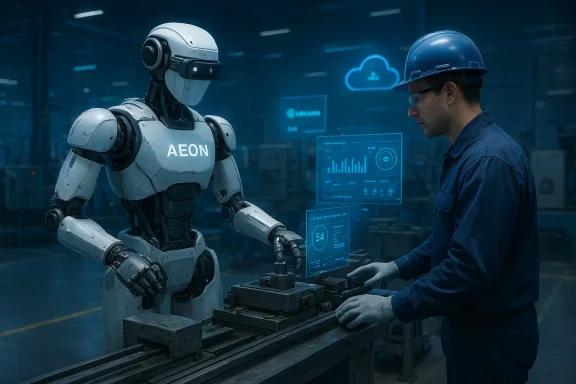
Hexagon launched AEON, its industrial humanoid, in mid‑2025 as part of a broader robotics initiative that marries the company’s long history in precision measurement, sensor fusion, and spatial intelligence with modern AI and autonomy tooling. AEON was presented as a purpose-built humanoid for industry — optimized for manipulation, inspection, reality capture, and teleoperation — and positioned to pair with partners across hardware and software ecosystems for pilots and production tests.
The January 2026 announcement formalizes a strategic collaboration with Microsoft to accelerate that vision. The partnership emphasizes three pillars: redefining data‑driven adaptive manufacturing through deep technical collaboration; scaling Physical AI frameworks that include imitation learning, reinforcement learning (RL), and multimodal vision‑language‑action models; and jointly engaging customers to deploy Azure‑backed, production‑ready humanoid solutions in sectors such as automotive, aerospace, manufacturing, and logistics.
This alliance is explicitly pitched as a factory‑floor integration play rather than a research partnership: Hexagon brings the AEON humanoid, sensor fusion, and spatial reasoning; Microsoft contributes cloud scale, telemetry and real‑time intelligence, IoT operations tooling, and platform services intended to make the robotics pipeline repeatable and enterprise‑grade.
However, the path to broad adoption is littered with technical, safety, regulatory, and economic hurdles. Real‑world deployments will require rigorous safety certification, robust edge/cloud architectures to manage latency and availability, and demonstrable ROI that justifies the upfront cost and integration work. The most immediate wins are likely to appear in high‑value manufacturing niches — aerospace, premium automotive, and specialized logistics — where the flexibility of a humanoid offsets cost.
The partnership’s emphasis on imitation learning, reinforcement learning, and multimodal models is technically sound, but the industry should expect incremental progress rather than an overnight revolution. Enterprises planning pilots should insist on measurable KPIs, strong safety guarantees, and a clear plan for workforce transition. If Hexagon and Microsoft can deliver reliable, maintainable, and secure solutions that reduce cycle times and defects while integrating smoothly into existing operations, AEON and its ecosystem partners could mark the beginning of a pragmatic, production‑oriented era for industrial humanoid robots.
Source: Intelligent CIO Hexagon Robotics partners with Microsoft to accelerate industrial humanoid robots – Intelligent CIO North America
 Background
Hexagon launched AEON, its industrial humanoid, in mid‑2025 as part of a broader robotics initiative that marries the company’s long history in precision measurement, sensor fusion, and spatial intelligence with modern AI and autonomy tooling. AEON was presented as a purpose-built humanoid for industry — optimized for manipulation, inspection, reality capture, and teleoperation — and positioned to pair with partners across hardware and software ecosystems for pilots and production tests.The January 2026 announcement formalizes a strategic collaboration with Microsoft to accelerate that vision. The partnership emphasizes three pillars: redefining data‑driven adaptive manufacturing through deep technical collaboration; scaling Physical AI frameworks that include imitation learning, reinforcement learning (RL), and multimodal vision‑language‑action models; and jointly engaging customers to deploy Azure‑backed, production‑ready humanoid solutions in sectors such as automotive, aerospace, manufacturing, and logistics.
This alliance is explicitly pitched as a factory‑floor integration play rather than a research partnership: Hexagon brings the AEON humanoid, sensor fusion, and spatial reasoning; Microsoft contributes cloud scale, telemetry and real‑time intelligence, IoT operations tooling, and platform services intended to make the robotics pipeline repeatable and enterprise‑grade.
What the partnership covers: technology, products, and scope
Core technical goals
- Scale Physical AI: Build training and inference pipelines for imitation learning, one‑shot learning, reinforcement learning, and multimodal models that can reason across vision, language and action.
- Cloud‑native telemetry and ops: Move live AEON telemetry into Microsoft Fabric Real‑Time Intelligence and Azure IoT services to support monitoring, debugging, and operational dashboards.
- Manufacturing deployments: Deliver production‑ready solutions for manipulation and inspection use cases and jointly engage early customers for pilots and rollouts in automotive, aerospace, manufacturing and logistics.
Platform and vendor roles
- Hexagon Robotics: AEON humanoid platform, sensor fusion stack, spatial intelligence modules, and on‑robot mission control.
- Microsoft: Azure cloud and platform services (Fabric Real‑Time Intelligence, Azure IoT operations, Azure App Service), model orchestration, and enterprise deployment support.
- Ecosystem partners already referenced include NVIDIA (for accelerated compute and Omniverse integration) and maxon (actuators). Those integrations aim to create an end‑to‑end solution that spans firmware, on‑robot compute, cloud training, and enterprise orchestration.
AEON: the robot at the center of the story
Design emphasis and capabilities
AEON is described as an industrial humanoid optimized for agility, awareness, versatility, and continuous operation. Key design points publicized by its developer include:- Sensor fusion and spatial intelligence: A multimodal sensor suite feeding spatial reasoning and mapping systems for environment understanding and inspection tasks.
- Dexterity and locomotion: Hardware and control stack designed to move reliably across factory spaces and handle objects with accuracy.
- Power autonomy: A battery‑swapping mechanism to reduce downtime for continuous missions.
- Onboard computing for autonomy: Local inference combined with cloud services for heavier training and data aggregation.
Pilots and industry partners
Early pilot partners named by Hexagon include established manufacturing OEMs and suppliers. Pilots are focused on machine tending, part inspection, tetherless reality capture, and other tasks where humanoid morphology and human‑like reach/mobility offer advantages over fixed automation or wheeled mobile robots.Technical analysis: how compelling is the stack?
Physical AI, imitation learning, and RL in the industrial context
Hexagon and Microsoft emphasize Physical AI—a term for models that close the loop between perception and action in the physical world. In practice this requires:- High‑quality, labeled sensor data streams covering multiple modalities (vision, depth, force/torque, proprioception).
- Robust imitation learning pipelines for mapping human demonstrations to robot policies.
- Reinforcement learning (possibly sim‑to‑real) to refine policies for unexpected variations.
- Multimodal models that combine visual inputs with language or symbolic instructions to allow flexible task specification.
Cloud‑edge balance and latency concerns
Humanoid use cases for manipulation and inspection have real‑time control and safety constraints. Latency and reliability become central:- Low‑latency control loops must remain on the robot or on tightly coupled edge compute.
- Cloud systems should be used for training, planning, mission analytics, and non‑safety‑critical inference, with careful delineation.
- Microsoft Fabric Real‑Time Intelligence and Azure IoT add monitoring and pipeline orchestration, but they do not replace deterministic on‑robot controllers.
Data management and model training at scale
One of the partnership’s stated aims is to tackle data management and one‑shot learning challenges. This is essential because:- Industrial inspection needs datasets that capture the variety of acceptable vs. defective parts, which can vary by production batch and vendor.
- One‑shot and few‑shot learning are attractive because labeled defect examples are rare, but these methods still require strong domain adaptation and validation regimes.
- Multimodal training at scale will require reproducible data pipelines, labeling standards, and model governance processes to prevent drift and unsafe behavior.
Operational and deployment challenges
Safety and certification
Industrial humanoids introduce new safety vectors relative to conventional machinery:- Whole‑body motion near human workers demands rigorous safety validation, certified control loops, and redundant sensing to avoid collisions.
- Regulatory frameworks for humanoid robots in factories are still nascent in many jurisdictions. Proving compliance with occupational safety standards will be an ongoing effort.
Integration into existing production systems
Manufacturers run multi‑decade capital cycles. Integrating humanoids into established conveyor flows, ERP systems, and PLCs is nontrivial:- Interoperability with existing machine controllers, MES, and quality systems requires adapters and mature integration patterns.
- AEON deployments will need clearly defined operation modes (collaborative, supervised, autonomous) and fallbacks to human operators.
Cost, ROI, and labor economics
Humanoid robotics hardware, compute, and integration are expensive. The value case hinges on:- The robot’s uptime and mean time between failures.
- The range of tasks it can replace or augment (versatility reduces unit cost per task).
- Savings from headcount reduction, improved throughput, or defect reduction.
Strengths of the partnership
- End‑to‑end stack: Combining Hexagon’s robot and sensing expertise with Microsoft’s cloud, security, and enterprise experience addresses gaps that many robotics startups face when scaling to production.
- Enterprise credibility: Microsoft brings procurement, compliance, and large‑customer engagement experience, which can accelerate pilot to production transitions.
- Data and Ops focus: Emphasizing telemetry, Fabric Real‑Time Intelligence, and IoT operations aligns with how manufacturers operate: they want measurable dashboards and predictable operational metrics, not black‑box robots.
- Ecosystem leverage: Existing partnerships with NVIDIA and industrial partners indicate that Hexagon is building a practical, hardware‑accelerated stack rather than a purely software demonstration.
Key risks and caveats
- Safety and certification timescales: Moving from demos to certified factory deployment will take time and may reveal unanticipated failure modes.
- Sample complexity for learning: While imitation and one‑shot learning are promising, many industrial tasks require edge‑case robustness that is costly to obtain in the real world.
- Operational dependency on cloud: Overreliance on cloud services for mission‑critical functions invites availability and latency risks. Clear edge/cloud boundaries are necessary.
- Economic viability: Until cost per task becomes competitive with traditional automation or manual labor, adoption may remain limited to high‑margin segments.
- Security and data privacy: Telemetry and defect data are commercially sensitive. Secure transmission, storage, and model governance are essential to prevent IP leakage or adversarial manipulation.
- Human factors and workforce impact: The partnership must include realistic retraining and human‑in‑the‑loop workflows to ensure safe collaboration and avoid negative labor outcomes.
Industry implications: where humanoids could matter first
Automotive and aerospace
These industries have repetitive inspection tasks, complex assembly steps, and a premium on quality. A humanoid that can imitate skilled human motions and sustain high accuracy could:- Reduce bottlenecks caused by labor shortages.
- Serve as a flexible alternative to fixed automation when part variants or small batches make traditional automation uneconomical.
- Perform quality inspection with high precision using combined visual and tactile sensing.
Logistics and warehousing
Humanoids could help in order fulfillment tasks that require human‑like reach and dexterity, especially where picking varied items and working in human‑centric spaces is necessary. However, simpler mobile manipulators or specialized picking arms will compete on cost and ease of deployment.Manufacturing lines with small lots / mixed models
In mixed‑model manufacturing, where product variants are frequent, humanoid robots that can be quickly retrained via imitation learning or language instructions would be especially valuable.Roadmap, timeline, and what to expect next
- Short term (6–18 months): pilot deployments with enterprise partners, real‑time telemetry pipelines, and incremental improvements to imitation learning and deployment tooling.
- Medium term (18–36 months): certified deployments in constrained production cells, expanded use cases beyond inspection (e.g., machine tending), and more mature cloud/edge orchestration for model updates.
- Long term (3–5+ years): broader adoption if costs drop, regulatory frameworks solidify, and field data proves durability and ROI.
Recommendations for IT and manufacturing leaders
- Inventory tasks by value and variability: prioritize processes that are repetitive, quality‑sensitive, and currently constrained by labor availability.
- Require clear metrics for pilots: uptime, defect detection improvement, cycle time, and total cost of ownership must be tracked before scaling.
- Define safety and edge/cloud boundaries: mandate deterministic local controllers for reflexive safety functions; reserve cloud for analytics and non‑safety planning.
- Prepare data governance: classify telemetry and inspection data, set access rules, and ensure IP protection before allowing cloud streams.
- Invest in workforce transition: pair humanoid deployment with retraining programs and hybrid workflows that preserve institutional knowledge.
Ethical, regulatory, and workforce considerations
Deploying humanoid robots at scale is more than a technical challenge; it raises social and ethical questions:- Worker displacement vs. augmentation: Companies must balance efficiency gains with fair transitions for affected workers, including retraining and redeployment programs.
- Transparency and accountability: When inspection results drive reject/rework decisions, maintaining explainable models and audit trails is crucial for trust and liability.
- Regulatory oversight: Occupational safety agencies will need to adapt standards for mobile humanoids operating in human environments; early adopters should engage with regulators proactively.
Conclusion
Hexagon Robotics’ partnership with Microsoft is a logical, well‑resourced attempt to close the commercialization gap for industrial humanoids. By combining an engineered humanoid platform with enterprise cloud and real‑time intelligence, the collaboration addresses several historically thorny problems: data pipelines, operations tooling, and integration with business systems.However, the path to broad adoption is littered with technical, safety, regulatory, and economic hurdles. Real‑world deployments will require rigorous safety certification, robust edge/cloud architectures to manage latency and availability, and demonstrable ROI that justifies the upfront cost and integration work. The most immediate wins are likely to appear in high‑value manufacturing niches — aerospace, premium automotive, and specialized logistics — where the flexibility of a humanoid offsets cost.
The partnership’s emphasis on imitation learning, reinforcement learning, and multimodal models is technically sound, but the industry should expect incremental progress rather than an overnight revolution. Enterprises planning pilots should insist on measurable KPIs, strong safety guarantees, and a clear plan for workforce transition. If Hexagon and Microsoft can deliver reliable, maintainable, and secure solutions that reduce cycle times and defects while integrating smoothly into existing operations, AEON and its ecosystem partners could mark the beginning of a pragmatic, production‑oriented era for industrial humanoid robots.
Source: Intelligent CIO Hexagon Robotics partners with Microsoft to accelerate industrial humanoid robots – Intelligent CIO North America
