

RLWRLD’s strategic alliance with Microsoft, announced on November 26, 2025, accelerates a clear industry trend: hyperscalers pairing cloud scale and enterprise channels with domain specialists that hold real-world industrial datasets and robotic expertise. The Seoul‑based startup will use Microsoft Azure’s compute, storage, and enterprise tooling to scale its robotics foundation model (RFM) — a multimodal system trained on high‑precision “4D+” captures from production floors in Korea, Japan, and the United States — while exploring research collaboration with Microsoft Research (MSR) and pursuing joint proof‑of‑concepts across manufacturing, logistics, retail and hospitality in Asia.
RLWRLD launched into public view during 2025 as one of a new generation of startups focused on “physical AI” — foundation models that enable robots to perceive, reason, and act in complex real-world environments. The company has emphasized dexterity-first architectures, a proprietary multi‑sensor capture rig, and large-scale multimodal datasets intended to close the simulation‑to‑real gap that has long constrained industrial robotics. The Microsoft alliance follows a flurry of RLWRLD activity earlier in 2025, including a $15 million seed round backed by major Asian manufacturers and strategic partners, and selection for AWS’s Generative AI Accelerator in October 2025 — moves that signal both investor and hyperscaler attention.
Enterprises considering pilots with RLWRLD and Microsoft will find genuine promise in the data‑centric approach and Azure’s managed tooling, but should proceed with disciplined PoC design, explicit contractual protections, and rigorous safety and cost modeling. If RLWRLD can translate its 4D+ captures and dexterity roadmap into repeatable, measurable field outcomes, the partnership could set a new commercial benchmark for embodied AI in factories and logistics — provided the practical governance and economic details are addressed openly and early.
Source: GlobeNewswire RLWRLD Partners with Microsoft to Accelerate Global Innovation in Industrial Robotics AI
 Background
RLWRLD launched into public view during 2025 as one of a new generation of startups focused on “physical AI” — foundation models that enable robots to perceive, reason, and act in complex real-world environments. The company has emphasized dexterity-first architectures, a proprietary multi‑sensor capture rig, and large-scale multimodal datasets intended to close the simulation‑to‑real gap that has long constrained industrial robotics. The Microsoft alliance follows a flurry of RLWRLD activity earlier in 2025, including a $15 million seed round backed by major Asian manufacturers and strategic partners, and selection for AWS’s Generative AI Accelerator in October 2025 — moves that signal both investor and hyperscaler attention. What RLWRLD says it brings
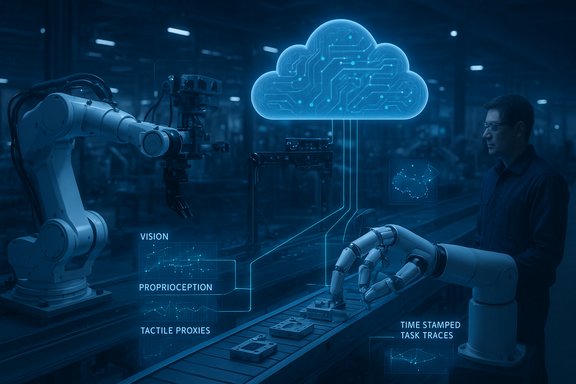
RLWRLD’s public materials describe three core assets:- A robotics foundation model (RFM) trained on synchronized, high‑precision 4D+ multimodal data (vision, motion/proprioception, tactile proxies, time‑stamped task traces) collected from real factory floors across multiple countries.
- A proprietary multi‑sensor capture system that records human demonstrations and robot/actuator traces to produce rich training datasets for imitation learning, reinforcement learning, and Vision‑Language‑Action (VLA) conditioning.
- A roadmap toward five‑finger dexterity models (the company has framed the effort as developing human‑level hand dexterity for industrial manipulators), enabling fine manipulation tasks on production lines and logistics hubs.
The Microsoft alliance: concrete components
The partnership covers three practical vectors that matter to enterprises and systems integrators.1) Cloud scale and enterprise operations on Azure
RLWRLD will leverage Azure GPU/CPU clusters, enterprise security, managed APIs and cloud storage to accelerate large‑scale training runs for RL, IL, and VLA models. Access to Azure’s compute footprint, regional availability, and managed services reduces engineering friction for repeated, compute‑intensive training cycles that dexterity models require.2) Research engagement with Microsoft Research
The announcement specifically cites exploratory research collaboration with Microsoft Research on topics such as latent‑action modeling — architectures that encode historical task context and trajectories to improve sequential planning — and industrialized vision‑language models adapted to factory complexity. The companies said these discussions may be formalized through future agreements. That research vector signals a hybrid approach: translate MSR algorithmic advances into production‑grade model families for industrial use.3) Joint go‑to‑market and PoC activity in Asia
Both firms will pursue proof‑of‑concepts, co‑marketing, and technical demonstrations across manufacturing, logistics, retail and hospitality in Asia, combining RLWRLD’s industrial datasets and dexterity IP with Microsoft’s field teams, partner channels, and enterprise sales motions. The stated intent is to shorten pilot timelines and move successful PoCs toward commercial deployment at scale.Why this matters: the business case for manufacturers and integrators
Enterprise buyers evaluate robotics AI on three pragmatic axes: reliability in production settings, predictable total cost of ownership (TCO), and governance/security for sensitive industrial data. This Microsoft–RLWRLD tie‑up addresses each axis in different ways.- Reliability: Models trained on real factory captures are less likely to fail on edge cases that only appear under real lighting, tooling wear, or operator variation. RLWRLD positions real data as a core moat.
- TCO and speed‑to‑pilot: Azure’s managed compute reduces the engineering labor of maintaining GPU clusters, while Microsoft’s co‑sell channels can materially speed procurement and customer discovery.
- Governance and security: Azure’s enterprise controls (identity, logging, compliance frameworks) are attractive to regulated manufacturers that must meet confidentiality and IP protection requirements. Microsoft is explicitly framed as providing enterprise‑grade security and API/hosting features.
Technical analysis: what RLWRLD’s claims really imply
Several technical claims in the announcement are load‑bearing and worth unpacking.The “4D+” multimodal dataset claim
RLWRLD asserts that its RFM is trained on synchronized, high‑precision “4D+” captures from real industrial environments. If true, this implies:- High‑quality temporal synchronization (video + proprioception + force/tactile proxies), enabling models to learn contact dynamics and grasp forces.
- Rich annotation or demonstration traces for imitation learning pipelines.
- Diversity across factories and task variants (Korea, Japan, U.S. that supports domain generalization.
The focus on dexterity and five‑finger manipulation
Human‑level hand dexterity in real factories is a notoriously hard problem: perception, force control, and real‑time planning must interoperate in constrained spaces with delicate tooling. RLWRLD’s roadmap toward five‑finger dexterity is a bold technical target that positions the company away from simple pick‑and‑place automation. Achieving robust, high‑throughput five‑finger manipulation at industrial cycle times requires:- Low‑latency perception and tactile feedback loops.
- Robust sim‑to‑real transfer or direct real‑world RL/IL with strong safety constraints.
- Certification and safety validation in human‑shared environments.
Model training patterns (RL, IL, VLA, latent actions)
The announcement mentions training regimes familiar to advanced robotics teams:- Reinforcement learning (RL) for policy optimization.
- Imitation learning (IL) from human demonstrations.
- Vision‑Language‑Action (VLA) conditioning to map natural language + visual context to motor outputs.
- Latent‑action modeling to incorporate task history and sequential dependence.
Cross‑checks and corroboration
Key public facts and claims are corroborated across independent outlets:- The partnership announcement on November 26, 2025, was published via a GlobeNewswire release describing the Azure collaboration, MSR research engagement, and Asia‑focused PoC plans.
- RLWRLD’s prior $15M seed raise and investor list (LG, SK, KDDI, ANA, Mitsui, Shimadzu, Hashed, Mirae Asset, Global Brain) were reported in April 2025, confirming investor and industrial interest.
- RLWRLD’s selection for the AWS Generative AI Accelerator in October 2025 is public and demonstrates the startup’s multi‑cloud engagement strategy and visibility among hyperscalers. That earlier selection suggests RLWRLD has been actively courting cloud compute and ecosystem partners throughout 2025.
Strengths and strategic opportunities
- Data moat: Real industrial captures are the most defensible asset in embodied AI. Companies that reliably collect, curate, and label multimodal, time‑synchronized datasets enjoy a material advantage over simulation‑only approaches.
- Hyperscaler scale + enterprise channels: Azure provides managed compute, compliance tooling, and sales channels. That combination shortens time‑to‑pilot and makes it economically feasible for a startup to run repeated experiments.
- Research + engineering bridge: Potential engagement with Microsoft Research could accelerate algorithmic advances (latent actions, industrial VLMs) and help translate lab prototypes into field‑hardened models.
- Regional commercial focus: Targeting manufacturing and logistics in Asia aligns with RLWRLD’s data collection footprint and East Asia’s dense manufacturing base — a practical route to generating referenceable wins and scaled deployments.
Risks, gaps and red flags
- Vendor lock‑in and portability: Heavy reliance on Azure native services (storage, Foundry or model orchestration layers) can create migration friction and commercial lock‑in. Enterprises with multi‑cloud strategies or sovereign data rules must enforce portability and export rights contractually.
- Data governance and IP: Industrial captures may include trade secrets, supplier part markings, and process IP. Contracts must specify ownership of raw captures, derivative models, retention policies, and permitted inference locations. The press release does not publish those contract terms.
- Compute economics: Dexterity models and RL/IL cycles are compute‑intensive. Azure credits and initial incentives ease proofs‑of‑concept but long‑term training and inference costs (GPU hours, data egress, model hosting) must be budgeted into TCO calculations.
- Safety and certification: When models command actuators in human‑shared spaces, deterministic safety interlocks, formal verification, and human‑in‑the‑loop procedures are necessary. The public announcement omits detailed safety validation frameworks — an omission procurement teams should address in PoC agreements.
- Multi‑hyperscaler ambiguity: RLWRLD’s prior engagement with AWS (Accelerator) and now Microsoft highlights a multi‑cloud posture that can complicate architecture, data residency, and commercial commitments. Clear runbooks for where datasets and models reside must be codified.
Due‑diligence checklist for enterprise pilots
Before greenlighting a PoC with RLWRLD and Microsoft, procurement, engineering and safety teams should require:- Clear PoC scope and KPIs: defined task success rate, cycle time targets, error thresholds, and business metrics (throughput, quality yield).
- Data ownership and portability clauses: who owns raw captures, who can retrain models, and guaranteed export/migration capability for model artifacts and datasets.
- Safety certifications and test plans: defined safety interlocks, guardrails, human‑in‑the‑loop protocols, red‑team testing and rollback criteria.
- Cost model and FinOps plan: estimated GPU training hours, expected retraining cadence, inference costs, storage and egress, and a multiyear TCO forecast.
- Incident response and runbooks: vendor SLAs, support escalation pathways, and a documented runbook for production incidents.
- Compliance and residency mapping: where data will be stored, how local data protection laws are satisfied, and whether edge inference will be used to meet latency or sovereignty needs.
Recommended pilot design: a pragmatic phased approach
A disciplined pilot sequence reduces risk and produces measurable, auditable outcomes.- Sandbox validation: small, isolated cell with non‑critical, repetitive tasks (simple pick/place or part orientation). Validate baseline capability and integration points with existing PLCs and control systems.
- Controlled Azure PoC: move training and managed deployment to Azure. Measure model transfer fidelity, inference latency, and orchestration via Microsoft tooling. Confirm data flows and residency controls.
- Operational PoC with human oversight: expand to adjacent lines with human supervisors, implement safety interlocks, and collect production telemetry for iterative model refinement.
- Scale and governance: establish model lifecycle management (versioning, rollback), cost controls, and cross‑functional governance for production rollout.
Market positioning and competitive context
The market for robotics foundation models and embodied AI is crowded and capital‑intensive. Hyperscalers, established robotics firms, and research labs are all investing heavily:- Hyperscalers (Microsoft, AWS, Google) are positioning platform primitives (model registries, managed Kubernetes, agent orchestration) to accelerate ISV adoption.
- Hardware and GPU vendors (notably NVIDIA) remain central because large dexterity models require specialized acceleration.
- Niche startups that own real-world datasets and capture rigs — the asset RLWRLD claims — are the natural acquisition or partner targets for larger industrial integrators.
Implications for WindowsForum readers: engineers, integrators and IT leaders
- IT leaders should treat the announcement as another sign that industrial AI is moving from labs into commercial pilots with hyperscaler support; this raises immediate operational questions about cloud residency, identity (Entra/Azure AD) integration, and FinOps for GPU usage.
- Systems integrators and roboticists should expect more vertically packaged PoC offerings combining model training on Azure with on‑prem inference patterns and edge orchestration to meet latency and safety needs.
- Procurement and plant operations should insist on contractual clarity on data IP, portability, and safety validation before allowing any production‑grade deployment.
Conclusion
The RLWRLD–Microsoft alliance is a consequential step in industrial robotics AI: a domain specialist with real factory captures pairing with a hyperscaler that supplies compute scale, enterprise governance tooling, and regional go‑to‑market channels. The combination addresses many practical blockers to robotics AI adoption — compute friction, governance, and commercialization pathways — while spotlighting familiar risks: vendor lock‑in, data governance, compute economics, and the long technical runway required to achieve five‑finger dexterity reliably in production.Enterprises considering pilots with RLWRLD and Microsoft will find genuine promise in the data‑centric approach and Azure’s managed tooling, but should proceed with disciplined PoC design, explicit contractual protections, and rigorous safety and cost modeling. If RLWRLD can translate its 4D+ captures and dexterity roadmap into repeatable, measurable field outcomes, the partnership could set a new commercial benchmark for embodied AI in factories and logistics — provided the practical governance and economic details are addressed openly and early.
Source: GlobeNewswire RLWRLD Partners with Microsoft to Accelerate Global Innovation in Industrial Robotics AI
