

RLWRLD’s announcement that it has entered a strategic alliance with Microsoft marks a clear inflection point for industrial robotics AI: the Seoul‑based startup will leverage Microsoft Azure and explore research engagements with Microsoft Research to scale a robotics foundation model (RFM) trained on high‑precision 4D+ multimodal factory data, and the two companies will pursue joint proof‑of‑concepts and go‑to‑market activities across manufacturing, logistics, retail and hospitality in Asia.
RLWRLD was founded to build what its leadership describes as physical AI — foundation models that let robots perceive, reason, and act in the messy, safety‑critical world of factories and logistics. The company’s stated approach combines large‑scale, real‑world multimodal data capture (vision, proprioception, tactile sensing, motion traces and time‑sequenced events) with model architectures designed for dexterous manipulation and Vision‑Language‑Action conditioning. The November 26, 2025 announcement frames the Microsoft tie‑up as the next stage of scaling: hosting training workloads on Azure GPU/CPU clusters, joint research with Microsoft Research (MSR) on latent‑action modeling, and industry pilots across Asia. RLWRLD is not a vaporware promise. The startup recently moved from stealth with notable seed funding and ecosystem validation: industry investors and strategic partners from East Asia, coverage of a meaningful seed round, and selection into an AWS Generative AI Accelerator cohort earlier in October 2025 — all signals that RLWRLD has both capital and technical momentum. Those earlier disclosures underline why major cloud partners want to work with the company: RLWRLD claims a repository of high‑fidelity “4D+” industrial captures and a dexterity model roadmap that targets five‑finger, human‑level manipulation.
Source: The Manila Times RLWRLD Partners with Microsoft to Accelerate Global Innovation in Industrial Robotics AI
 Background
RLWRLD was founded to build what its leadership describes as physical AI — foundation models that let robots perceive, reason, and act in the messy, safety‑critical world of factories and logistics. The company’s stated approach combines large‑scale, real‑world multimodal data capture (vision, proprioception, tactile sensing, motion traces and time‑sequenced events) with model architectures designed for dexterous manipulation and Vision‑Language‑Action conditioning. The November 26, 2025 announcement frames the Microsoft tie‑up as the next stage of scaling: hosting training workloads on Azure GPU/CPU clusters, joint research with Microsoft Research (MSR) on latent‑action modeling, and industry pilots across Asia. RLWRLD is not a vaporware promise. The startup recently moved from stealth with notable seed funding and ecosystem validation: industry investors and strategic partners from East Asia, coverage of a meaningful seed round, and selection into an AWS Generative AI Accelerator cohort earlier in October 2025 — all signals that RLWRLD has both capital and technical momentum. Those earlier disclosures underline why major cloud partners want to work with the company: RLWRLD claims a repository of high‑fidelity “4D+” industrial captures and a dexterity model roadmap that targets five‑finger, human‑level manipulation. What the Microsoft–RLWRLD alliance actually covers
Core technical objectives
- Scale RLWRLD’s existing robotics foundation model with Azure compute and storage, enabling larger‑scale reinforcement learning, imitation learning, and training for Vision‑Language‑Action (VLA) models.
- Explore research collaborations with Microsoft Research (MSR) on latent‑action modeling (models that use historical task context and trajectories) and industrialized vision‑language backbones adapted to the complexities of factory floors.
- Move from pure R&D toward commercialization via joint proof‑of‑concept (PoC) deployments, co‑marketing, and technical demos aimed at Asian manufacturers, logistics hubs, retail and hospitality operators.
The dataset and model claims
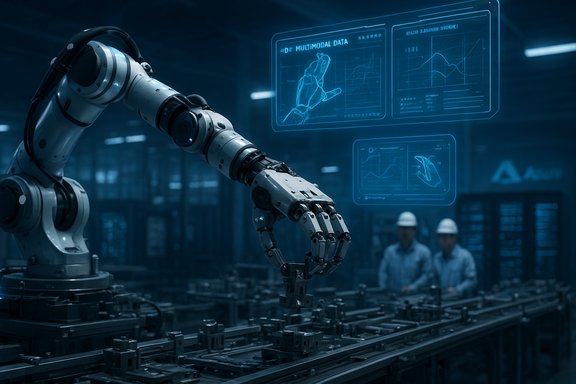
RLWRLD describes its RFM as trained on high‑precision 4D+ multimodal data gathered from real manufacturing environments in Korea, Japan and the U.S. The company positions that data as a differentiator: real operational captures (not purely simulated trajectories) enable models to learn subtle manipulation sequences, contact dynamics, and the visual variability of real production lines. Microsoft’s involvement is framed as both compute scaling and research collaboration to harden model performance for industrial realities.Why this matters to manufacturers, integrators and enterprise IT
Practical value propositions
- Faster PoCs and shorter time‑to‑pilot: Access to Azure compute + Microsoft field channels can dramatically reduce the engineering friction for pilots that need large‑scale training runs, managed orchestration and cloud‑native deployment patterns.
- Better model grounding: Industry‑specific, real‑world datasets reduce the simulation‑to‑real gap that has historically held back robotics AI. Models trained on factory data are less likely to fail on edge cases that appear on operational floors.
- Hybrid R&D + GTM: With MSR research and Azure engineering, the partnership can move promising lab outcomes into field trials faster — provided the proof‑of‑value metrics are agreed and measured.
Enterprise footprints and sector targeting
RLWRLD and Microsoft singled out manufacturing, logistics, retail and hospitality across Asia as initial verticals. These sectors are attractive because they combine repetitive, high‑volume manual tasks with relatively standardized work patterns where automation can deliver direct ROI (labor savings, quality consistency, throughput improvements). Microsoft’s regional sales teams and partner channels can accelerate customer discovery and procurement workflows.Technical anatomy: what RLWRLD says it brings to the table
The multi‑sensor capture system
RLWRLD’s stated IP includes a proprietary multi‑sensor rig designed to collect synchronized, high‑precision demonstrations from real factory floors. That capture stack purports to record:- High‑resolution visual streams (multi‑camera, multi‑view)
- Motion capture and joint/proprioceptive signals
- Force/tactile contacts and haptic proxies
- Timestamped task annotations and operator demonstrations
Model types and training patterns
The alliance description references several model and training approaches commonly used in advanced robotics stacks:- Reinforcement learning (policy optimization in simulated or real environments)
- Imitation learning (learning from human demonstrations)
- Vision‑Language‑Action conditioning (linking natural language and visual context to motor outputs)
- Latent‑action modeling (encoding task histories into model state for better sequential planning)
Business and market context: RLWRLD’s recent traction and cloud interest
RLWRLD’s public activity in 2025 shows a startup rapidly courting both cloud relationships and industrial partners. The company announced participation in the AWS Generative AI Accelerator in October 2025 and has published seed‑stage funding and investor engagement that includes major manufacturers and telecoms from Korea and Japan. That background explains why multiple hyperscalers — AWS and now Microsoft via Azure — see RLWRLD as a partner worth courting. Multiple press releases and media write‑ups corroborate these developments. This multi‑cloud interest is notable: startups building physical AI often partner with multiple cloud providers to access varied tooling, regional availability, and commercial levers. But those multi‑cloud relationships also create strategic decisions for customers: which cloud hosts the primary model, where is data stored, and how are governance and runbooks distributed across providers?Critical analysis: strengths, opportunities, and red flags
Strengths and credible positives
- Data advantage: Real operational 4D+ datasets are the most defensible moat in industrial robotics. Companies that can collect, curate and label high‑quality multimodal captures from real factories have a head start that synthetic simulation alone cannot match.
- Strategic hyperscaler support: Microsoft brings proven scale for model training, enterprise governance tooling (identity, logging, compliance), and powerful go‑to‑market channels across Asia. Those elements materially lower the friction of turning ML prototypes into production pilots.
- Dual research + commercialization path: An explicit MSR research engagement — if it materializes into formal agreements — can accelerate algorithmic innovation (latent‑action architectures, industrial vision‑language models) while Azure supports the engineering side.
Risks, gaps and caveats
- Vendor lock‑in and portability: Heavy investment in Azure‑native training, dataset storage and Foundry/AKS patterns increases the risk that customers and RLWRLD become tightly bound to Microsoft’s cloud stack. That matters for companies with existing multi‑cloud or sovereign requirements. Independent verification of portability and exportability of datasets and model artifacts should be contractually enforceable.
- Data governance and IP: Industrial data from factories often includes IP, processes and supplier information. Clear rules are required about who owns raw and derived data, retention policies, and where model artifacts are permitted to run (region/data residency). Those details are not fully disclosed in the announcement and must be clarified in PoC contracts.
- Compute costs and economics: Large dexterity models and repeated RL/IL training are compute‑intensive. Azure credits and co‑sell incentives accelerate early trials, but long‑term operational costs must be modeled for realistic TCO calculations.
- Safety, certification and human oversight: When models control real actuators and human‑shared spaces, operators need deterministic safety loops and human‑in‑the‑loop governance. The announcement does not specify industrial safety validation processes, verification frameworks, or red‑teaming efforts; these are essential for industrial adoption.
- Conflicting cloud relationships: RLWRLD’s selection for AWS’s Generative AI Accelerator earlier in October 2025 shows the firm is engaging multiple hyperscalers. That’s sensible for a startup, but enterprise customers should ask for an explicit runbook that explains how training, model hosting and inference are partitioned across clouds.
Competitive landscape and strategic implications
The market for “foundation models for robots” is crowded and strategic: larger players and specialized startups alike are investing heavily in embodied AI. Names that appear in adjacent coverage include major cloud vendors (Microsoft, AWS), AI labs (DeepMind, Google), hardware and platform companies (NVIDIA), and robotics startups focused on dexterity. RLWRLD’s approach — East Asia‑sourced industrial datasets, a dexterity emphasis, and partnerships with both ecosystem players and hyperscalers — is a defensible niche, but success will depend on execution at scale. Strategically, Microsoft gains a partner that brings real manufacturing data and dexterity IP; RLWRLD gets Azure scale, security, and MSR research expertise. For Microsoft, this is consistent with a broader enterprise agenda: verticalize AI by pairing domain partners with Azure AI Foundry, Fabric/OneLake, and co‑sell channels to accelerate adoption in regulated industries.Due diligence checklist for procurement and engineering teams
Organizations evaluating an RLWRLD + Microsoft pilot should insist on the following before approving a PoC:- Clear scope and KPIs: define measurable pilot outcomes (task success rate, cycle time reduction, error rate, MTTR).
- Data ownership and portability: contractual terms for raw capture data, model artifacts, and the ability to export models/datasets.
- Safety certification: test plans, safety interlocks, human‑in‑the‑loop procedures and rollback mechanisms.
- Cost model: realistic estimates for training (GPU hours), inference, and ongoing data storage and transfer costs.
- Compliance and residency: where data is stored and how it complies with local regulations (especially relevant for multi‑jurisdiction factories).
- Runbooks and incident response: who owns run‑time, who supports the stack (vendor SLAs), and how incidents are triaged.
Implementation patterns and recommended pilot design
A pragmatic phased pilot (recommended sequence)
- Phase 1 — Sandbox validation: Small, isolated cell with noncritical tasks (pick/place) using RLWRLD models on sample datasets. Confirm baseline capability and integration points.
- Phase 2 — Controlled PoC on Azure: Move training and managed deployment to Azure; measure model transfer, latency, and orchestration via Microsoft tooling.
- Phase 3 — Gradual operationalization: Expand to adjacent lines, implement human guardrails, and collect production telemetry to refine models.
- Phase 4 — Scale and governance: Establish model lifecycle management, versioning and auditing (Foundry/Fabric patterns) and a cross‑functional governance board.
Broader implications for the industrial AI ecosystem
This alliance is another data point in a larger structural shift: hyperscalers are increasingly pairing platform services with domain specialists to offer practical, auditable, industrial AI solutions. The pattern benefits enterprise buyers by shortening procurement cycles and providing integrated governance tooling. But it also concentrates technical and commercial power; industrial customers must demand transparency: explainability, portability and rigorous safety validation. The companies that win in industrial robotics will be those that combine research excellence, reproducible field results, and enterprise‑grade operational governance.Conclusion
RLWRLD’s strategic alliance with Microsoft is credible and consequential: real‑world industrial datasets, a dexterity‑first model roadmap, and Azure’s compute and enterprise channels form a promising combination for accelerating robotics AI in Asia’s manufacturing and logistics ecosystems. The announcement is backed by corporate PR and multiple independent outlets, and it follows prior signs of RLWRLD’s traction — seed funding and accelerator selection — that make the company worth watching. That said, the path from promising models to safe, scalable production systems is littered with engineering, governance and commercial pitfalls. Realistic pilots, clear KPIs, contractual clarity on data and portability, and rigorous safety validation must be non‑negotiable parts of any PoC. If RLWRLD and Microsoft can deliver on these fundamentals — and if customers insist on transparency rather than vendor magic — the partnership could become a meaningful accelerator for industrial automation across Asia and beyond.Source: The Manila Times RLWRLD Partners with Microsoft to Accelerate Global Innovation in Industrial Robotics AI
