

RLWRLD’s announced alliance with Microsoft marks a high‑profile step in industrial robotics: the Seoul‑based physical‑AI startup will use Microsoft Azure compute and explore research collaboration with Microsoft Research to scale its robotics foundation model (RFM), run joint proof‑of‑concepts across manufacturing, logistics, retail and hospitality in Asia, and move toward faster commercialization of dexterous, vision‑driven robotic capabilities.
RLWRLD (sometimes written RealWorld) surfaced publicly during 2025 as one of a new wave of startups focused on so‑called physical AI—foundation models trained on real‑world multimodal sensor captures that combine vision, motion/proprioception, tactile proxies and time‑sequenced traces to close the simulation‑to‑real gap in robotics. The company has emphasized a dexterity‑first approach and says it trains on high‑precision “4D+” multimodal datasets captured in actual factory environments in South Korea, Japan and the United States. Microsoft’s involvement is framed as a practical scaling and go‑to‑market partnership: Azure’s GPU/CPU clusters, enterprise security, APIs and storage will host heavier training workloads, while Microsoft Research (MSR) is mentioned as a potential research partner for advanced modeling work such as latent‑action modeling and industrialized vision‑language backbones tailored for factory floors. RLWRLD and Microsoft plan joint PoCs and technical demos aimed at Asian industrial customers. Why this matters now: RLWRLD is not a pure research lab. The startup came out of stealth with a significant seed round and strategic industry investors in East Asia, giving it both data access and customer pilots that attract hyperscaler interest. For Microsoft, the alliance is another vertical play that ties Azure compute and MSR expertise to an emerging robotics stack—an axis increasingly important as enterprises ask for turnkey industrial AI solutions rather than piecemeal experiments.
For industry watchers, the announcement is an important signal: hyperscalers and specialized robotics startups are converging on a model‑centric industrial stack, and Asia is an early battleground for commercial adoption. For enterprises, the practical path forward is cautious pragmatism—prioritize measured PoCs with clear KPIs, enforce strong governance and safety frameworks, and demand independent verification of dexterity and performance claims before committing to widespread rollouts.
What matters most in the coming months is concrete evidence: open research outputs, repeatable PoC results and scalable commercial engagements. If RLWRLD and Microsoft can deliver those, the alliance will have moved from strategic promise to industrial transformation.
Source: Enidnews.com RLWRLD Partners with Microsoft to Accelerate Global Innovation in Industrial Robotics AI
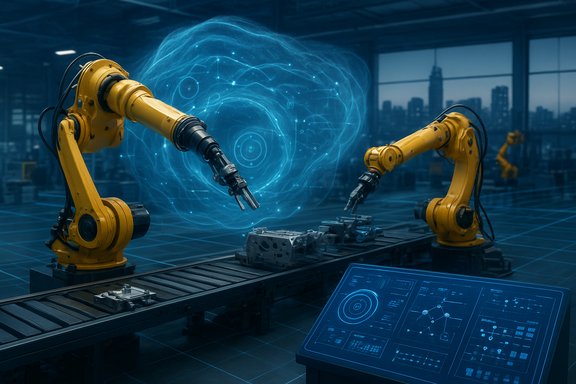 Background / Overview
RLWRLD (sometimes written RealWorld) surfaced publicly during 2025 as one of a new wave of startups focused on so‑called physical AI—foundation models trained on real‑world multimodal sensor captures that combine vision, motion/proprioception, tactile proxies and time‑sequenced traces to close the simulation‑to‑real gap in robotics. The company has emphasized a dexterity‑first approach and says it trains on high‑precision “4D+” multimodal datasets captured in actual factory environments in South Korea, Japan and the United States. Microsoft’s involvement is framed as a practical scaling and go‑to‑market partnership: Azure’s GPU/CPU clusters, enterprise security, APIs and storage will host heavier training workloads, while Microsoft Research (MSR) is mentioned as a potential research partner for advanced modeling work such as latent‑action modeling and industrialized vision‑language backbones tailored for factory floors. RLWRLD and Microsoft plan joint PoCs and technical demos aimed at Asian industrial customers. Why this matters now: RLWRLD is not a pure research lab. The startup came out of stealth with a significant seed round and strategic industry investors in East Asia, giving it both data access and customer pilots that attract hyperscaler interest. For Microsoft, the alliance is another vertical play that ties Azure compute and MSR expertise to an emerging robotics stack—an axis increasingly important as enterprises ask for turnkey industrial AI solutions rather than piecemeal experiments. What the announcement actually covers
Core technical commitments
- Scale RLWRLD’s robotics foundation model using Microsoft Azure’s GPU/CPU clusters, cloud storage and enterprise APIs.
- Explore research collaborations with Microsoft Research on topics such as latent‑action modeling, which aims to incorporate historical task and trajectory context into action planning.
- Run joint proof‑of‑concept (PoC) deployments, technical demos and co‑marketing across manufacturing, logistics, retail and hospitality in Asia to accelerate adoption.
What RLWRLD brings to the table
- A proprietary multi‑sensor capture system and a labelled repository of high‑fidelity real‑world demonstrations (visual, motion, tactile proxies) from operational factory floors.
- A robotics foundation model designed for vision‑language‑action (VLA) conditioning and dexterous manipulation tasks including a stated roadmap toward five‑finger dexterity for industrial manipulators.
- Existing pilots and strategic investor relationships across Korea, Japan and other East Asian markets that provide access to industrial environments for further data capture and PoC validation.
Technical deep dive: models, data, and engineering tradeoffs
What is a robotics foundation model (RFM)?
A robotics foundation model aims to provide a general‑purpose backbone that can perceive, reason and plan actions across multiple robotic hardware platforms. For RLWRLD, that means models trained on synchronized multimodal streams so the same backbone can be adapted via fine‑tuning or policy conditioning to different manipulators and tasks. The RFM concept parallels large language models in NLP but requires far richer sensor fusion and physics‑aware learning to succeed in the physical world.The role of 4D+ multimodal captures
Training real‑world robotics models at scale requires ground truth captures that include:- High‑resolution vision (RGB/depth/video),
- Motion traces and proprioceptive signals,
- Timestamps and task sequencing (the “4D” time dimension), and
- Tactile or contact proxies where available.
Training modalities: RL, imitation, VLA
The announcement calls out three complementary training techniques:- Imitation learning to copy human demonstrations recorded by RLWRLD’s capture rig.
- Reinforcement learning (RL) for improving policies in closed‑loop scenarios with reward signals.
- Vision‑Language‑Action (VLA) conditioning to allow models to tie natural language intent to visual contexts and action sequences.
Latent‑action modeling: what it may mean
“Latent‑action modeling” as referenced in the announcement is an emerging term that describes models able to learn compact representations of action sequences conditioned on historical context—effectively encoding a task‑level memory that can inform future decisions. For industrial tasks that require multi‑step manipulation and recovery strategies, latent‑action approaches can improve robustness. The specifics of any RLWRLD–MSR work remain to be formalized and published; the announcement signals intent rather than published technical details.Commercial strategy and market implications
Go‑to‑market and PoCs
The stated commercial path is pragmatic: joint PoCs and co‑marketing targeted at factories, warehouses and service environments in Asia. These pilots will test real integration points—hardware interoperability, safety gateways, human‑robot workflows and enterprise security/compliance around data and model use. For Microsoft, successful PoCs create Azure consumption, showcase MSR‑backed research gains, and strengthen Microsoft’s industrial AI narrative. For RLWRLD, hyperscaler backing accelerates scalability and enterprise confidence.Investors, funding and runway
RLWRLD emerged from stealth with seed financing reported at roughly 21 billion KRW (~$14.4–$14.8 million) led by regional VCs and supported by strategic manufacturers in Korea and Japan—evidence both of investor appetite and industrial interest in the company’s data and pilots. That funding profile is consistent with the capital needs for early research and PoC work, but scaling large‑scale RL training and commercializing dexterous robotics will likely require further funding or partnerships to cover continued hardware, compute and integration costs.Where this could create value
- Faster on‑line automation of manual assembly and pick‑and‑place tasks that remain hard to automate due to variability and contact dynamics.
- Smarter warehouse robotics that combine fine manipulation with language‑conditioned tasking (e.g., responding to operator intent in natural language).
- New service robotics use cases in retail and hospitality where perception + language + action create flexible, human‑centric interactions.
Strengths of the alliance (what’s credible)
- Data and domain realism: RLWRLD’s emphasis on real industrial captures (not synthetic simulation alone) is a practical advantage for bridging to production use cases where contact physics and human context matter.
- Hyperscaler scale for compute: Azure GPU/CPU capacity, enterprise security and managed services reduce friction for large‑scale RL and multi‑modality training, enabling faster iteration cycles than an independent startup with limited on‑prem compute.
- Research credibility via MSR: A collaboration with Microsoft Research (even exploratory) gives access to top academic and systems research talent and can accelerate method development in semantics, latent actions and model safety.
- Commercial channels: Microsoft’s enterprise relationships and marketplace channels significantly boost go‑to‑market reach across manufacturing and retail customers in Asia.
Risks, unknowns and critical caveats
Technical and operational risks
- Scalability of dextrous manipulation remains an open research challenge. Claims of five‑finger, human‑level dexterity are aspirational and should be treated as a roadmap target rather than an immediately verifiable capability. Performance details, task coverage, success rates and safety preconditions are not published in the press materials. Treat those dexterity claims with caution until independent benchmarks or peer‑reviewed results appear.
- Reinforcement learning at industrial scale requires massive, reliable simulation or prohibitive amounts of real robotic interactions; the latter is costly in time, hardware wear, and safety risk. Azure compute reduces training time but does not remove the empirical data and engineering effort needed to make policies robust across heterogeneous factory settings.
Safety, governance and compliance
- Deploying agentic or semi‑autonomous robotics near humans triggers regulatory, insurance and safety engineering obligations. Industry adoption will hinge on verified safety cases, deterministic fallback behaviors, and rigorous human‑in‑the‑loop controls—areas not yet detailed in the public announcement.
- Data governance is material: training on real factory data raises IP, privacy and export‑control questions depending on the jurisdictions and partners providing datasets. Enterprises will require clear contractual/risk frameworks before production rollouts.
Commercial and market risks
- Market readiness remains uneven: some factories and logistics players are ready for high‑value PoCs, while many remain conservative, prefer proven PLC/robotics vendors, or require long procurement cycles. Successful pilots do not automatically translate into broad fleet rollouts.
- Capital intensity: moving from PoCs to broad deployments requires capital for robots, integration services, edge compute, and maintenance. RLWRLD’s seed funding is credible for research and PoCs but further rounds or strategic OEM partnerships will likely be necessary to mass commercialize.
Practical implications for enterprises and Windows/Azure ecosystems
- For Azure customers and Windows‑centric enterprises, this partnership reinforces Azure’s industrial strategy: more vertical solutions that combine cloud compute, research, and partner ecosystems to create end‑to‑end offerings for automation and robotics. Enterprises evaluating robotics AI should consider how cloud vendor partnerships affect long‑term support, security, and integration with existing MES/ERP stacks.
- From an operational IT perspective, expect attention on:
- Secure data ingestion pipelines from factory OT systems into cloud training datasets,
- Edge‑to‑cloud synchronization patterns for inference and policy updates,
- Standardized APIs and model‑serving semantics to integrate perception and control with existing PLCs and SCADA systems.
What to watch next (milestones and verification points)
- Publication of technical papers, MSR joint research memos or open benchmarks that describe latent‑action approaches, VLA conditioning results, or dexterity evaluations. Those would materially reduce uncertainty about the partnership’s technical depth.
- Detailed PoC case studies showing measured KPIs—task success rates, cycle‑time improvements, safety incident records and TCO comparisons versus existing automation. Published KPIs will determine whether pilot gains generalize across sites.
- Follow‑on commercial agreements with large OEMs or systems integrators that commit robots and deployment budgets at scale. These strategic channel deals would convert research momentum into durable revenue.
- Funding updates: additional capital raises or strategic investments that match the expected scale‑up needs for compute, hardware and global deployment.
Strategic takeaways for CIOs, plant managers and integrators
- Treat early engagements as learning pilots. Use PoCs to validate specific tasks (e.g., delicate pick‑and‑place, mixed‑SKU bin picking, or assistance tasks) rather than betting on immediate full‑line automation. A phase‑gated acceptance approach reduces operational risk.
- Insist on runbooks and ownership matrices that clearly allocate responsibility across cloud, model, hardware and integrator teams. When a model-driven action influences a physical actuator, clarity on SLA, rollback, and incident response is essential.
- Validate reproducible metrics and insist on on‑site acceptance tests under your actual operating conditions (lighting, part variance, human proximity). Simulated or lab results rarely capture the full complexity of a true production floor.
Conclusion
The RLWRLD–Microsoft alliance is a credible, well‑scoped attempt to translate robotics foundation models into industrial value by combining RLWRLD’s claimed real‑world 4D+ datasets and dexterity roadmap with Microsoft Azure’s compute and potential MSR collaboration. The partnership addresses the exact pain points that have slowed robotics progress—data realism, compute scale and enterprise channels—yet it does not remove deep technical, safety and commercial hurdles that have historically slowed the transition from PoC to production.For industry watchers, the announcement is an important signal: hyperscalers and specialized robotics startups are converging on a model‑centric industrial stack, and Asia is an early battleground for commercial adoption. For enterprises, the practical path forward is cautious pragmatism—prioritize measured PoCs with clear KPIs, enforce strong governance and safety frameworks, and demand independent verification of dexterity and performance claims before committing to widespread rollouts.
What matters most in the coming months is concrete evidence: open research outputs, repeatable PoC results and scalable commercial engagements. If RLWRLD and Microsoft can deliver those, the alliance will have moved from strategic promise to industrial transformation.
Source: Enidnews.com RLWRLD Partners with Microsoft to Accelerate Global Innovation in Industrial Robotics AI
