

RLWRLD’s announcement that it has entered a strategic alliance with Microsoft to scale its robotics foundation model marks a pivotal moment for industrial robotics AI — combining RLWRLD’s real‑world, high‑precision 4D+ multimodal datasets and dexterity models with Azure’s cloud compute, enterprise tooling, and potential Microsoft Research collaboration to accelerate reinforcement learning, imitation learning, and Vision‑Language‑Action model training for factories, logistics centers and service venues across Asia.
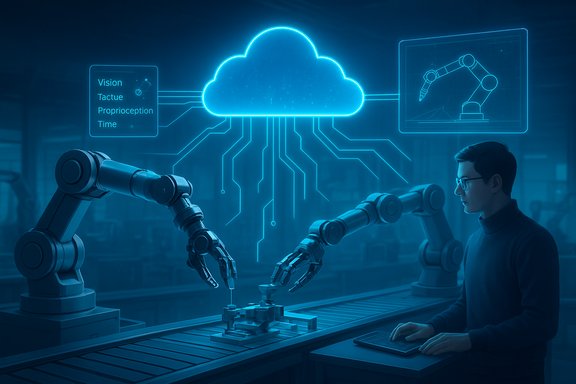
RLWRLD (also reported as RealWorld in some regional coverage) is a startup focused on “physical AI” — robotics foundation models (RFMs) designed to give robots human‑level hand dexterity and contextual understanding. The company says its RFM family is trained on 4D+ multimodal captures — synchronized high‑precision vision, proprioception, tactile and temporal data — recorded in live manufacturing environments across Korea, Japan and the United States. That dataset footprint is the core differentiator RLWRLD pitches to manufacturers and system integrators. Microsoft’s role, as described in the joint announcement, centers on three pillars:
Source: AI Insider RLWRLD Partners with Microsoft to Scale Robotics AI Model Development
 Background / Overview
RLWRLD (also reported as RealWorld in some regional coverage) is a startup focused on “physical AI” — robotics foundation models (RFMs) designed to give robots human‑level hand dexterity and contextual understanding. The company says its RFM family is trained on 4D+ multimodal captures — synchronized high‑precision vision, proprioception, tactile and temporal data — recorded in live manufacturing environments across Korea, Japan and the United States. That dataset footprint is the core differentiator RLWRLD pitches to manufacturers and system integrators. Microsoft’s role, as described in the joint announcement, centers on three pillars:- Cloud infrastructure: access to Azure GPU/CPU clusters, enterprise security, storage and APIs to scale training and inference.
- Research collaboration: exploratory engagement with Microsoft Research (MSR) on advanced topics such as latent‑action modeling and industrial‑grade vision‑language models.
- Go‑to‑market: joint PoCs, technical demos and co‑marketing across manufacturing, logistics, retail and hospitality in Asia.
What RLWRLD Actually Brings to the Table
The 4D+ Multimodal Dataset and Robotics Foundation Models
RLWRLD’s technology pitch rests on two claims: first, that it captures large‑scale, high‑precision multimodal data in real factories (visual, tactile, proprioceptive, temporal), and second, that it trains RFMs capable of supporting a range of hardware platforms for real‑world manipulation tasks.- The 4D+ dataset is significant because industrial manipulation is inherently multimodal — vision alone rarely suffices for reliable grasping and fine manipulation. RLWRLD’s emphasis on tactile sensing plus proprioception and temporally dense capture aims to improve sim‑to‑real transfer and robustness in unstructured conditions.
- Their flagship RFM (referred to in earlier materials as RLDX and related dexterity models) is described as hardware‑agnostic and focused on human‑level hand dexterity, a rare and commercially valuable capability in manufacturing and logistics automation. Prior RLWRLD announcements show the company engaging with AWS accelerators and pilot partners — indicating ongoing multimodal collection and live pilot deployments.
Why the Data Matters
Industrial datasets captured in real facilities are valuable because they:- Encode real environmental noise, variability and edge cases that simulators or synthetic datasets often miss.
- Support supervised trajectories for imitation learning and high‑fidelity reward signals for reinforcement learning.
- Enable Vision‑Language‑Action (VLA) training, which aims to combine visual perception, language understanding and action policy in a single framework.
What Microsoft Brings — and Why It Matters
Azure Compute, Foundry and Enterprise Tooling
The partnership’s immediate, tangible benefit to RLWRLD is compute and infrastructure scale. Azure offers large GPU/CPU clusters, security and storage services that let model teams train bigger models faster and operate them under enterprise governance. These capabilities are especially relevant for robotics model training because:- Reinforcement learning (RL) and imitation learning pipelines can be compute‑intensive, demanding repeated environment simulations and large batch updates.
- Vision‑Language‑Action models require both heavy vision encoders and long context windows for multimodal reasoning.
Research and MSR Collaboration
Beyond raw compute, the announcement signals exploratory engagement with Microsoft Research on specialized topics such as latent‑action modeling — an approach that augments action policies with historical task context to improve sequential decision making in complex tasks. Collaboration with MSR could accelerate research into:- Long‑horizon planning for physical manipulation.
- Industrial‑grade vision‑language encoders tuned for factory imagery and instrumentation.
- Safety, verification and simulation‑to‑real transfer methods tailored for physical systems.
Technical Implications: How This Partnership Could Advance Robotics AI
Training Modalities Supported
- Reinforcement Learning (RL): Continuous control and policy refinement through reward‑driven exploration — computationally intensive but powerful for discovering emergent manipulation strategies.
- Imitation Learning: Bootstraps policies from expert demonstrations (the 4D+ trajectories), reducing the cold‑start problem for RL.
- Vision‑Language‑Action (VLA): Enables instruction‑driven task specification and human‑robot collaboration via natural language interfaces.
Latent‑Action Modeling and Contextual Memory
Latent‑action approaches that encode historical task state into action conditioning could improve performance on multi‑step industrial tasks (assembly sequences, conditional handling, regrasping). If MSR collaboration delivers practical algorithms for long‑context latent actions, RFMs could better plan multi‑stage jobs with fewer resets and human interventions.Cross‑Platform Hardware Support
RLWRLD highlights hardware‑agnostic models — critical for commercialization. Models that generalize across grippers, hands and arm kinematics make downstream integration easier for OEMs and system integrators. However, robust cross‑platform performance requires domain adaptation, per‑robot calibration, and careful engineering of perception‑to‑control interfaces.Commercial and Market Implications
PoCs, Co‑Marketing, and GTM in Asia
The alliance explicitly targets proof‑of‑concepts across manufacturing, logistics, retail and hospitality in Asia. Joint demonstrations can:- Lower buyer skepticism by showing models in situ on real hardware and workflows.
- Accelerate procurement cycles when Azure‑backed demos are backed by Microsoft co‑sell channels.
- Help RLWRLD scale from pilot projects to commercial contracts by leveraging Microsoft’s enterprise reach.
Multi‑Cloud Signals
Notably, RLWRLD was selected for the AWS Generative AI Accelerator in October 2025, demonstrating prior engagement with AWS infrastructure and neutral accelerator programs. That prior AWS relationship suggests RLWRLD is pursuing pragmatic multi‑cloud and partner approaches rather than exclusive vendor lock‑in — a sensible posture for a deep tech startup that needs flexible access to compute and go‑to‑market channels. Organizations evaluating RLWRLD should therefore clarify contractual exclusivity and data residency implications in future agreements.Strengths of the Partnership
- Data + Compute Match: RLWRLD’s real‑world multimodal data is exactly the kind of asset that benefits from scale compute and rigorous MLOps; pairing it with Azure’s high‑performance clusters is a natural fit.
- Research Depth: Potential MSR collaboration could accelerate state‑of‑the‑art research (latent actions, VLA for industry), shortening the path from paper to pilot.
- Commercial Reach: Microsoft’s enterprise channels and cloud SLAs help move robotics AI from R&D demos to commercial PoCs and deployments.
- Cross‑Domain Use Cases: The partnership is positioned to serve multiple verticals (manufacturing, logistics, retail, hospitality), increasing the addressable market and potential revenue streams.
Risks, Unknowns and Caveats
1. Vendor Lock‑In and Operational Coupling
Deep integration with Azure services and possible reliance on Azure‑specific model management (Foundry, AKS, proprietary monitoring) could increase switching costs. Enterprises should:- Negotiate portability, data export and multi‑cloud deployment clauses.
- Require clearly defined SLAs for training and inference workloads. Analysis of other Azure ISV partnerships shows that Foundry integration can accelerate productization but also concentrate operational dependencies.
2. Compute and Cost Management
Training and fine‑tuning RFMs for RL and VLA at scale is expensive. Even with Azure credits or partnership discounts, production‑grade pipelines need disciplined FinOps:- Track per‑experiment compute consumption.
- Use mixed‑precision and model sharding strategies to control costs.
- Validate cost estimates for large RL runs before committing to broad PoC scope.
3. Data Governance and Privacy
Industrial datasets often contain sensitive IP (manufacturing processes, product designs, supplier info). Risk mitigation requires:- Clear data handling and residency commitments.
- Role‑based access controls and audit trails in the model lifecycle.
- Explicit licensing on dataset reuse in model training and commercial products.
4. Safety, Explainability and Liability
Robots operating in factories interact with humans and expensive equipment. Key concerns:- How are safety cases, monitoring and human‑in‑the‑loop gating implemented?
- Who bears liability for model‑induced failures?
- Are there verification and validation artefacts (test suites, red‑team reports) for deployed policies?
5. Uncertain Research Outcomes and Timelines
The announcement references exploratory MSR engagement but does not define deliverables, timelines or IP/ownership terms. Until formal agreements are published, any claim about MSR co‑developed breakthroughs should be treated as aspirational. Flag: further collaborative results are possible, not guaranteed.6. Competitive and Supply‑Chain Context
Cloud GPU supply constraints and competition between hyperscalers for frontier AI workloads mean:- Pricing and capacity can shift rapidly.
- Enterprises should verify regional Azure GPU availability for heavy training runs and plan for contingency (co‑location or multi‑cloud options). Industry reporting shows large GPU deployments (e.g., GB300 cluster rollouts) but warns that precise price and capacity guarantees require procurement diligence.
Practical Guidance for Manufacturers and Integrators
For manufacturing IT and automation leads evaluating RLWRLD + Microsoft PoCs, a disciplined approach helps reduce risk and improve outcomes.- Define measurable PoC success criteria up front (throughput, error rate, mean time between human interventions).
- Require model lineage and explainability artifacts before deployment (test harness, failure cases, rollback procedures).
- Insist on data governance clauses: where data is stored, who can access it, and how it can be used for training.
- Negotiate portability: request deliverables that let you redeploy models off‑cloud or on alternative cloud providers if needed.
- Budget for iterative training costs — expect multiple fine‑tuning cycles once the robot is in the field.
Strategic Takeaways: What This Means for the Industry
- The RLWRLD–Microsoft alliance underscores a maturing market dynamic: robotics AI is moving from simulation proofs to data‑driven, cloud‑backed, enterprise‑oriented deployments.
- Partnerships that marry unique real‑world datasets with hyperscaler compute and governance are likely to accelerate usable robotics applications in manufacturing and logistics.
- Multi‑cloud pragmatism (RLWRLD’s prior AWS accelerator participation followed by an Azure partnership) suggests startups will continue to hedge infrastructure dependencies while maximizing partner reach.
- For enterprises, the primary value will come from credible PoCs that demonstrate deterministic ROI — not from marketing language about “foundation models” alone.
Final Assessment — Opportunities vs. Reality
This Microsoft partnership materially strengthens RLWRLD’s ability to scale training and run enterprise PoCs faster, giving the startup access to Azure’s compute, security and go‑to‑market reach while opening the door to MSR collaboration on industrial research topics. Multiple independent reports confirm the announcement and its core claims. However, the announcement is an early‑stage commercial and research alignment rather than a promise of immediate, drop‑in robotics solutions. Key details — precise compute allocations, contract terms, MSR deliverables, safety and liability frameworks, and deployment SLAs — are not specified publicly and should be verified during procurement. Treat the press release as a strategic partnership announcement that creates promising capability, not as a turnkey product launch.Conclusion
The RLWRLD–Microsoft alliance is a notable development in industrial robotics AI: it pairs a company claiming industry‑grade multimodal robotics datasets and dexterity models with the compute, governance and go‑to‑market resources of a hyperscaler. For manufacturers, system integrators and automation vendors, the partnership is worth watching and evaluating via tightly scoped PoCs that prioritize safety, explainability and measurable ROI. For RLWRLD, Microsoft’s cloud and research ecosystem could be the lever that turns lab‑grade dexterity research into pragmatic, deployable robotic systems — provided both parties address the practical business, legal and operational challenges that stand between impressive demos and factory‑floor reality.Source: AI Insider RLWRLD Partners with Microsoft to Scale Robotics AI Model Development
