

Microsoft published a May 13, 2026 industrial AI feature showing how ARUM, Cemex, Beca and Obeikan are using Azure, Microsoft Foundry, Copilot and related services to turn scarce expertise, fragmented data and factory-floor bottlenecks into software-mediated workflows. The argument hiding inside Microsoft’s customer showcase is bigger than another round of AI case studies: industrial AI is moving from the office into the places where mistakes are expensive, skills are scarce and institutional memory is aging out. That makes the upside real, but it also raises the stakes for reliability, governance and who ultimately owns the knowledge that keeps production running.
The most revealing example in Microsoft’s package comes from Japan, where ARUM is trying to encode the judgment of experienced machinists into software. Precision manufacturing has always depended on more than procedure manuals. A senior machinist knows which tool path will chatter, which material will misbehave, and which apparently small design choice will turn into scrap metal after the spindle starts moving.
ARUMCODE, as Microsoft describes it, converts CAD files into machine instructions within minutes. That is not just “automation” in the lazy marketing sense. It is an attempt to turn tacit knowledge — expertise that usually lives in hands, habits and years of shop-floor mistakes — into a repeatable digital process.
The economic pressure is obvious. Japan’s demographic squeeze has made skilled labor harder to replace, and manufacturing is one of the places where apprenticeship gaps show up brutally. You can hire a junior worker quickly; you cannot instantly manufacture the instincts of someone who has spent decades reading metal, tooling and tolerances.
Microsoft’s role is equally clear. Azure supplies the cloud platform, GitHub Copilot assists the software development process, and Azure AI Speech plus Azure OpenAI in Microsoft Foundry are being used for KAYA, a prototype conversational interface for ARUM’s TTMC Origin machining system. In Microsoft’s telling, this turns a high-skill bottleneck into a guided workflow that less-experienced workers can operate.
That framing is persuasive, but it deserves scrutiny. AI is not replacing the master craftsperson so much as capturing a version of that person’s decisions and embedding them into a system that can be scaled. The risk is that organizations mistake captured expertise for complete expertise, forgetting that the hardest industrial problems often appear precisely when the standard pattern breaks.
That is why Microsoft’s four examples hang together. ARUM applies AI to machining instructions. Cemex uses an AI financial agent called LUCA Bot for executive decision support. Beca uses Azure-backed systems and an AI assistant to query geotechnical data in New Zealand. Obeikan connects factory machines and production lines to an in-house platform that uses machine learning and Copilot-style interfaces to expose real-time bottlenecks.
The common thread is not a single model or app. It is the conversion of operational reality into structured data that can be queried, reasoned over and acted upon. Once that happens, AI becomes less like a chatbot and more like a control layer.
That is also where Microsoft’s enterprise strategy becomes visible. Azure is the substrate, Microsoft Foundry is the model-and-agent workbench, GitHub Copilot is the developer productivity wedge, and Copilot branding gives business users a familiar entry point. The company is not merely selling AI features; it is selling an industrial operating environment.
The bet is that companies already committed to Microsoft identity, developer tooling, security management and cloud infrastructure will find it easier to extend those investments into industrial AI than to stitch together a new stack from scratch. For CIOs and plant operators, that integration story is powerful. For skeptics, it is also a reminder that every “assistant” is another dependency.
Encoding that expertise into ARUMCODE could make precision work more resilient. If a system can generate tool sequences from CAD data quickly, a factory can respond faster to custom orders, reduce delays and let one worker supervise multiple machines. That is exactly the kind of leverage manufacturers need when demand becomes more variable and labor becomes less abundant.
The planned KAYA conversational interface pushes the idea further. Instead of expecting junior workers to interpret dense instructions or escalate every uncertainty, the system can provide natural-language guidance. In principle, that reduces training friction and makes advanced equipment accessible to a wider labor pool.
But the trap is overconfidence. Natural language can make a system feel more authoritative than it is. A calm voice giving step-by-step machining instructions may reassure a junior operator, yet the underlying recommendations still need validation, traceability and escalation paths when reality deviates from the model.
In industrial settings, “mostly right” is not good enough in the same way it might be for drafting an email. Bad instructions can waste material, damage equipment or create safety hazards. The more AI mediates skilled work, the more companies need clear boundaries around what the system may decide, what it may suggest and when a human with real authority must intervene.
That matters because industrial companies often suffer from a split brain. The people closest to production have local knowledge but limited strategic visibility; executives have dashboards but not always timely context. An agent that can surface plant-level performance through conversational queries narrows that gap.
The benefit is not just speed. It is the possibility of a common operating picture. If managers can ask the same system about monthly goals, country-level performance or plant-specific issues, the organization can reduce the ritual of hunting for reports, forwarding spreadsheets and reconciling conflicting numbers.
Still, executive AI has its own failure mode: it can make uncertainty look clean. A dashboard already compresses complexity; a conversational agent compresses it further. If the model’s answers are not grounded, permissioned and auditable, leaders may get the illusion of precision without the discipline of analysis.
That is why governance matters as much as the model. Who can ask what? Which data sources are authoritative? How are stale figures flagged? Can leaders see the assumptions behind a generated answer? Those questions sound boring until a capital allocation decision, supply chain response or plant intervention depends on them.
This is the part of the AI story vendors often underplay. Models do not magically fix disorganized information. They amplify whatever data estate they are given. If the relevant records are scattered, inconsistent, poorly permissioned or trapped in legacy formats, the AI assistant becomes a polite interface to confusion.
In Beca’s case, the value comes from combining a centralized repository, a digital-twin platform and an AI assistant that can help engineers query complex underground data in minutes. The productivity gain is not simply that a model can respond in natural language. It is that the organization has done enough foundational work for the response to mean something.
That lesson applies well beyond civil engineering. Manufacturers, utilities, hospitals and logistics firms all have decades of operational data in formats that made sense at the time. The hard work is not putting a chatbot on top; it is deciding which data is trustworthy, how it should be structured, who can access it and how results will be verified.
For IT pros, this is familiar territory. AI projects are often sold as innovation initiatives, but many succeed or fail as data hygiene projects. Identity, access control, retention policies, logging, integration and backup strategy become the difference between a useful assistant and a compliance headache with a friendly prompt box.
That is the unglamorous revolution. A plant manager spending hours untangling logs is not suffering from a lack of generative AI. He is suffering from missing telemetry, delayed visibility and inconsistent root-cause analysis. Once sensors and systems capture the right signals, machine learning can identify bottlenecks and defects faster than a human meeting cycle.
The reported 30 percent efficiency boost is the kind of figure that will make executives pay attention. But the mechanism matters more than the number. The value comes from compressing the time between an operational problem and a corrective action.
This is where industrial AI differs from consumer AI. The goal is not to entertain, generate prose or answer trivia. The goal is to reduce downtime, scrap, waste, rework and uncertainty. That means the system has to fit into maintenance workflows, shift handoffs, quality processes and safety rules.
It also means AI must coexist with older equipment. Most factories are not greenfield showrooms filled with identical modern machines. They are messy environments with mixed vendors, retrofitted sensors, legacy controllers and production targets that do not pause for digital transformation. Any industrial AI platform that ignores that reality will fail outside the demo.
Yet industrial customers will not move everything to the cloud without hesitation. Latency, uptime, sovereignty, safety and cost all complicate the story. A machining center cannot wait for a distant service during a critical operation. A factory cannot lose core visibility because a network link drops. A regulated company cannot casually move sensitive operational data across borders.
That is why the next phase of industrial AI will likely be hybrid. Cloud services will train, coordinate, govern and analyze. Edge systems will execute, cache, monitor and fail safely. The winning architecture will not be “cloud versus local”; it will be a disciplined division of labor.
Microsoft has been moving in that direction with local and hybrid offerings, and the industrial market will push it harder. A plant wants the intelligence of the cloud without becoming helpless when disconnected. That requires model deployment options, synchronization strategies, local inference, strong observability and boring-but-critical operational resilience.
For Windows administrators, this is where the story becomes practical. Industrial AI will touch endpoint management, network segmentation, device identity, patching windows, certificate management and incident response. The AI layer may be new, but the failure modes will look very familiar to anyone who has kept production systems alive.
That matters because industrial environments already have complicated security boundaries. Operational technology and information technology have different histories, priorities and maintenance rhythms. IT wants patch velocity and centralized management. OT wants stability, safety and minimal disruption. AI systems sit awkwardly between the two.
A model that can summarize plant performance may expose sensitive commercial data if permissions are too broad. A system that generates machine instructions may become dangerous if inputs are manipulated. A conversational assistant that lowers the skill barrier may also lower the social barrier for users to ask for actions they do not fully understand.
The answer is not to reject the technology. It is to treat AI systems as privileged operational components rather than novelty interfaces. They need logging, role-based access control, data-loss protections, red-team testing, change management and incident playbooks.
The most mature organizations will also insist on human accountability. If AI recommends a tooling sequence, a production change or a financial interpretation, the organization still needs to know who approved the action and under what policy. “The model said so” is not an acceptable postmortem.
That integration is difficult for smaller AI vendors to match. A manufacturer already using Microsoft Entra ID, Defender, Teams, Windows endpoints, Azure services and GitHub has fewer procurement and integration hurdles when adopting Microsoft-backed AI. The stack sells itself as continuity.
But integration also concentrates trust. If Azure hosts the workflow, Foundry supplies the models, Copilot shapes the development process and Microsoft security tools monitor the environment, Microsoft becomes deeply embedded in the customer’s operational nervous system. That is valuable, sticky and strategically powerful.
It also makes transparency more important. Customers need to understand model behavior, data handling, service dependencies, regional availability, update cadence and failure modes. In consumer software, unclear behavior is annoying. In industrial settings, unclear behavior can become expensive.
Microsoft’s customer stories are strongest when they show concrete operational change rather than generic AI enthusiasm. ARUM reduces dependence on scarce machinists. Cemex reduces friction in executive analysis. Beca makes buried ground data queryable. Obeikan shortens the loop between defect and diagnosis. Those are real business problems, not prompt-engineering parlor tricks.
For junior machinists, that may mean following AI-generated guidance while learning the deeper principles behind it. For plant managers, it may mean spending less time reconstructing yesterday’s failures and more time acting on live signals. For executives, it may mean querying operational data directly instead of waiting for a reporting chain.
That can be empowering if it raises the floor. A less-experienced worker can do more. A manager can see more. An engineer can query more. An organization can retain knowledge that would otherwise retire or disappear.
But it can also deskill if companies use AI to avoid investing in human expertise. If junior workers only learn to follow instructions, they may never develop the judgment needed when the instructions are wrong. If managers only consume generated summaries, they may lose touch with the messy reality behind the metrics.
The healthiest deployments will treat AI as scaffolding, not a substitute for competence. Workers should be able to learn from the system, challenge it and escalate beyond it. Otherwise, the organization simply trades one labor shortage for a deeper dependency on opaque automation.
That architecture is appealing because it attacks the chronic problems of industrial organizations: siloed information, scarce expertise, slow reporting, inconsistent execution and delayed diagnosis. It also aligns perfectly with Microsoft’s strengths. The company does not need to own the machine tool, the cement plant or the geotechnical survey; it needs to own the digital layer through which those assets become intelligible.
The competitive question is whether customers see that layer as neutral infrastructure or strategic dependency. Industrial companies tend to be conservative for good reason. They will adopt AI where it demonstrably improves throughput, quality or resilience, but they will also demand proof that the system can be governed and trusted.
That is why the next year of industrial AI will be less about flashy demos and more about boring evidence. Uptime. Error rates. Audit trails. Operator acceptance. Safety reviews. Integration cost. Recovery behavior after outages. These are the measures that separate industrial software from keynote software.
Microsoft has put forward a credible vision. Now customers will test whether that vision survives contact with production.
Source: Microsoft Source 4 ways AI is enabling the future of industrial work
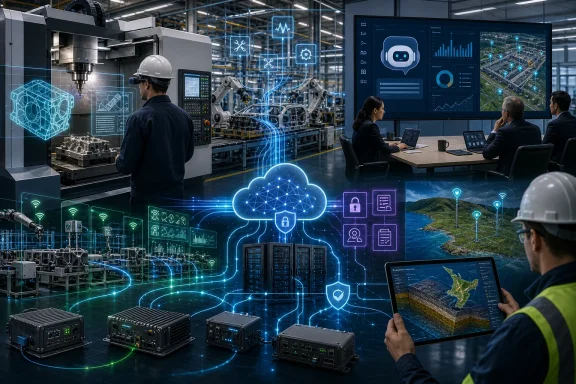 Microsoft’s Industrial AI Pitch Is Really a Labor Story
The most revealing example in Microsoft’s package comes from Japan, where ARUM is trying to encode the judgment of experienced machinists into software. Precision manufacturing has always depended on more than procedure manuals. A senior machinist knows which tool path will chatter, which material will misbehave, and which apparently small design choice will turn into scrap metal after the spindle starts moving.ARUMCODE, as Microsoft describes it, converts CAD files into machine instructions within minutes. That is not just “automation” in the lazy marketing sense. It is an attempt to turn tacit knowledge — expertise that usually lives in hands, habits and years of shop-floor mistakes — into a repeatable digital process.
The economic pressure is obvious. Japan’s demographic squeeze has made skilled labor harder to replace, and manufacturing is one of the places where apprenticeship gaps show up brutally. You can hire a junior worker quickly; you cannot instantly manufacture the instincts of someone who has spent decades reading metal, tooling and tolerances.
Microsoft’s role is equally clear. Azure supplies the cloud platform, GitHub Copilot assists the software development process, and Azure AI Speech plus Azure OpenAI in Microsoft Foundry are being used for KAYA, a prototype conversational interface for ARUM’s TTMC Origin machining system. In Microsoft’s telling, this turns a high-skill bottleneck into a guided workflow that less-experienced workers can operate.
That framing is persuasive, but it deserves scrutiny. AI is not replacing the master craftsperson so much as capturing a version of that person’s decisions and embedding them into a system that can be scaled. The risk is that organizations mistake captured expertise for complete expertise, forgetting that the hardest industrial problems often appear precisely when the standard pattern breaks.
The Factory Floor Is Becoming a Software Surface
For WindowsForum readers, the important shift is not that AI can write code or summarize meetings. It is that industrial operations are increasingly being treated as software surfaces: queryable, instrumented, modeled and mediated by agents. The factory floor, the quarry, the construction site and the machining center are becoming endpoints in a larger cloud-and-data architecture.That is why Microsoft’s four examples hang together. ARUM applies AI to machining instructions. Cemex uses an AI financial agent called LUCA Bot for executive decision support. Beca uses Azure-backed systems and an AI assistant to query geotechnical data in New Zealand. Obeikan connects factory machines and production lines to an in-house platform that uses machine learning and Copilot-style interfaces to expose real-time bottlenecks.
The common thread is not a single model or app. It is the conversion of operational reality into structured data that can be queried, reasoned over and acted upon. Once that happens, AI becomes less like a chatbot and more like a control layer.
That is also where Microsoft’s enterprise strategy becomes visible. Azure is the substrate, Microsoft Foundry is the model-and-agent workbench, GitHub Copilot is the developer productivity wedge, and Copilot branding gives business users a familiar entry point. The company is not merely selling AI features; it is selling an industrial operating environment.
The bet is that companies already committed to Microsoft identity, developer tooling, security management and cloud infrastructure will find it easier to extend those investments into industrial AI than to stitch together a new stack from scratch. For CIOs and plant operators, that integration story is powerful. For skeptics, it is also a reminder that every “assistant” is another dependency.
ARUM Shows the Promise and the Trap of Encoded Craft
ARUM’s story is the most emotionally compelling because it addresses a real fear in advanced manufacturing: the knowledge is walking out the door. When master machinists retire, companies do not lose only labor capacity. They lose judgment, shortcuts, cautionary memory and the informal rules that never made it into a process document.Encoding that expertise into ARUMCODE could make precision work more resilient. If a system can generate tool sequences from CAD data quickly, a factory can respond faster to custom orders, reduce delays and let one worker supervise multiple machines. That is exactly the kind of leverage manufacturers need when demand becomes more variable and labor becomes less abundant.
The planned KAYA conversational interface pushes the idea further. Instead of expecting junior workers to interpret dense instructions or escalate every uncertainty, the system can provide natural-language guidance. In principle, that reduces training friction and makes advanced equipment accessible to a wider labor pool.
But the trap is overconfidence. Natural language can make a system feel more authoritative than it is. A calm voice giving step-by-step machining instructions may reassure a junior operator, yet the underlying recommendations still need validation, traceability and escalation paths when reality deviates from the model.
In industrial settings, “mostly right” is not good enough in the same way it might be for drafting an email. Bad instructions can waste material, damage equipment or create safety hazards. The more AI mediates skilled work, the more companies need clear boundaries around what the system may decide, what it may suggest and when a human with real authority must intervene.
Cemex Puts the Agent in the Boardroom Before the Robot Takes the Floor
Cemex’s LUCA Bot is a different kind of industrial AI story because it operates at the executive decision layer. Microsoft says the financial agent is used by roughly 100 senior leaders and trained on thousands of internal data points, including sales figures and plant-level performance. It provides natural-language access to financial and operational views across business lines, regions, countries and plants.That matters because industrial companies often suffer from a split brain. The people closest to production have local knowledge but limited strategic visibility; executives have dashboards but not always timely context. An agent that can surface plant-level performance through conversational queries narrows that gap.
The benefit is not just speed. It is the possibility of a common operating picture. If managers can ask the same system about monthly goals, country-level performance or plant-specific issues, the organization can reduce the ritual of hunting for reports, forwarding spreadsheets and reconciling conflicting numbers.
Still, executive AI has its own failure mode: it can make uncertainty look clean. A dashboard already compresses complexity; a conversational agent compresses it further. If the model’s answers are not grounded, permissioned and auditable, leaders may get the illusion of precision without the discipline of analysis.
That is why governance matters as much as the model. Who can ask what? Which data sources are authoritative? How are stale figures flagged? Can leaders see the assumptions behind a generated answer? Those questions sound boring until a capital allocation decision, supply chain response or plant intervention depends on them.
New Zealand’s Ground Data Case Is a Reminder That AI Needs Plumbing First
Beca’s work around New Zealand’s geotechnical data is the least flashy example and perhaps the most instructive. The 2011 Christchurch earthquake exposed a severe data problem: critical ground information was fragmented at the moment engineers and officials needed it most. Years later, the New Zealand Geotechnical Database and Beca’s BEYON platform show how data infrastructure can become a prerequisite for AI-assisted decision-making.This is the part of the AI story vendors often underplay. Models do not magically fix disorganized information. They amplify whatever data estate they are given. If the relevant records are scattered, inconsistent, poorly permissioned or trapped in legacy formats, the AI assistant becomes a polite interface to confusion.
In Beca’s case, the value comes from combining a centralized repository, a digital-twin platform and an AI assistant that can help engineers query complex underground data in minutes. The productivity gain is not simply that a model can respond in natural language. It is that the organization has done enough foundational work for the response to mean something.
That lesson applies well beyond civil engineering. Manufacturers, utilities, hospitals and logistics firms all have decades of operational data in formats that made sense at the time. The hard work is not putting a chatbot on top; it is deciding which data is trustworthy, how it should be structured, who can access it and how results will be verified.
For IT pros, this is familiar territory. AI projects are often sold as innovation initiatives, but many succeed or fail as data hygiene projects. Identity, access control, retention policies, logging, integration and backup strategy become the difference between a useful assistant and a compliance headache with a friendly prompt box.
Obeikan’s Smart Factory Shows Why Sensors Matter More Than Slogans
Obeikan’s Rigid Plastics division illustrates another industrial AI reality: before machines can “talk,” they need to be connected. Microsoft says the Saudi company connected 1,200 machines and 280 assembly lines through its O3sigma platform, using Azure, machine learning and Copilot-style capabilities to move from handwritten logs and retrospective debates to near-real-time production insight.That is the unglamorous revolution. A plant manager spending hours untangling logs is not suffering from a lack of generative AI. He is suffering from missing telemetry, delayed visibility and inconsistent root-cause analysis. Once sensors and systems capture the right signals, machine learning can identify bottlenecks and defects faster than a human meeting cycle.
The reported 30 percent efficiency boost is the kind of figure that will make executives pay attention. But the mechanism matters more than the number. The value comes from compressing the time between an operational problem and a corrective action.
This is where industrial AI differs from consumer AI. The goal is not to entertain, generate prose or answer trivia. The goal is to reduce downtime, scrap, waste, rework and uncertainty. That means the system has to fit into maintenance workflows, shift handoffs, quality processes and safety rules.
It also means AI must coexist with older equipment. Most factories are not greenfield showrooms filled with identical modern machines. They are messy environments with mixed vendors, retrofitted sensors, legacy controllers and production targets that do not pause for digital transformation. Any industrial AI platform that ignores that reality will fail outside the demo.
The Cloud Is Winning, But the Edge Will Keep Arguing
Microsoft’s examples naturally emphasize Azure because that is where Microsoft’s industrial AI business lives. Cloud platforms are attractive for these workloads because they centralize data, provide scalable compute, simplify model access and integrate identity and security controls. For multinational firms, that can be the only practical way to deploy AI across plants, regions and business units.Yet industrial customers will not move everything to the cloud without hesitation. Latency, uptime, sovereignty, safety and cost all complicate the story. A machining center cannot wait for a distant service during a critical operation. A factory cannot lose core visibility because a network link drops. A regulated company cannot casually move sensitive operational data across borders.
That is why the next phase of industrial AI will likely be hybrid. Cloud services will train, coordinate, govern and analyze. Edge systems will execute, cache, monitor and fail safely. The winning architecture will not be “cloud versus local”; it will be a disciplined division of labor.
Microsoft has been moving in that direction with local and hybrid offerings, and the industrial market will push it harder. A plant wants the intelligence of the cloud without becoming helpless when disconnected. That requires model deployment options, synchronization strategies, local inference, strong observability and boring-but-critical operational resilience.
For Windows administrators, this is where the story becomes practical. Industrial AI will touch endpoint management, network segmentation, device identity, patching windows, certificate management and incident response. The AI layer may be new, but the failure modes will look very familiar to anyone who has kept production systems alive.
The Security Model Has to Catch Up With the Business Model
Industrial AI expands the attack surface in subtle ways. A chatbot connected to financial data, a machining assistant connected to production logic, or a factory analytics tool connected to sensor streams is not just another app. It is a new pathway into operational decision-making.That matters because industrial environments already have complicated security boundaries. Operational technology and information technology have different histories, priorities and maintenance rhythms. IT wants patch velocity and centralized management. OT wants stability, safety and minimal disruption. AI systems sit awkwardly between the two.
A model that can summarize plant performance may expose sensitive commercial data if permissions are too broad. A system that generates machine instructions may become dangerous if inputs are manipulated. A conversational assistant that lowers the skill barrier may also lower the social barrier for users to ask for actions they do not fully understand.
The answer is not to reject the technology. It is to treat AI systems as privileged operational components rather than novelty interfaces. They need logging, role-based access control, data-loss protections, red-team testing, change management and incident playbooks.
The most mature organizations will also insist on human accountability. If AI recommends a tooling sequence, a production change or a financial interpretation, the organization still needs to know who approved the action and under what policy. “The model said so” is not an acceptable postmortem.
Microsoft’s Advantage Is Integration, and Its Burden Is Trust
Microsoft enters this market with obvious advantages. It has Azure, GitHub, Microsoft 365, security tooling, identity infrastructure and a large installed base in enterprise IT. It can meet customers where they already are, then extend AI into workflows that span developers, executives and frontline operations.That integration is difficult for smaller AI vendors to match. A manufacturer already using Microsoft Entra ID, Defender, Teams, Windows endpoints, Azure services and GitHub has fewer procurement and integration hurdles when adopting Microsoft-backed AI. The stack sells itself as continuity.
But integration also concentrates trust. If Azure hosts the workflow, Foundry supplies the models, Copilot shapes the development process and Microsoft security tools monitor the environment, Microsoft becomes deeply embedded in the customer’s operational nervous system. That is valuable, sticky and strategically powerful.
It also makes transparency more important. Customers need to understand model behavior, data handling, service dependencies, regional availability, update cadence and failure modes. In consumer software, unclear behavior is annoying. In industrial settings, unclear behavior can become expensive.
Microsoft’s customer stories are strongest when they show concrete operational change rather than generic AI enthusiasm. ARUM reduces dependence on scarce machinists. Cemex reduces friction in executive analysis. Beca makes buried ground data queryable. Obeikan shortens the loop between defect and diagnosis. Those are real business problems, not prompt-engineering parlor tricks.
The Human Worker Is Not Disappearing, But the Job Boundary Is Moving
The lazy version of the industrial AI debate asks whether machines will replace people. The better question is which parts of a job become software-mediated, and what skills remain distinctively human. Microsoft’s examples suggest a future where workers do not vanish but are increasingly surrounded by systems that structure their choices.For junior machinists, that may mean following AI-generated guidance while learning the deeper principles behind it. For plant managers, it may mean spending less time reconstructing yesterday’s failures and more time acting on live signals. For executives, it may mean querying operational data directly instead of waiting for a reporting chain.
That can be empowering if it raises the floor. A less-experienced worker can do more. A manager can see more. An engineer can query more. An organization can retain knowledge that would otherwise retire or disappear.
But it can also deskill if companies use AI to avoid investing in human expertise. If junior workers only learn to follow instructions, they may never develop the judgment needed when the instructions are wrong. If managers only consume generated summaries, they may lose touch with the messy reality behind the metrics.
The healthiest deployments will treat AI as scaffolding, not a substitute for competence. Workers should be able to learn from the system, challenge it and escalate beyond it. Otherwise, the organization simply trades one labor shortage for a deeper dependency on opaque automation.
The Four Case Studies Point to One Industrial Operating System
Microsoft’s feature is framed as “four ways” AI enables industrial work, but the deeper pattern is a single architecture emerging across sectors. Companies are digitizing expert knowledge, centralizing operational data, exposing it through natural-language interfaces and using cloud platforms to scale the results.That architecture is appealing because it attacks the chronic problems of industrial organizations: siloed information, scarce expertise, slow reporting, inconsistent execution and delayed diagnosis. It also aligns perfectly with Microsoft’s strengths. The company does not need to own the machine tool, the cement plant or the geotechnical survey; it needs to own the digital layer through which those assets become intelligible.
The competitive question is whether customers see that layer as neutral infrastructure or strategic dependency. Industrial companies tend to be conservative for good reason. They will adopt AI where it demonstrably improves throughput, quality or resilience, but they will also demand proof that the system can be governed and trusted.
That is why the next year of industrial AI will be less about flashy demos and more about boring evidence. Uptime. Error rates. Audit trails. Operator acceptance. Safety reviews. Integration cost. Recovery behavior after outages. These are the measures that separate industrial software from keynote software.
Microsoft has put forward a credible vision. Now customers will test whether that vision survives contact with production.
The Shop-Floor AI Era Will Be Judged by Scrapped Parts, Not Slide Decks
The practical lessons from Microsoft’s industrial examples are concrete enough to matter, especially for IT and operations teams being asked to evaluate similar projects. The promise is real, but only if organizations treat AI as part of a governed production system rather than a magic interface.- AI is most valuable in industrial settings when it captures scarce expertise, shortens decision loops or makes fragmented operational data usable.
- Cloud platforms such as Azure give companies scale and integration, but industrial workloads still require edge resilience, local fallback and clear failure planning.
- Natural-language interfaces can lower training barriers, but they must not obscure uncertainty, permissions or accountability.
- Data readiness remains the hidden prerequisite, because an AI assistant built on messy or untrusted records will simply make bad information easier to consume.
- Security teams should treat industrial AI systems as privileged operational components, not ordinary productivity apps.
- The best deployments will augment worker judgment while preserving pathways for training, challenge and escalation.
Source: Microsoft Source 4 ways AI is enabling the future of industrial work
