

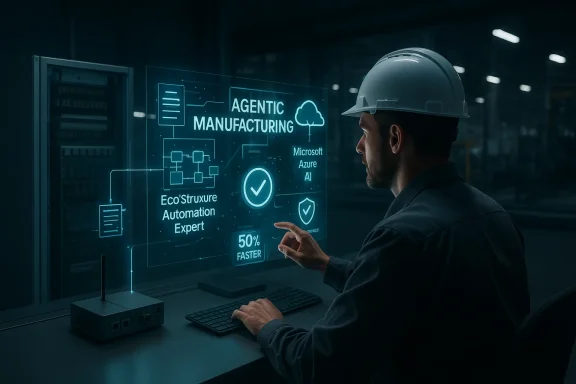
Schneider Electric’s Hannover Messe 2026 message is bigger than a product demo, and that is exactly why it matters. The company is not simply adding AI to industrial software; it is trying to redefine how factories are designed, validated, commissioned, and changed by pairing EcoStruxure Automation Expert with Microsoft Azure AI. The pitch is that “agentic manufacturing” can compress engineering cycles, reduce documentation overhead, and make production changes far faster without sacrificing control or compliance, with Schneider claiming time savings of up to 50% on configuration and documentation tasks . That is an ambitious claim, but it lands in a moment when manufacturers are under pressure to modernize without disrupting uptime, labor stability, or quality.
Schneider Electric has spent years building a case for software-defined automation, and that history is essential to understanding the current announcement. EcoStruxure Automation Expert is designed around portability, reusable logic, and deployment across hardware and environment boundaries, which makes it far more than a conventional controls product . The strategic logic is simple: if automation logic can be authored once and redeployed across sites, the cost and friction of change fall dramatically. In manufacturing, that is not a marginal convenience; it is an operating advantage.
Microsoft’s role has also been developing over time rather than appearing overnight. The company has spent several Hannover Messe cycles pushing industrial AI, digital twins, copilots, and workflow orchestration, gradually shifting the narrative from “AI as a helper” to “AI as a platform layer for industry” . In that framing, Azure AI is not just a model endpoint. It is the intelligence fabric around industrial data, helping connect maintenance records, production signals, documentation, and operator workflows into something more actionable and governable .
The significance of the 2026 announcement is that it represents a convergence of those two trajectories. Schneider brings the industrial control credibility, the open automation architecture, and the reality of plant-floor execution. Microsoft brings cloud scale, orchestration, and AI services that can reason over context rather than simply react to queries . Together, the companies are presenting a story in which AI is not bolted onto the side of manufacturing; it is inserted into the lifecycle itself.
That shift matters because the manufacturing industry has long struggled with the gap between engineering intent and shop-floor execution. Traditional automation environments are reliable, but they are often siloed, rigid, and expensive to modify when product mix, demand, or regulatory requirements change . The promise of agentic manufacturing is to reduce the cost of those handoffs and make change more repeatable. In a sector where every hour of downtime and every rework loop can be expensive, the appeal is obvious.
There is also a broader market context. Industrial AI is moving from proof-of-concept territory toward production-grade workflows, and buyers are becoming more selective about what counts as real value. They do not want novelty. They want repeatability, traceability, and measurable engineering savings. That is why the Schneider-Microsoft partnership lands differently than a generic chatbot announcement. It is being framed around the unglamorous but decisive details of manufacturing economics: validation, documentation, commissioning, and deployment speed.
The term agentic manufacturing is doing a lot of work here. It implies that software agents can assemble context, validate logic, generate documentation, and route decisions through the right workflow steps while humans remain responsible for final judgment . That is a more realistic industrial AI vision than full autonomy. Factories require deterministic behavior, auditability, and safety, so the real prize is not replacing engineers but automating the repetitive connective tissue that slows them down.
This is also why the announcement is strongest when it talks about engineering time. Schneider’s claim that configuration and documentation tasks can be cut by as much as 50% is strategically important even if the exact number varies by site and maturity level . In manufacturing, engineering time is not an abstract metric. It affects how quickly a plant can respond to product changes, adjust recipes, complete commissioning, and recover from disruptions.
The collaboration also fits a larger competitive shift in industrial technology. Cloud vendors, automation suppliers, and industrial software companies are all competing to become the control plane for industrial intelligence . That control plane is increasingly where value accumulates: not in any single algorithm, but in the architecture that determines how data, agents, engineers, and control systems interact. Schneider and Microsoft are trying to make their combined stack the default answer to that question.
Another important detail is that the companies are emphasizing trust and resiliency as much as speed. Microsoft’s Hannover Messe messaging around industrial intelligence has highlighted human-agent trust and AI grounded in reliable workflows . That is not marketing fluff. It reflects a real enterprise requirement: AI that cannot be audited or constrained is not useful in regulated industrial environments. The implication is that the winners in industrial AI will be the vendors who can balance ambition with operational discipline.
That matters because industrial projects are often slowed by fragmentation. Different teams handle design, simulation, commissioning, and operations, and each handoff introduces delay or error. By standardizing the workflow around a common automation layer, the companies are trying to reduce that friction and make deployment more predictable . In plain terms, they are attempting to turn a custom engineering problem into a repeatable software process.
The announcement also leans heavily on the idea of reusable automation packages. That is not just a technical convenience. It is a way of lowering the cost of standardization across plants, product lines, and geographies. If a logic package can be reused and validated once, it becomes much easier to scale change across a portfolio rather than rebuilding each site from scratch.
Key points:
If automation logic is still trapped in tightly coupled proprietary stacks, AI can only help at the margins. But if logic is modular and deployable across environments, AI can actually support engineering rather than simply summarize it. That is why the platform architecture matters more than the demo. A good industrial AI story needs a good industrial software story underneath it.
That is especially valuable in high-mix manufacturing, where product variations, seasonal demand, and regulatory changes can force frequent reconfiguration. In those environments, the ability to reuse validated assets can become a direct competitive advantage. It reduces the number of unique engineering problems the plant has to solve, which in turn reduces both cost and risk.
This is where the industrial software narrative becomes more compelling than the AI narrative alone. AI is the accelerator, but software-defined automation is the road. Without the road, the accelerator is just a flashy engine sitting in the driveway.
Benefits of the architecture:
That is why the Microsoft framing around industrial intelligence emphasizes governance, traceability, and human-agent trust . The company is positioning Azure as the environment where industrial data can be unified, reasoned over, and tied to workflows that matter. This is a platform play, not a point product play.
This matters because plant managers do not trust systems that cannot explain themselves. They care about reproducibility, auditability, and the ability to trace decisions after the fact. If Azure AI can help create that kind of context-rich environment, Microsoft strengthens its position as a serious industrial platform provider rather than just another cloud vendor.
The competitive payoff is clear. If Microsoft becomes the AI layer that industrial customers rely on for coordination, it gains leverage far beyond one manufacturing use case. It also makes the Azure ecosystem harder to displace, because the value is increasingly embedded in the workflow rather than in a single application.
Important takeaways:
That matters because engineering cycles are often the hidden bottleneck in manufacturing transformation. Plants may know what they want to change, but the time required to validate, document, and deploy those changes can be long and expensive. By compressing that cycle, manufacturers can become more responsive without necessarily adding more headcount.
That is one reason this announcement is more credible than a generic AI story. It targets work that is repetitive, expensive, and essential, rather than trying to replace expert judgment. When the system helps engineers produce better documentation and validate logic earlier, fewer errors survive into commissioning or production. That saves time twice: once during setup and again when issues are avoided downstream.
The wider economic logic is straightforward. Shorter engineering cycles mean:
Factories are not office environments. They need deterministic response times, local resilience, segmented networks, and predictable uptime. A pure cloud model would create operational and political resistance, while a purely local model would limit the benefits of AI and shared intelligence. Hybrid is the middle path, and in manufacturing, it is often the only path that is realistic.
This is also where the Schneider-Microsoft pairing has a practical edge over many rivals. It is not asking customers to accept an all-or-nothing architecture. Instead, it offers a path that can be introduced gradually, proving value in one part of the workflow before expanding into others. That incrementalism is not a weakness. It is often the reason enterprise adoption succeeds.
Advantages of hybrid:
For Schneider Electric, the opportunity is to strengthen its position as a software-defined automation leader with real-world industrial credibility. For Microsoft, the goal is to make Azure indispensable to industrial customers who need AI, governance, and orchestration in one stack. Together, they are trying to prove that the most valuable industrial AI platform is one that combines trusted execution with modern intelligence.
That is a tough standard, but it is becoming the market reality. Industrial buyers have little patience for shallow copilots that produce text but do not reduce engineering friction. They want systems that can help standardize the work, lower the cost of change, and improve reliability at scale.
The likely competitive battlegrounds are:
The opportunity is not just technical. It is commercial, organizational, and operational. If the companies can prove that agentic workflows cut engineering time, reduce documentation burden, and make changes safer, they can reshape how manufacturers justify automation spending. That opens the door to broader adoption across multi-site enterprises and regulated industries.
There is also a structural risk that AI becomes another layer of abstraction without enough value if the underlying data is poor. Context is the whole game in industrial AI. If the data is fragmented, stale, or poorly governed, the system can still generate noise instead of insight . In that case, the promise of agentic manufacturing would be harder to realize.
The other thing to watch is whether the companies broaden the stack. Today the message is centered on engineering, documentation, and workflow orchestration. Tomorrow it may extend further into digital twins, supply chain coordination, maintenance optimization, and cross-site standardization. That would strengthen the platform story and increase the economic value of the partnership.
Watch for:
The most important conclusion is that this announcement is less about one product launch than about a changing industrial philosophy. Manufacturing is moving toward systems that are more open, more reusable, and more governed by software, with AI serving as the connective tissue rather than the headline act. If that transition continues, the companies best positioned to win will be the ones that understand a simple truth: in industry, the real value of AI is not novelty, but operational leverage.
Source: Indovizka.com Schneider Electric unveils next generation agentic manufacturing capabilities powered by Microsoft Azure AI at Hannover Messe 2026
 Background
Schneider Electric has spent years building a case for software-defined automation, and that history is essential to understanding the current announcement. EcoStruxure Automation Expert is designed around portability, reusable logic, and deployment across hardware and environment boundaries, which makes it far more than a conventional controls product . The strategic logic is simple: if automation logic can be authored once and redeployed across sites, the cost and friction of change fall dramatically. In manufacturing, that is not a marginal convenience; it is an operating advantage.Microsoft’s role has also been developing over time rather than appearing overnight. The company has spent several Hannover Messe cycles pushing industrial AI, digital twins, copilots, and workflow orchestration, gradually shifting the narrative from “AI as a helper” to “AI as a platform layer for industry” . In that framing, Azure AI is not just a model endpoint. It is the intelligence fabric around industrial data, helping connect maintenance records, production signals, documentation, and operator workflows into something more actionable and governable .
The significance of the 2026 announcement is that it represents a convergence of those two trajectories. Schneider brings the industrial control credibility, the open automation architecture, and the reality of plant-floor execution. Microsoft brings cloud scale, orchestration, and AI services that can reason over context rather than simply react to queries . Together, the companies are presenting a story in which AI is not bolted onto the side of manufacturing; it is inserted into the lifecycle itself.
That shift matters because the manufacturing industry has long struggled with the gap between engineering intent and shop-floor execution. Traditional automation environments are reliable, but they are often siloed, rigid, and expensive to modify when product mix, demand, or regulatory requirements change . The promise of agentic manufacturing is to reduce the cost of those handoffs and make change more repeatable. In a sector where every hour of downtime and every rework loop can be expensive, the appeal is obvious.
There is also a broader market context. Industrial AI is moving from proof-of-concept territory toward production-grade workflows, and buyers are becoming more selective about what counts as real value. They do not want novelty. They want repeatability, traceability, and measurable engineering savings. That is why the Schneider-Microsoft partnership lands differently than a generic chatbot announcement. It is being framed around the unglamorous but decisive details of manufacturing economics: validation, documentation, commissioning, and deployment speed.
Overview
At the center of this story is the idea that industrial software should behave more like a living system than a fixed stack. Schneider Electric says its open automation platform can run across on-premises, edge, and hybrid environments, giving manufacturers flexibility without forcing a big-bang migration . Microsoft complements that with Azure AI and cloud orchestration, creating a path where intelligence can be applied before, during, and after deployment rather than only after problems appear.The term agentic manufacturing is doing a lot of work here. It implies that software agents can assemble context, validate logic, generate documentation, and route decisions through the right workflow steps while humans remain responsible for final judgment . That is a more realistic industrial AI vision than full autonomy. Factories require deterministic behavior, auditability, and safety, so the real prize is not replacing engineers but automating the repetitive connective tissue that slows them down.
This is also why the announcement is strongest when it talks about engineering time. Schneider’s claim that configuration and documentation tasks can be cut by as much as 50% is strategically important even if the exact number varies by site and maturity level . In manufacturing, engineering time is not an abstract metric. It affects how quickly a plant can respond to product changes, adjust recipes, complete commissioning, and recover from disruptions.
The collaboration also fits a larger competitive shift in industrial technology. Cloud vendors, automation suppliers, and industrial software companies are all competing to become the control plane for industrial intelligence . That control plane is increasingly where value accumulates: not in any single algorithm, but in the architecture that determines how data, agents, engineers, and control systems interact. Schneider and Microsoft are trying to make their combined stack the default answer to that question.
Another important detail is that the companies are emphasizing trust and resiliency as much as speed. Microsoft’s Hannover Messe messaging around industrial intelligence has highlighted human-agent trust and AI grounded in reliable workflows . That is not marketing fluff. It reflects a real enterprise requirement: AI that cannot be audited or constrained is not useful in regulated industrial environments. The implication is that the winners in industrial AI will be the vendors who can balance ambition with operational discipline.
What Schneider Electric and Microsoft Actually Announced
The core announcement is straightforward, but the implications are broad. Schneider Electric is using Microsoft Azure AI with EcoStruxure Automation Expert to create a more adaptive automation environment that spans cloud, edge, and on-premises deployments . Microsoft’s language around “agentic design” suggests a closed loop from engineering intent to operational reality, where early validation and reusable automation packages reduce downstream rework.That matters because industrial projects are often slowed by fragmentation. Different teams handle design, simulation, commissioning, and operations, and each handoff introduces delay or error. By standardizing the workflow around a common automation layer, the companies are trying to reduce that friction and make deployment more predictable . In plain terms, they are attempting to turn a custom engineering problem into a repeatable software process.
Why the wording matters
The phrase agentic sounds futuristic, but in practice it points to delegation with guardrails. Software agents can gather context, prepare decisions, validate outputs, and hand off tasks, while humans retain approval authority over the important steps . That distinction is crucial. Industrial leaders are not looking for magic; they are looking for fewer manual steps and fewer opportunities for error.The announcement also leans heavily on the idea of reusable automation packages. That is not just a technical convenience. It is a way of lowering the cost of standardization across plants, product lines, and geographies. If a logic package can be reused and validated once, it becomes much easier to scale change across a portfolio rather than rebuilding each site from scratch.
Key points:
- The workflow is centered on reusability rather than one-off coding.
- Validation first is a major theme, not an afterthought.
- The architecture assumes human oversight, not full automation.
- The goal is faster deployment with less rework.
- The model is designed to support hybrid industrial environments.
Why Software-Defined Automation Is the Real Story
The big strategic story is not AI in isolation. It is software-defined automation becoming the backbone of industrial change. Schneider Electric has been pushing this model for years, arguing that logic should be portable, reusable, and less dependent on rigid hardware coupling . That philosophy is what makes AI assistance meaningful in the first place.If automation logic is still trapped in tightly coupled proprietary stacks, AI can only help at the margins. But if logic is modular and deployable across environments, AI can actually support engineering rather than simply summarize it. That is why the platform architecture matters more than the demo. A good industrial AI story needs a good industrial software story underneath it.
From rigid control to adaptable control
Manufacturers have long accepted that automation systems should be reliable. The harder challenge is making them adaptable without sacrificing determinism. Software-defined automation addresses that problem by separating more of the logic from the hardware layer, allowing changes to be simulated and redeployed more easily .That is especially valuable in high-mix manufacturing, where product variations, seasonal demand, and regulatory changes can force frequent reconfiguration. In those environments, the ability to reuse validated assets can become a direct competitive advantage. It reduces the number of unique engineering problems the plant has to solve, which in turn reduces both cost and risk.
This is where the industrial software narrative becomes more compelling than the AI narrative alone. AI is the accelerator, but software-defined automation is the road. Without the road, the accelerator is just a flashy engine sitting in the driveway.
Benefits of the architecture:
- Faster engineering cycles
- Less custom integration per site
- Improved portability of logic
- Lower risk during changeovers
- Better support for mixed hardware environments
- Stronger standardization across plants
The Microsoft Azure AI Layer
Microsoft’s contribution is not simply model access. Azure AI acts as the orchestration and context layer around Schneider’s automation platform . In manufacturing, context is everything. A recommendation that ignores maintenance history, production constraints, or compliance requirements is not helpful; it is a liability.That is why the Microsoft framing around industrial intelligence emphasizes governance, traceability, and human-agent trust . The company is positioning Azure as the environment where industrial data can be unified, reasoned over, and tied to workflows that matter. This is a platform play, not a point product play.
Why context beats raw model power
The practical value of Azure AI in factories is that it can connect different kinds of information. Maintenance logs, production signals, documentation, and workflow steps can be brought into the same governed system, which gives the AI something more useful than a generic prompt response . In an industrial setting, that difference can separate a good recommendation from a bad one.This matters because plant managers do not trust systems that cannot explain themselves. They care about reproducibility, auditability, and the ability to trace decisions after the fact. If Azure AI can help create that kind of context-rich environment, Microsoft strengthens its position as a serious industrial platform provider rather than just another cloud vendor.
The competitive payoff is clear. If Microsoft becomes the AI layer that industrial customers rely on for coordination, it gains leverage far beyond one manufacturing use case. It also makes the Azure ecosystem harder to displace, because the value is increasingly embedded in the workflow rather than in a single application.
Important takeaways:
- Azure AI is being positioned as an orchestration layer.
- The value is in context, not just model generation.
- Governance and traceability are central to the pitch.
- The platform is designed for hybrid industrial deployment.
- Microsoft is competing for the industrial control plane.
Engineering Efficiency and the Business Case
The most concrete claim in the announcement is the productivity gain. Schneider says its industrial copilot, powered by Azure AI, is already reducing time spent on control configuration and documentation by up to 50% . Even if that figure varies by use case, the direction of travel is unmistakable: the labor-intensive parts of industrial engineering are the first targets for AI-assisted automation.That matters because engineering cycles are often the hidden bottleneck in manufacturing transformation. Plants may know what they want to change, but the time required to validate, document, and deploy those changes can be long and expensive. By compressing that cycle, manufacturers can become more responsive without necessarily adding more headcount.
Why documentation is not a side issue
Documentation is frequently dismissed as overhead, but in industry it is part of the control system’s memory. It supports traceability, compliance, maintenance continuity, and knowledge transfer. Automating documentation is therefore not just a productivity gain; it is also a risk-management improvement .That is one reason this announcement is more credible than a generic AI story. It targets work that is repetitive, expensive, and essential, rather than trying to replace expert judgment. When the system helps engineers produce better documentation and validate logic earlier, fewer errors survive into commissioning or production. That saves time twice: once during setup and again when issues are avoided downstream.
The wider economic logic is straightforward. Shorter engineering cycles mean:
- Faster commissioning
- Lower integration overhead
- Less manual rework
- Reduced changeover friction
- Improved utilization of scarce engineering talent
Hybrid Deployment Is Not a Compromise; It Is the Strategy
One of the smartest elements in the announcement is the emphasis on hybrid deployment. Schneider Electric’s platform is designed to operate across on-premises, edge, and hybrid environments, while Microsoft brings cloud intelligence into that environment rather than replacing it . That approach matches how real factories actually work.Factories are not office environments. They need deterministic response times, local resilience, segmented networks, and predictable uptime. A pure cloud model would create operational and political resistance, while a purely local model would limit the benefits of AI and shared intelligence. Hybrid is the middle path, and in manufacturing, it is often the only path that is realistic.
Why hybrid wins in industrial settings
Hybrid deployment allows companies to preserve their existing investments while modernizing incrementally. That matters because most manufacturers are not going to rip out reliable control systems just to adopt AI. They want to add intelligence without destabilizing production, and they want migration to happen site by site, not all at once.This is also where the Schneider-Microsoft pairing has a practical edge over many rivals. It is not asking customers to accept an all-or-nothing architecture. Instead, it offers a path that can be introduced gradually, proving value in one part of the workflow before expanding into others. That incrementalism is not a weakness. It is often the reason enterprise adoption succeeds.
Advantages of hybrid:
- Local control remains deterministic
- Edge reduces latency and supports resilience
- Cloud adds scale and intelligence
- Existing systems can stay in place longer
- Adoption can proceed in phases
- IT and OT concerns are easier to reconcile
Competitive Implications
The partnership sends a clear signal to the market: industrial AI is moving from isolated pilots to platform competition. Cloud providers, automation vendors, and software companies are all trying to become the layer that coordinates industrial intelligence . That competition is about more than feature sets. It is about who controls the workflow.For Schneider Electric, the opportunity is to strengthen its position as a software-defined automation leader with real-world industrial credibility. For Microsoft, the goal is to make Azure indispensable to industrial customers who need AI, governance, and orchestration in one stack. Together, they are trying to prove that the most valuable industrial AI platform is one that combines trusted execution with modern intelligence.
What rivals have to prove
Competing vendors will need to show more than impressive demos. They will need to demonstrate that their systems improve real engineering throughput, support traceability, and work across multiple deployment environments . If they cannot prove that, they risk being relegated to the category of point solutions and innovation theater.That is a tough standard, but it is becoming the market reality. Industrial buyers have little patience for shallow copilots that produce text but do not reduce engineering friction. They want systems that can help standardize the work, lower the cost of change, and improve reliability at scale.
The likely competitive battlegrounds are:
- Platform depth versus feature breadth
- Open standards versus lock-in
- Hybrid deployment versus cloud-only ambition
- Auditability versus black-box automation
- Repeatability versus one-off customization
Strengths and Opportunities
The strongest feature of this announcement is that it ties AI to a concrete industrial architecture rather than presenting it as a standalone capability. Schneider Electric brings an operationally credible automation platform, and Microsoft brings the AI and orchestration layer that can make that platform more adaptive . That combination gives the partnership a serious shot at moving beyond experimentation and into repeatable deployments.The opportunity is not just technical. It is commercial, organizational, and operational. If the companies can prove that agentic workflows cut engineering time, reduce documentation burden, and make changes safer, they can reshape how manufacturers justify automation spending. That opens the door to broader adoption across multi-site enterprises and regulated industries.
- Clear engineering ROI through configuration and documentation savings
- Strong alignment between OT, IT, and AI
- A credible base in EcoStruxure Automation Expert
- Better lifecycle continuity from design to operations
- Strong fit for regulated environments
- Potential for multi-site standardization
- Improved resilience through faster validation and change management
Risks and Concerns
The biggest risk is that the rhetoric runs ahead of the deployment footprint. Industrial buyers are right to be skeptical of broad time-saving claims unless they can see them in their own environments. Schneider’s reported gains are promising, but they will be scrutinized carefully in sectors where complexity, legacy infrastructure, and safety requirements are high .There is also a structural risk that AI becomes another layer of abstraction without enough value if the underlying data is poor. Context is the whole game in industrial AI. If the data is fragmented, stale, or poorly governed, the system can still generate noise instead of insight . In that case, the promise of agentic manufacturing would be harder to realize.
- Deployment may be harder in legacy-heavy plants
- ROI will vary widely by site maturity
- Poor data quality can limit AI usefulness
- Safety and compliance concerns will slow autonomy
- Customers may resist any hint of vendor lock-in
- Integration work could still be costly despite the platform story
- The word agentic may create expectations that exceed the real product
Looking Ahead
The next phase of this story will be about proof, not promise. The key question is whether Schneider Electric and Microsoft can show repeatable outcomes across multiple plants, sectors, and operating environments. If they can, the collaboration could become a reference model for industrial AI adoption rather than just another trade-show announcement.The other thing to watch is whether the companies broaden the stack. Today the message is centered on engineering, documentation, and workflow orchestration. Tomorrow it may extend further into digital twins, supply chain coordination, maintenance optimization, and cross-site standardization. That would strengthen the platform story and increase the economic value of the partnership.
Watch for:
- Additional customer case studies with measurable outcomes
- Expansion of agentic workflows beyond engineering tasks
- Closer integration with digital twin and simulation tools
- Wider adoption in regulated industrial sectors
- Competitive responses from rival automation and cloud vendors
The most important conclusion is that this announcement is less about one product launch than about a changing industrial philosophy. Manufacturing is moving toward systems that are more open, more reusable, and more governed by software, with AI serving as the connective tissue rather than the headline act. If that transition continues, the companies best positioned to win will be the ones that understand a simple truth: in industry, the real value of AI is not novelty, but operational leverage.
Source: Indovizka.com Schneider Electric unveils next generation agentic manufacturing capabilities powered by Microsoft Azure AI at Hannover Messe 2026
