

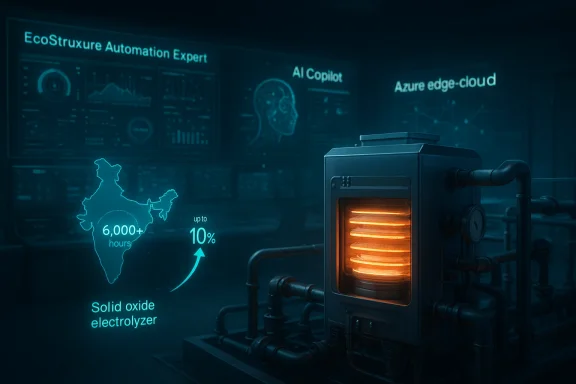
Schneider Electric’s deepening work with Microsoft is another sign that industrial automation is entering a new software-first phase, and this time the implications reach far beyond pilot projects. The companies are positioning open, AI-powered automation as a practical alternative to legacy control architectures that have constrained factories, plants, and energy systems for decades. Their collaboration also arrives with a live proof point in India, where Schneider Electric and h2e POWER say they have deployed a fully autonomous solid oxide electrolyzer system that has run for more than 6,000 hours and improved energy efficiency enough to materially change the economics of green hydrogen. That combination of platform strategy and field validation is what makes this story matter now.
Industrial automation has long been shaped by proprietary hardware, tightly coupled software stacks, and vendor-specific engineering tools. That model worked when plants changed slowly, but it has become a drag in an era defined by labor shortages, software-defined operations, and rapidly evolving energy and sustainability requirements. Schneider Electric has spent years arguing that industrial systems need the same kind of abstraction and modularity that transformed enterprise IT, and Microsoft has been building the cloud, edge, and AI infrastructure to support that shift.
The timing is important. Microsoft has repeatedly framed industrial AI as a blend of cloud intelligence, edge inference, and domain-specific copilots, while Schneider Electric has emphasized open automation and reusable software applications. In 2023 and 2024, Microsoft customer stories highlighted Schneider’s use of Azure OpenAI Service, Azure Machine Learning, and copilots for energy management and PLC code generation. That history makes the current collaboration look less like a one-off announcement and more like a deliberate expansion of an established industrial AI roadmap.
At the center of the latest push is EcoStruxure Automation Expert, Schneider Electric’s open, software-defined automation environment, which is designed to decouple software from hardware and let customers reuse automation applications across equipment generations and vendors. Schneider has said this platform is the basis for its newer industrial copilot offerings, including the automation assistant it has shown at Hannover Messe 2025 and Automate 2025. Microsoft, meanwhile, is contributing the cloud and AI substrate through Azure, Azure OpenAI Service, and its broader industrial cloud stack.
The h2e POWER deployment gives the strategy a concrete industrial use case. Hydrogen production is notoriously difficult to optimize because uptime, thermal stability, safety, and energy efficiency all interact in real time. Schneider and h2e POWER say the autonomous solid oxide electrolyzer system has improved control over those variables, reduced stack wear, and cut electricity consumption by up to 10% in a process where power dominates operating cost. If those numbers hold at larger scale, the business case for industrial AI becomes much easier to defend.
Microsoft’s role in this story is less about selling a generic AI model and more about creating a manufacturing-grade cloud stack. The company has repeatedly described an “adaptive cloud” approach for industrial data, where edge devices normalize data locally and send insights to the cloud and back. That architecture matters because industrial AI rarely works well if every decision has to traverse a distant datacenter. Real plants need local inference, deterministic behavior, and strong data governance.
Schneider Electric has already used that philosophy in customer-facing software. Microsoft customer stories describe EcoStruxure Resource Advisor Copilot and other Schneider tools built on Azure OpenAI Service to help customers manage energy use, optimize large distributed building portfolios, and accelerate PLC code generation. Those examples show that Schneider was not merely experimenting with generative AI for office productivity. It was applying AI to the actual engineering and energy management workflows that define industrial value.
The broader industry backdrop also matters. Siemens and Microsoft have been promoting Industrial Copilot concepts since 2023, and Microsoft’s industrial messaging in 2024 and 2025 has emphasized partnerships with Rockwell, Schneider Electric, AVEVA, and others. In other words, the market is converging on a familiar pattern: domain specialists bring process expertise, while hyperscalers supply AI, data integration, and cloud scale. The race is now over whose stack becomes the default abstraction layer for industrial operations.
The strategic logic is compelling because it addresses one of the hardest industrial problems: modernization without interruption. Many factories cannot afford a big-bang replacement, and many utilities cannot tolerate extended downtime. By emphasizing vendor neutrality and reuse across hardware generations, Schneider is trying to reduce the cost of inertia that typically delays modernization for years. That is a subtle but important competitive advantage.
Microsoft’s contribution is equally strategic. Azure gives the collaboration a path for secure cloud connectivity, edge deployments, data normalization, and AI inference. It also brings a familiar enterprise procurement model to industrial buyers who already use Microsoft tooling in other parts of the organization. For CIOs and CTOs, that matters because industrial transformation often fails not on technology capability, but on organizational alignment.
That shift could be transformative if it proves reliable. An industrial copilot that shortens code creation, validation, and troubleshooting would not just save time; it would also lower the threshold for iterative improvement. In manufacturing, the difference between a project that takes weeks and one that takes hours can determine whether a change ever happens at all.
The open-stack approach is designed to reduce vendor lock-in, but its deeper value is operational flexibility. If software can move more freely between hardware generations, companies can modernize incrementally and preserve prior investments. That is especially attractive in sectors like chemicals, water, mining, energy, and food processing, where equipment lifecycles can stretch over decades and plants rarely have the luxury of replacing everything at once.
Microsoft’s cloud role complements that model. Instead of treating automation as a closed control problem, the architecture treats plant data as a structured resource that can feed analytics, copilots, and business systems. In effect, Azure becomes the connective tissue between industrial assets and enterprise decision-making. That is consistent with Microsoft’s broader manufacturing strategy, which has focused on data solutions, Copilot Studio, and industrial AI demos across the edge-cloud continuum.
The “edge” part is especially important for operational continuity. Plants often need local decision-making even when network conditions are imperfect or the cloud connection is unavailable. That is why the combination of Azure cloud services and edge inference is more than a technical preference; it is a practical necessity for industrial workloads. It also makes the AI deployment easier to trust because the system can keep operating even when connectivity is degraded.
Schneider’s industrial copilot concept is built around this reality. The goal is not to replace engineers, but to compress the time it takes for them to convert knowledge into action. If a copilot can suggest validated code, help interpret documentation, and surface likely causes of equipment issues, it can remove a substantial amount of friction from daily operations. That is a meaningful productivity gain in an environment where skilled labor is scarce.
That is significant because green hydrogen economics are brutal. Electricity often accounts for more than 70% of hydrogen production cost, so even modest efficiency gains can matter a great deal. In that context, a 10% reduction in electricity use can meaningfully improve the levelized cost of hydrogen, especially in commercial-scale plants where every percentage point affects payback.
The technical challenge is also harder than it may look. Solid oxide electrolyzers operate under demanding thermal conditions, and autonomous control requires more than a basic monitoring dashboard. The system must manage thermal balance, hydrogen flow, energy input, and equipment health in real time while remaining stable enough to operate for thousands of hours. That makes the demonstration a credible test case for industrial AI under high-stakes conditions.
The claim that engineering teams can save up to 50% of their time is more difficult to generalize, but it is directionally consistent with what copilots are trying to do in industrial settings. When code generation, documentation lookup, and system configuration are accelerated, the compounded time savings can be substantial. The key question is whether those savings survive validation, change management, and the demands of production-grade reliability.
Likewise, the statement that a typical 10 MW plant could see about €500,000 in annual savings from a 10% cost reduction should be treated as an illustrative benchmark rather than a universal guarantee. But it is still useful because it shows how quickly industrial AI can translate into financial terms executives understand. In energy-intensive sectors, a small operational gain can create an outsized business impact.
Schneider’s differentiator is its emphasis on open automation and migration without wholesale replacement. That may be especially attractive to customers with large installed bases who are wary of getting trapped in a new proprietary stack. If Schneider can prove that its platform protects existing investments while still enabling AI, it could win customers who want modernization without strategic dependency.
Microsoft’s differentiator is the breadth of its cloud and AI ecosystem. Its industrial partners can leverage Azure, edge services, Fabric, Copilot Studio, and AI models in a way that goes well beyond one narrow product. That gives Microsoft an advantage in ecosystem gravity, because industrial customers increasingly want a platform that can connect engineering, operations, maintenance, and enterprise analytics without stitching together too many disconnected tools.
Schneider will also need to keep threading a difficult needle: protecting existing industrial investments while convincing customers that software-defined automation is worth the transition. Microsoft, for its part, will need to continue proving that its cloud and AI stack can meet the reliability, latency, and security demands of real production environments. If both companies execute well, they could help reset expectations for how industrial automation is bought, deployed, and improved.
Source: Bisinfotech Schneider Electric and Microsoft advance AI industrial automation
 Overview
Industrial automation has long been shaped by proprietary hardware, tightly coupled software stacks, and vendor-specific engineering tools. That model worked when plants changed slowly, but it has become a drag in an era defined by labor shortages, software-defined operations, and rapidly evolving energy and sustainability requirements. Schneider Electric has spent years arguing that industrial systems need the same kind of abstraction and modularity that transformed enterprise IT, and Microsoft has been building the cloud, edge, and AI infrastructure to support that shift.The timing is important. Microsoft has repeatedly framed industrial AI as a blend of cloud intelligence, edge inference, and domain-specific copilots, while Schneider Electric has emphasized open automation and reusable software applications. In 2023 and 2024, Microsoft customer stories highlighted Schneider’s use of Azure OpenAI Service, Azure Machine Learning, and copilots for energy management and PLC code generation. That history makes the current collaboration look less like a one-off announcement and more like a deliberate expansion of an established industrial AI roadmap.
At the center of the latest push is EcoStruxure Automation Expert, Schneider Electric’s open, software-defined automation environment, which is designed to decouple software from hardware and let customers reuse automation applications across equipment generations and vendors. Schneider has said this platform is the basis for its newer industrial copilot offerings, including the automation assistant it has shown at Hannover Messe 2025 and Automate 2025. Microsoft, meanwhile, is contributing the cloud and AI substrate through Azure, Azure OpenAI Service, and its broader industrial cloud stack.
The h2e POWER deployment gives the strategy a concrete industrial use case. Hydrogen production is notoriously difficult to optimize because uptime, thermal stability, safety, and energy efficiency all interact in real time. Schneider and h2e POWER say the autonomous solid oxide electrolyzer system has improved control over those variables, reduced stack wear, and cut electricity consumption by up to 10% in a process where power dominates operating cost. If those numbers hold at larger scale, the business case for industrial AI becomes much easier to defend.
Background
The industrial world has spent years talking about digital transformation, but in many plants the reality still looks stubbornly old-fashioned. Control systems are often tied to specific hardware, updates can be painful, and vendor lock-in makes modernization expensive. That creates a paradox: industrial operators know they need more software flexibility, but their installed base makes moving slowly the rational choice. Schneider Electric has built much of its modern industrial narrative around breaking that stalemate.Microsoft’s role in this story is less about selling a generic AI model and more about creating a manufacturing-grade cloud stack. The company has repeatedly described an “adaptive cloud” approach for industrial data, where edge devices normalize data locally and send insights to the cloud and back. That architecture matters because industrial AI rarely works well if every decision has to traverse a distant datacenter. Real plants need local inference, deterministic behavior, and strong data governance.
Schneider Electric has already used that philosophy in customer-facing software. Microsoft customer stories describe EcoStruxure Resource Advisor Copilot and other Schneider tools built on Azure OpenAI Service to help customers manage energy use, optimize large distributed building portfolios, and accelerate PLC code generation. Those examples show that Schneider was not merely experimenting with generative AI for office productivity. It was applying AI to the actual engineering and energy management workflows that define industrial value.
The broader industry backdrop also matters. Siemens and Microsoft have been promoting Industrial Copilot concepts since 2023, and Microsoft’s industrial messaging in 2024 and 2025 has emphasized partnerships with Rockwell, Schneider Electric, AVEVA, and others. In other words, the market is converging on a familiar pattern: domain specialists bring process expertise, while hyperscalers supply AI, data integration, and cloud scale. The race is now over whose stack becomes the default abstraction layer for industrial operations.
Why this matters now
The industrial software market is moving from digitization to orchestration. Companies are no longer satisfied with dashboards and isolated analytics; they want automation systems that can learn, recommend, and eventually act. That makes copilots, edge AI, and open automation more than marketing language. They are becoming the mechanism through which industrial firms try to bridge the gap between legacy assets and future operating models.The Schneider-Microsoft Collaboration
Schneider Electric’s collaboration with Microsoft is best understood as a layered architecture rather than a single product announcement. The companies are combining Schneider’s industrial domain knowledge and automation stack with Microsoft’s cloud, AI, and edge infrastructure. The pitch is simple: make it easier for industrial companies to modernize without ripping out working infrastructure or taking full production outages.The strategic logic is compelling because it addresses one of the hardest industrial problems: modernization without interruption. Many factories cannot afford a big-bang replacement, and many utilities cannot tolerate extended downtime. By emphasizing vendor neutrality and reuse across hardware generations, Schneider is trying to reduce the cost of inertia that typically delays modernization for years. That is a subtle but important competitive advantage.
Microsoft’s contribution is equally strategic. Azure gives the collaboration a path for secure cloud connectivity, edge deployments, data normalization, and AI inference. It also brings a familiar enterprise procurement model to industrial buyers who already use Microsoft tooling in other parts of the organization. For CIOs and CTOs, that matters because industrial transformation often fails not on technology capability, but on organizational alignment.
The software-defined automation thesis
The real idea here is software-defined automation, which separates control logic from specific hardware and lets automation applications move more freely across systems. That is a major break from traditional industrial control, where functionality is frequently bound to a vendor’s PLCs, engineering tools, and runtime environment. Schneider’s argument is that once the abstraction layer changes, innovation can move much faster.- Reuse automation applications across sites and equipment families.
- Reduce the friction of upgrading plants in phases.
- Decouple engineering productivity from hardware replacement cycles.
- Standardize data access for AI, analytics, and remote operations.
- Accelerate integration of new equipment and new vendors.
Industrial Copilot as a workflow change
The copilot angle is especially important because it targets the bottleneck that actually slows projects down: engineering labor. Schneider and Microsoft have described automation copilots that help generate control logic, configure systems, and navigate technical documentation. In practical terms, that means reducing the repetitive work that occupies highly paid engineers and slows the release cycle for production changes.That shift could be transformative if it proves reliable. An industrial copilot that shortens code creation, validation, and troubleshooting would not just save time; it would also lower the threshold for iterative improvement. In manufacturing, the difference between a project that takes weeks and one that takes hours can determine whether a change ever happens at all.
EcoStruxure Automation Expert and the Open Stack
Schneider Electric keeps returning to EcoStruxure Automation Expert because it is the core of the company’s open-automation argument. Schneider describes it as the world’s first open, software-defined automation solution, and the newer EcoStruxure Automation Expert Platform extends that concept into a unified environment for control logic, motion, HMI, safety, and simulation. That matters because many industrial stacks still treat those capabilities as separate silos.The open-stack approach is designed to reduce vendor lock-in, but its deeper value is operational flexibility. If software can move more freely between hardware generations, companies can modernize incrementally and preserve prior investments. That is especially attractive in sectors like chemicals, water, mining, energy, and food processing, where equipment lifecycles can stretch over decades and plants rarely have the luxury of replacing everything at once.
Microsoft’s cloud role complements that model. Instead of treating automation as a closed control problem, the architecture treats plant data as a structured resource that can feed analytics, copilots, and business systems. In effect, Azure becomes the connective tissue between industrial assets and enterprise decision-making. That is consistent with Microsoft’s broader manufacturing strategy, which has focused on data solutions, Copilot Studio, and industrial AI demos across the edge-cloud continuum.
Why openness changes the economics
Open automation is not just a philosophical preference. It changes how organizations buy, update, and scale operational technology. Closed systems often force customers into expensive replacement cycles, while open systems can extend asset life and reduce integration overhead. For executives trying to justify modernization, that can mean a cleaner ROI story and less fear of stranded investment.What the platform may enable
The platform could support a broader shift in industrial operating models. Instead of engineering every site as a bespoke project, companies could treat automation as a reusable software asset. That would enable more standardization across plants, more centralized governance, and faster deployment of AI-enabled workflows.- Faster migration away from obsolete control systems.
- More consistent engineering practices across sites.
- Lower integration cost for new equipment and software.
- Better readiness for AI-assisted maintenance and operations.
- Improved ability to scale pilot projects into portfolios.
Industrial AI at the Edge
Industrial AI is only useful when it can operate under real plant constraints. That means latency, safety, resilience, and data quality matter as much as model sophistication. Microsoft’s industrial cloud messaging has increasingly stressed the importance of edge normalization and cloud-to-edge feedback loops, which is exactly what manufacturing and energy applications require.The “edge” part is especially important for operational continuity. Plants often need local decision-making even when network conditions are imperfect or the cloud connection is unavailable. That is why the combination of Azure cloud services and edge inference is more than a technical preference; it is a practical necessity for industrial workloads. It also makes the AI deployment easier to trust because the system can keep operating even when connectivity is degraded.
Schneider’s industrial copilot concept is built around this reality. The goal is not to replace engineers, but to compress the time it takes for them to convert knowledge into action. If a copilot can suggest validated code, help interpret documentation, and surface likely causes of equipment issues, it can remove a substantial amount of friction from daily operations. That is a meaningful productivity gain in an environment where skilled labor is scarce.
Edge inference and trust
One of the most important design choices in industrial AI is where the model runs. Edge inference can preserve responsiveness and reduce dependency on external networks, while cloud services provide scale, training, and orchestration. In practice, successful industrial AI platforms will almost certainly be hybrid. That hybrid model is becoming the default architecture for serious industrial deployments.Enterprise and plant-floor impact
For enterprises, the benefit is visibility and standardization. For plant operators, the benefit is faster reaction time and fewer manual tasks. Those are related but not identical goals, and many industrial software projects fail because they optimize for one and ignore the other. A useful copilot has to satisfy both the boardroom and the control room.- Enterprise teams want standard reporting and portfolio control.
- Operators want actionable guidance at the moment of decision.
- Engineers want code generation and validation that they can trust.
- Maintenance teams want faster diagnosis and predictive support.
- Executives want measurable gains in productivity and uptime.
The h2e POWER Green Hydrogen Demonstration
The h2e POWER project is the most tangible evidence that this collaboration is moving beyond slideware. Schneider Electric and h2e POWER say they deployed India’s first fully autonomous solid oxide electrolyzer system and that it has exceeded 6,000 hours of stable operation in part-load and full-load conditions. They also say the system supports just-in-time predictive maintenance and has the potential to reduce electricity consumption by up to 10%.That is significant because green hydrogen economics are brutal. Electricity often accounts for more than 70% of hydrogen production cost, so even modest efficiency gains can matter a great deal. In that context, a 10% reduction in electricity use can meaningfully improve the levelized cost of hydrogen, especially in commercial-scale plants where every percentage point affects payback.
The technical challenge is also harder than it may look. Solid oxide electrolyzers operate under demanding thermal conditions, and autonomous control requires more than a basic monitoring dashboard. The system must manage thermal balance, hydrogen flow, energy input, and equipment health in real time while remaining stable enough to operate for thousands of hours. That makes the demonstration a credible test case for industrial AI under high-stakes conditions.
Why the hydrogen use case matters
Hydrogen is often discussed as a climate solution, but it is also a systems-engineering problem. If automation can reduce maintenance burden and improve thermal stability, it can lower operational risk as well as cost. That makes hydrogen a useful proving ground for industrial AI because the stakes are economic, operational, and environmental all at once.Interpreting the reported gains
The reported efficiency improvement is promising, but it should be read carefully. The figures come from company reporting, and industrial demonstrations often outperform or underperform when they move from pilot scale to broader deployment. Still, a stable autonomous run of this length is a meaningful indicator that the control approach is mature enough to warrant attention.- 6,000+ hours of operation suggests durability, not just novelty.
- Predictive maintenance can reduce reactive interventions.
- Thermal control is central to SOEC performance and longevity.
- Lower electricity use directly improves cost competitiveness.
- Remote management can free operators for higher-value tasks.
What the Numbers Really Suggest
The strongest claim in the story is not that AI can improve automation. That is now broadly accepted across the industry. The stronger claim is that AI can materially reshape operating economics when it is embedded into a well-designed industrial platform and validated in a real process environment. The h2e POWER demonstration is intended to prove exactly that.The claim that engineering teams can save up to 50% of their time is more difficult to generalize, but it is directionally consistent with what copilots are trying to do in industrial settings. When code generation, documentation lookup, and system configuration are accelerated, the compounded time savings can be substantial. The key question is whether those savings survive validation, change management, and the demands of production-grade reliability.
Likewise, the statement that a typical 10 MW plant could see about €500,000 in annual savings from a 10% cost reduction should be treated as an illustrative benchmark rather than a universal guarantee. But it is still useful because it shows how quickly industrial AI can translate into financial terms executives understand. In energy-intensive sectors, a small operational gain can create an outsized business impact.
Reading the claims with discipline
Industrial announcements often blend engineering results, product messaging, and market vision. That does not make them untrue, but it does mean readers should separate verified field performance from forward-looking estimates. The more mature the platform, the more likely it is that early claims will prove repeatable across multiple sites.The business case equation
For most buyers, the question will come down to cost, trust, and deployment friction. If a solution reduces downtime, lowers engineering effort, and improves energy efficiency without forcing a full system replacement, it becomes much easier to justify. That is why this announcement is strategically strong even if individual metrics vary by site.- Lower operating cost improves project economics.
- Faster engineering reduces deployment cycles.
- Better uptime protects production revenue.
- Open architecture reduces lock-in risk.
- AI-assisted maintenance can extend asset life.
Competitive Implications
Schneider Electric and Microsoft are not operating in a vacuum. Siemens and Microsoft have already been pushing Industrial Copilot concepts, Rockwell is active in AI-driven automation discussions, and the broader industrial software market is rapidly converging around the idea that generative AI belongs inside engineering workflows. The competitive question is no longer whether industrial copilots will exist, but which vendors can make them reliable enough for production.Schneider’s differentiator is its emphasis on open automation and migration without wholesale replacement. That may be especially attractive to customers with large installed bases who are wary of getting trapped in a new proprietary stack. If Schneider can prove that its platform protects existing investments while still enabling AI, it could win customers who want modernization without strategic dependency.
Microsoft’s differentiator is the breadth of its cloud and AI ecosystem. Its industrial partners can leverage Azure, edge services, Fabric, Copilot Studio, and AI models in a way that goes well beyond one narrow product. That gives Microsoft an advantage in ecosystem gravity, because industrial customers increasingly want a platform that can connect engineering, operations, maintenance, and enterprise analytics without stitching together too many disconnected tools.
Why rivals should pay attention
The biggest threat to competitors is not a single feature but an operating model. If Schneider and Microsoft make AI-assisted automation look safe, manageable, and incremental, they could normalize a deployment pattern that competitors will have to match. That would shift market expectations from “specialized digital project” to “standard industrial platform capability.”The broader market signal
The market is also seeing a convergence between sustainability and automation. Energy efficiency, carbon reduction, and operating resilience are no longer separate conversations. In that sense, the hydrogen demonstration is not just a green tech story; it is a signal that industrial AI will increasingly be judged on both financial and environmental performance.- Siemens remains a strong benchmark in industrial AI.
- Rockwell continues to shape automation buyer expectations.
- Schneider is betting on openness and reuse.
- Microsoft is betting on cloud scale and ecosystem depth.
- Customers are demanding faster ROI and lower integration pain.
Strengths and Opportunities
Schneider Electric and Microsoft have several advantages here. They are not trying to introduce AI into a vacuum; they are building on years of industrial cloud, automation, and energy-management work. That gives them credibility, a clearer route to adoption, and a better chance of connecting technical innovation to measurable business outcomes.- Established partnership with proven industrial and cloud overlap.
- Open automation strategy that reduces vendor lock-in concerns.
- Real-world proof from the h2e POWER hydrogen deployment.
- Strong enterprise reach through Microsoft’s ecosystem.
- Clear productivity angle for engineers and operators.
- Energy-efficiency benefits that support sustainability goals.
- Incremental migration path for legacy industrial environments.
Opportunity to scale from pilot to portfolio
The most compelling opportunity is to move from a successful demonstration to a repeatable deployment pattern. If the same architecture can be applied across hydrogen, water, discrete manufacturing, and energy infrastructure, the commercial upside could be significant. That would turn AI from a feature into a platform capability.Risks and Concerns
The collaboration is promising, but industrial buyers will still ask hard questions. The most obvious issue is whether the reported gains are reproducible across different plants, equipment types, and operating conditions. Industrial AI often performs well in controlled demonstrations and then becomes more complicated when exposed to variability, human overrides, and regulatory scrutiny.- Pilot-to-scale risk if results do not generalize.
- Data quality issues that can undermine AI recommendations.
- Cybersecurity exposure from deeper cloud-edge connectivity.
- Integration complexity in brownfield industrial environments.
- Operational trust gaps if engineers do not accept the copilot’s suggestions.
- Vendor coordination risk if the stack still depends on multiple partners.
- Regulatory and safety concerns in critical infrastructure use cases.
The trust problem
The biggest hidden challenge is confidence. Industrial operators do not adopt systems because they are intelligent; they adopt them because they are dependable, explainable, and safe. If the AI layer becomes another source of ambiguity, adoption could slow even if the technology is impressive.Security and governance
Deeper cloud integration also raises the stakes on cybersecurity and governance. Plants that connect more equipment to AI services must ensure that access controls, update policies, and failure modes are exceptionally well managed. In industrial settings, resilience is not optional, and any modernization story that ignores that reality will struggle in the field.Looking Ahead
The next phase of this collaboration will be judged by deployment breadth, not press-event polish. If Schneider and Microsoft can prove that industrial copilots and open automation reduce time to change, improve energy performance, and scale beyond headline demonstrations, they will have a powerful story for both enterprise buyers and plant operators. The h2e POWER project is a strong starting point, but the market will want to see multiple sectors and multiple operating environments before declaring the model a winner.Schneider will also need to keep threading a difficult needle: protecting existing industrial investments while convincing customers that software-defined automation is worth the transition. Microsoft, for its part, will need to continue proving that its cloud and AI stack can meet the reliability, latency, and security demands of real production environments. If both companies execute well, they could help reset expectations for how industrial automation is bought, deployed, and improved.
- Watch for additional customer deployments beyond hydrogen.
- Track whether the copilot moves from engineering aid to operational assistant.
- Look for evidence of faster migration from legacy PLC environments.
- Monitor whether energy savings remain consistent at larger scale.
- Assess how well the security and governance model holds up in critical infrastructure.
Source: Bisinfotech Schneider Electric and Microsoft advance AI industrial automation
