

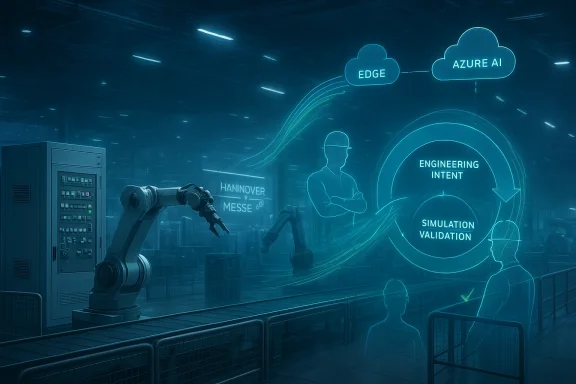
AI is moving deeper into the factory, and the latest Hannover Messe 2026 announcements suggest the industry is shifting from pilots to production-grade, software-defined operations. Schneider Electric and Microsoft used the show to frame agentic manufacturing as the next step in industrial AI, combining EcoStruxure Automation Expert with Azure cloud and AI services to standardize workflows, simulate automation logic, and shorten engineering cycles. That matters because the conversation is no longer just about smarter dashboards or predictive maintenance; it is about re-architecting how plants are designed, validated, and changed.
At the same time, the broader AI chip and infrastructure market is still being shaped by large strategic alliances. Broadcom’s expanded agreement with Meta through 2029, NVIDIA’s industrial software partnerships, and the continuing race to build custom silicon all point to one conclusion: the winners in AI will increasingly be the companies that connect chips, software, networking, and operational workflows into a coherent stack. For manufacturers, that stack is starting to look less like a collection of point tools and more like an operating model.
The manufacturing industry has spent years trying to close the gap between engineering intent and shop-floor execution. Traditional automation systems are reliable, but they are often rigid, siloed, and expensive to modify when production requirements change. In that environment, even modest adjustments can require significant engineering effort, long validation cycles, and deep specialist knowledge. That is why software-defined automation has become such a powerful idea: it promises portability, reuse, and faster change management without forcing manufacturers to rebuild everything from scratch.
Schneider Electric has been pushing this model for several years through its EcoStruxure portfolio, and Microsoft has been positioning Azure as the cloud layer that can ingest industrial data, support AI workflows, and extend automation beyond the local plant. What is different in 2026 is the language and ambition. The companies are now talking about agentic manufacturing, which implies AI systems that do not merely assist operators but participate in planning, validation, and orchestration across the industrial lifecycle.
That shift did not happen overnight. At Hannover Messe 2024 and 2025, Microsoft and partners increasingly emphasized industrial AI, digital threads, and factory operations agents, while Schneider Electric showcased AI-assisted automation, mixed reality, and unified automation platforms. Those earlier efforts helped build the conceptual bridge from “AI as a helper” to “AI as part of the control architecture.” In that sense, the 2026 announcement looks less like a standalone splash and more like the product of a multi-year industrial software roadmap.
The timing is also important from a market perspective. AI spending is still being driven by hyperscale infrastructure, custom accelerators, and cloud services, but the industrial sector is now asking a different question: how do we convert AI from a compute expense into operational leverage? The answer appears to be a combination of digital twins, reusable automation packages, cloud validation, and edge deployment. That is precisely the kind of stack Schneider Electric and Microsoft are trying to normalize.
The practical value is in standardization. Instead of treating each line, machine, or process variant as a separate engineering project, manufacturers can model the logic once, simulate it, validate it, and deploy it with less manual rework. That reduces the friction between design and production, which has historically been one of the most expensive bottlenecks in manufacturing transformation. It also makes faster product changes less disruptive, which is crucial in sectors where demand, regulation, or supply conditions shift quickly.
The companies are also framing this as a trust and resiliency story, not just a productivity story. Microsoft’s Hannover Messe theme, “Industrial Intelligence Unlocked,” is explicitly tied to human ingenuity and AI grounded in trust. That language is deliberate: industrial buyers want the upside of AI without sacrificing deterministic behavior, safety, or compliance.
This also changes the economics of automation projects. Conventional industrial transformation often fails not because the technology is weak, but because integration is slow, costly, and highly customized. By shifting more of that effort into a standardized software layer, Schneider Electric and Microsoft are essentially trying to commoditize the hard parts of automation engineering. That is exactly the kind of move that can unlock broad enterprise adoption.
There is also a workforce angle. Software-defined systems can reduce dependence on scarce specialists for every modification, though they do not eliminate the need for expertise. That distinction matters, because the goal is not to replace engineers but to amplify them with more repeatable tooling and better decision support.
But the word “agentic” should not be read as “fully autonomous.” In industrial environments, the control stack has to remain predictable, auditable, and safe. What appears to be happening here is a hybrid model in which AI proposes, simulates, and prepares actions while humans and deterministic control layers retain authority over execution. That is a more credible path than promising fully autonomous factories overnight.
This is one reason why the Microsoft-Schneider collaboration is significant: it is grounded in a known industrial execution platform rather than a generic AI overlay. The value lies in connecting data, simulation, and control in a way that respects the realities of factories. In other words, the AI is not replacing the control system; it is becoming part of the workflow that feeds it.
For enterprise customers, that flexibility can be decisive. Many industrial organizations have legacy systems, site-specific constraints, and strict requirements around latency, data sovereignty, and reliability. A hybrid architecture offers a more realistic migration path than a big-bang rip-and-replace strategy. It also aligns with the broader market trend toward distributed AI, where inference and orchestration happen closer to the equipment.
This approach also helps preserve investment in existing infrastructure. Manufacturers do not want to abandon proven controls just to modernize their software stack. By treating Azure as an enabling layer rather than a replacement for industrial systems, Schneider Electric and Microsoft are offering a modernization path that feels incremental rather than disruptive.
The green hydrogen example also reinforces the sustainability narrative. Industrial customers increasingly want AI systems that improve efficiency without creating excessive energy overhead or operational risk. If software-defined automation can stabilize operations while reducing engineering drag, it becomes easier to justify on both financial and environmental grounds.
Still, readers should separate demonstrated capability from universal readiness. Success in one environment does not automatically translate to every factory, process line, or geography. The broader significance is that the companies are trying to prove the model under tough conditions, which is exactly how industrial trust is built.
For manufacturers, this matters because industrial AI depends on more than inference speed. It depends on simulation, digital twins, networking, data pipelines, and integration with operational systems. NVIDIA’s recent industrial partnerships show how tightly hardware and industrial software are becoming linked, and Schneider Electric’s work with Microsoft sits in that same strategic lane, though with a different emphasis on automation architecture and cloud services.
Schneider Electric and Microsoft are clearly targeting the workflow layer, but they benefit from the broader silicon arms race because modern industrial AI workloads demand serious compute. That is why the manufacturing story cannot be separated from the chip story. The factory of the future will be shaped by the same economic forces driving data centers, only with stricter uptime and safety requirements.
Microsoft’s “Industrial Intelligence Unlocked” framing is especially telling. It suggests the company sees manufacturing as one of the next major battlegrounds for cloud, AI, and partner ecosystem expansion. The inclusion of Schneider Electric, ABB, TK Elevator, Bosch Connected Industries, and others reinforces that this is not a one-off marketing exercise but part of a broader industrial platform strategy.
That does not mean every demo becomes a deployment. It means the market is giving companies a chance to define what “modern manufacturing” should look like, and that definition is becoming more software-centric by the year. The strategic significance is that cloud and industrial automation are now being sold as a single transformation story.
It also benefits from timing. Manufacturing leaders are under pressure to improve resiliency, reduce complexity, and make plants more adaptive, while AI buyers are increasingly demanding concrete ROI. The collaboration sits neatly at that intersection, which could make it easier to move from pilot to procurement.
There is also the integration challenge. Even with an open, software-defined platform, most factories still have old hardware, custom logic, and fragmented data sources. That means implementation complexity will not disappear; it will just move to a different layer, and organizations may need new skills to manage that transition.
What happens next will also depend on ecosystem breadth. If Schneider Electric and Microsoft can get integrators, OEMs, and plant operators to build around the platform, the value could compound quickly. If not, the system may remain impressive but limited to flagship deployments and showcase events.
Source: Sahm AI Chips Update - AI Transforms Manufacturing Efficiency Through Strategic Partnerships
At the same time, the broader AI chip and infrastructure market is still being shaped by large strategic alliances. Broadcom’s expanded agreement with Meta through 2029, NVIDIA’s industrial software partnerships, and the continuing race to build custom silicon all point to one conclusion: the winners in AI will increasingly be the companies that connect chips, software, networking, and operational workflows into a coherent stack. For manufacturers, that stack is starting to look less like a collection of point tools and more like an operating model.
 Background
The manufacturing industry has spent years trying to close the gap between engineering intent and shop-floor execution. Traditional automation systems are reliable, but they are often rigid, siloed, and expensive to modify when production requirements change. In that environment, even modest adjustments can require significant engineering effort, long validation cycles, and deep specialist knowledge. That is why software-defined automation has become such a powerful idea: it promises portability, reuse, and faster change management without forcing manufacturers to rebuild everything from scratch.Schneider Electric has been pushing this model for several years through its EcoStruxure portfolio, and Microsoft has been positioning Azure as the cloud layer that can ingest industrial data, support AI workflows, and extend automation beyond the local plant. What is different in 2026 is the language and ambition. The companies are now talking about agentic manufacturing, which implies AI systems that do not merely assist operators but participate in planning, validation, and orchestration across the industrial lifecycle.
That shift did not happen overnight. At Hannover Messe 2024 and 2025, Microsoft and partners increasingly emphasized industrial AI, digital threads, and factory operations agents, while Schneider Electric showcased AI-assisted automation, mixed reality, and unified automation platforms. Those earlier efforts helped build the conceptual bridge from “AI as a helper” to “AI as part of the control architecture.” In that sense, the 2026 announcement looks less like a standalone splash and more like the product of a multi-year industrial software roadmap.
The timing is also important from a market perspective. AI spending is still being driven by hyperscale infrastructure, custom accelerators, and cloud services, but the industrial sector is now asking a different question: how do we convert AI from a compute expense into operational leverage? The answer appears to be a combination of digital twins, reusable automation packages, cloud validation, and edge deployment. That is precisely the kind of stack Schneider Electric and Microsoft are trying to normalize.
What Schneider Electric and Microsoft Actually Announced
The core announcement is straightforward but strategically significant. Schneider Electric said it is using Microsoft Azure AI with EcoStruxure Automation Expert to create a more open, adaptive automation environment that can run across on-premises, edge, and hybrid deployments. Microsoft described the effort as “agentic design,” emphasizing a closed loop from engineering intent to operational reality, with early validation and reusable automation packages that can move across cloud and edge environments.The practical value is in standardization. Instead of treating each line, machine, or process variant as a separate engineering project, manufacturers can model the logic once, simulate it, validate it, and deploy it with less manual rework. That reduces the friction between design and production, which has historically been one of the most expensive bottlenecks in manufacturing transformation. It also makes faster product changes less disruptive, which is crucial in sectors where demand, regulation, or supply conditions shift quickly.
Why this matters
A software-defined automation architecture can be more than a technical upgrade. It can become a governance model for industrial change, creating a common environment for engineers, operators, and data teams. That matters because factories are now expected to be both efficient and adaptable, often simultaneously.The companies are also framing this as a trust and resiliency story, not just a productivity story. Microsoft’s Hannover Messe theme, “Industrial Intelligence Unlocked,” is explicitly tied to human ingenuity and AI grounded in trust. That language is deliberate: industrial buyers want the upside of AI without sacrificing deterministic behavior, safety, or compliance.
- Open architecture is the selling point, not just AI features.
- Simulation first reduces downstream engineering churn.
- Cloud plus edge gives manufacturers flexibility in deployment.
- Reusable automation packages can shorten changeovers and commissioning.
- Trust and resiliency are becoming as important as speed.
- Operational consistency is the real economic prize.
The Manufacturing Efficiency Argument
The biggest promise here is shorter engineering time. If AI can help generate, validate, and adapt automation logic more quickly, plants can spend less time in setup and reconfiguration and more time producing. In sectors with frequent product variation, that difference can be the margin between scaling efficiently and being trapped by complexity.This also changes the economics of automation projects. Conventional industrial transformation often fails not because the technology is weak, but because integration is slow, costly, and highly customized. By shifting more of that effort into a standardized software layer, Schneider Electric and Microsoft are essentially trying to commoditize the hard parts of automation engineering. That is exactly the kind of move that can unlock broad enterprise adoption.
Engineering time as a strategic KPI
Engineers are not just building new lines; they are constantly updating, debugging, and validating existing ones. AI-assisted workflows can compress that cycle, especially when they are anchored to simulations and digital twins rather than live production risk. The result is less downtime, fewer risky changes, and faster introduction of new recipes, products, or production constraints.There is also a workforce angle. Software-defined systems can reduce dependence on scarce specialists for every modification, though they do not eliminate the need for expertise. That distinction matters, because the goal is not to replace engineers but to amplify them with more repeatable tooling and better decision support.
- Faster commissioning
- Lower integration overhead
- More repeatable change management
- Less risk during production transitions
- Better utilization of engineering talent
- Stronger alignment between plant and cloud teams
Agentic AI and the Industrial Control Stack
The phrase agentic manufacturing deserves attention because it signals a higher level of autonomy than the industry has typically embraced. In this model, AI systems can help make decisions, validate them early, and package automation logic for deployment. That is a step beyond basic analytics or predictive alerts, and it has serious implications for how factories are managed.But the word “agentic” should not be read as “fully autonomous.” In industrial environments, the control stack has to remain predictable, auditable, and safe. What appears to be happening here is a hybrid model in which AI proposes, simulates, and prepares actions while humans and deterministic control layers retain authority over execution. That is a more credible path than promising fully autonomous factories overnight.
Human oversight still matters
Manufacturing systems are physical systems, which means mistakes can damage equipment, interrupt supply chains, or create safety issues. As a result, the best industrial AI will likely be bounded intelligence rather than open-ended autonomy. It will operate inside guardrails, with validation steps and human sign-off where needed.This is one reason why the Microsoft-Schneider collaboration is significant: it is grounded in a known industrial execution platform rather than a generic AI overlay. The value lies in connecting data, simulation, and control in a way that respects the realities of factories. In other words, the AI is not replacing the control system; it is becoming part of the workflow that feeds it.
- Agentic AI can support decision-making without taking full control.
- Validation loops reduce the chance of expensive mistakes.
- Auditability is essential in regulated industries.
- Human-in-the-loop design remains the practical standard.
- Industrial AI succeeds when it is bounded by process, not hype.
The Azure and EcoStruxure Architecture
The architecture itself is a major part of the story. Schneider Electric says EcoStruxure Automation Expert runs consistently across on-premises, edge, and hybrid environments, while Microsoft Azure provides the AI and cloud layer. That combination is attractive because it gives manufacturers flexibility without forcing them into a cloud-only model that could be hard to justify operationally or politically.For enterprise customers, that flexibility can be decisive. Many industrial organizations have legacy systems, site-specific constraints, and strict requirements around latency, data sovereignty, and reliability. A hybrid architecture offers a more realistic migration path than a big-bang rip-and-replace strategy. It also aligns with the broader market trend toward distributed AI, where inference and orchestration happen closer to the equipment.
Why hybrid beats pure cloud in factories
Factories are not office environments. Machines need deterministic response times, networks can be segmented, and uptime expectations are unforgiving. Running every task in the cloud would add unnecessary complexity, while running everything locally can limit intelligence and scale. The hybrid model is the compromise that makes industrial AI practical.This approach also helps preserve investment in existing infrastructure. Manufacturers do not want to abandon proven controls just to modernize their software stack. By treating Azure as an enabling layer rather than a replacement for industrial systems, Schneider Electric and Microsoft are offering a modernization path that feels incremental rather than disruptive.
- On-premises control preserves local determinism.
- Edge deployment reduces latency and supports resilience.
- Hybrid models fit real-world manufacturing constraints.
- Azure AI adds modeling, orchestration, and data capabilities.
- The architecture is designed for evolution, not wholesale replacement.
Real-World Proof Points: Green Hydrogen and High-Performance Environments
One of the most compelling claims in the announcement is the reported success in high-performance environments such as green hydrogen production. That matters because hydrogen systems are complex, energy intensive, and unforgiving of inefficiency. Demonstrating stable operations there suggests the architecture can handle demanding industrial workloads rather than just demo-floor scenarios.The green hydrogen example also reinforces the sustainability narrative. Industrial customers increasingly want AI systems that improve efficiency without creating excessive energy overhead or operational risk. If software-defined automation can stabilize operations while reducing engineering drag, it becomes easier to justify on both financial and environmental grounds.
Why industrial credibility is earned, not claimed
Manufacturing buyers are skeptical by nature, and with good reason. They have seen many technologies promise radical change only to struggle with integration, maintenance, or operator acceptance. That is why a demonstrated use case in a difficult environment carries more weight than another abstract AI vision deck.Still, readers should separate demonstrated capability from universal readiness. Success in one environment does not automatically translate to every factory, process line, or geography. The broader significance is that the companies are trying to prove the model under tough conditions, which is exactly how industrial trust is built.
- Green hydrogen is a strong stress test for industrial software.
- Efficiency gains matter more when energy systems are complex.
- A successful proof point increases buyer confidence.
- One demonstration is not the same as broad deployment.
- Industrial credibility depends on repeatable outcomes.
The Competitive Landscape in AI Chips and Industrial AI
This manufacturing announcement lands in a much larger competitive environment. Broadcom’s extended partnership with Meta through 2029 reinforces the trend toward custom AI accelerators, while NVIDIA continues to expand its industrial software ecosystem with Cadence, Siemens, and others. The common thread is that companies are no longer just buying AI; they are building platforms that control their own economics and technical destiny.For manufacturers, this matters because industrial AI depends on more than inference speed. It depends on simulation, digital twins, networking, data pipelines, and integration with operational systems. NVIDIA’s recent industrial partnerships show how tightly hardware and industrial software are becoming linked, and Schneider Electric’s work with Microsoft sits in that same strategic lane, though with a different emphasis on automation architecture and cloud services.
Hardware vendors versus workflow platforms
The market is splitting into two overlapping battles. One is the race for the best AI silicon and accelerator ecosystems, where Broadcom, NVIDIA, AMD, and custom-chip designers are trying to capture value at the hardware layer. The other is the race to own the workflow layer, where industrial automation and cloud providers aim to become the default operating systems for manufacturing intelligence.Schneider Electric and Microsoft are clearly targeting the workflow layer, but they benefit from the broader silicon arms race because modern industrial AI workloads demand serious compute. That is why the manufacturing story cannot be separated from the chip story. The factory of the future will be shaped by the same economic forces driving data centers, only with stricter uptime and safety requirements.
- AI chip competition is pushing more specialized architectures.
- Industrial AI vendors are racing to own the software stack.
- Workflow control may matter as much as raw compute.
- Partnerships are becoming the dominant go-to-market strategy.
- Manufacturing is increasingly tied to data-center economics.
Why Hannover Messe Still Matters
Hannover Messe remains the industrial world’s most important stage for signaling where manufacturing is heading. The 2026 event is packed with AI, automation, digital twin, and cloud announcements, which shows how far the discourse has moved from isolated pilots to system-level transformation. When companies choose Hannover to make these statements, they are speaking directly to the buyers who actually commission plants, lines, and industrial modernization projects.Microsoft’s “Industrial Intelligence Unlocked” framing is especially telling. It suggests the company sees manufacturing as one of the next major battlegrounds for cloud, AI, and partner ecosystem expansion. The inclusion of Schneider Electric, ABB, TK Elevator, Bosch Connected Industries, and others reinforces that this is not a one-off marketing exercise but part of a broader industrial platform strategy.
Trade show announcements can still shape investment
Skeptics sometimes dismiss trade show news as theater, but in industrial technology, these events often define procurement conversations for the next 12 to 18 months. Executives, integrators, and plant operators attend Hannover Messe to compare roadmaps, not just product features. As a result, announcements like this can influence partner ecosystems, pilot pipelines, and capital allocation.That does not mean every demo becomes a deployment. It means the market is giving companies a chance to define what “modern manufacturing” should look like, and that definition is becoming more software-centric by the year. The strategic significance is that cloud and industrial automation are now being sold as a single transformation story.
- Hannover Messe is still the industrial sector’s signaling hub.
- Buyers use it to evaluate long-term platforms, not just products.
- Ecosystem breadth matters as much as individual feature demos.
- Trade-show visibility can accelerate partner and customer interest.
- The definition of manufacturing modernization is shifting fast.
Strengths and Opportunities
The strongest part of this story is that it aligns technical architecture with a real operational pain point: manufacturers need faster change without sacrificing reliability. By combining Azure AI with EcoStruxure Automation Expert, Schneider Electric and Microsoft are addressing a genuine bottleneck rather than inventing a problem to solve. That gives the collaboration more commercial credibility than a generic “AI everywhere” pitch.It also benefits from timing. Manufacturing leaders are under pressure to improve resiliency, reduce complexity, and make plants more adaptive, while AI buyers are increasingly demanding concrete ROI. The collaboration sits neatly at that intersection, which could make it easier to move from pilot to procurement.
- Shorter engineering cycles can improve time to value.
- Reusable automation logic may reduce duplication across sites.
- Hybrid deployment suits legacy-heavy industrial environments.
- Simulation and validation can cut commissioning risk.
- Sustainability use cases broaden the business case.
- Partner ecosystems can accelerate adoption.
- Industrial trust is strengthened by familiar control-layer integration.
Risks and Concerns
The main risk is overpromising autonomy in a domain that still depends on safety, reliability, and human oversight. If “agentic manufacturing” becomes shorthand for vague AI claims, buyers may become cautious rather than enthusiastic. The industrial market has a long memory, and credibility can be lost quickly when marketing outruns deployment reality.There is also the integration challenge. Even with an open, software-defined platform, most factories still have old hardware, custom logic, and fragmented data sources. That means implementation complexity will not disappear; it will just move to a different layer, and organizations may need new skills to manage that transition.
- Legacy integration can slow real-world deployment.
- Cybersecurity becomes more complicated as cloud connectivity expands.
- Safety validation may limit how autonomous AI can actually be.
- Skills gaps could delay adoption in smaller plants.
- Vendor lock-in remains a concern even in “open” architectures.
- Energy and compute costs could erode some efficiency gains.
- Proof points may not generalize across industries or geographies.
Looking Ahead
The next phase will be less about announcements and more about measurable adoption. The key questions are whether manufacturers can use this stack to reduce engineering hours, cut commissioning time, and improve uptime in a repeatable way. If the answer is yes, the collaboration could become a model for how industrial AI is commercialized across process industries, discrete manufacturing, and energy-intensive sectors.What happens next will also depend on ecosystem breadth. If Schneider Electric and Microsoft can get integrators, OEMs, and plant operators to build around the platform, the value could compound quickly. If not, the system may remain impressive but limited to flagship deployments and showcase events.
- Watch for more customer case studies beyond hydrogen and demo environments.
- Track whether engineering time savings are quantified in hard numbers.
- Monitor ecosystem support from integrators and OEMs.
- Look for deeper integration with digital twins and simulation tools.
- Pay attention to how security and governance are handled in production.
Source: Sahm AI Chips Update - AI Transforms Manufacturing Efficiency Through Strategic Partnerships
