

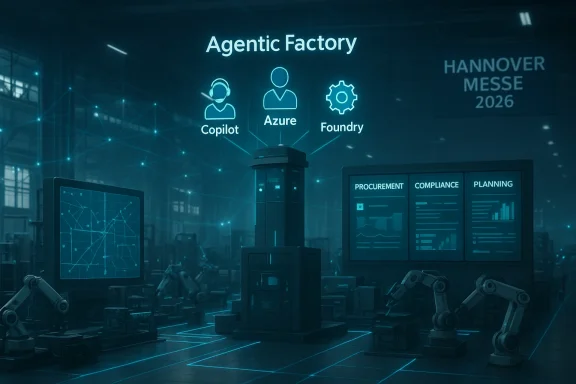
Resilinc’s decision to unveil its Agentic Factory at Hannover Messe 2026 with Microsoft is more than a booth announcement. It is a signal that supply chain resilience is moving from dashboards and alerts toward operational AI that can reason, prioritize, and initiate action inside the systems manufacturers already use. The timing matters: with industrial supply chains still exposed to tariffs, geopolitical shocks, and multi-tier supplier opacity, vendors are now racing to prove that agentic AI can do more than generate summaries. Resilinc is making the case that it can help companies act faster, with more context, and with less manual effort.
The industrial AI narrative at Hannover Messe 2026 is clearly centered on agents, orchestration, and real-world execution rather than demo-only experimentation. Microsoft’s own conference framing emphasizes “Industrial Intelligence Unlocked” and places supply chains alongside factories, service workflows, and product lifecycle intelligence as core domains for agentic transformation. In that context, Resilinc’s announcement fits neatly into Microsoft’s broader manufacturing story, which already includes partners showing how AI can support simulation, operations, and decision-making across the value chain
Resilinc is not arriving at Hannover Messe as a newcomer to AI branding. In March 2026, the company said its platform had evolved into a cohesive Agent Factory built around mapping, material flow intelligence, and agent orchestration. That earlier update also highlighted support for MCP and A2A interoperability, plus a Databricks Lakehouse data foundation, suggesting a deliberate move away from isolated risk tooling toward a broader, enterprise-grade operating model
The Microsoft connection is equally strategic. Microsoft’s Hannover Messe material describes a unified intelligence layer spanning Work IQ, Fabric IQ, and Foundry IQ, with the fourth booth zone focused on orchestrating supply chains with AI agents. That framing gives partner solutions a ready-made narrative: if Microsoft is building the infrastructure and orchestration layer, partners like Resilinc can specialize in the domain intelligence that makes the agents useful in manufacturing and procurement contexts
This is also happening in a market where the language of “agentic” is becoming a competitive weapon. Schneider Electric’s April 16 announcement with Microsoft made a similar pitch around agentic manufacturing, software-defined automation, and Microsoft Azure AI. Its Hannover Messe showcase sits in the same booth hall and underscores how quickly industrial vendors are converging on the same story: AI agents are the new interface between data and action
That matters because supply chain disruption management is rarely a single-system problem. A tariff change may require trade review, sourcing analysis, inventory decisions, customer communication, and finance visibility. A platform that can surface the disruption and then carry context into adjacent workflows has a much stronger chance of becoming part of day-to-day operations instead of an after-the-fact analytics tool.
That distinction is critical. Many supply chain tools can tell you a supplier is at risk. Fewer can help decide whether the exposure affects a part, a site, a product line, or revenue. Even fewer can push that conclusion into procurement or planning workflows fast enough to matter.
The Microsoft Foundry angle is especially important. Microsoft’s product page positions Foundry as the environment for building AI apps and agents, including agentic AI solutions. In practical terms, this gives Resilinc a platform story that is aligned with Microsoft’s current direction: build agents, connect them to enterprise tools, and embed them where users already work
That matters because supply chain data is only useful if it is usable. Many organizations have sophisticated source systems but still rely on analysts to pull, reconcile, and explain information across functions. If Resilinc can deliver trusted context through Copilot, it lowers the friction between event detection and business understanding
That kind of interaction does three things at once:
The important point is that tariffs are only one part of a larger compliance workload. Export controls, sanctions exposure, supplier certifications, origin tracking, and regulatory changes all create similar pressures. The real value of the platform is not one tariff scenario; it is the ability to build a reusable decision framework for compliance-driven supply chain disruption.
That can be a major differentiator because many firms still operate with partial maps and fragmented records. In a tariff event, that means exposure is often invisible until procurement, finance, and logistics are already scrambling.
That approach has several implications:
Microsoft’s Foundry positioning reinforces that direction. Microsoft says Foundry is intended for building and managing AI apps and agents at scale. In other words, the ecosystem is moving toward a world where agents are not isolated products but components in a broader software fabric
That means interoperability is not a feature; it is the product.
The harder the decision, the more the backend matters. If a system cannot explain where its conclusion came from, who validated the underlying relationships, and when the data was last refreshed, enterprise users will treat it as advisory at best. That is why governance is not an afterthought in agentic supply chain platforms.
That creates pressure on several fronts. Risk software vendors will need tighter integration with procurement and planning. ERP and supply chain suite providers will need richer disruption intelligence. AI platform vendors will need domain partners that can prove utility in messy operational environments. The old separation between analytics, workflow, and execution is getting thinner by the quarter
That means the competitive field is fragmenting and converging at the same time. Everyone wants agents. Few have the supply chain data quality to make them useful.
For enterprises, the impact is much more immediate. Manufacturers, procurement teams, and compliance leaders are being offered a way to compress the time between disruption detection and response. That could change how companies manage inventory, supplier diversification, tariff exposure, and executive escalation.
That said, consumers should not expect miracles. Agentic AI can shorten response times, but it cannot eliminate global volatility. It can make companies faster and better informed; it cannot make trade shocks disappear.
Microsoft’s Hannover Messe strategy also suggests that the industrial AI ecosystem is entering a more competitive and more disciplined phase. Partners are being asked to align with a shared architecture while still proving their own vertical value. That is good news for customers, because it should reduce hype and increase usefulness, but it also raises the performance bar substantially
The bigger story, though, is not one company’s booth at one trade show. It is that supply chain software is being rewritten around the assumption that insight alone is no longer enough. Enterprises want systems that can reason across disruptions, recommend responses, and fit into the workflows where people already work. Resilinc, backed by Microsoft’s industrial AI push, is betting that this is the moment when resilience stops being a reporting function and becomes an always-on, operational capability.
Source: The Manila Times Resilinc’s Agentic Factory for Operational Supply Chain Resilience at Hannover Messe 2026
 Background
The industrial AI narrative at Hannover Messe 2026 is clearly centered on agents, orchestration, and real-world execution rather than demo-only experimentation. Microsoft’s own conference framing emphasizes “Industrial Intelligence Unlocked” and places supply chains alongside factories, service workflows, and product lifecycle intelligence as core domains for agentic transformation. In that context, Resilinc’s announcement fits neatly into Microsoft’s broader manufacturing story, which already includes partners showing how AI can support simulation, operations, and decision-making across the value chainResilinc is not arriving at Hannover Messe as a newcomer to AI branding. In March 2026, the company said its platform had evolved into a cohesive Agent Factory built around mapping, material flow intelligence, and agent orchestration. That earlier update also highlighted support for MCP and A2A interoperability, plus a Databricks Lakehouse data foundation, suggesting a deliberate move away from isolated risk tooling toward a broader, enterprise-grade operating model
The Microsoft connection is equally strategic. Microsoft’s Hannover Messe material describes a unified intelligence layer spanning Work IQ, Fabric IQ, and Foundry IQ, with the fourth booth zone focused on orchestrating supply chains with AI agents. That framing gives partner solutions a ready-made narrative: if Microsoft is building the infrastructure and orchestration layer, partners like Resilinc can specialize in the domain intelligence that makes the agents useful in manufacturing and procurement contexts
This is also happening in a market where the language of “agentic” is becoming a competitive weapon. Schneider Electric’s April 16 announcement with Microsoft made a similar pitch around agentic manufacturing, software-defined automation, and Microsoft Azure AI. Its Hannover Messe showcase sits in the same booth hall and underscores how quickly industrial vendors are converging on the same story: AI agents are the new interface between data and action
Why this announcement matters
The announcement is less about a single product than about a category transition. Supply chain risk management is being repositioned from a monitoring function into a decision-support and execution function. That shift changes buyer expectations, implementation patterns, and the competitive field.- It reframes resilience as continuous operational response, not periodic review.
- It pushes supply chain software closer to planning, procurement, compliance, and ERP workflows.
- It raises the bar for vendors that still rely on static scorecards and post-event alerts.
- It suggests Microsoft wants partner ecosystems to demonstrate business value, not just model demos.
- It makes Hannover Messe 2026 a proving ground for enterprise AI, not merely an exhibition floor.
What Resilinc Is Actually Showing
Resilinc says its Agentic Factory integrates Microsoft Copilot, Microsoft Azure, Microsoft Foundry, and Azure-native monitoring and security services into a supply chain intelligence platform that can predict, quantify, and orchestrate responses to disruptions. The company is also emphasizing agent-to-agent orchestration, which implies that its software is being designed to cooperate with other enterprise agents rather than live as a standalone risk consoleThat matters because supply chain disruption management is rarely a single-system problem. A tariff change may require trade review, sourcing analysis, inventory decisions, customer communication, and finance visibility. A platform that can surface the disruption and then carry context into adjacent workflows has a much stronger chance of becoming part of day-to-day operations instead of an after-the-fact analytics tool.
From visibility to execution
The most important promise in Resilinc’s messaging is not better visibility by itself. It is the ability to translate visibility into recommended actions and, in some cases, automated orchestration. Resilinc’s March platform update said its system delivers continuously updated risk and compliance insights directly into the systems where supply chain decisions are madeThat distinction is critical. Many supply chain tools can tell you a supplier is at risk. Fewer can help decide whether the exposure affects a part, a site, a product line, or revenue. Even fewer can push that conclusion into procurement or planning workflows fast enough to matter.
What the platform appears to include
Based on Resilinc’s own description, the platform centers on several layers working together.- Validated multi-tier mapping to discover sub-tier supplier relationships.
- Material flow intelligence to connect parts, materials, sites, and products.
- Agent orchestration to route work and recommend next steps.
- Interoperability through MCP and A2A-style collaboration.
- Enterprise data foundations to support scale, governance, and lineage.
- Native Copilot access for natural language interaction inside Microsoft 365.
Microsoft’s Role in the Story
Microsoft is not simply hosting a partner at a trade show. It is building a manufacturing AI narrative that depends on partners demonstrating domain-specific outcomes. In the company’s Hannover Messe blog, supply chain orchestration is one of four main areas of industrial intelligence, alongside lifecycle intelligence, AI-powered factories, and human-agent trust. That makes supply chain risk and compliance a first-class use case in Microsoft’s industrial story, not an adjacent vertical add-onThe Microsoft Foundry angle is especially important. Microsoft’s product page positions Foundry as the environment for building AI apps and agents, including agentic AI solutions. In practical terms, this gives Resilinc a platform story that is aligned with Microsoft’s current direction: build agents, connect them to enterprise tools, and embed them where users already work
Why the partnership is strategically useful
For Microsoft, the value is ecosystem proof. For Resilinc, the value is distribution, credibility, and integration depth. Together, the companies can show manufacturing buyers a path from raw data to action without forcing them to invent the plumbing themselves.- Microsoft supplies the cloud, identity, and agent framework.
- Resilinc supplies the supply chain domain logic.
- Copilot provides the user-facing interaction model.
- Foundry and Azure provide the developer and deployment substrate.
- The combined pitch is enterprise AI with operational consequences.
The broader Microsoft manufacturing pattern
Microsoft’s Hannover Messe messaging also shows a wider industrial thesis: AI only matters when it is embedded in work, not perched above it. The company repeatedly stresses trust, governance, and human oversight, especially where agents make recommendations that affect operations, service, and supply chains. Resilinc is well positioned to ride that wave because its use case already lives in the tension between automation and accountabilityThe Copilot Angle and User Experience
One of the more interesting elements in the announcement is the Resilinc connector for Copilot, which lets enterprise users access disruption intelligence, network views, and material flow insights inside Microsoft 365 Copilot. That means the value proposition is not confined to a separate risk-management portal. It moves into the conversational interface where planners, executives, and procurement staff increasingly expect to ask questions and receive context quickly.That matters because supply chain data is only useful if it is usable. Many organizations have sophisticated source systems but still rely on analysts to pull, reconcile, and explain information across functions. If Resilinc can deliver trusted context through Copilot, it lowers the friction between event detection and business understanding
What natural-language access changes
Natural-language access is not just a convenience feature. It changes the social workflow around decision-making. A procurement leader can ask what a disruption means for a category, a line manager can ask which parts are exposed, and an executive can ask what revenue is at risk.That kind of interaction does three things at once:
- It reduces dependency on specialists for first-pass analysis.
- It shortens the path from alert to understanding.
- It encourages broader adoption across non-technical stakeholders.
Headless access is arguably the bigger enterprise feature
Resilinc also says it supports headless interaction, meaning executives and business users can query data from Copilot or from applications of their choosing. That is a quiet but important detail. It suggests the company understands that enterprises do not want every workflow trapped inside one front end.- Some users will want Copilot.
- Some will want embedded workflows in ERP or procurement apps.
- Some will want API-driven orchestration.
- Some will want control tower views and approvals.
- Some will want all of the above, depending on role.
Compliance, Tariffs, and the New Resilience Playbook
Resilinc’s live demo story includes a Fortune 100 industrial manufacturer that used its Tariffs Agent to uncover blind spots, map exposure, and respond faster before new tariffs took effect. Even without independently verifying the customer-specific claims, the use case is plausible and timely. Trade policy remains one of the most volatile levers in global manufacturing, and tariff intelligence is becoming a board-level concern rather than a niche compliance issueThe important point is that tariffs are only one part of a larger compliance workload. Export controls, sanctions exposure, supplier certifications, origin tracking, and regulatory changes all create similar pressures. The real value of the platform is not one tariff scenario; it is the ability to build a reusable decision framework for compliance-driven supply chain disruption.
Why sub-tier visibility matters
Tier-one supplier data is rarely enough. By the time a disruption reaches the direct supplier, the damage may already be locked in farther downstream. Resilinc’s validated mapping approach is designed to discover and verify sub-tier relationships through supplier input, trade signals, public disclosures, and industry-derived relationshipsThat can be a major differentiator because many firms still operate with partial maps and fragmented records. In a tariff event, that means exposure is often invisible until procurement, finance, and logistics are already scrambling.
A more operational definition of compliance
Resilinc’s pitch effectively expands compliance into a continuous operating discipline. Rather than checking boxes after the fact, organizations are being asked to use compliance intelligence to shape sourcing, inventory, and continuity decisions in real time.That approach has several implications:
- Compliance becomes tied to time-to-action.
- Risk teams become partners to procurement and planning.
- Regulatory changes can trigger scenario analysis automatically.
- Evidence and lineage become more important than static reports.
- Human review remains necessary, but it starts from a richer baseline.
Technical Architecture and Interoperability
Resilinc’s March announcement is helpful because it explains the architecture behind the Hannover Messe message. The company says it has built support for MCP and Agent-to-Agent communication, along with a common data and orchestration foundation. That is a serious architectural claim, because interoperability is one of the biggest blockers to enterprise agent adoptionMicrosoft’s Foundry positioning reinforces that direction. Microsoft says Foundry is intended for building and managing AI apps and agents at scale. In other words, the ecosystem is moving toward a world where agents are not isolated products but components in a broader software fabric
Why interoperability is the real test
Many AI vendors can build an impressive single-agent workflow. Far fewer can make those agents cooperate safely across systems. Supply chain operations are inherently cross-functional, so any real deployment must touch ERP, procurement, planning, finance, and often external trading partners.That means interoperability is not a feature; it is the product.
The data foundation problem
Resilinc says its platform is underpinned by a Databricks Lakehouse data foundation, which is meant to support ingestion, transformation, governance, and lineage at scale That is not glamorous, but it is exactly what large enterprises need if they are going to trust AI recommendations.The harder the decision, the more the backend matters. If a system cannot explain where its conclusion came from, who validated the underlying relationships, and when the data was last refreshed, enterprise users will treat it as advisory at best. That is why governance is not an afterthought in agentic supply chain platforms.
What a production-ready agent stack needs
A credible industrial AI stack needs more than a model.- Reliable identity and access control.
- Secure data retrieval and lineage.
- Human review where required.
- Workflow routing and escalation.
- Monitoring for drift and bad outputs.
- Integration with business systems that act on recommendations.
Competitive Implications
This announcement also tells us something about the market. Supply chain resilience software is entering a phase where the competitive differentiator is no longer just visibility or alert coverage. The next battleground is whether a platform can turn intelligence into actionable orchestration and fit inside the enterprise AI stack that buyers are standardizing around.That creates pressure on several fronts. Risk software vendors will need tighter integration with procurement and planning. ERP and supply chain suite providers will need richer disruption intelligence. AI platform vendors will need domain partners that can prove utility in messy operational environments. The old separation between analytics, workflow, and execution is getting thinner by the quarter
Who is being challenged
Resilinc’s move puts pressure on traditional supply chain risk management tools that still rely on periodic monitoring and manual analyst work. It also pressures broader supply chain suites that offer visibility but not deep sub-tier intelligence. Finally, it challenges emerging agent platforms that can orchestrate tasks but lack domain specificity.That means the competitive field is fragmenting and converging at the same time. Everyone wants agents. Few have the supply chain data quality to make them useful.
Why Microsoft matters competitively
Microsoft is becoming the default credibility layer for enterprise AI in manufacturing. By anchoring partner demos in Azure, Foundry, and Copilot, it helps vendors signal that they are not building toy apps. This is especially important for industrial buyers, who tend to be conservative about architecture, security, and resilience.- Microsoft gives partners a trusted enterprise platform.
- Partners give Microsoft industry relevance.
- Buyers get a lower-risk adoption path.
- The whole ecosystem benefits from shared language around agents, governance, and workflows.
- But it also means vendors must keep proving differentiated value.
Enterprise vs. Consumer Impact
For consumers, this announcement will have little direct day-to-day visibility. But the downstream effects can still matter. More resilient manufacturing networks can reduce stockouts, improve product availability, and limit the kind of cascading disruptions that show up later as delays or price increases. In that sense, the consumer impact is indirect but real.For enterprises, the impact is much more immediate. Manufacturers, procurement teams, and compliance leaders are being offered a way to compress the time between disruption detection and response. That could change how companies manage inventory, supplier diversification, tariff exposure, and executive escalation.
Enterprise use cases that stand out
The strongest enterprise value appears to be in workflows where time, traceability, and context all matter.- Rapid disruption triage.
- Multi-tier supplier exposure mapping.
- Tariff and trade scenario planning.
- Compliance validation inside business workflows.
- Executive-level revenue-at-risk analysis.
- Procurement exception handling with human oversight.
What consumers may feel indirectly
Consumers do not buy supply chain software, but they do live with its consequences. Better resilience can mean fewer delays, more stable product launches, and less volatility in affected categories. In sectors like autos, industrial equipment, and electronics, a faster response loop can also help preserve supply continuity when components become scarce.That said, consumers should not expect miracles. Agentic AI can shorten response times, but it cannot eliminate global volatility. It can make companies faster and better informed; it cannot make trade shocks disappear.
Strengths and Opportunities
Resilinc’s announcement has several clear strengths, and they are strongest when viewed through the lens of enterprise adoption rather than marketing language. The combination of validated multi-tier visibility, agent orchestration, and Microsoft ecosystem integration gives the company a credible story for large manufacturers that need measurable operational gains.- Deep sub-tier visibility can uncover risks hidden beyond direct suppliers.
- Copilot integration lowers the barrier for non-specialist users.
- MCP and A2A support position the platform for broader enterprise interoperability.
- Tariff and compliance workflows map to urgent, high-value use cases.
- Microsoft booth placement boosts trust and market visibility.
- Agentic orchestration can reduce manual work across teams.
- Data lineage and governance should appeal to regulated industries.
Risks and Concerns
The biggest risk is that the industry may be moving faster in terminology than in real deployment readiness. “Agentic” is now a powerful buzzword, but buyers will quickly become skeptical if the technology behaves like a glorified alert engine with a chat interface on top. Proof, not phrasing, will determine which vendors win long term.- Overpromising autonomy could trigger buyer backlash.
- Data quality gaps may weaken recommendations in edge cases.
- Integration complexity can slow deployments in large enterprises.
- Human trust may lag if agents are not transparent enough.
- Model drift and stale mappings could reduce confidence over time.
- Security and access control must be airtight across connected systems.
- Tariff-specific demos may not translate to broader operational ROI.
The accountability question
Agentic systems are only as trustworthy as their oversight model. If a disruption recommendation affects sourcing, production continuity, or regulatory compliance, the organization must know who approved what and why. That is especially important in industries where a bad recommendation could create real-world operational losses.- Who reviews the agent’s recommendation?
- How often are mappings revalidated?
- Can users inspect the evidence behind an alert?
- What happens when two agents disagree?
- How are exceptions escalated?
Looking Ahead
The next phase for Resilinc will likely be less about the announcement itself and more about the quality of deployment stories that follow. If the company can show repeatable wins in disruption triage, tariff exposure management, and compliance workflows, the Agentic Factory concept will gain real traction. If the demos stay impressive but operational adoption remains limited, the market will move on quickly.Microsoft’s Hannover Messe strategy also suggests that the industrial AI ecosystem is entering a more competitive and more disciplined phase. Partners are being asked to align with a shared architecture while still proving their own vertical value. That is good news for customers, because it should reduce hype and increase usefulness, but it also raises the performance bar substantially
What to watch next
- Customer case studies showing measurable time-to-response improvements.
- Evidence of broader workflow adoption beyond pilot teams.
- How well the Copilot connector performs in real enterprise use.
- Expansion of MCP and A2A interoperability across other platforms.
- Whether tariff intelligence generalizes to other disruption categories.
- Security and governance details for agentic actions in regulated environments.
- Competitive responses from ERP, planning, and risk software vendors.
The bigger story, though, is not one company’s booth at one trade show. It is that supply chain software is being rewritten around the assumption that insight alone is no longer enough. Enterprises want systems that can reason across disruptions, recommend responses, and fit into the workflows where people already work. Resilinc, backed by Microsoft’s industrial AI push, is betting that this is the moment when resilience stops being a reporting function and becomes an always-on, operational capability.
Source: The Manila Times Resilinc’s Agentic Factory for Operational Supply Chain Resilience at Hannover Messe 2026
