Hexagon Robotics Teams with Microsoft to Industrialize AEON Humanoid on Azure

  • Thread Author
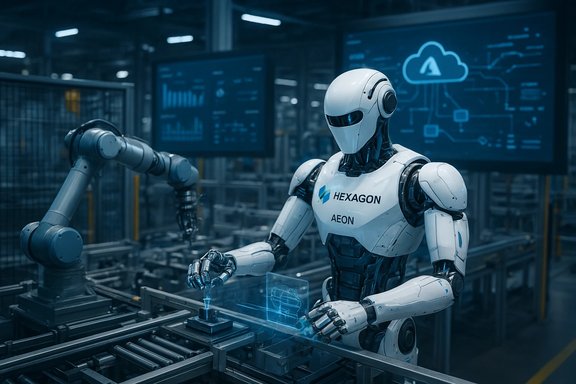
A white humanoid robot labeled HEXAGON AEON operates at a futuristic assembly line with a robotic arm.
Hexagon Robotics’ announcement of a strategic partnership with Microsoft marks a major step in the race to industrialize humanoid robotics—pairing Hexagon’s AEON humanoid and sensor-fusion stack with Microsoft Azure, Fabric Real‑Time Intelligence, and Azure IoT operations to deliver production‑ready robots for manipulation and inspection in automotive, aerospace, manufacturing and logistics environments.

Background / Overview​

Hexagon unveiled AEON, its industrial humanoid, in June 2025 as a purpose‑built robot for factory floors and inspection tasks, positioning the platform around three pillars: agility (locomotion + dexterity), awareness (multimodal sensor fusion and spatial intelligence), and versatility (manipulation, inspection, digital reality capture, teleoperation). Hexagon signaled early pilots with industrial customers such as Schaeffler and Pilatus and identified Microsoft, NVIDIA and maxon among its technology partners. The new Jan. 7, 2026 partnership announcement clarifies the next stage: tightly integrating AEON’s on‑robot perception and mission control with Microsoft’s cloud and edge services—specifically Microsoft Fabric Real‑Time Intelligence, Azure IoT Operations and Azure App Service—to build data‑driven, adaptive manufacturing workflows that scale imitation learning, reinforcement learning and multimodal vision‑language‑action models. Hexagon’s own demos—most notably a Microsoft Ignite showcase where AEON streamed telemetry and completed thousands of missions—are invoked as proof‑points for a cloud‑connected robotics pipeline. This collaboration sits inside a broader industry wave toward “physical AI” (foundation models and multimodal systems grounded in real physical data) and echoes other hyperscaler‑robotics tie‑ups and vendor efforts to move humanoids from demos to controlled production use. Independent industry reporting has also emphasized aggressive timelines from other players, underscoring that AEON + Azure joins a crowded, fast‑moving field.

What the partnership actually covers​

Core technical commitments​

  • Combining Hexagon Robotics’ sensor fusion, spatial intelligence, and AEON platform with Microsoft Azure’s cloud and edge infrastructure, targeting production‑grade deployments for manipulation and inspection workflows.
  • Using Microsoft Fabric Real‑Time Intelligence and Azure IoT Operations to build real‑time telemetry, monitoring and MLOps pipelines that feed model training and production inference across cloud and near‑edge nodes.
  • Scaling Physical AI training approaches—imitation learning, reinforcement learning, and multimodal vision‑language‑action (VLA) models—by leveraging Azure compute, tooling and Microsoft’s enterprise go‑to‑market channels.

Commercial and go‑to‑market elements​

  • Joint customer engagements and pilot programs targeting automotive, aerospace, manufacturing and logistics customers, with the stated intent to move automation “from concept to factory floor.”
  • Hexagon will deploy AEON in production environments on an expanding timeline (ongoing pilots were announced in mid‑2025, with commercial rollout intentions over subsequent months).

Why this matters: the upside for industrial users​

Hexagon + Microsoft is strategically significant because it combines strengths that are often required to move robotics beyond pilot stage:
  • Domain hardware + measurement expertise (Hexagon) — AEON is built on Hexagon’s precision measurement and sensor heritage, which is valuable for part inspection and tight‑tolerance manipulation work. That gives AEON a credible starting point for tasks where measurement and repeatability matter.
  • Cloud scale, enterprise tooling and operational continuity (Microsoft Azure) — Azure provides the managed compute, security, device management and MLOps capabilities industrial customers expect when they scale critical automation workloads. Integrations like Azure IoT Operations and Fabric RTI are explicitly targeted to transform raw telemetry into operational dashboards and closed‑loop learning pipelines.
  • A worked demo of the architecture — Hexagon’s Microsoft Ignite showcase demonstrated a real‑time telemetry pipeline that streamed AEON mission data into Fabric and Azure IoT tooling and recorded more than 1,600 uninterrupted missions, illustrating a plausible path from live data capture to actionable insights. That demo matters because data quality, reliability and observability are often the gating factors that make robotics pilots unscalable.
  • Industry focus — By targeting automotive, aerospace, manufacturing and logistics first, the partnership aligns with industries that have repeatable tasks, rigorous QA processes and capital budgets large enough to underwrite complex automation projects.

The technical reality: what’s feasible today and what remains aspirational​

Feasible in the near term​

  • Deterministic manipulation and inspection workflows in constrained workcells. AEON’s sensor suite and Hexagon’s measurement tech make it well suited for visual inspection, part scanning, machine tending and pick‑and‑place tasks where the environment can be semi‑structured and safety protocols are well defined.
  • Cloud‑assisted MLOps and telemetry. Using Fabric RTI and Azure IoT Operations to collect, process and visualize robot telemetry is a realistic and practical step—demonstrated in the Ignite showcase—and gives teams the tools needed for iteration and remote debugging.
  • Closed‑loop improvement for narrowly scoped tasks using imitation learning and reinforcement learning in simulated and hybrid sim‑to‑real pipelines. The partnership specifically calls out scaling these frameworks, and Hexagon’s prior use of simulation and NVIDIA Omniverse for training suggests a working simulation‑first approach.

Aspirational or uncertain elements​

  • Large‑scale, open‑environment, general‑purpose humanoid operation remains out of reach for general factory deployment. Tasks that require unconstrained social interaction, complex tool use across novel contexts, or continuous unsupervised decision‑making around humans still pose substantial safety, verification and robustness challenges. Industry timelines for broadly capable humanoids vary significantly and remain aspirational in many public roadmaps.
  • Concrete terms for Microsoft Research collaboration, compute quotas, timelines, pricing and service SLAs are not specified in the public release. Those are important commercial and technical details for buyers and integrators and are currently unverifiable without follow‑up agreements or procurement documents. Treat any promises of rapid, broad rollout as conditional on these undisclosed elements.

Safety, data and governance: practical risks to watch​

Hexagon and Microsoft explicitly frame the partnership as keeping “humans in the loop,” but the move toward multimodal vision‑language‑action models and cloud‑centered learning pipelines raises several risk areas purchasers must assess:
  • Physical safety and verification — Embodied AI introduces failure modes that combine perception errors, model mis‑predictions, and actuator trajectories. Any model update that changes control policies must be validated in rigorous, instrumented test harnesses and safety cages. Historical research warns against assuming LLM‑style models are safe as raw decision layers for robots without extensive constraints.
  • Data governance and IP — Training RL or VLA models on production data raises questions about ownership of the data and derivative models, cross‑customer data pooling, and contractual limits on reuse. Contracts should specify where telemetry is stored, who can re‑use it for model training, and what data minimization controls exist.
  • Latency and edge resilience — Real‑time control loops must often run locally; dependence on cloud services for low‑latency decision making creates availability risks. The architecture must clearly delineate which components run on‑robot, which run on edge devices, and which require cloud connectivity for non‑timing‑sensitive learning pipelines.
  • Regulatory and standards uncertainty — There is no industry‑wide certification regime yet for humanoids operating in human‑proximate industrial spaces. Buyers should demand rigorous third‑party safety audits, fail‑safe proofs, and clear liability frameworks in procurement.

Strategic implications for manufacturers and integrators​

The Hexagon–Microsoft tie‑up should be evaluated both as a technology stack and a service model. For manufacturers considering pilots or contracts, a measured approach will reduce operational and financial risk.

Short‑term benefits to pursue​

  • Use AEON for inspection, scanning, and constrained manipulation tasks where precision measurement is critical. Hexagon’s sensor suite and pre‑integrations make AEON a strong candidate for quality inspection and digital twin capture.
  • Pilot cloud telemetry and MLOps first. Validate the Fabric RTI + Azure IoT Operations pipeline on a single line or cell to measure data fidelity, model iteration velocity and incident detection. AEON’s Ignite demo is a blueprint for this style of evaluation.
  • Require vendor transparency on model lineage, update cadence, and rollback procedures. Any robotics deployment needs a documented path to revert to a known safe policy and a test harness that reproduces real on‑floor conditions.

How to evaluate Hexagon + Microsoft offers (practical checklist)​

  1. Define measurable KPIs up front (e.g., defect detection rate, mean time between human interventions, throughput delta).
  2. Ask for a scoped proof‑of‑value (6–12 weeks) with sample telemetry, expected compute usage and demonstrable ROI metrics.
  3. Insist on third‑party safety audits and a documented hazard analysis for any task that places AEON near humans or heavy machinery.
  4. Negotiate data governance: ownership, retention, anonymization, and reuse rights for training datasets.
  5. Confirm on‑robot vs. cloud responsibilities: which decision loops are local, which depend on cloud, and how failover works.
  6. Verify the commercial SLA for Azure resources used in the pilot (GPU availability, region, pricing model) and any Microsoft‑provided managed services.

Competitive and market context​

Humanoid robotics is increasingly a multi‑front race: startups and industrial incumbents alike are pursuing vertical use cases where the hardware and software stack deliver measurable ROI. Hexagon’s AEON joins entries like Hyundai/Boston Dynamics’ Atlas (production roadmap announced by other OEMs) and other well‑funded humanoid projects that are targeting industrial automation. The presence of hyperscaler partnerships—Azure for Hexagon, Nvidia/Omniverse for simulation and stack acceleration—reflects the emerging triad of hardware, simulation tools and cloud compute required to scale physical AI. Two implications stand out for buyers and systems integrators:
  • Partnerships with hyperscalers can materially accelerate the path to production by reducing integration friction and offering enterprise‑grade telemetry and security tooling.
  • However, these partnerships also create vendor concentration and operational lock‑in risks (e.g., dependency on Azure GPU capacity or Fabric features). Procurement teams should negotiate portability clauses and data export provisions.

Strengths and limitations of Hexagon’s approach​

Strengths​

  • Domain expertise and sensor quality — Hexagon’s measurement heritage is a genuine asset for inspection and quality workflows where micron‑level precision or calibrated spatial intelligence matters.
  • Ecosystem integrations — Early demonstrations with Azure and NVIDIA show Hexagon is building a pragmatic pipeline that links simulation, data capture, MLOps and operations—exactly the pieces customers need for scalable robotics.
  • Industrial pilot partners — Pilots with established manufacturers (Schaeffler, Pilatus) provide field validation and user feedback that can shorten the path to robust industrialization.

Limitations and open questions​

  • Undefined Microsoft Research deliverables and compute terms — The announcement references scaling and exploratory research but lacks specifics on MSR involvement, exact compute commitments or timelines—critical commercial variables for customers. These remain to be negotiated or disclosed.
  • End‑to‑end safety certification and standards — Without regulatory frameworks and standardized safety certification, large‑scale humanoid deployments will continue to face procurement friction and liability questions.
  • Economic cost model — The public materials do not provide detailed per‑unit cost, total cost of ownership estimates, or the incremental costs of Azure training cycles and continued model updates. Buyers should insist on transparent TCO modeling.

Practical recommendations for IT leaders and automation teams​

  • Treat humanoid robotics pilots as long‑term platform investments, not one‑off equipment purchases. Plan for recurring costs: simulation compute, cloud training, model governance and safety validation.
  • Start with bounded, measurable tasks: high‑volume inspection, machine tending with well‑documented task envelopes, or reality capture for digital twin creation.
  • Insist on clear human‑in‑the‑loop control policies, explicit action templates for any VLA system, and conservative safety interlocks.
  • Negotiate clear data governance, portability and rollback clauses that allow models and datasets to be exported or redeployed outside a single cloud provider if required.
  • Budget for iterative model tuning and edge‑to‑cloud latency testing; real‑world robustness typically requires multiple retraining cycles with production telemetry.

Final assessment​

The Hexagon–Microsoft partnership is a credible, pragmatic advance for industrial humanoid robotics: it pairs a robotics platform designed around measurement and sensor fusion with an established cloud and enterprise software partner that can supply the MLOps, telemetry and scale required for real industrial use. Hexagon’s AEON demonstrators and the Ignite telemetry pipelines show a realistic pathway from data capture to operational insight—exactly the blueprint many manufacturers and integrators need to adopt robotics at scale. However, the announcement is a strategic partnership announcement rather than a contractual guarantee of rollout timelines, compute quotas or absolute safety certification. Critical procurement details—compute allocations, MSR deliverables, pricing, SLAs and clear independent safety audits—remain undisclosed and must be clarified before any enterprise signs on to large deployments. Buyers should proceed with disciplined pilots, rigorous safety validation and contractual protections around data and portability. In short: Hexagon + Microsoft brings together the right technical pieces for scalable, data‑driven humanoid automation, and AEON looks well positioned for constrained industrial tasks. The real test will be whether the partners can deliver robust, audited safety, transparent economics and portable models that industrial IT and operations teams can trust at scale.

Source: AI Insider Hexagon Robotics Partners with Microsoft to Develop Humanoid Robots
 

Hexagon Robotics’ new partnership with Microsoft is a substantive step toward industrializing humanoid robots for factory floors, combining Hexagon’s AEON humanoid and sensor‑fusion expertise with Microsoft Azure, Fabric Real‑Time Intelligence, and Azure IoT tooling to pursue production‑ready solutions for manipulation and inspection across automotive, aerospace, manufacturing and logistics.

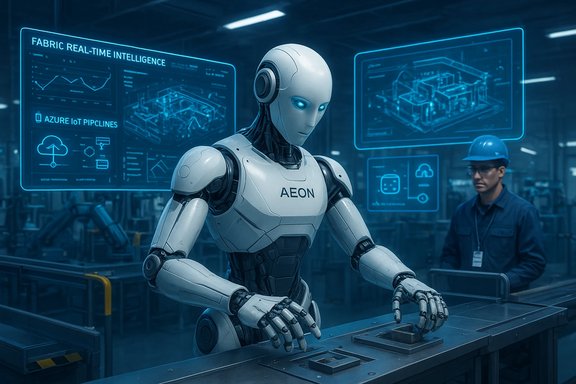
AEON robot operates at a factory line beneath blue holographic displays.Background​

Hexagon announced AEON as an industrial humanoid platform in mid‑2025 and has since positioned the robot around three core pillars: agility (locomotion and dexterity), awareness (multimodal sensor fusion and spatial intelligence), and versatility (manipulation, inspection, digital capture and teleoperation). Early pilots and ecosystem ties with NVIDIA and other vendors established a simulation‑first pipeline for training and testing. The joint announcement with Microsoft on January 7, 2026 clarifies a roadmap to marry AEON’s on‑robot capabilities with Microsoft’s cloud and edge services.
This collaboration explicitly targets three technical and commercial goals: redefining data‑driven, adaptive manufacturing through deep technical integration; scaling physical AI training frameworks (imitation learning, reinforcement learning and multimodal vision‑language‑action models); and jointly engaging enterprise customers to bring humanoid automation from concept to the factory floor. The partners emphasize keeping humans in the loop while accelerating closed‑loop learning and operational telemetry.

Why this matters: the industrial case for humanoid robots​

Humanoid robots offer a pragmatic value proposition for many industrial contexts: they can operate in human‑oriented workcells, use existing tools and fixtures, and perform varied manipulation tasks without bespoke tooling per task. For manufacturers facing labor shortages and rising quality demands, a humanoid platform that can perform inspection and manipulation across multiple product families is attractive because it promises:
  • Greater reuse of the same automation investment across lines and tasks.
  • Reduced integration cost when the robot can use standard human fixtures, hand tools and inspection stations.
  • Faster pilot-to-production cycles when cloud‑assisted MLOps and telemetry accelerate model iteration.
Hexagon + Microsoft specifically target repetitive, high‑value tasks—inspection, part scanning, machine tending and constrained manipulation—where measurement precision and repeatability matter most. Those are realistic early production use cases because the environment can be bounded and safety controls tightened.

Technical integration: what Hexagon and Microsoft are promising​

Core cloud and edge components​

The partnership lists several Azure technologies as integration points:
  • Microsoft Fabric Real‑Time Intelligence (Fabric RTI) to ingest, contextualize and operationalize high‑frequency robot telemetry.
  • Azure IoT Operations to manage device fleets, provisioning, and secure telemetry pipelines.
  • Azure App Service and other Azure platform services for hosting control dashboards, inference endpoints and operator tooling.
These services are intended to enable a continuous data loop: on‑robot sensors stream mission data and environmental captures to Fabric RTI and Azure IoT, those data feed model training and validation pipelines, and updated policies or perception models are deployed back to edge nodes or the robot. The result: a pragmatic MLOps pipeline for embodied AI.

On‑robot vs cloud responsibilities​

Practical deployments will separate time‑critical control loops from cloud‑dependent learning and telemetry. Low‑latency motion control and safety interlocks must run on‑robot or on local edge devices, while non‑timing‑sensitive training and model refinement can use Azure compute. The partnership materials emphasize this architectural boundary but do not disclose exact allocation or formal SLAs for compute and latency guarantees—items enterprises must confirm during procurement.

Training modalities targeted​

Hexagon and Microsoft plan to scale three core learning approaches:
  • Imitation Learning (IL): bootstrap robot policies from human demonstrations captured via synchronized multimodal rigs.
  • Reinforcement Learning (RL): refine policies through reward‑driven exploration in simulation and hybrid sim‑to‑real loops.
  • Vision‑Language‑Action (VLA) models: combine perception, language directives and action policies to enable instruction‑driven tasking and more flexible task specification.
A simulation‑first strategy—using NVIDIA Omniverse and high‑fidelity digital twins—appears central to the roadmap, compressing sample complexity and enabling rapid iteration before field testing.

AEON demos and proof points​

Hexagon has already demonstrated AEON in industry events and showcases where the robot streamed telemetry and executed many missions in succession, feeding Fabric‑hosted dashboards. Those demos are important proof points because data quality, reliability and observability are often the gating factors that make robotics pilots scalable. Nevertheless, demos are controlled environments: independent validation across live production lines and third‑party safety audits remain critical next steps.

Strengths of the partnership​

  • Domain expertise and sensor pedigree: Hexagon’s long history in precision measurement and spatial intelligence is a clear advantage for inspection and QA tasks that demand calibrated sensors and micron‑level fidelity. This gives AEON credibility for tasks that require measurement accuracy rather than pure brute‑force manipulation.
  • Enterprise MLOps and telemetry tooling: Azure’s managed services provide an enterprise‑grade backbone—compute, device management, security, and governance—that manufacturers expect when scaling critical automation. Fabric RTI and Azure IoT together create a plausible operational telemetry and observability stack.
  • Ecosystem and pilot validation: Public pilots and early collaborations with manufacturers demonstrate that AEON is being tested in relevant contexts, shortening the path to deployable solutions versus purely laboratory prototypes.

Key risks and open questions​

No announcement of this sort is free of caveats. The most important unresolved areas—where buyers should demand clarity—are:
  • Compute commitments and cost transparency. The public materials outline scaling ambitions but do not disclose compute quotas, pricing models for cloud training cycles, or the expected ongoing costs of model updates. These directly affect total cost of ownership (TCO) and procurement decisions. Treat any claims of “fast scaling” as conditional until compute and pricing terms are contractualized.
  • Safety certification and standards. There is not yet an industry‑wide certification regime for humanoid robots operating in human‑proximate industrial spaces. Enterprises should insist on third‑party safety audits, hazard analyses and formal verification of any policy update process that could change robot behavior.
  • Data governance and IP. Training RL or VLA models on production telemetry raises questions about who owns the data and derivative models, cross‑customer pooling for training, and contractual reuse rights. Clear clauses about telemetry storage, anonymization, portability and model derivative rights are essential.
  • Vendor lock‑in and portability. Heavy dependence on Azure Fabric features and other Microsoft‑specific services might create operational lock‑in. Procurement teams should negotiate portability and data export provisions so models and datasets can be redeployed or migrated if needed.
  • Latency and resilience. Any cloud‑assisted loop must delineate which operations require local execution. Over‑reliance on cloud inference for low‑latency control exposes operations to availability risks; test failover and edge resilience rigorously.

Practical checklist for IT and automation leaders​

When evaluating Hexagon + Microsoft offers, use a structured checklist to reduce ambiguity and procurement risk:
  • Define measurable KPIs up front (e.g., defect detection rate, mean time between human interventions, throughput change).
  • Request a scoped proof‑of‑value (6–12 weeks) with sample telemetry, expected compute usage, and demonstrable ROI metrics.
  • Require vendor transparency on model lineage, update cadence and rollback procedures for any policy or perception model updates.
  • Insist on third‑party safety audits, a documented hazard analysis, and certification if the robot operates near personnel or heavy equipment.
  • Negotiate data governance: ownership, retention, anonymization and reuse rights for telemetry and training datasets.
  • Confirm on‑robot vs. cloud responsibilities: specify which decision loops are local and how failover is handled.
  • Verify commercial SLA for Azure resources used in the pilot (GPU availability, region, pricing model) and any Microsoft‑managed services.

Implementation roadmap (recommended sequence)​

  • Start with a narrow scope: choose a single, well‑understood task such as visual inspection or machine tending in a constrained cell.
  • Run a simulation‑first proof: use digital twin and Omniverse‑style simulation to validate initial policies and reduce wear‑in on hardware.
  • Deploy in a controlled cell with robust safety cages and human‑in‑the‑loop overrides.
  • Integrate telemetry into Fabric RTI + Azure IoT and instrument KPIs for rapid iteration.
  • Iterate: use imitation learning from on‑floor human demonstrations, augment with RL in simulation/hybrid setups, and validate VLA capabilities only after deterministic behavior is proven.
  • Conduct independent safety and compliance audits before wider deployment.
  • Scale fleet management gradually, ensuring data governance rules and portability clauses are honored.

Economics and TCO considerations​

Humanoid robots are platform investments, not consumables. Buyers should budget beyond initial hardware:
  • Recurring cloud costs for training, model updates and telemetry ingestion.
  • Edge hardware and redundant compute for low‑latency control loops.
  • Simulation and validation compute (often large GPU clusters).
  • Ongoing maintenance, spare parts, calibration and safety audits.
  • Integration, safety engineering and operator training.
Procurement teams should require clear pricing models for Azure compute and data egress, predictable update cadences, and a path to cap cloud spend or migrate models if costs become prohibitive. The partnership announcement does not specify per‑unit costs or compute quotas—this must be clarified before committing to scale.

Safety, standards and regulatory outlook​

The field of embodied AI requires cross‑disciplinary safety engineering. Practical mitigations include:
  • Constraining language‑to‑action pipelines: map natural language or high‑level goals to a small set of validated action templates.
  • Explicit human authorization for any operation that could impact human safety or critical infrastructure.
  • Verified rollback procedures and immutable logs for each model update.
  • Routine adversarial and robustness testing for perception stacks (vision, tactile proxies, proprioception).
  • Independent third‑party labs to perform hazard analysis and certify safety claims before unsupervised or human‑proximate operation.
Regulators and standards bodies will need to catch up; in the interim, buyers should demand conservative safety postures and contractual liability protections.

Competitive context​

The Hexagon–Microsoft tie‑up lands in a crowded market where other hyperscaler‑robotics alliances, startups with robotics foundation models, and incumbent automation vendors are pursuing similar objectives. Key competitive observations:
  • Hyperscaler partnerships (Azure, AWS, NVIDIA) accelerate the path to production because they reduce integration friction and provide managed tooling.
  • Domain specialists that own high‑fidelity real‑world datasets and sensor stacks still have an edge for industrial tasks—data from real production floors often beats purely simulated datasets for robustness.
  • The combination of simulation tools (Omniverse), hardware sensor quality, and enterprise cloud MLOps is now the canonical stack for scaling “physical AI.”
However, the market also risks vendor concentration and lock‑in if portability, data export, and migration clauses are not negotiated up front. Enterprises should evaluate long‑term supplier flexibility as a core procurement metric.

Recommended posture for enterprises​

Adopt informed optimism: engage with Hexagon and Microsoft on focused pilots where the ROI can be clearly measured, but insist on contractual protections and operational transparency. Practical stances include:
  • Treat early humanoid pilots as multi‑year platform investments with recurring costs for models and cloud infrastructure.
  • Start with tightly constrained tasks to demonstrate repeatable value and validate safety and governance workflows.
  • Negotiate explicit data rights, model portability, and rollback terms.
  • Budget for independent safety audits and extended validation cycles.
  • Plan for edge resilience and failover, ensuring critical control remains local when latency matters.

Conclusion​

The Hexagon Robotics and Microsoft partnership is a credible, strategically sensible step toward making humanoid robots operationally useful on the factory floor. It brings together Hexagon’s measurement and sensor heritage with Microsoft’s enterprise cloud tooling to create a realistic MLOps and telemetry pipeline for embodied AI. Public demos and early pilots suggest a pragmatic pathway from simulation to constrained production tasks, particularly in inspection and manipulation workflows.
That said, important commercial and technical details remain undisclosed—compute quotas, pricing, formal Microsoft Research deliverables, and third‑party safety certifications among them. These are material items that will determine whether AEON and its cloud‑assisted stack become a durable industrial platform or a promising but limited niche. Buyers should proceed with disciplined pilots, conservative safety engineering, and strict contractual protections for data and portability while taking advantage of the clear near‑term benefits for repeatable, measurement‑intensive tasks.
In short: this alliance assembles many of the practical pieces that manufacturers and integrators need for scaling humanoid automation—but the path to widespread production deployment will be defined by rigorous safety validation, transparent economics and careful negotiation around data and cloud dependence.

Source: AiThority Hexagon Robotics Collaborates With Microsoft to Advance the Field of Humanoid Robots
 

Hexagon Robotics’ new strategic partnership with Microsoft lays out an explicit plan to industrialize humanoid robots for factory floors by combining Hexagon’s AEON humanoid, sensor fusion and spatial-intelligence stack with Microsoft Azure’s cloud, edge and real‑time analytics services — a move that aims to turn staged demonstrations into production‑ready solutions for manipulation and inspection across automotive, aerospace, manufacturing and logistics industries.

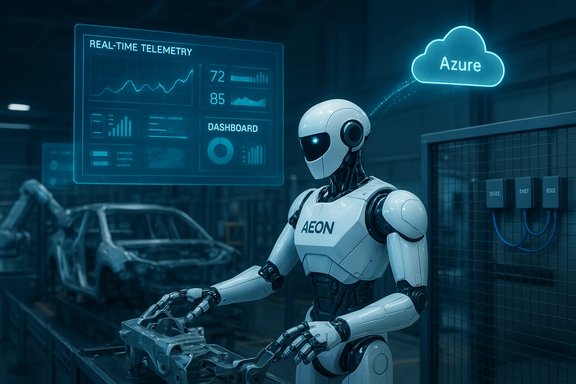
AEON, a humanoid robot, assembles car parts in a high-tech factory with Azure cloud telemetry.Background​

Hexagon first unveiled AEON — a purpose‑built industrial humanoid focused on agility, awareness and versatility — in June 2025 as part of its broader robotics and measurement portfolio. AEON was framed from day one as a robot optimized for real‑world factory tasks: manipulation, part scanning/inspection, reality capture and teleoperation. Hexagon positioned AEON around three technical pillars: locomotion and dexterity (agility), multimodal sensor fusion and spatial reasoning (awareness), and a design geared toward multiple industrial workflows (versatility). Microsoft’s complementary offering is Azure’s suite of cloud and edge services — notably Microsoft Fabric Real‑Time Intelligence (Real‑Time Intelligence or Fabric RTI), Azure IoT Operations for edge/IoT orchestration, and Azure App Service for hosting operator tooling and API endpoints. These services underpin the partnership’s promise to create a continuous data loop: live telemetry and sensor captures flow into Fabric RTI and Azure IoT pipelines, feed MLOps and model training, and return validated updates or policies to edge or on‑robot runtimes. Microsoft describes Fabric RTI as an event‑driven, no‑code to low‑code platform for ingesting, indexing and acting on streaming data; Azure IoT Operations is an edge‑to‑cloud management layer designed to run and govern workloads across hybrid, multicloud and on‑prem environments. Hexagon publicly demonstrated a proof‑pattern at Microsoft Ignite 2025, where AEON streamed live telemetry into Azure and Fabric RTI and completed more than 1,600 missions during the event — a showcase Hexagon cites as validation of a real‑time telemetry and MLOps pipeline for embodied AI.

What the announcement actually says​

  • The partnership’s stated technical goals are to: redefine data‑driven adaptive manufacturing; scale “Physical AI” frameworks (imitation learning, reinforcement learning, and multimodal vision‑language‑action models); and jointly engage customers to take AI‑driven humanoid solutions from pilot to factory floor.
  • Microsoft technologies called out include Microsoft Fabric Real‑Time Intelligence, Azure IoT Operations, and Azure App Service. Hexagon will bring AEON’s sensor fusion and mission control; Microsoft will provide scalable compute, telemetry, device management and MLOps tooling.
  • Initial industry targets are automotive, aerospace, manufacturing and logistics — sectors with repeatable, safety‑constrained tasks where inspection and precision manipulation deliver measurable ROI. Hexagon already lists early pilot partners and use cases that align with these verticals.

Why this matters: the industrial case for humanoid robots​

Humanoid robots promise pragmatic advantages for many factory scenarios because they are inherently compatible with environments built for humans: fixtures, tools, and workstations typically assume human form factor and reach. For manufacturers already struggling with labor shortages or demanding QA tolerances, a humanoid that can perform inspection, machine tending or multi‑skilled manipulation reduces the need for bespoke end‑of‑arm tooling and could accelerate reuse across product lines.
The Hexagon + Microsoft combination aims to solve two of the biggest practical pain points that block scaling robotics pilots:
  • Data and MLOps: streaming high‑fidelity telemetry into an enterprise‑grade pipeline so model iteration is continuous, auditable and governed.
  • Domain grounding: pairing sensor‑grade measurement capabilities and on‑robot intelligence with cloud scale to train policies for imitation learning and reinforcement learning at enterprise scale.
This is the canonical industrial playbook: domain hardware + real operational data + hyperscaler tooling = faster path from demo to controlled production.

Technical architecture: what’s realistic and what remains open​

What Hexagon + Microsoft have demonstrated (and documented)​

  • Real‑time telemetry ingestion, visualization and eventization via Fabric RTI, consuming AEON’s sensor streams (vision, inertial/proprioceptive traces, mission telemetry) and feeding actionable events to dashboards and workflows. Hexagon’s Ignite demo shows a functioning event pipeline that produced repeatable missions and operator dashboards.
  • Edge/cloud responsibilities: the partnership documentation and Azure product pages make it clear that low‑latency control loops should remain on‑robot or on local edge nodes, while non‑time‑critical training, analytics and model management can be cloud‑hosted — a practical separation embraced by both vendors. Azure IoT Operations and Fabric RTI are designed to support that hybrid model.

What remains unspecified (and must be clarified by customers)​

  • Exact compute commitments and pricing for the training and inference workloads required to scale imitation learning, reinforcement learning, and Vision‑Language‑Action (VLA) models. Public materials speak to “scaling on Azure” but do not publish quotas, pricing models or cost estimates for large‑scale RL training runs.
  • MSR or research deliverables: press materials refer to exploratory research collaboration but do not define milestones or timelines for joint R&D outcomes.
  • Safety certification and compliance: there is no industry‑wide, standardized humanoid certification yet. Procurement documents must require third‑party verification, hazard analyses and a clear rollback mechanism for model updates that affect control policies.
Flagged claim: Hexagon states AEON has demonstrated “real‑time defect detection and operational intelligence.” While live demos and conference showcases show feasibility, independent, third‑party validation in production environments remains necessary before treating those demonstrations as equivalent to mature, audited production performance. This should be considered a proof‑point rather than a finished, certified solution.

Strengths of the partnership​

  • Domain expertise and sensor pedigree. Hexagon’s heritage in precision measurement and calibrated spatial intelligence is unusually well‑aligned to inspection and QA tasks that demand repeatability and traceable measurements. That sensor quality is an advantage when training perception stacks that must meet industrial tolerances.
  • Enterprise MLOps and telemetry stack. Microsoft supplies managed, hardened services for streaming, governance and device management: Fabric RTI for event streams and real‑time dashboards, Azure IoT Operations for edge orchestration and device registry, and Azure App Service for hosting control apps — all tools enterprises already use for mission‑critical applications.
  • A simulation‑first training pipeline. Hexagon’s prior use of NVIDIA Omniverse and simulation tooling suggests a hybrid sim‑to‑real training strategy that accelerates policy development while minimizing wear and risk on physical robots. This reduces sample complexity for RL and imitation learning.
  • Focused vertical targeting. Starting with automotive, aerospace, manufacturing and logistics is pragmatic: these industries have high volumes, repeatable tasks and budgets for automation — making measurable ROI easier to demonstrate.

Key risks, limitations and procurement red flags​

  • Cost and TCO uncertainty. Humanoid deployments are platform investments, not one‑off purchases. Expect recurring cloud costs (training, telemetry ingestion, model hosting), edge compute and redundancy, maintenance and spares, and prolonged integration and safety validation work. The press materials do not provide transparent TCO modeling; buyers must demand cost scenarios, GPU quotas, and predictable pricing for training runs.
  • Data governance and IP. Using production telemetry for training raises hard questions about data ownership, derivative models and cross‑customer reuse. Contracts should explicitly state telemetry storage, anonymization, portability and whether vendors may aggregate data to train shared models.
  • Vendor lock‑in. Heavy reliance on Microsoft Fabric features and Azure‑specific services can create long‑term migration complexity. Enterprises should negotiate portability clauses and data export provisions so models and datasets can be redeployed outside a single cloud provider if needed.
  • Safety, standards and regulatory uncertainty. No universal certification exists for humanoid operation in human‑proximate industrial spaces. Until independent safety audits and formal verification become commonplace, buyers must insist on conservative human‑in‑the‑loop policies, mechanical interlocks, test harnesses and immutable model‑update logs.
  • Technology maturity limits. Broadly capable, general‑purpose humanoids that operate unsupervised across unconstrained environments remain aspirational. Early production use cases will be bounded, deterministic tasks; wild‑card aspirations should be treated cautiously.

Practical recommendations for IT leaders and automation teams​

Start small, prove value, then scale. A disciplined pilot approach reduces risk and provides measurable evidence for procurement committees.
  • Define measurable KPIs up front.
  • Examples: defect detection accuracy, mean time between human interventions (MTBHI), throughput delta per shift.
  • Run a scoped proof‑of‑value (6–12 weeks).
  • Validate Fabric RTI + Azure IoT Operations telemetry fidelity on one line or cell; measure data latency, loss rate, and model iteration velocity.
  • Insist on transparency around model lineage and rollback procedures.
  • Require documented hazard analysis and immutable logs for each model update.
  • Negotiate data governance and portability.
  • Clarify telemetry retention, anonymization and derivative model rights in contract terms.
  • Budget for edge resilience and safety.
  • Ensure critical control loops remain local and test failover scenarios; require third‑party safety audits before any human‑proximate operations.
  • Demand TCO scenarios.
  • Require Azure compute estimates for training cycles, projected inference costs, and an option to cap cloud spend or run training on premises if cloud costs escalate.

Implementation roadmap (recommended sequence)​

  • Phase 1 — Constrained pilot
  • Deploy AEON in a physically bounded workcell (caged or segregated).
  • Confirm sensor calibration and measurement repeatability.
  • Connect telemetry to Fabric RTI and validate event generation and dashboarding.
  • Phase 2 — Iterative model training
  • Use imitation learning from human demonstrations captured in the cell.
  • Run sim‑to‑real RL cycles to refine policies while minimizing physical trials.
  • Quantify defect detection rates and human intervention frequency.
  • Phase 3 — Safety and audit
  • Commission third‑party safety assessment and hazard analysis.
  • Establish rollback, rollback verification and incident response protocols.
  • Phase 4 — Controlled scale
  • Expand to additional, similar cells; instrument centralized MLOps and governance.
  • Reassess cloud cost and compute scaling strategy.
  • Phase 5 — Production integration
  • Integrate AEON‑generated events into MES/ERP workflows for automated quality flags, work orders and traceability if ROI is clearly positive.

Competitive landscape — why timing matters​

The Hexagon–Microsoft tie‑up lands in a crowded and accelerating market. Major OEMs and robotics companies demonstrated commercial intents at recent industry events: a high‑profile example is Hyundai’s plan to deploy humanoids derived from Boston Dynamics’ Atlas in U.S. factories by 2028, showing that multiple players are racing to industrialize humanoids for production tasks. These competing efforts increase urgency for incumbents to secure ecosystem partnerships and enterprise credibility. Hyperscaler partnerships (Azure, AWS, NVIDIA) are becoming the de‑facto route to scale because they reduce engineering friction, provide managed tooling for device fleets and MLOps, and offer enterprise governance. But the flip side is vendor concentration and migration risk; organizations must evaluate long‑term flexibility in procurement.

Final analysis: pragmatic optimism with contractual rigor​

Hexagon Robotics’ partnership with Microsoft is a strategically sensible step that aligns a domain specialist (Hexagon) with an enterprise cloud and MLOps provider (Microsoft). The announced architecture — AEON on the edge with Azure Fabric RTI and Azure IoT Operations as the telemetry and operations backbone — is coherent and mirrors accepted best practices for scaling embodied AI: simulation‑first training, hybrid edge/cloud control separation, and closed‑loop telemetry feeding model lifecycle pipelines. Hexagon’s AEON demonstrations and Microsoft Ignite showcase provide credible proof that the telemetry and dashboarding concepts work at scale in a controlled environment. However, the announcement is a strategic partnership statement, not a procurement contract. Critical, load‑bearing details remain undisclosed: compute commitments and pricing for large‑scale RL/IL training; third‑party safety certifications; specific MSR research deliverables and timelines; and the exact mechanics of data ownership and model portability. These are non‑trivial: they determine whether pilots can become economically sustainable and auditable production deployments. Buyers should therefore proceed with measured optimism — embrace the technical promise, but demand contractual clarity, third‑party validation and transparent TCO modeling before scaling.

What to watch next​

  • Evidence of independent, third‑party audits validating AEON’s inspection accuracy and safety in live production lines.
  • Clear compute and pricing frameworks from Hexagon or Microsoft that quantify training and telemetry costs at fleet scale.
  • Published case studies showing measurable ROI (reduction in defects, decreased human interventions, throughput gains) in automotive or aerospace pilot sites.
  • Any research outputs or benchmarks from Microsoft Research collaborations that push VLA or latent‑action modeling from proof to production.
Hexagon and Microsoft are assembling the right technical pieces — sensor‑grade hardware, simulation tools, and enterprise telemetry and governance — to push humanoid robots into industrial practice. The next test will be commercial discipline: whether those pieces are delivered with the contractual rigor, safety verification and transparent economics that large manufacturers need to trust humanoid automation at scale.

Source: Metrology and Quality News Hexagon Robotics to Collaborate with Microsoft to Advance Humanoid Robots – Metrology and Quality News - Online Magazine
 

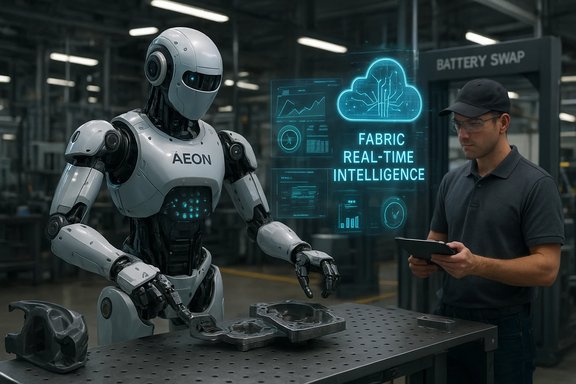
An AEON robot works at a metal bench while a technician monitors fabric real-time intelligence on a holographic display.
Hexagon Robotics’ new strategic partnership with Microsoft aims to turn humanoid robots from staged demos into production-ready automation — pairing Hexagon’s AEON humanoid, sensor-fusion and spatial-intelligence stack with Microsoft Azure, Microsoft Fabric Real‑Time Intelligence, and Azure IoT Operations to deliver inspection and manipulation solutions for automotive, aerospace, manufacturing and logistics environments.

Background / Overview​

Hexagon first unveiled AEON, its industrial humanoid built specifically for factory environments, at Hexagon LIVE in June 2025. AEON was presented as a purpose-built platform focused on three pillars: agility (locomotion + dexterity), awareness (multimodal sensor fusion and spatial intelligence) and versatility (manipulation, inspection, digital reality capture and teleoperation). Hexagon positioned AEON to address labor shortages and quality demands across high-precision industries. Microsoft and Hexagon announced a deeper collaboration in January 2026 to integrate AEON’s on-robot sensing and mission control with Microsoft’s cloud and edge services — specifically Microsoft Fabric Real‑Time Intelligence (Real‑Time Intelligence), Azure IoT Operations, and Azure App Service. The joint goal is a continuous, auditable data and MLOps pipeline that supports imitation learning, reinforcement learning and multimodal vision‑language‑action (VLA) models, all targeted at moving automation from concept to the factory floor. This is the latest, concrete example of a broader industry pattern: robotics vendors pairing domain-specific hardware and simulation tools with hyperscalers to obtain the scale, governance and MLOps tooling required for real-world deployments. Early Hexagon pilots with industrial customers and integrations with NVIDIA Omniverse and maxon actuators already show the three‑party technology stack Hexagon intends to scale.

What the partnership actually covers​

Core technical commitments​

  • Integrate AEON’s sensor fusion, spatial intelligence, and mission-control stack with Azure for scalable model training, telemetry, and production inference.
  • Use Microsoft Fabric Real‑Time Intelligence to ingest, index and operationalize streaming AEON telemetry into event houses, dashboards and triggerable actions.
  • Deploy Azure IoT Operations at the edge for unified device and asset management, consistent deployments on Azure Arc–enabled Kubernetes, and edge-to-cloud orchestration for mission-critical workloads.
  • Co‑develop MLOps pipelines to support imitation learning (one-shot and few-shot capture), reinforcement learning (sim‑to‑real cycles using simulation tools) and Vision‑Language‑Action models for instruction-driven tasks.

Commercial and go‑to‑market elements​

  • Joint customer engagements and proofs-of-concept focused on inspection, machine tending, part scanning and constrained manipulation workflows in automotive, aerospace, manufacturing and logistics.
  • Hexagon and Microsoft will position AEON as a production-capable humanoid for factories, with Microsoft supplying the enterprise-grade tooling to scale telemetry, governance and security.

Why this matters: the industrial case for humanoid robots​

Humanoid robots offer pragmatic advantages in factories where tooling, fixtures and workstations are built for human workers. A humanoid that can reach, grasp, operate existing tools and access human-centric workstations reduces the need for bespoke end‑of‑arm tooling and can be reused across product lines and task families.
Early, realistic production value will be found where the environment can be bounded and tasks are repeatable:
  • High‑value visual inspection and defect detection where precision measurement and calibrated sensors are critical.
  • Machine tending and material handling in deterministic workcells with well-defined safety envelopes.
  • Digital reality capture and teleoperation for data-driven digital-twin creation and remote expertise.
Pairing domain hardware and high-fidelity sensors (Hexagon) with cloud MLOps and telemetry (Microsoft Azure + Fabric RTI + Azure IoT Operations) addresses two perennial scaling blockers: data quality and lifecycle management for embodied AI. When high-fidelity telemetry flows into a governed pipeline, enterprises can iterate models faster, audit behavior, and enforce rollback / governance policies — all prerequisites for broad industrial acceptance.

Technical architecture: realistic separations and design patterns​

On‑robot vs cloud responsibilities​

Production deployments will follow an accepted hybrid pattern:
  1. Time‑critical control, collision avoidance and safety interlocks run locally on the robot or nearby edge devices. These must remain low latency and deterministic.
  2. Non‑timing-critical tasks — telemetry aggregation, analytics, model retraining and long‑horizon planning — run in the cloud or across Azure-managed edge services.
  3. Real‑time event ingestion and observable dashboards are provided by Fabric Real‑Time Intelligence, which centralizes streaming telemetry and supports alerting and action triggers.

Training and simulation​

Hexagon’s AEON program already uses simulation-first training with NVIDIA Omniverse to accelerate reinforcement learning and imitation-learning pipelines before moving to hybrid sim‑to‑real fine-tuning. This pattern reduces wear on hardware, speeds iteration, and focuses physical trials on validation rather than data collection. Microsoft’s role is to provide scalable Azure compute, Fabric data flows, and enterprise MLOps to coordinate large-scale training runs and model versioning across customers.

Data and MLOps considerations​

  • A continuous data loop: AEON telemetry → Fabric Real‑Time Intelligence event houses → model training pipelines → validated policy deployment to edge or on‑robot runtime.
  • Key controls: immutable model lineage logs, safe rollback mechanisms, per-customer data isolation for training datasets, and explicit contractual terms about derivative-model ownership. These are essential to manage intellectual property and regulatory risk.

What Hexagon and Microsoft have demonstrated so far — and what remains to be proven​

Hexagon has publicly demonstrated AEON in multiple industry showcases. The company reported live telemetry streaming at Microsoft Ignite and other events, with AEON executing numerous repeatable missions while feeding mission telemetry into Fabric and Azure dashboards. These demonstrations validate the feasibility of a real‑time telemetry and MLOps pipeline for embodied AI.
However, PR and showcase demos are not a substitute for independent, audited production validation. Claims such as “real‑time defect detection and operational intelligence” are consistent with demo results, but independent, third‑party verification in operational production environments is necessary before treating these capabilities as mature production features. Procurement teams should request metrics (accuracy, false positive/negative rates, MTBHI — mean time between human interventions) derived from real factory deployments.

Strengths of the partnership​

  • Sensor pedigree and measurement-grade data: Hexagon’s history in precision measurement gives AEON an edge where calibrated sensing matters (inspection, dimensional verification). Higher-quality sensors reduce perception error and shorten validation cycles.
  • Enterprise-grade cloud tooling: Microsoft brings Fabric Real‑Time Intelligence for stream processing, Azure IoT Operations for edge orchestration, and the broader Azure ecosystem for security, identity, and compliance — all compelling for regulated industries.
  • Simulation-first training pipeline: Using NVIDIA Omniverse for simulated RL/IL reduces physical trials and offers faster iteration loops for policy learning.
  • Vertical focus: Targeting automotive, aerospace, manufacturing and logistics is pragmatic — these sectors pay for quality and tolerate integration efforts where measurable ROI can be demonstrated.

Key risks, limitations and procurement red flags​

  • Unclear cost and compute models: The partnership materials promise “scaling on Azure” but do not publish per‑job compute quotas, expected GPU hours for RL training, or typical egress and storage costs. Enterprises must secure transparent cost projections and caps.
  • Vendor lock‑in and portability: Heavy use of Fabric RTI, Azure IoT Operations and Azure App Service raises long‑term migration risk. Procurement should require data export, model portability and exit clauses to avoid costly future migrations.
  • Safety, standards and certification: There is no universal humanoid certification for human‑proximate industrial use today. Buyers must demand independent safety audits, formal hazard analyses, and documented rollback procedures for any model update that affects control policies.
  • Data governance and IP: Clarify who owns telemetry, trained models, and derivative models. Contracts must state whether vendors can aggregate cross-customer data to train shared models and what anonymization safeguards are in place.
  • Maturity gap for general‑purpose humanoids: Broadly capable, unsupervised humanoids remain aspirational. Expect the earliest, credible production wins to be bounded, deterministic tasks rather than complex, open‑environment work.

Practical buying checklist for IT leaders and automation teams​

  1. Require an initial constrained pilot: physically bounded cell, pre‑defined KPIs (defect detection accuracy, MTBHI, throughput delta).
  2. Ask for explicit TCO scenarios: projected Azure GPU hours for training, telemetry ingestion volume, storage, and migration costs. Insist on cost caps or alternative on‑premise training options.
  3. Demand independent safety verification and hazard analyses before human‑proximate deployments. Include rollback and immutable logging in contracts.
  4. Negotiate data rights: telemetry retention limits, anonymization, portability and restrictions on cross‑customer training.
  5. Validate on‑robot vs cloud responsibilities in writing: guarantee that all time‑critical control remains local and specify SLAs for edge/cloud components.

How to pilot AEON (recommended phased roadmap)​

Phase 1 — Scoping and constrained pilot (6–12 weeks)​

  • Deploy AEON in a caged or segregated workcell.
  • Verify sensor calibration and baseline measurement repeatability.
  • Connect telemetry to Fabric Real‑Time Intelligence and validate ingestion, latency and event generation.

Phase 2 — Iterative model training​

  • Capture human demonstrations for imitation learning in the same cell.
  • Run sim‑to‑real RL cycles primarily in Omniverse and Azure GPU clusters; restrict physical trials to validation.
  • Measure defect detection metrics and human intervention frequency.

Phase 3 — Safety and audit​

  • Commission third‑party safety assessment, hazard analysis and failover testing.
  • Implement immutable model lineage logs and rollback procedures.

Phase 4 — Controlled scale​

  • Expand to additional similar workcells once KPIs and safety audits pass. Instrument centralized governance and MLOps.

Phase 5 — Production integration​

  • Integrate events and QA flags into MES/ERP workflows for automated work orders and traceability only after ROI and reliability are proven.

Broader competitive context​

The Hexagon–Microsoft tie‑up joins a crowded competitive landscape where hyperscalers, large OEMs and startups are racing to industrialize humanoids. Partnerships that combine simulation (NVIDIA Omniverse), domain hardware (Hexagon or specialized robotics vendors), and cloud MLOps (Azure, AWS or GCP) are now the de‑facto route for accelerating pilots. That makes cloud partnerships strategically valuable — and increases the need for procurement discipline to avoid concentration risk and opaque long‑term costs.

Verification of key claims and flagged items​

  • Hexagon’s AEON launch and platform design were publicly announced on June 17, 2025; the company details AEON’s sensor‑fusion, locomotion and battery‑swap autonomy in official Hexagon materials.
  • The partnership announcement with Microsoft, dated January 7, 2026, is publicly available via Microsoft/Hexagon press channels and PR distribution services; the press release explicitly names Fabric Real‑Time Intelligence, Azure IoT Operations and Azure App Service as integration points.
  • Microsoft’s Real‑Time Intelligence and Azure IoT Operations product pages document the capabilities Hexagon cites: event-driven streaming, the Real‑Time hub and edge orchestration via Azure Arc‑enabled Kubernetes. These are production Microsoft offerings suitable for industrial telemetry and edge control.
Flagged/unverifiable claim: Hexagon’s statement that AEON has demonstrated “real‑time defect detection and operational intelligence” is consistent with demos and event showcases, but independent, third‑party production validation (metrics from long‑running factory deployments, audited safety certifications) is not yet public; treat the claim as a validated demo rather than verified production performance until independent data is produced.

Bottom line — pragmatic optimism with contractual rigor​

The Hexagon‑Microsoft partnership provides a coherent, practical blueprint for industrializing humanoid robots: domain sensors + simulation + hyperscaler MLOps + edge orchestration. For manufacturers, this combination is promising because it addresses the two gating problems that historically stall robotics pilots: poor data quality and absent lifecycle management.
However, the announcement is a strategic partnership and showcase of capabilities — not a turnkey guarantee of production readiness at scale. Enterprises should engage with disciplined pilots, insist on audited safety and measurable KPIs, secure transparent pricing and compute commitments, and negotiate portability and data‑ownership protections before committing to fleet-wide rollouts. When those contractual and operational protections are in place, AEON on Azure represents a realistic next step toward data‑driven industrial automation and a pragmatic path to augment human workforces in high‑precision sectors.
Conclusion
Hexagon’s AEON and Microsoft’s Azure stack together form one of the most complete production‑oriented humanoid automation roadmaps announced so far: sensor‑grade perception, simulation-first training, real‑time telemetry and edge orchestration. The potential upside for inspection and constrained manipulation workflows is real. The central challenge now is execution — turning demos and Ignite‑style showcases into certified, cost‑transparent, audited solutions that factories can depend on day after day. Adopt a structured pilot approach, insist on third‑party safety validation and clear commercial terms, and treat this partnership as a powerful enabler — but not a substitute for rigorous operational due diligence.

Source: Robotics & Automation News Hexagon Robotics collaborates with Microsoft to advance the field of humanoid robots
 

Back
Top