

Highguard arrived on January 26, 2026, with a big launch-day showcase, frantic server login queues, and a player surge that briefly pushed the free-to-play PvP raid shooter into the upper echelons of Steam’s concurrent charts — even as early reviews and teething problems painted a far more complicated picture for the new studio behind it. .com]())
Why it mattered: players who encountered Highguard’s cinematic reveal at The Game Awards — and were left unconvinced or confused — got an operational look at how the game plays. For a new IP from an unknown independent publisher, demonstrating the loop and the live roadmap at unlock is a defensive communications move: it lowers the friction for trial and gives press creators fresh material to judge the mechanics rather than the mystique of the reveal.
Shortly after the initial surge, Steam review sentiment skewed negative: the storefront shows a “Mostly Negative” user rating at the time of writing, with many early complaints focused on technical issues, long login queues, perceived empty maps for 3v3 skirmishes, and balancing concerns. Multiple reporters highlighted widespread queues and server login friction during the first hours.
Flag: when studios use language like “Episode” and “Seasons,” the specific duration (two weeks, monthly, bi-monthly) affects retention planning, content scope, and monetization pacing. Players and press should watch Wildlight’s first official roadmap update and the studio’s post-launch patch notes for definitive cadence.
Short-term success will be measured by:
Highguard is worth watching closely for Windows and Xbox communities: the core ideas are original enough to merit a fair run, but the weekend that follows this launch will be decisive. Wildlight’s next moves on stability, communication, and content cadence will determine whether this is a launching point for a durable live shooter or another high-profile curiosity that fades after week one.
Source: Windows Central Highguard releases with a massive launch showcase trailer, big login queues
 Background
Who made Highguard and how it was revealed
Highguard is the debut project from Wildlight Entertainment, a studio populated with veterans from Respawn (Titanfall, Apex Legends) and other high-profile shooter teams. The game first surfaced publicly as the surprise closer at The Game Awards 2025, an unusual reveal that immediately divided audiences and left many questions unanswered about what the title actually played like. That silence persisted through the holiday window, until Wildlight scheduled an official launch-day showcase to coincide with the global release on January 26, 2026.What Wildlight promised — the pitch
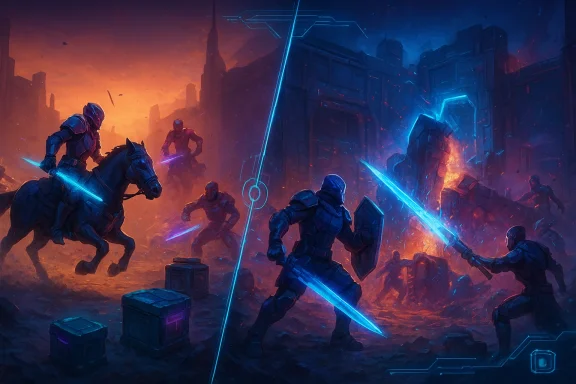
Wildlight calls Highguard a “PvP raid shooter.” The core promise is an identity that blends tight, shooter-first gunplay with short-form loot-and-gear loops and a late-match raid phase where teams assault a fortified player base. Key hooks include:- 3v3 matches built around a two-phase flow: open-world looting and a subsequent raid/assault phase.
- Wardens, distinct playable characters with unique abilities, layered on top of a fundamentally gun-skewed combat model.
- Mounted combat, destructible bases, and siege tools, with the Shieldbreaker sword serving as a high-value field objective that triggers a siege when used.
Overview: How a round of Highguard actually plays
Two phases, one match
Highguard’s match loop deliberately splits into two contrasting phases to create shifting priorities and tempo within a single match.- Phase 1 — Looting & gearing: Teams fortify a chosen base, then mount up and ride across an open map to scavenge better weapons, armor, and tools. The early minutes resemble the loot scramble of extraction and battle-royale style games, where positioning and the early engagement winner gains a meaningful advantage.
- Phase 2 — The raid: The Shieldbreaker — a distinct in-world sword objective that spawns during the match — becomes the key to initiating the raid. If a team secures and carries the Shieldbreaker into the opposing team’s base and plunges it into their shield, a giant battering ram (siege engine) appears and opens a breach, allowing attackers to push into critical base systems (generators or anchor stones) to destroy the enemy keep and win the match.
Wardens, mounts, and the ‘gun game’ claim
Wardens provide character fantasy and ability differentiation, yet Wildlight has repeatedly emphasized that Highguard remains, in essence, a gun game. Abilities add flavor and tactical options, but aim, recoil control, and weapon choice ultimately decide most firefights. Mounts are more than traversal — you can fight while mounted, but mounts have health and cooldown mechanics that add a tactical layer to repositioning.The launch showcase: what it showed and why it mattered
Wildlight’s “Official Launch Showcase” dropped at the moment the game unlocked. The studio used the 25‑minute video to show live gameplay loops, world and art direction, and to walk through year‑one plans for content. Several outlets noted the showcase runs just over 25 minutes and provides the most complete explanation of Highguard’s match flow to date — far more revealing than the gameplay-lite trailer that closed The Game Awards.Why it mattered: players who encountered Highguard’s cinematic reveal at The Game Awards — and were left unconvinced or confused — got an operational look at how the game plays. For a new IP from an unknown independent publisher, demonstrating the loop and the live roadmap at unlock is a defensive communications move: it lowers the friction for trial and gives press creators fresh material to judge the mechanics rather than the mystique of the reveal.
Launch performance, player numbers, and first impressions
The raw telemetry
Highguard shot to a large Steam peak on day one. SteamDB recorded an all‑time concurrent peak of 97,249 players during launch day, a figure echoed by multiple outlets and trackers. That spike translated to tens of thousands of real players on Steam alone, while console numbers remain opaque because platform holders do not publish live concurrent telemetry in the same way.Shortly after the initial surge, Steam review sentiment skewed negative: the storefront shows a “Mostly Negative” user rating at the time of writing, with many early complaints focused on technical issues, long login queues, perceived empty maps for 3v3 skirmishes, and balancing concerns. Multiple reporters highlighted widespread queues and server login friction during the first hours.
What the numbers actually tell us
- Peak concurrency is a useful headline but not the whole story. A big curiosity spike is common for free-to-play debuts, especially for a title announced at a high-profile show. What matters next is retention (day‑7, day‑30), stream and creator traction, and whether early players convert into a stable, engaged base.
- Console and cross‑platform totals are estimated unless Wildlight or platform holders publish consolidated telemetry; SteamDB only covers Steam. Treat any aggregated, cross‑platform “all‑platform” peaks as provisional unless confirmed.
Technical requirements, anti‑cheat and PC specifics
System requirements and install footprint
Highguard’s Steam store page lists the following PC targets: a modest base requirement (Intel Core i5‑6600K / Ryzen 5 1600, GTX 1060 / RX 580, 8 GB RAM) and recommended targets around Core i5‑9600K / Ryzen 5 3600 with an RTX 2080 / RX 6650 XT and 12 GB RAM. The game is DirectX 12, and the on‑disk requirement is reported at roughly 25 GB (SSD/NVMe recommended). These values are authoritative as they’re published on the Steam product page.Kernel anti‑cheat and boot protection
Highguard uses kernel‑level anti‑cheat (Easy Anti‑Cheat is called out in store metadata) and enforces firmware boot protections such as Secure Boot and TPM 2.0. The Steam listing explicitly warns players that these protections exist and that Easy Anti‑Cheat requires manual uninstallation steps if you remove the game. For Windows power users, dual‑boot setups, or those who run certain virtualisation or enterprise endpoint tools, this raises the likelihood of day‑one friction and support tickets.Practical advice for Windows users
- Ensure Secure Boot and TPM 2.0 are enabled in UEFI if you want to avoid immediate entitlement or launch failures.
- Update GPU drivers before launch; drivers often land on or right before release windows.
- If you rely on virtualization, developer toolchains, or unusual endpoint agents, be prepared to temporarily disable conflicting software when testing the client.
Content cadence: mixed messages and why it matters
Wildlight and several outlets spoke to an Episode model for new content. One authoritative copy on the Steam store describes Episodes as bringing “an array of new core content every month,” while coverage from multiple outlets and the launch reporting described Episode updates occurring every two months, with Episode 2 arriving in early February — roughly two weeks after launch. This discrepancy is material because cadence shapes both player expectations and operational planning (how quickly the live team must produce new Wardens, maps, and modes). At present the messaging is inconsistent across sources and should be considered unresolved until Wildlight confirms the official cadence in a dev post.Flag: when studios use language like “Episode” and “Seasons,” the specific duration (two weeks, monthly, bi-monthly) affects retention planning, content scope, and monetization pacing. Players and press should watch Wildlight’s first official roadmap update and the studio’s post-launch patch notes for definitive cadence.
Strengths: what Highguard brings to the table
- A distinctive match structure — the fusion of an open‑map looting phase with a concrete raid/assault objective produces emergent, multi-stage matches that feel different from hero shooters fixed to a single mode. This mechanical distinction is a genuine identity play, not just skin-deep.
- Developer pedigree — the team’s Respawn roots set baseline expectations around movement feel, gunplay, and competitive polish. That pedigree helps attract early curiosity and creator attention.
- Low barrier to try — free‑to‑play launch reduces the cost of entry and can create a large initial sample size for testing and tuning.
- Clear systemic hooks for live ops — Wardens, mounts, weapons, and bases provide modular content channels for recurring episodes or patches, giving the team a lot of levers to pull for live tuning and new monetized cosmetics.
Risks and unknowns — the rub of launch
- Day‑one operational risk: queues, login failures, and anti‑cheat friction are real threats to first impressions. A free launch invites a crowdsourced stress test: if servers or anti‑cheat break for significant segments of users, negative sentiment can ossify quickly. Multiple first-hour reports of login queues were already noted.
- Messaging inconsistency around cadence: conflicting descriptions of Episode frequency (monthly vs. bi-monthly) sow confusion; that matters because players use cadence expectations to decide whether to stay engaged. Wildlight needs a clear, public cadence and a transparent roadmap to avoid goodwill erosion.
- Balance and map scale: some early feedback claims maps feel too large for 3v3, creating stretches where combat density drops and loot skews outcomes. The design trades are real: larger maps can enable interesting flanking and looting, but they also amplify the chance that matches feel empty. Those concerns will be resolved (or not) by tuning patches in the coming weeks.
- Reputation risk: Highguard’s odd Game Awards reveal and weeks of silence set it up for a skeptical audience. That initial narrative bias amplifies critical takes and raises the bar for post-launch communications. Rapid, transparent patch notes and community engagement are mandatory to undo a sour early narrative.
What Wildlight should prioritize next (editorial recommendations)
- Publicly reconcile episode cadence and post a clear content roadmap covering the next 60–90 days. Ambiguity kills trust; cadence clarity buys patience.
- Publish a transparent post‑mortem on launch issues within 48–72 hourseue telemetry, prioritized fixes, and estimated ETA for hotfixes.
- Surface PC troubleshooting guidance for anti‑cheat/boot protection early and pin it on Steam and social channels; more players will face Secure Boot/TPM errors than the studio might expect.
- Rapidly iterate on map density and loot distribution tools based on early telemetry: shorten travel times or add dynamic high-value zones if combat density is too low.
- Preserve cosmetic-only incentives in early monetization and make sure nothing in the Episode roadmap gives players gameplay advantage behind a paywall; the community is sensitive to perceived pay‑to‑win in PvP titles.
Practical tips for Windows users who want to try Highguard now
- Check your UEFI: enable Secure Boot and firmware TPM if they’re not already on. That will reduce the chance of client-blocking entitlement checks.
- Update GPU drivers and disable third‑party overlays that hook into graphics stacks (some overlays can conflict with kernel anti‑cheat).
- If you experience a login queue, do not spam reconnects — let the queue advance; spamming can trigger disconnect/retry penalties in some systems.
- If you have a limited data plan or slow broadband, begin pre-downloads as soon as they become available; although there was little to no wide preload window announced, day‑one patches can be sizeable.
Verdict — first week outlook and why to care
Highguard’s launch is emblematic of modern live multiplayer debuts: huge initial visibility, complicated technical surface area, and a steep dependence on good early operations and messaging. The game’s core loop — a looting phase feeding into raid assaults — is distinct and interesting, and the studio’s talent gives it credibility. That said, launch-day server friction, a torrent of negative reviews, and messaging inconsistencies about content cadence have created a volatile first impression that Wildlight must actively manage.Short-term success will be measured by:
- Whether Wildlight stabilizes matchmaking and reduces queues within days.
- How quickly they publish a coherent cadence and shipping schedule for new Wardens and maps.
- Early retention metrics: do players stick beyond the initial curiosity spike?
Highguard is worth watching closely for Windows and Xbox communities: the core ideas are original enough to merit a fair run, but the weekend that follows this launch will be decisive. Wildlight’s next moves on stability, communication, and content cadence will determine whether this is a launching point for a durable live shooter or another high-profile curiosity that fades after week one.
Source: Windows Central Highguard releases with a massive launch showcase trailer, big login queues
