

Hitachi Energy’s GMS600 versions 1.3.0 and 1.3.1 are affected by CVE-2022-4304, an OpenSSL RSA timing-side-channel vulnerability republished by CISA on May 21, 2026, with the vendor’s remediation pointing operators to GMS600 version 1.3.2. The bug is not a new zero-day, and it is not the kind of flaw that lets an attacker casually pop a substation gateway over lunch. But its reappearance in an industrial control advisory is a useful reminder that old cryptographic implementation bugs can become live operational risks when they sit inside long-lived infrastructure.
The advisory lands in the uncomfortable middle ground that defines much of industrial cybersecurity. The CVSS score is “medium,” the attack complexity is high, and exploitation requires many trial messages and timing measurements. Yet the affected product lives in critical manufacturing environments, where network assumptions are often old, maintenance windows are scarce, and a “medium” cryptographic weakness can matter more than it would on a disposable web server.
CVE-2022-4304 is a timing-based side channel in OpenSSL’s RSA decryption implementation. In practical terms, an attacker who can observe a legitimate TLS connection and then send a large number of crafted trial messages to the server may be able to infer enough from processing-time differences to recover the pre-master secret for that original connection. Once that secret is recovered, the attacker could decrypt application data sent over that connection.
That is a very different beast from remote code execution. There is no shell, no wormable exploit path, and no immediate indication that an attacker can take command of a GMS600 device simply by reaching it over the network. The risk is more surgical: confidentiality loss through a cryptographic oracle, enabled by the tiny timing differences that modern cryptography spends a great deal of engineering effort trying to erase.
For ordinary IT teams, this may sound like one more OpenSSL entry in a vulnerability backlog already overflowing with OpenSSL entries. For operational technology teams, the problem is that the affected software may be sitting in systems whose upgrade cadence is measured in plant outages, vendor service visits, and certification paperwork. The vulnerability may date from 2022, but the operational decision arrives in 2026.
That delay is not necessarily negligence. It is the physics of industrial technology. Equipment that participates in monitoring, control, and energy management is often deployed for years, sometimes decades, and changes to it must be validated against safety, reliability, and production constraints. The result is that software supply-chain vulnerabilities do not age out evenly across sectors; they fossilize.
This is both good and bad news. It is good because OpenSSL receives intense scrutiny, public vulnerability handling, and upstream fixes. It is bad because that same ubiquity means a bug can ripple through routers, appliances, engineering stations, gateways, embedded products, and industrial management systems long after upstream maintainers have moved on.
CVE-2022-4304 is especially awkward because it attacks not the mathematics of RSA but the implementation details around decryption. Side-channel attacks exploit behavior around the algorithm: timing, cache access, power use, error messages, or other observable differences. In this case, the relevant observable is how long RSA decryption takes under different inputs.
That distinction matters for defenders. You cannot look at a device and say, “It uses strong encryption, therefore we are fine.” Strong cryptography can be weakened by implementation behavior, by protocol choices, and by deployment patterns. The lock may be good, but the sound it makes while being picked can still give something away.
A high-complexity timing attack is hard to exploit across noisy networks. It requires repeated probing, measurement discipline, and a target configuration where RSA decryption behavior is exposed in the right way. In many modern TLS deployments, RSA key exchange has been displaced by ephemeral Diffie-Hellman methods, which changes the practical exposure.
But industrial environments often contain legacy assumptions. Old TLS stacks, long-lived certificates, constrained devices, and segmented but not always well-monitored network paths can combine in ways that make a theoretically difficult attack less dismissible. The right question is not “Is this easy?” but “Could an adversary already positioned near the control network use this to read something we assumed was protected?”
That is why CISA’s familiar defensive guidance still matters even when it sounds boilerplate. Minimize network exposure. Keep control systems off the public internet. Place control networks behind firewalls. Separate them from business networks. Use VPNs when remote access is required, but do not treat a VPN as magic armor. These measures are not exciting, but timing attacks become much less useful when an attacker cannot reach the oracle in the first place.
In enterprise IT, that might trigger a patch cycle, a maintenance window, and a change ticket. In critical manufacturing, the same sentence can start a much longer process. Operators must identify deployed versions, determine where the product sits in the network, evaluate whether the vulnerable interface is reachable, confirm compatibility with surrounding systems, and decide whether the upgrade can be performed without risking operations.
This is where many security advisories quietly fail. They assume that “upgrade” is an action rather than a project. In OT, even a minor version update may need rollback planning, vendor coordination, site access, and approval from stakeholders who are more worried about production downtime than abstract cryptographic exposure.
Still, the existence of a fixed version changes the calculus. When a vendor offers a specific remediated release, long-term compensating controls should not become a permanent substitute for patching. Firewalls and allowlists reduce risk; they do not remove the vulnerable code.
A timing oracle is not necessarily useful to a random internet scanner. It may be useful to an adversary who has already achieved proximity: a foothold in the corporate network, access through a poorly governed remote-support path, or visibility into traffic between clients and servers. In that scenario, confidentiality attacks against management traffic, credentials, configuration data, or operational telemetry become more plausible.
The vendor’s general mitigation guidance also mentions rate limiting. That is particularly relevant because this attack class needs a large number of trial messages. Rate limiting, logging, and anomaly detection can make exploitation harder, noisier, and more time-consuming. They are not cryptographic fixes, but they attack the economics of the attack.
Ingress IP allowlisting is similarly useful, provided it is maintained honestly. A stale allowlist that includes old vendor VPN ranges, decommissioned jump boxes, or broad corporate subnets is not much of a control. In OT security, the difference between segmentation and segmentation theater is often whether anyone can explain why each allowed path still exists.
The Windows angle is not that Windows itself is implicated in CVE-2022-4304. It is that Windows-heavy enterprise networks often provide the identity, remote access, and management plane through which attackers approach industrial systems. A vulnerable industrial appliance may not be internet-facing, but the laptop, VPN account, RDP gateway, or Active Directory path that leads to it may be.
For sysadmins, the practical move is to connect the dots between vulnerability management and network reality. If GMS600 is present, where is it reachable from? Which Windows hosts can talk to it? Which service accounts, vendor accounts, or admin groups can administer the surrounding environment? Are logs from those paths collected, reviewed, and correlated?
That kind of mapping is unglamorous, but it is where defensive value lives. The advisory tells you the vulnerable versions. Your environment tells you whether the vulnerability is buried behind three meaningful controls or sitting one misconfigured firewall rule away from a compromised workstation.
That chronology matters. This is not a brand-new vulnerability disclosure. It is a visibility and distribution event for a known issue, now presented through CISA’s ICS advisory channel. For defenders, the distinction matters because the right reaction is not panic; it is verification.
The updated fixed version is also notable. Industrial advisories often evolve as vendors refine product impact, release trains, and remediation guidance. A change in fixed-version information can be the difference between “we think we are patched” and “we are still on an affected build.” Asset owners should treat advisory revisions as active security signals, not clerical housekeeping.
CSAF-based republication is part of a broader trend toward machine-readable vulnerability handling. That is good news for large organizations trying to automate ingestion and triage. But automation only helps if asset data is accurate enough to match product names, versions, and deployment locations. A perfect advisory feed cannot compensate for an inventory that says “miscellaneous substation server.”
This is where security teams should avoid both extremes. It would be reckless to dismiss the issue merely because modern TLS best practices prefer forward-secret key exchange. It would also be misleading to assume every affected product instance is equally exploitable in the field. The truth likely varies by deployment.
A careful assessment should look at exposed services, TLS configuration, allowed cipher suites, certificate use, and network reachability. If older RSA key exchange remains enabled, the concern becomes sharper. If only modern forward-secret suites are negotiated and access is tightly restricted, urgency may be lower, though the vendor upgrade remains the clean remediation.
For many organizations, the fastest path will be vendor engagement rather than independent cryptographic archaeology. Hitachi Energy says customers should contact their product provider or service organization for additional information. That is not just legal phrasing; it may be the practical route to confirm whether a particular deployment profile is at risk.
But confidentiality matters in industrial systems. Operational data, topology information, credentials, configuration details, and control-system communications can all help an adversary plan later actions. A vulnerability that decrypts traffic may not itself alter a process, but it can erode the secrecy assumptions that protect the process.
This is especially true in environments where encryption was added to compensate for weak segmentation or remote access growth. If the network design quietly assumes that TLS protects sensitive traffic even when routing is broad, then a TLS-adjacent vulnerability deserves more than a shrug. Crypto weaknesses often expose the places where architecture relied on encryption as a patch for messy trust boundaries.
That is why the right response is layered. Patch to GMS600 1.3.2 where possible. Restrict reachability immediately. Confirm that only necessary clients can talk to the system. Watch for unusual volumes of failed or abnormal handshake behavior. Then use the advisory as a prompt to revisit whether the surrounding network design is doing enough.
That cross-domain nature is why these advisories can feel frustrating. No single team owns the whole risk. Product owners know the system. Security teams know the CVE. Network teams know the firewall paths. Operations teams know the downtime constraints. Vendors know the code. Attackers, unfortunately, only need the gaps between them.
The best organizations treat an advisory like this as a coordination test. Can they identify affected versions quickly? Can they determine exposure without days of manual archaeology? Can they explain compensating controls in concrete terms? Can they schedule the upgrade without turning it into a political battle?
If the answer is no, CVE-2022-4304 is not the biggest problem. It is merely the latest reminder that vulnerability management in OT fails first as a process problem and only later as a technical one.
Industrial security rarely turns on one dramatic disclosure. It advances through the slow work of closing inherited software flaws, tightening access paths, and refusing to let old dependencies become permanent blind spots. The GMS600 advisory is another small entry in that ledger, but for organizations that run critical systems, small entries are exactly where tomorrow’s preventable incidents are often hiding.
The advisory lands in the uncomfortable middle ground that defines much of industrial cybersecurity. The CVSS score is “medium,” the attack complexity is high, and exploitation requires many trial messages and timing measurements. Yet the affected product lives in critical manufacturing environments, where network assumptions are often old, maintenance windows are scarce, and a “medium” cryptographic weakness can matter more than it would on a disposable web server.
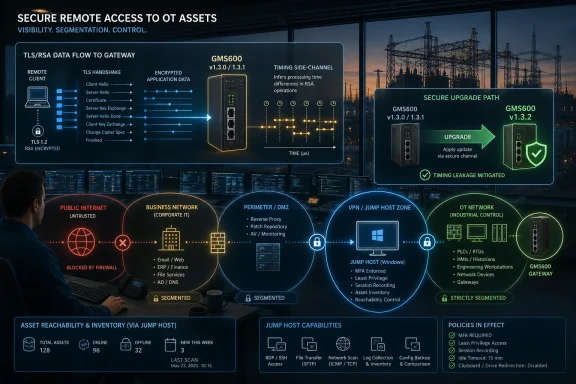 The Vulnerability Is Old, but the Installed Base Is the Story
CVE-2022-4304 is a timing-based side channel in OpenSSL’s RSA decryption implementation. In practical terms, an attacker who can observe a legitimate TLS connection and then send a large number of crafted trial messages to the server may be able to infer enough from processing-time differences to recover the pre-master secret for that original connection. Once that secret is recovered, the attacker could decrypt application data sent over that connection.That is a very different beast from remote code execution. There is no shell, no wormable exploit path, and no immediate indication that an attacker can take command of a GMS600 device simply by reaching it over the network. The risk is more surgical: confidentiality loss through a cryptographic oracle, enabled by the tiny timing differences that modern cryptography spends a great deal of engineering effort trying to erase.
For ordinary IT teams, this may sound like one more OpenSSL entry in a vulnerability backlog already overflowing with OpenSSL entries. For operational technology teams, the problem is that the affected software may be sitting in systems whose upgrade cadence is measured in plant outages, vendor service visits, and certification paperwork. The vulnerability may date from 2022, but the operational decision arrives in 2026.
That delay is not necessarily negligence. It is the physics of industrial technology. Equipment that participates in monitoring, control, and energy management is often deployed for years, sometimes decades, and changes to it must be validated against safety, reliability, and production constraints. The result is that software supply-chain vulnerabilities do not age out evenly across sectors; they fossilize.
OpenSSL Turns a Product Advisory Into a Supply-Chain Case Study
The affected component here is not some obscure vendor-written parser. It is OpenSSL, the cryptographic library that underpins a huge amount of internet and enterprise security plumbing. That matters because it shifts the security story away from a single vendor mistake and toward a recurring architectural dependency: industrial products routinely inherit vulnerabilities from the general-purpose software ecosystem.This is both good and bad news. It is good because OpenSSL receives intense scrutiny, public vulnerability handling, and upstream fixes. It is bad because that same ubiquity means a bug can ripple through routers, appliances, engineering stations, gateways, embedded products, and industrial management systems long after upstream maintainers have moved on.
CVE-2022-4304 is especially awkward because it attacks not the mathematics of RSA but the implementation details around decryption. Side-channel attacks exploit behavior around the algorithm: timing, cache access, power use, error messages, or other observable differences. In this case, the relevant observable is how long RSA decryption takes under different inputs.
That distinction matters for defenders. You cannot look at a device and say, “It uses strong encryption, therefore we are fine.” Strong cryptography can be weakened by implementation behavior, by protocol choices, and by deployment patterns. The lock may be good, but the sound it makes while being picked can still give something away.
The CVSS Score Understates the Operational Conversation
The advisory rates the vulnerability at CVSS 3.1 base score 5.9, medium severity, with network attack vector, high attack complexity, no privileges required, no user interaction, unchanged scope, high confidentiality impact, and no integrity or availability impact. That is a precise scoring statement, but it is not the same thing as an operational risk decision.A high-complexity timing attack is hard to exploit across noisy networks. It requires repeated probing, measurement discipline, and a target configuration where RSA decryption behavior is exposed in the right way. In many modern TLS deployments, RSA key exchange has been displaced by ephemeral Diffie-Hellman methods, which changes the practical exposure.
But industrial environments often contain legacy assumptions. Old TLS stacks, long-lived certificates, constrained devices, and segmented but not always well-monitored network paths can combine in ways that make a theoretically difficult attack less dismissible. The right question is not “Is this easy?” but “Could an adversary already positioned near the control network use this to read something we assumed was protected?”
That is why CISA’s familiar defensive guidance still matters even when it sounds boilerplate. Minimize network exposure. Keep control systems off the public internet. Place control networks behind firewalls. Separate them from business networks. Use VPNs when remote access is required, but do not treat a VPN as magic armor. These measures are not exciting, but timing attacks become much less useful when an attacker cannot reach the oracle in the first place.
The Fix Is Simple; the Change Window May Not Be
Hitachi Energy’s remediation is direct: upgrade affected GMS600 installations to version 1.3.2. The advisory identifies GMS600 versions 1.3.0 and 1.3.1 as affected. That kind of version boundary is valuable because it gives asset owners a concrete inventory target rather than a vague “check with your vendor” warning.In enterprise IT, that might trigger a patch cycle, a maintenance window, and a change ticket. In critical manufacturing, the same sentence can start a much longer process. Operators must identify deployed versions, determine where the product sits in the network, evaluate whether the vulnerable interface is reachable, confirm compatibility with surrounding systems, and decide whether the upgrade can be performed without risking operations.
This is where many security advisories quietly fail. They assume that “upgrade” is an action rather than a project. In OT, even a minor version update may need rollback planning, vendor coordination, site access, and approval from stakeholders who are more worried about production downtime than abstract cryptographic exposure.
Still, the existence of a fixed version changes the calculus. When a vendor offers a specific remediated release, long-term compensating controls should not become a permanent substitute for patching. Firewalls and allowlists reduce risk; they do not remove the vulnerable code.
The Real Threat Model Begins Inside the Perimeter
The advisory’s mitigation language focuses heavily on keeping process control systems isolated from the internet and separated from business networks. That is sound advice, but it should not lull operators into thinking that “not internet-facing” equals “not exposed.” Many serious OT incidents begin after an attacker compromises the enterprise side, steals credentials, abuses remote access, or lands on a jump host.A timing oracle is not necessarily useful to a random internet scanner. It may be useful to an adversary who has already achieved proximity: a foothold in the corporate network, access through a poorly governed remote-support path, or visibility into traffic between clients and servers. In that scenario, confidentiality attacks against management traffic, credentials, configuration data, or operational telemetry become more plausible.
The vendor’s general mitigation guidance also mentions rate limiting. That is particularly relevant because this attack class needs a large number of trial messages. Rate limiting, logging, and anomaly detection can make exploitation harder, noisier, and more time-consuming. They are not cryptographic fixes, but they attack the economics of the attack.
Ingress IP allowlisting is similarly useful, provided it is maintained honestly. A stale allowlist that includes old vendor VPN ranges, decommissioned jump boxes, or broad corporate subnets is not much of a control. In OT security, the difference between segmentation and segmentation theater is often whether anyone can explain why each allowed path still exists.
Windows Shops Should Read This as an Asset-Inventory Problem
WindowsForum readers may look at a Hitachi Energy industrial advisory and assume it lives far from their world. In many organizations, that would be a mistake. Windows systems often sit near OT environments as engineering workstations, historian clients, domain controllers, remote access hosts, patch-management servers, or administrative jump boxes.The Windows angle is not that Windows itself is implicated in CVE-2022-4304. It is that Windows-heavy enterprise networks often provide the identity, remote access, and management plane through which attackers approach industrial systems. A vulnerable industrial appliance may not be internet-facing, but the laptop, VPN account, RDP gateway, or Active Directory path that leads to it may be.
For sysadmins, the practical move is to connect the dots between vulnerability management and network reality. If GMS600 is present, where is it reachable from? Which Windows hosts can talk to it? Which service accounts, vendor accounts, or admin groups can administer the surrounding environment? Are logs from those paths collected, reviewed, and correlated?
That kind of mapping is unglamorous, but it is where defensive value lives. The advisory tells you the vulnerable versions. Your environment tells you whether the vulnerability is buried behind three meaningful controls or sitting one misconfigured firewall rule away from a compromised workstation.
CISA’s Republication Is a Visibility Event, Not a Fresh Discovery
One important detail in the advisory is procedural: CISA says this is a republication of Hitachi Energy PSIRT advisory 8DBD000159 through a CSAF conversion. The original public release dates back to June 27, 2023, with later revisions including an updated fixed version on April 28, 2026, and CISA’s republication on May 21, 2026.That chronology matters. This is not a brand-new vulnerability disclosure. It is a visibility and distribution event for a known issue, now presented through CISA’s ICS advisory channel. For defenders, the distinction matters because the right reaction is not panic; it is verification.
The updated fixed version is also notable. Industrial advisories often evolve as vendors refine product impact, release trains, and remediation guidance. A change in fixed-version information can be the difference between “we think we are patched” and “we are still on an affected build.” Asset owners should treat advisory revisions as active security signals, not clerical housekeeping.
CSAF-based republication is part of a broader trend toward machine-readable vulnerability handling. That is good news for large organizations trying to automate ingestion and triage. But automation only helps if asset data is accurate enough to match product names, versions, and deployment locations. A perfect advisory feed cannot compensate for an inventory that says “miscellaneous substation server.”
The Hard Part Is Knowing Whether RSA Is Reachable
A subtle challenge in CVE-2022-4304 is that product version alone may not describe practical exploitability. The flaw sits in OpenSSL RSA decryption, and the advisory describes a TLS scenario where RSA is used by a client to send an encrypted pre-master secret to a server. Whether that path exists in a given deployment depends on configuration, protocol support, cipher suites, and client behavior.This is where security teams should avoid both extremes. It would be reckless to dismiss the issue merely because modern TLS best practices prefer forward-secret key exchange. It would also be misleading to assume every affected product instance is equally exploitable in the field. The truth likely varies by deployment.
A careful assessment should look at exposed services, TLS configuration, allowed cipher suites, certificate use, and network reachability. If older RSA key exchange remains enabled, the concern becomes sharper. If only modern forward-secret suites are negotiated and access is tightly restricted, urgency may be lower, though the vendor upgrade remains the clean remediation.
For many organizations, the fastest path will be vendor engagement rather than independent cryptographic archaeology. Hitachi Energy says customers should contact their product provider or service organization for additional information. That is not just legal phrasing; it may be the practical route to confirm whether a particular deployment profile is at risk.
“Medium” Vulnerabilities Can Still Break Trust
The most dangerous thing about medium-severity advisories is that they invite backlog complacency. Nobody wants to stop a plant line for a 5.9. Nobody wants to prioritize a high-complexity confidentiality issue over an actively exploited remote code execution flaw. That triage instinct is rational.But confidentiality matters in industrial systems. Operational data, topology information, credentials, configuration details, and control-system communications can all help an adversary plan later actions. A vulnerability that decrypts traffic may not itself alter a process, but it can erode the secrecy assumptions that protect the process.
This is especially true in environments where encryption was added to compensate for weak segmentation or remote access growth. If the network design quietly assumes that TLS protects sensitive traffic even when routing is broad, then a TLS-adjacent vulnerability deserves more than a shrug. Crypto weaknesses often expose the places where architecture relied on encryption as a patch for messy trust boundaries.
That is why the right response is layered. Patch to GMS600 1.3.2 where possible. Restrict reachability immediately. Confirm that only necessary clients can talk to the system. Watch for unusual volumes of failed or abnormal handshake behavior. Then use the advisory as a prompt to revisit whether the surrounding network design is doing enough.
A Small Advisory With a Large Lesson for Industrial Security
This advisory is narrow, but its lesson is broad: industrial cybersecurity is increasingly a dependency-management problem. The vulnerable code is OpenSSL. The affected product is Hitachi Energy GMS600. The operational environment is critical manufacturing. The defensive response spans vendor patching, network architecture, remote access governance, and asset inventory.That cross-domain nature is why these advisories can feel frustrating. No single team owns the whole risk. Product owners know the system. Security teams know the CVE. Network teams know the firewall paths. Operations teams know the downtime constraints. Vendors know the code. Attackers, unfortunately, only need the gaps between them.
The best organizations treat an advisory like this as a coordination test. Can they identify affected versions quickly? Can they determine exposure without days of manual archaeology? Can they explain compensating controls in concrete terms? Can they schedule the upgrade without turning it into a political battle?
If the answer is no, CVE-2022-4304 is not the biggest problem. It is merely the latest reminder that vulnerability management in OT fails first as a process problem and only later as a technical one.
The GMS600 Advisory Draws a Practical Line for Defenders
The useful response is not alarmism; it is disciplined reduction of uncertainty. Hitachi Energy has named the affected versions, named the fixed version, and described the general mitigation posture. That gives defenders enough to act.- Organizations running Hitachi Energy GMS600 should verify whether versions 1.3.0 or 1.3.1 are deployed anywhere in production, lab, backup, or vendor-managed environments.
- Affected installations should be upgraded to GMS600 version 1.3.2 through normal operational change-control procedures.
- Network teams should confirm that GMS600 systems are not reachable from the public internet and are isolated from ordinary business networks.
- Remote access paths should be reviewed because a VPN or jump host can become the practical route to an otherwise isolated control-system asset.
- Security teams should look for unusual volumes of connection attempts or handshake-like activity that could indicate probing for a timing oracle.
- Asset inventories should record not only the product name and version but also reachable services, management paths, and ownership contacts.
Industrial security rarely turns on one dramatic disclosure. It advances through the slow work of closing inherited software flaws, tightening access paths, and refusing to let old dependencies become permanent blind spots. The GMS600 advisory is another small entry in that ledger, but for organizations that run critical systems, small entries are exactly where tomorrow’s preventable incidents are often hiding.
References
- Primary source: CISA
Published: 2026-05-21T12:00:00+00:00

Hitachi Energy GMS600 | CISA
www.cisa.gov
