

Hitachi Vantara’s Virtual Storage Platform One (VSP One) has been named a winner in CRN’s 2025 Products of the Year Awards in the Storage – Cloud-Focused category, a recognition that underscores the vendor’s push to position VSP One as a unifying platform for hybrid and multi‑cloud data operations. The award — announced alongside Hitachi’s own press materials — arrives as the company doubles down on major product claims: a 100% data‑availability guarantee, integrated ransomware defenses, cloud tiering and unified management for block, file, object and mainframe storage.
Hybrid cloud storage is now a procurement imperative, not an option. Enterprises contend with multi‑cloud complexity, growing AI workloads and increasingly sophisticated cyber threats. Hitachi’s VSP One is explicitly marketed as a response to that environment: a single data platform designed to span on‑premises arrays, colocation facilities and public cloud services while consolidating multiple data protocols under one control plane (VSP 360). The vendor highlights guarantees and SLAs intended to signal operational confidence to customers and channel partners. At a glance, the recent timeline looks like this:
Analyst signals (e.g., GigaOm Radar placements) and editorial awards (CRN Products of the Year) accelerate go‑to‑market momentum, but they also invite a higher standard of evidence: measurable POC outcomes, third‑party audits and robust customer success programs to back headline claims.
Conclusion
Hitachi Vantara’s CRN 2025 Products of the Year recognition for VSP One reflects both vendor momentum and a wider market shift toward unified, resilient hybrid storage tailored for AI and mission‑critical workloads. The platform’s feature set and guarantees are compelling in principle; the decisive factor for enterprise buyers will be verification: hardened PoCs, contractually binding SLAs, and independent attestations of the platform’s cyber‑resilience and performance in production settings. Only with those evidence pieces in place will the promises of continuous availability, predictable capacity and rapid ransomware recovery translate into real operational value.
Source: systemtek.co.uk Hitachi Vantara's Virtual Storage Platform One Wins CRN 2025 Products of the Year Award for Excellence in Hybrid Cloud Storage
 Background / Overview
Hybrid cloud storage is now a procurement imperative, not an option. Enterprises contend with multi‑cloud complexity, growing AI workloads and increasingly sophisticated cyber threats. Hitachi’s VSP One is explicitly marketed as a response to that environment: a single data platform designed to span on‑premises arrays, colocation facilities and public cloud services while consolidating multiple data protocols under one control plane (VSP 360). The vendor highlights guarantees and SLAs intended to signal operational confidence to customers and channel partners. At a glance, the recent timeline looks like this:- August 2025 — Hitachi highlights GigaOm recognitions for VSP One Object and primary storage accolades.
- November 18, 2025 — Hitachi launched VSP One Block High End, an all‑flash NVMe expansion targeted at AI and mission‑critical workloads. The launch included performance and resilience claims (50 million IOPS, hardware compression, FIPS/NIST alignment).
- December 1, 2025 — CRN’s Products of the Year Awards named VSP One a category winner (Storage — Cloud‑Focused). Hitachi issued a press release celebrating the distinction.
What Hitachi is claiming — the technical promises
Core platform capabilities
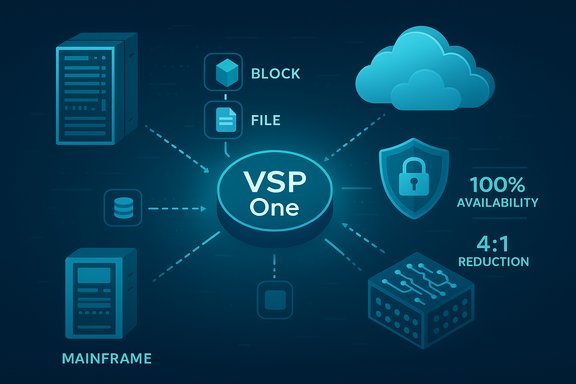
Hitachi’s public materials and press releases call out a consistent set of capabilities for VSP One:- Unified protocol support for block, file, object and mainframe data with a single management plane (VSP 360).
- Integrated cloud tiering and hybrid mobility, enabling policy‑based data placement between on‑premises and public cloud targets.
- Built‑in ransomware protection including immutable snapshots, anomaly detection and an offered Cyber Resilience Guarantee.
- Customer guarantees such as a 100% Data Availability Guarantee, Effective Capacity Guarantee (4:1 data reduction claims on block) and Performance and Sustainability SLAs. These are framed as commercial guarantees intended to reduce procurement risk.
VSP One Block High End specifics
Hitachi’s product launch materials for the Block High End model include aggressive performance and resiliency metrics meant to appeal to AI/HPC and critical OLTP workloads:- All‑flash NVMe architecture with claims up to 50 million IOPS and hardware compression acceleration.
- Security posture aligned to U.S. government standards, including FIPS 140‑3 Level 2 cryptographic protections and references to NIST‑relevant features; a cyber resilience guarantee that promises near‑zero data loss and fast clean recovery following ransomware incidents.
- Sustainability features such as power‑saving CPU modes and a 4:1 data reduction guarantee to reduce energy and footprint per effective TB.
Market recognition cited by the vendor
Hitachi points to several awards and analyst recognitions in its rollups: the CRN Products of the Year Award, GigaOm Radar placements (Leader / Outperformer), and a Fortress Cybersecurity Award mention from the Business Intelligence Group for VSP One Object. Many of these appear in Hitachi press materials and replicated PR wire stories.Independent validation: what checks out and what needs closer scrutiny
Key product claims should be evaluated on three axes: verifiable engineering specs, independent analyst validation, and contractual guarantees that survive procurement scrutiny.- The CRN award can be independently confirmed in CRN’s 2025 Products of the Year coverage where VSP One appears as winner in the customer‑need subcategory for Storage: Cloud‑Focused segments and is listed among finalists/winners. This is a straightforward editorial award decided by solution provider voting and CRN’s editorial preselection.
- Hitachi’s product and launch details (VSP One Block High End feature list, IOPS claims, FIPS guidance and sustainability statements) are published on Hitachi’s global and regional press pages and product landing pages; those are primary source documents reflecting vendor claims. These are useful and authoritative for what the vendor is advertising, but they are vendor materials and not proof of delivered, in‑customer outcomes.
- Analyst recognition: Hitachi cites GigaOm Radar placements (Primary Storage and AI‑optimized storage Radar) and has public press materials pointing to those reports. A direct read of the GigaOm reports is gated in many cases, but Hitachi’s summaries align with common Radar criteria (innovation, platform play, technical features). Where possible, procurement teams should secure the actual GigaOm report excerpts or request the vendor’s authorized copy to verify the specific scoring and context.
- Awards and third‑party medals: Hitachi also mentions a Fortress Cybersecurity Award (Business Intelligence Group) for Data Protection attributed to VSP One Object. That claim appears in multiple Hitachi press distributions and republished wire stories; however, a search for a direct Business Intelligence Group page naming Hitachi as a Fortress winner did not return a clear confirmation at the time of review. When a vendor cites awards from smaller or loosely curated programs, independent confirmation on the award organiser’s official site or the award program’s winner list is necessary before relying on the badge in procurement decisions. Treat this claim as unverified until you locate the award program record.
- Guarantees such as 100% Data Availability Guarantee and Cyber Resilience Guarantee are meaningful contractually but must be validated in writing. Many vendors offer strong‑sounding guarantees but limit their exposure through detailed exclusions, operational prerequisites (e.g., specific replication topologies, maintenance windows) or additional paid services. Procurement should insist on the explicit SLA language, measurable acceptance tests and financial remediation terms. Vendor marketing alone does not substitute for enforceable contract terms.
Strengths: where VSP One genuinely moves the market needle
- Unified management across protocols. If implemented as advertised, a single control plane that handles block, file, object and mainframe storage materially reduces administrative overhead and helps avoid data silos — a common pain point for enterprise Windows and Linux shops supporting diverse workloads. Consolidation can simplify backup, snapshot and replication strategies.
- Holistic cyber resilience approach. The combination of immutable snapshots, anomaly detection (CyberSense‑like features) and an offered cyber‑resilience guarantee addresses a core modern requirement: the ability to recover quickly to clean data after a ransomware event. When matched with verified detection accuracy and tested recovery playbooks, this approach reduces MTTR and business impact.
- AI workload focus. The Block High End’s NVMe claims and performance-oriented architecture are clearly targeted at AI workloads that suffer from I/O stalls and GPU starvation. If the IOPS, NVMe‑oF and storage latency profiles are deliverable in real deployments (validated via vendor POCs), customers gain a decisive advantage for large model training and mixed transactional/analytic environments.
- Commercial guarantees as a sales differentiator. Offering explicit guarantees (availability, capacity reduction, cyber resilience) helps channel partners position VSP One against competitors that avoid hard promises. When such guarantees are backed by measurable SLAs, they simplify risk allocation between vendor, integrator and buyer.
Risks and caveats: what enterprise buyers must not overlook
- Marketing vs. deliverability — awards and press releases are marketing instruments. They indicate interest and vendor momentum, but they do not replace technical audits. A product that looks great on paper can still fail operational KPIs in specific customer topologies. Ask for measurable PoC results on representative workloads.
- Guarantee fine print — the headline “100% Data Availability” or “Cyber Resilience Guarantee” often comes with operational preconditions: designated replication fabrics, supported firmware/software versions, specific replication topologies, runbook requirements and vendor‑approved maintenance procedures. Insist on the contractual SLA text with objective metrics and financial remedies.
- Vendor lock‑in and migration friction — a unified platform simplifies operations, but it may also centralize operational knowledge, making exit planning more complicated. Verify data export tooling, standardized APIs and tested egress procedures before committing to long‑term contracts.
- Independent verification gaps — certain accolades cited by the vendor (for example, the Fortress Cybersecurity Award) are not always easy to independently confirm on the awarding body’s website. Treat such claims as pending until you find the award organiser’s official winner list or a published judging summary.
- Sustainability and reduction guarantees — metrics such as “4:1 data reduction guarantee” or dynamic CPU eco modes are attractive, but real‑world data reduction varies widely by data type. Compression and dedupe ratios heavily depend on workload characteristics; plan conservative capacity models and validate reduction claims with sample datasets.
Practical due diligence checklist for sourcing VSP One
To convert vendor claims into procurement confidence, perform the following steps in order:- Request the precise SLA text for any guarantee (100% availability, cyber resilience, effective capacity) and have legal review remediation and exclusion clauses.
- Obtain two named customer references with comparable scale and workload profiles and ask for measured RTO/RPO, snapshot frequency, and actual recovery times from ransomware test drills.
- Run an instrumented PoC using representative workloads (Windows SQL Server, VMware or Hyper‑V VMs, object store ingress/egress, AI training data pipelines) and capture p50/p95/p99 latency, throughput, and IOPS under sustained load.
- Validate security attestations: recent SOC2 Type II, penetration test summaries, FIPS/NIST claims and proof of third‑party validation for any government‑grade security statements.
- Confirm integration and portability: test data export, replication to an alternate vendor, and exit procedures. Obtain export performance expectations and egress cost estimates.
- Insist on documented change‑management and maintenance runbooks that include upgrade and patching procedures that preserve guarantees.
- Negotiate contractual FinOps guardrails where autoscaling or cloud tiering could incur variable costs. Include cost thresholds and periodic review points.
How channel partners and Windows admins should position VSP One in 2026 projects
- For channel partners: Use the CRN award and vendor guarantees as conversation openers, but build technical credibility with measured PoCs and joint customer success playbooks. Translate guarantees into deployment checklists required for customers to qualify for the promised SLAs.
- For Windows infrastructure teams: Focus POCs on common Windows workloads (Active Directory‑dependent applications, SQL Server, Hyper‑V clusters) to ensure the VSP One topology preserves boot and transaction consistency under failover and recovery scenarios.
- For security and compliance teams: Prioritise testing ransomware detection and clean‑recovery drills using production‑like data. Ensure integration into SIEM/EDR workflows and confirm identity and key management compatibility with enterprise KM systems (for example, customer managed keys and HSM integrations).
What this means for the storage market
Vendors that combine performance, unified management and cyber‑resilience will attract enterprise attention, particularly where AI workloads and regulatory pressures collide. Hitachi’s product trajectory — moving from VSP One Object to VSP One Block High End and attaching commercial guarantees — is emblematic of the industry trend toward bundled, outcome‑oriented offerings that shift risk toward suppliers. That model benefits buyers who demand predictable results, but it also raises the bar for vendor transparency and enforceability.Analyst signals (e.g., GigaOm Radar placements) and editorial awards (CRN Products of the Year) accelerate go‑to‑market momentum, but they also invite a higher standard of evidence: measurable POC outcomes, third‑party audits and robust customer success programs to back headline claims.
Final assessment and recommendations
Hitachi Vantara’s VSP One is a credible contender in the hybrid storage market. The platform’s unified management, hybrid mobility features and cyber‑resilience focus address top‑of‑mind enterprise needs. The CRN award is an industry accolade that validates partner interest and channel relevance; GigaOm recognitions add analyst weight to technical capabilities. Together these signals justify placing VSP One on shortlists for major hybrid cloud and AI storage evaluations. However, purchasers should proceed with disciplined verification:- Treat vendor guarantees as negotiable contractual elements that require explicit, testable SLAs.
- Demand independent proof for any award claims that matter to procurement decisions (some vendor‑cited awards may require extra confirmation).
- Insist on conservative capacity planning and verify data‑reduction figures with your own datasets before committing to aggressive consolidation targets.
- Use Hitachi’s award and public materials to open conversations and justify an evaluation.
- Run a bounded, instrumented PoC that proves performance, manageability and clean‑recovery under ransomware‑scenario tests.
- Negotiate SLAs and proof points into the contract, including named remediation remedies and acceptance criteria.
Conclusion
Hitachi Vantara’s CRN 2025 Products of the Year recognition for VSP One reflects both vendor momentum and a wider market shift toward unified, resilient hybrid storage tailored for AI and mission‑critical workloads. The platform’s feature set and guarantees are compelling in principle; the decisive factor for enterprise buyers will be verification: hardened PoCs, contractually binding SLAs, and independent attestations of the platform’s cyber‑resilience and performance in production settings. Only with those evidence pieces in place will the promises of continuous availability, predictable capacity and rapid ransomware recovery translate into real operational value.
Source: systemtek.co.uk Hitachi Vantara's Virtual Storage Platform One Wins CRN 2025 Products of the Year Award for Excellence in Hybrid Cloud Storage
